
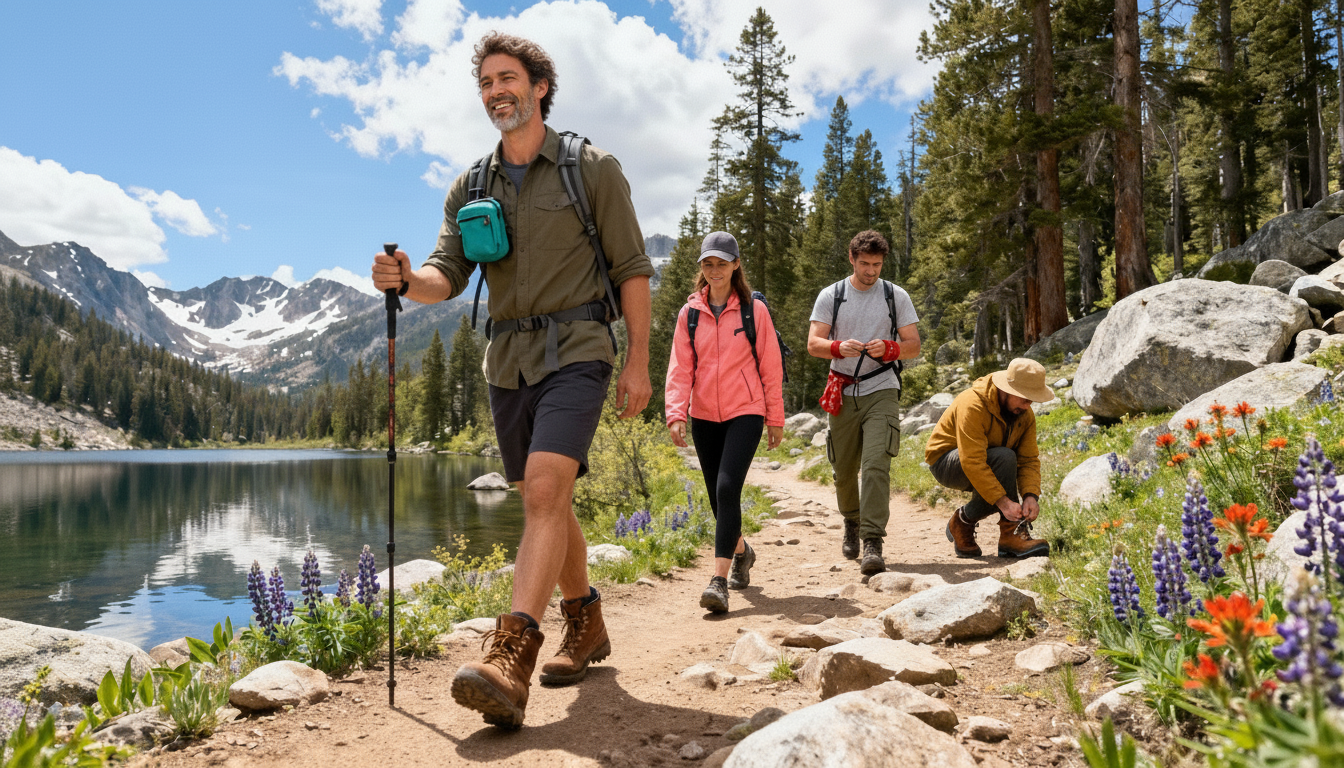
Wilderness Exploration for Retirees: Your Complete, Honest Guide to Wild Places After 60
Wilderness exploration for retirees offers something no resort can match — real adventure, measurable health benefits, and the kind of story worth telling. Here’s how to do it right.
I’ve always believed that retirement is the first time in most people’s adult lives when they have both the time and the permission to go somewhere genuinely wild. Not the manicured garden path behind the hotel. Not the “scenic overlook” with a parking lot. The actual wilderness — where the trail gets quiet, the signal disappears, and the only thing on your schedule is finding out what’s around the next bend.
Wilderness exploration for retirees isn’t a niche idea for the unusually fit or the perpetually adventurous. It’s a spectrum. On one end, a half-day hike to an alpine lake in a national park. On the other, a week-long backcountry canoe route through a landscape that looks exactly as it did a thousand years ago. Both are wilderness exploration. Both are available to you. And both deliver something that very little else in retirement can.
This guide is written for retirees at every starting point — people who’ve been active their whole lives and are ready to push further, people who are starting from near zero and want to figure out where to begin, and everyone in between. What it requires is honest preparation, genuine respect for the environment, and the willingness to start smaller than your ego suggests and build from there.
Why Wilderness Exploration for Retirees Is Worth Taking Seriously
The research on this is clearer than most people realize.
A peer-reviewed study published in Social Science & Medicine examining wilderness as a therapeutic landscape specifically in later life found that older adults who engaged in nature-adventure activities in wild settings reported measurably improved wellbeing across physical, emotional, and psychological dimensions — with the natural environment providing what researchers described as restorative and stress-reducing effects that indoor or urban settings consistently failed to replicate.
A scoping review published in the Journal of Outdoor and Environmental Education, drawing on data from over 11,000 participants aged 50 to 85 across multiple studies, found that outdoor-based interventions including hiking, backpacking, and adventure programs consistently produced health outcomes across three categories: prevention of disease and disability, retention of physical and cognitive functioning, and enhanced active engagement with life. That’s not a modest finding. That’s the case for wilderness exploration as a genuine health strategy in retirement.
And a study published in Frontiers in Psychology, comparing senior hikers directly against sedentary older adults, found that those who engaged in regular hiking demonstrated significantly better cognitive reserve, executive function, decision-making ability, and psychophysical wellbeing than their sedentary counterparts — with the hiking group showing advantages across nearly every measured domain.
The wilderness isn’t just beautiful. For retirees, it’s doing real, measurable work.
Key Takeaways
- Wilderness exploration for retirees ranges from comfortable day hikes in national parks to multi-day backcountry adventures — every level is valid and valuable
- Research consistently links outdoor adventure activity in later life with better cognitive function, lower disease risk, and higher quality of life
- Preparation is the difference between a great trip and a cautionary tale — planning, fitness training, gear testing, and sharing your itinerary are all non-negotiable
- Start smaller than your ego suggests and build progressively — the wilderness rewards patience and punishes overconfidence equally
- Leave No Trace isn’t just etiquette — it’s what keeps these places worth returning to
- The social dimension of wilderness trips matters enormously; exploring with others amplifies every benefit
- Having a satellite communication device in remote areas isn’t paranoia — it’s the smart decision that keeps options open when things go unexpectedly
What Wilderness Exploration Actually Looks Like for Retirees
The word “wilderness” carries a certain amount of intimidation that it doesn’t quite deserve. Here’s the honest range of what wilderness exploration for retirees actually covers.
Day Hiking: The Best Starting Point
A day hike in a national park or state wilderness area is wilderness exploration. Full stop. You don’t need overnight gear, a permit for a remote zone, or a training regimen. You need a trail, appropriate footwear, water, a snack, and someone who knows roughly where you are.
Yellowstone, Yosemite, Rocky Mountain National Park — these places have trails for every fitness level, and some of the most spectacular country on earth is accessible within a few hours of the parking lot. Starting here is not settling. It’s smart. It’s how you build the confidence and fitness that makes longer trips feel possible rather than terrifying.
Multi-Day Backpacking: Where the Real Shift Happens
When most people imagine wilderness exploration, this is what they’re picturing — a pack on their back, nights under the stars, days of moving through country that doesn’t have a gift shop. And there’s a reason it has that pull.
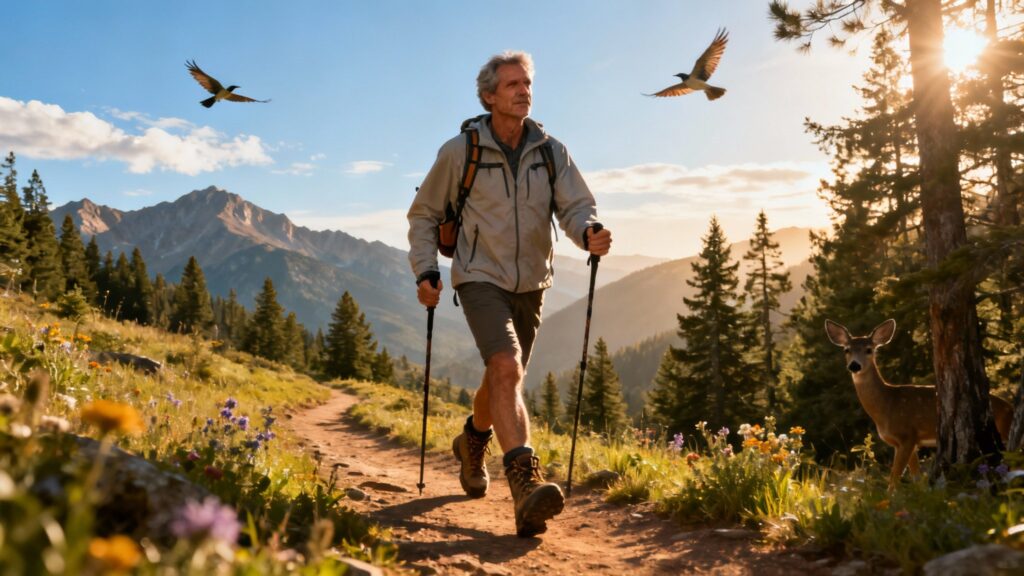
My first multi-day backpacking trip was an education in what I thought I needed versus what I actually needed. The pack was embarrassingly heavy — full-size toiletries, a book I never opened, layers of backup layers. By day two, I was doing math on what I could leave at the next junction. By day three, standing at an alpine lake watching the sunset while a deer ambled through camp like we were barely there, none of the pack weight mattered at all. That’s when it makes sense. That’s when you understand what the fuss is about.
For retirees starting multi-day backpacking, the formula is straightforward: begin with two-night trips on well-maintained trails, go with at least one experienced person, keep daily mileage honest (8 to 10 miles is plenty with a loaded pack), and treat gear research as seriously as you’d treat any significant investment.
Canoe and Kayak Wilderness Trips
Water-based wilderness exploration is worth its own mention because it changes the physical equation considerably. A canoe or kayak carries your gear, which means your body isn’t hauling it. For retirees with joint concerns or limited hiking range, paddling opens up remote country that foot travel wouldn’t reach.
The Boundary Waters Canoe Area in Minnesota — over a million acres of interconnected lakes with no motors allowed — is one of the genuinely extraordinary wilderness experiences available anywhere. The first morning you wake up in a campsite accessible only by water, with loons calling across the lake and a sunrise that looks painted, is the kind of thing you’ll try to describe to people and fail at entirely. Some experiences are like that.
Winter Wilderness: Snowshoeing and Nordic Skiing
Winter doesn’t close the wilderness — it just redecorates it. Snowshoeing is one of the most accessible wilderness activities available to retirees: the learning curve is minimal, the equipment is inexpensive, and the experience of moving through a snow-covered forest in genuine quiet — the kind of quiet you can only find in winter — is something that earns its own category.
Many retirees find winter wilderness exploration more appealing than summer, precisely because the crowds are gone. The same trail that draws a hundred people on a July Saturday is empty by February. That solitude is its own reward.
Planning a Wilderness Trip in Retirement: What Actually Matters
Good wilderness exploration for retirees starts months before you hit the trailhead. Here’s where the preparation that makes or breaks trips happens.
Research Permits and Regulations First
This sounds administrative, and it is. It’s also the step that ruins more trips than any other single factor. Popular wilderness areas require permits that sell out months in advance. National parks impose timed-entry systems, daily visitor limits, and zone-specific requirements that aren’t always obvious from the website. The six-hour drive to a trailhead that requires a permit you didn’t know you needed, ending with a locked gate and a long, quiet drive home — that story is entirely avoidable with an hour of research.
Call the ranger station. Read the current regulations on the park or forest’s official site. Do this before you plan anything else.
Train for the Trip You’re Actually Taking
The gap between how you feel on your neighborhood walk and how you feel on day two of a 10-mile-per-day backpacking route with 2,000 feet of elevation gain is significant. It’s not a character flaw — it’s just physics. The solution is honest fitness preparation starting six to eight weeks before your trip.
Progressive hiking with a loaded pack is the most specific preparation available. Start with manageable distances, add pack weight gradually, and do your training hikes in the actual boots and gear you plan to use. Finding out that your boots cause blisters at mile two is information you want in your neighborhood, not in the backcountry. Your body needs to know what you’re asking of it before it actually matters.
Test Your Gear Before You Leave
I once spent an entire night in a “waterproof” tent that leaked from four separate seams during a rain that was, in hindsight, not even that heavy. Every piece of equipment I had was questioned by morning. Now I set up camp in the backyard before every trip — sleeping bag, tent, stove, filter, all of it — and anything that fails at home fails at home, where the solution is walking inside, not improvising in the dark ten miles from the trailhead.
A wilderness first aid kit is non-negotiable on any trip more than a few miles from help. Take a wilderness first aid course if you haven’t — it’s one of the most useful things you can invest a weekend in, and the skills don’t expire the way gear does.
Tell Someone Your Plan
This is the one that people skip because it feels like overkill until it isn’t. Before any wilderness trip, someone who isn’t going with you should have your full itinerary: where you’re starting, where you’re camping each night, where you’re finishing, and when to expect you back. If they don’t hear from you by a specified check-in time, they know to act.
A satellite messenger device — the kind that works without cell signal and can summon help from anywhere — is worth serious consideration for multi-day trips in remote areas. Not because you’re planning for disaster. Because having options when something goes sideways is better than having only hope. They’re compact, relatively inexpensive, and genuinely save lives.
Before heading into the backcountry, the guides in Safety Tips When Hiking for Retirees cover the essential preparation checklist and emergency protocols in detail — it’s written specifically for the retiree body and mindset and worth reading before any wilderness trip, day hike or multi-day.
Premier Wilderness Destinations for Retirees
Boundary Waters Canoe Area, Minnesota
A million-plus acres of interconnected lakes with portage trails between them and a strict no-motors policy. The quiet is genuine — not “quiet for a park,” but actually quiet, the kind where you hear fish break the surface and the first loon call of the morning travels across the water like it has somewhere to be. For retirees who want wilderness without the physical demands of heavy backpacking, a guided canoe trip here is genuinely one of the best outdoor experiences available anywhere.
Bob Marshall Wilderness, Montana
“The Bob” is about 1.5 million acres of Northern Rockies — alpine lakes, glacier-carved valleys, big skies, and the kind of scale that genuinely humbles you. Days without seeing another person are common in the backcountry zones. The trail system ranges from moderate to demanding, and entry-level routes give retirees access to country that rewards the effort with scenery that doesn’t have an adequate human description.
Olympic National Park, Washington
Nearly a million acres encompassing temperate rainforest, high meadows, and wild Pacific coastline. It rains here — generously — and everything is impossibly green as a result. The forest, dense with moss-covered trees and ferns, has an otherworldly quality that I’ve never quite seen matched anywhere else. The diversity of landscapes in a single park means retirees can calibrate their experience precisely to their fitness level and still access genuinely wild country.
Desert Wilderness: Utah’s Canyon Country
Desert wilderness demands respect that forest and alpine environments don’t always make obvious. Water is the variable that controls everything. I learned this on a spring trip when I underestimated my consumption and spent the final miles doing math on how many sips per mile I had left. Every swallow felt like a negotiation. Now I carry at least a liter more than seems necessary. The extra weight is never a regret.
That said, the canyon country of southern Utah — Canyonlands, the Escalante drainage, the Paria River corridor — offers some of the most visually stunning wilderness in North America. The scale of the geology, the silence of the slot canyons, the particular quality of light at dusk on red sandstone: there’s nothing else like it.
Navigation and Safety in the Wilderness
Maps, Compasses, and GPS: Use All Three
Topographic maps on waterproof paper don’t need batteries, don’t need satellite signals, and give you spatial context that a phone screen can’t match. They also survive being dropped, which happens. A quality compass provides direction when electronics fail — and they will fail, usually at the moment that’s most inconvenient. I’ve had GPS units drain overnight in cold temperatures and greet me in the morning as inert plastic rectangles. Paper maps don’t do that.
GPS devices are excellent at telling you precisely where you are. Compasses tell you which direction to go without needing to know where you are. Maps tell you what’s between here and there. Together, they cover the scenarios where any single one would fail you. Learn to use all three. Practice at home, before you need them in the field.
Altitude, Hypothermia, and Dehydration
These are the three conditions that end wilderness trips early, and all three are largely preventable with awareness. Altitude sickness begins at around 8,000 feet and can affect anyone regardless of age or fitness level — the symptoms include headache, nausea, fatigue, and disrupted sleep. The treatment is descent, and there’s no shame in it. The wilderness will be there for another attempt.
Hypothermia develops faster than most people expect, and the onset can happen at temperatures well above freezing when someone is wet and tired. The “cotton kills” warning in wilderness circles is real — cotton holds moisture against the skin and removes heat rapidly. Merino wool and synthetic fabrics maintain insulation when wet in ways cotton simply doesn’t. This is one of those gear decisions where getting it wrong is costly.
Dehydration at altitude and in dry environments happens faster than sea-level intuition suggests. Mountain air is dry. Exertion increases fluid loss. The standard advice — drink before you’re thirsty — exists because thirst is a lagging indicator, not a leading one.
Knowing When to Turn Around
This is the hardest skill in wilderness travel to develop and probably the most important. Turning around within sight of a summit because the weather shifted, or because someone in your group is showing signs of altitude sickness, or because the afternoon thunderstorm arrived earlier than expected — these decisions sting. They’re also the right calls almost every time.
The wilderness does not care about your itinerary, your expectations, or how far you’ve already come. It respects preparation and punishes overconfidence with consistency. Every experienced wilderness traveler has a story about the time they turned around, and most of them will tell you they’re glad they did.
Leave No Trace: Why It Matters More Than Ever
Wilderness areas are absorbing more visitors than at any point in history, which makes responsible behavior more consequential, not less.
Pack out everything you carry in — food scraps, wrappers, toilet paper, all of it. Camp on durable surfaces at least 200 feet from water sources. A lakeside that gets trampled by careless camping can take years to recover, and some never fully do. A lightweight stove leaves no fire scar in fragile alpine soil; a fire ring does, permanently.
Secure food properly and give wildlife actual space — not the ten-foot distance that seems polite but the real distance that doesn’t habituate animals to human presence. A bear that learns that tents equal food doesn’t get a re-education — it gets relocated or worse, and the chain of events started with improperly stored granola bars.
I pick up one piece of trash on every trip that isn’t mine. It’s a small habit. Over time, across thousands of visitors who do the same thing, it’s what keeps wild places wild.
The Mindset That Makes Wilderness Exploration in Retirement Work
A scoping review published in ScienceDirect studying older adults (aged 64 to 91) who participated in structured nature-adventure programs found that participants who engaged in outdoor exploration consistently described the experience as restorative — not just physically, but in terms of identity, purpose, and sense of capability — with many reporting that access to wild environments gave them back a sense of themselves they’d felt slipping away.
That language — “got my life back” — shows up in the qualitative research with striking regularity. It’s not about summits or mileage. It’s about the encounter with something that doesn’t negotiate with your age, your schedule, or your assumptions about what’s still possible.
Wilderness exploration for retirees works best when it’s approached as a practice rather than an event. Not the single bucket-list trip, but the ongoing relationship with wild places that builds on itself — each experience making the next one more accessible, more comfortable, more meaningful. And Retirement Lifestyle Planning makes the broader case for exactly this kind of intentional activity-building in retirement: that what you do with your days shapes your health, your sense of purpose, and your overall satisfaction in ways that financial planning alone never quite reaches.
Start with guided trips and outdoor clubs if you’re new to this. The mentorship from experienced wilderness travelers is worth more than any gear purchase. Learn from people who’ve made the mistakes you don’t have to make. Build the skills that the wilderness will test eventually, and build them deliberately rather than discovering the gaps in a situation where gaps matter.
Conclusion: Wilderness Exploration for Retirees Is the Trip Worth Planning
Here’s what I keep coming back to. The wilderness doesn’t know how old you are. It knows whether you prepared. It knows whether you respected it. It knows whether you brought enough water. Those are the variables it cares about — and all of them are within your control.
Wilderness exploration for retirees isn’t about proving something. It’s about showing up to one of the few remaining experiences that asks you to be genuinely present, physically honest, and humble in the face of something larger than yourself. The health benefits are real and well-documented. The memories are the kind that don’t blur into the general background of daily life. And the person who comes back from a week in wild country tends to be slightly different from the one who left — a little more patient, a little more capable, a little more certain about what matters.
Plan the permit research. Train for the fitness demands. Test the gear before you need it. Tell someone where you’re going and when you’ll be back. Start smaller than your ego suggests. Build from there.
The wilderness has been waiting. It’ll keep waiting as long as you need. But at some point, the right answer is to lace up the boots, shoulder the pack, and find out what’s past the trailhead.
You might be surprised what’s out there. I still am, every time.





2 Comments
Comments are closed.