

Safety Tips When Hiking for Retirees: Equipment, Accident Prevention, and Emergency Preparedness
Safety tips when hiking for retirees cover everything from what to pack to how to handle emergencies — so you can enjoy every trail with confidence and a lot more peace of mind.
I have a confession that might sound a little too familiar.
When I first started hiking seriously in retirement, I treated it the way I used to treat a lot of things in my working years: wing it, adapt, figure it out as you go. Put on some boots, grab some water, go look at trees. How complicated could it be?
Pretty complicated, as it turns out. Not in a terrifying, call-for-rescue kind of way — but in a “why didn’t I check the weather, and why is this trail so much steeper than the description suggested, and where exactly did I put that snack I was definitely going to eat at the top?” kind of way that sneaks up on you around mile three when your optimism starts to feel a little thin.
The thing is, I love hiking. I love it the way I love a good cup of coffee on a quiet morning — it clears my head, slows me down in the best possible way, and reminds me that the world is genuinely beautiful when you’re not staring at a screen. But I’ve also learned, sometimes the hard way, that enjoying it fully means being a little more intentional than I was in those early outings.
Research from the American Hiking Society consistently shows that regular trail walking improves cardiovascular health, balance, and mental well-being — all things that matter more, not less, as we get older. That’s not a small thing. That’s a really good reason to keep going. But it’s also a good reason to go prepared.
This guide pulls together the safety tips when hiking for retirees that actually make a difference — the ones that help you stay comfortable, confident, and ready if the day gets interesting. And occasionally, the day does get interesting. Trails are funny like that.
Key Takeaways
- First aid, navigation, and hydration are the core essentials for hiking safety at any age
- Proper footwear and layered clothing improve comfort, balance, and protection on the trail
- Staying on marked trails and watching your footing helps prevent the most common accidents
- Warming up, pacing yourself, and resting when needed significantly lowers injury risk for retirees
- Checking weather and understanding basic navigation reduce avoidable problems
- A hiking plan and emergency kit matter even on shorter, familiar outings
- Clear communication and a buddy system make group hikes safer and more enjoyable
- Wildlife awareness and environmental caution help you avoid unnecessary risk
- Hydration and layered clothing are two of the most powerful tools for outdoor comfort and survival
Must-Have Hiking Safety Equipment for Retired Hikers
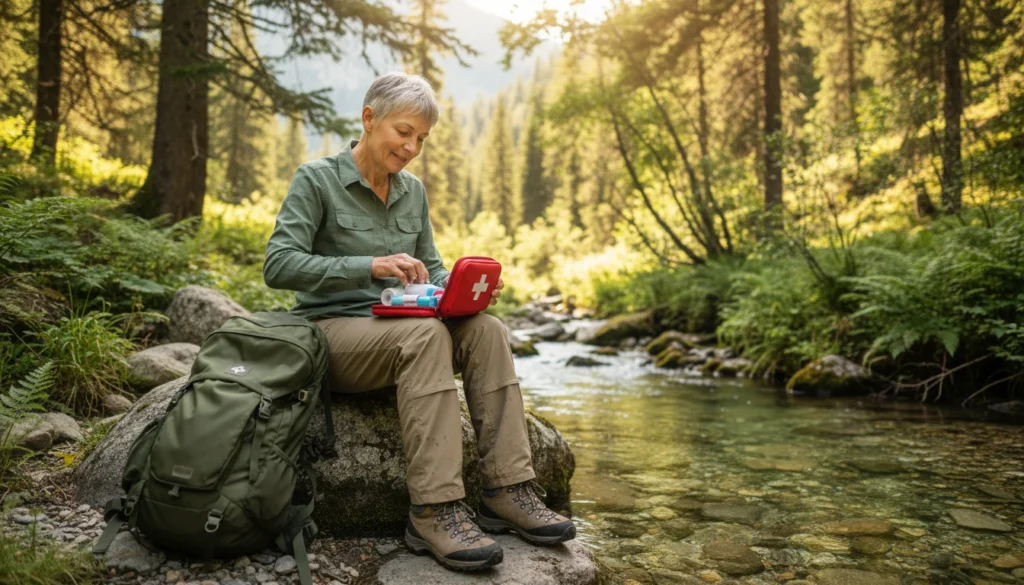
If you only remember one thing from this entire article, let it be this: the best safety tips when hiking for retirees usually start before your hike does. What you pack matters — not in a glamorous, cinematic way, but in a “future you will be deeply grateful” kind of way that becomes very clear around mile four when past you made some questionable decisions.
A first aid kit is the obvious starting point. It’s not exciting. Nobody posts a photo of their gauze pads with the caption “living my best life.” But when you get a blister halfway through a long trail, or scrape your shin on a rock because your foot placement got sloppy after a long descent, that little kit becomes the most interesting thing you own.
I’ve had moments on the trail where I would have traded a lot for a single blister pad. A good hiking first aid kit for retirees should be small, practical, and built for real-world trail problems: cuts, scrapes, hot spots, mild sprains, headaches, and the occasional “well, that was dumb” moment that we’ve all had and none of us talk about enough.
Navigation tools belong in the same category. Most of us rely on our phones for everything now, which is convenient until it isn’t. Batteries die. Screens crack. Signal disappears right when you need it most — usually at the exact fork in the trail where both paths look equally plausible and equally wrong.
I once stood at one of those forks for a solid five minutes, phone held up at various angles like I was trying to summon a signal from the sky. A paper map and compass still matter. So does a GPS device if you use one. You don’t need to go full wilderness survival expert. You just want a backup plan that doesn’t depend on a charging cable and good luck.
Hydration is another non-negotiable. Not kind of important. Actually important. Bring enough water for the trail, the temperature, and your pace — plus a little extra if conditions are uncertain. On longer hikes, a basic water filter or purifier gives you insurance if you run low near a water source. Dehydration has a sneaky personality. It rarely arrives with trumpets. It just slowly turns you into a slower, dizzier, more annoyed version of yourself — and for retirees, the effects can come on faster than they did at 40. I learned this the hard way on a warm afternoon hike when I was absolutely certain I’d packed enough water. I had not. My confidence was not matched by my math.
Then there are the small items that earn their keep fast: an emergency whistle, a compact multi-tool, and a headlamp if there’s any chance you’ll be out longer than planned. That last one is especially useful because hikes tend to obey trail math, not normal math. Somehow “we’ll just do a quick loop” can become a whole afternoon. Every single time.
First Aid Kits and Navigation Tools Worth Carrying
Owning gear is one thing. Knowing what’s actually worth carrying is another. I’ve definitely packed things that sounded useful in theory and then ignored them for months. But when it comes to safety tips when hiking for retirees, first aid and navigation tools are not the place to get cute or overly minimalist.
First Aid Kits
A solid hiking first aid kit should cover the injuries that actually happen on trails — not the ones that belong in a disaster movie. That means basics like adhesive bandages, antiseptic wipes, gauze, medical tape, blister treatment, pain relievers, and an emergency blanket. Tweezers are handy too, because splinters and ticks have a talent for appearing at the least charming moment possible. Usually when your hands are already full of something else.
Basic skills matter just as much as supplies. A study on trekking risk management found that preventable injuries were often linked to poor risk awareness and weak first-aid knowledge, especially in situations involving delayed care. That doesn’t mean every retired hiker needs to become a wilderness medic. It just means there’s real value in knowing how to clean a wound, support a sprain, and recognize when something is moving beyond “annoying” into “we should probably head back now and stop pretending this is fine.”
For retirees managing chronic conditions, it’s also worth carrying any personal medications, a list of current prescriptions, and a note about any relevant medical history. That information can matter a great deal if someone else needs to help you — and it takes about five minutes to put together before you leave the house. Five minutes. That’s less time than it takes to find your car keys.
Navigation Tools
For navigation, a paper topographic map, compass, and GPS device make a strong trio. Each covers the others’ weak spots. A compass won’t run out of battery. A map gives you broader terrain awareness. A GPS can confirm your location quickly when the trail gets confusing or poorly marked.
Topographic maps are especially helpful once you know how to read them. They show elevation, ridgelines, water crossings, and terrain changes in a way that’s much more useful than simply following a blinking dot. And honestly, once you get used to reading them, they’re oddly satisfying — like solving a puzzle before the trail tries to hand you one. My wife thinks I’m a little too enthusiastic about topographic maps. She is probably right. I’ve accepted this about myself.
One of the smartest safety tips when hiking for retirees is to treat navigation as a skill, not just a device.
How Proper Hiking Gear Supports Outdoor Safety for Retirees
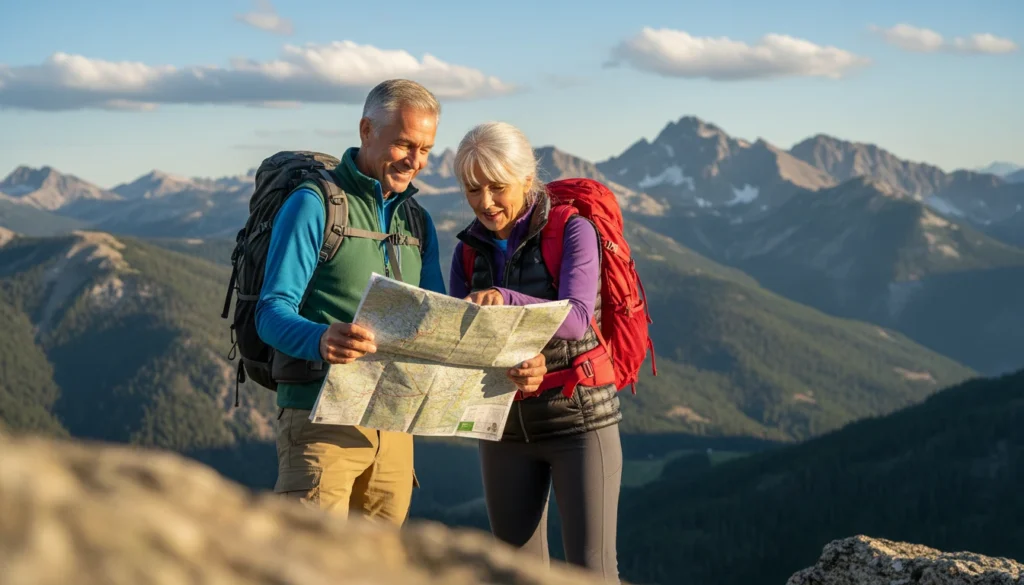
There’s a reason experienced hikers talk about clothing and footwear so much. It’s not because they’re trying to turn the trail into a gear convention. It’s because proper gear gives you options — and options are a big part of staying safe and comfortable, especially as our bodies become a little more particular about conditions than they used to be. Mine certainly has opinions now that it didn’t have at 45.
Layered clothing helps you adjust when temperatures shift, wind picks up, or rain shows up uninvited. A moisture-wicking base layer moves sweat away from your skin. An insulating layer traps warmth. A waterproof shell protects you from rain and wind. Simple system. Very effective. I used to think layering sounded like overkill until I got caught in cold rain wearing the wrong clothes and spent the next hour feeling like a damp sandwich with strong opinions about life choices. Now I layer. Every time. No exceptions. Not even on days that look suspiciously perfect.
Footwear matters just as much — arguably more for retirees, where ankle stability and joint support become increasingly important. Supportive hiking boots or trail shoes with reliable grip help you move more confidently on loose gravel, rocky terrain, mud, and slick roots. This is one of those safety tips when hiking for retirees that sounds obvious right up until someone learns it the hard way. I have, unfortunately, learned it the hard way. The trail was not sympathetic. My pride recovered eventually. My ankle took a little longer.
Pack organization is worth mentioning too. If your water, rain jacket, or first aid kit is buried under everything else, you’re less likely to use it when you should. Humans are lazy in weirdly predictable ways. If something is hard to reach, we’ll convince ourselves we don’t need it yet. Then we do. Suddenly. And urgently. And with a level of regret that is entirely proportional to how easy it would have been to just pack it properly.
How to Avoid Common Hiking Accidents
A lot of trail accidents happen in deeply ordinary ways. Nobody was doing anything wild. They were just tired, distracted, rushing, or trying to save a few minutes. That’s what makes the best safety tips when hiking for retirees feel so practical — they’re less about heroics and more about habits.
Staying on marked trails is a big one. Established routes reduce the chance of getting lost, wandering onto unstable ground, or ending up somewhere rescuers won’t think to look. Going off-trail can feel adventurous for about ten minutes. Then it starts to feel expensive — in time, energy, and occasionally dignity. I’ve done it. I don’t recommend it. The bushes always win.
Watching your footing matters too, especially on wet rock, roots, loose gravel, and steep downhills. A lot of slips happen near the end of a hike, when people are tired and paying less attention. That’s completely normal — and it means you have to be a little more deliberate when your legs are no longer thrilled with your decisions. The trail doesn’t care that you’re almost done. It will absolutely still trip you up at mile seven.
Knowing your limits is another underrated skill. Pick a trail that fits your current fitness, experience, weather conditions, and available daylight. Ambition is great. So is good judgment. I’m a big fan of turning around when needed. The mountain doesn’t take it personally, and neither should you. There will always be another trail day — and that’s the whole point of taking care of yourself out there.
And please — tell someone your plan before you go. Route, start time, expected return. It takes almost no effort, and if something does go wrong, it gives people a place to start looking. This is one of those safety tips when hiking for retirees that feels unnecessary right up until it isn’t. Don’t skip it.
Best Practices to Prevent Hiking Injuries for Retirees
Injury prevention isn’t glamorous. It’s mostly small decisions made consistently — which is true of a lot of things adults are told to do and would rather not think about too hard. Still, it works. Annoyingly well, actually.
Warming up before a hike helps your body transition into movement, which matters more as we age. You don’t need to do a full dramatic stretch routine in the parking lot while strangers pretend not to watch. Just a few minutes of leg swings, ankle rolls, calf stretches, or easy walking can loosen things up before the climb starts. Your joints will thank you. Quietly, but sincerely. And with noticeably less complaining on the descent.
Pacing matters more than people expect. Starting too fast is one of the easiest ways to burn through your energy early — and for retirees, recovery from overexertion takes longer than it used to. A steady, comfortable pace almost always wins. If you can hold a conversation without feeling wrecked, you’re probably moving at a smart speed. If you can’t, slow down. The view at the top will still be there. It’s been there for thousands of years. It can wait another twenty minutes.
Trekking poles are worth serious consideration for retired hikers. They improve balance on uneven terrain, reduce strain on knees during descents, and provide an extra point of contact on slippery surfaces. Descents have a sneaky way of looking easy and feeling rude — poles help with both the looking and the feeling. I resisted them for longer than I should have, convinced they were for “serious” hikers. Then I used them once on a steep downhill and immediately understood what I’d been missing. Now they come on every hike.
Eating and drinking regularly supports injury prevention too. Low energy and dehydration don’t just make you uncomfortable. They make you clumsier, slower to react, and more likely to make poor choices. Trail snacks are not optional joy. They’re strategy. Eat before you’re hungry. Drink before you’re thirsty. Your future self will be very pleased with your past self — and that’s a rare and wonderful feeling.
Weather Awareness and Trail Navigation for Retired Hikers
Weather and navigation are where a good hike can go sideways faster than people expect. That’s why they deserve real attention — not just a quick glance at an app while putting on your socks and hoping for the best.
Checking the forecast means looking at more than temperature. Rain chances, wind, storm timing, and sudden drops in temperature all matter. The U.S. National Park Service regularly warns that mountain weather can change quickly, especially at higher elevations, where storms can roll in with very little patience for your plans . For retirees, cold and wet conditions carry additional risks — hypothermia can develop faster in older adults, and wet trails become significantly more hazardous underfoot. I’ve watched a perfectly sunny morning turn into a cold, windy mess by early afternoon. The sky gave no warning. The forecast had.
Navigation helps because getting mildly confused is common, but staying mildly confused while continuing to walk is how small problems become big ones. Study your route before you go. Notice the trail junctions, turnaround spots, and major landmarks. If something feels off, stop and check sooner rather than later. I’ve made the mistake of walking confidently in the wrong direction for twenty minutes because I didn’t want to admit I was unsure. The trail eventually made the point for me, loudly and without sympathy.
One of the simplest safety tips when hiking for retirees is this: don’t let momentum make decisions for you. Stop. Check. Then continue.
Emergency Preparedness Steps Every Retired Hiker Should Follow
Emergency preparedness sounds intense until you realize it mostly comes down to being thoughtful. You don’t need to expect disaster. You just need to respect the possibility of inconvenience getting ambitious — because sometimes it does.
Start with a hiking plan. Write down your route, who’s going, when you expect to return, and any alternate paths you might take. Share it with someone reliable. If you’re delayed or hurt, that information matters enormously — and it takes about five minutes to put together. I text mine to my daughter before every hike. She rolls her eyes a little. I do it anyway.
Your emergency kit should fit the trail and conditions, but the basics usually include:
- A headlamp with fresh batteries
- Extra food and water
- Navigation tools (map, compass, GPS)
- First-aid supplies including personal medications
- An emergency whistle
- A fire starter
- An emergency blanket
- Water purification backup
This is especially important in remote areas. Wilderness medicine experts consistently point out that help may be delayed by distance, terrain, and communication limits — which is a polite way of saying you may be on your own longer than you’d like. Preparation fills that gap. It’s not pessimism. It’s just good sense dressed in practical clothing, which is honestly the best kind of sense.
Using Emergency Signaling Devices and First Aid on the Trail
A whistle only helps if you know how to use it. Same with a signal mirror, headlamp, or first aid kit. The tools matter, but the calm to use them matters too — and calm is something you can actually practice before you need it.
Three short whistle blasts is the standard distress signal. It’s clearer and more effective than shouting until you lose your voice. A signal mirror can be useful in open daylight. A headlamp helps rescuers spot you after dark and helps you avoid making a bad situation worse by stumbling around in low light trying to find the trail you were just on.
With first aid, the goal is usually stabilization. Stop the bleeding. Clean the wound. Protect it. Keep the injured person warm, calm, and as comfortable as possible. It’s not about being perfect. It’s about making things less bad until help arrives or you can get out safely. That’s a completely achievable goal, and it’s worth practicing before you’re standing on a trail hoping you remember what to do.
For retirees, it’s also worth knowing the signs of heat exhaustion, hypothermia, and cardiac stress — conditions that can develop more quickly in older adults and that benefit enormously from early recognition and a calm, steady response. Knowledge here is genuinely protective.
Group Safety and Communication on Retirement Hikes
Group hikes are safer in a lot of ways — but only if people actually communicate. Otherwise it’s just several individuals sharing the same scenery at different speeds and hoping for the best, which is a lovely description of a bad plan.
A buddy system works because it creates accountability. Someone notices if you’re lagging, limping, unusually quiet, or not yourself. That’s useful. So are regroup points, shared pacing expectations, and clear decisions about who leads and who watches the rear. My hiking group has a rule: nobody disappears around a bend without checking that the person behind them is still visible. It sounds simple. It’s saved us from a few awkward moments and at least one minor panic.
It also helps to make space for honesty. Sometimes the safest thing someone can say on a hike is “I need a break,” or “I don’t feel good,” or “I think we should turn around.” That kind of honesty saves people from turning manageable discomfort into a real problem — and in retirement, there’s no ego worth protecting at the expense of your safety or your hiking partner’s. The trail will be there next weekend. Your health is the priority every time.
Wildlife and Environmental Safety for Retired Hikers
Wildlife and environmental hazards are part of what makes hiking feel real. You’re in nature, not a theme park. The rules are different out there — and honestly, that’s part of the beauty. It’s also part of why paying attention matters.
Most wildlife encounters are uneventful if hikers behave well. Keep your distance. Don’t feed animals. Don’t try to get closer for a photo that makes you look brave and actually makes you look like a cautionary tale. Learn what animals are common in the area and what local guidance recommends before you go. “What lives here?” is a much better pre-hike question than “Wait, are there bears here?” halfway through the day when you’re already deep in the woods.
Environmental hazards deserve the same respect. Loose terrain, unstable ledges, flash-flood-prone areas, poison ivy, heat exposure, and sudden cold can all create problems fast. Paying attention to the trail, the weather, and your surroundings is one of the most practical safety tips when hiking for retirees you can follow — and it costs nothing except a little awareness.
Simple habits help with wildlife specifically: make noise in thick brush or around blind corners so animals aren’t surprised, hike in groups when possible, store food properly, and keep pets under control if they’re allowed on the trail. If you do encounter wildlife, stay calm and back away slowly. Give the animal space. Your best move is almost always the least dramatic one. The dramatic move makes for a better story but a much worse afternoon.
Hydration and Weather Management for Retired Hikers
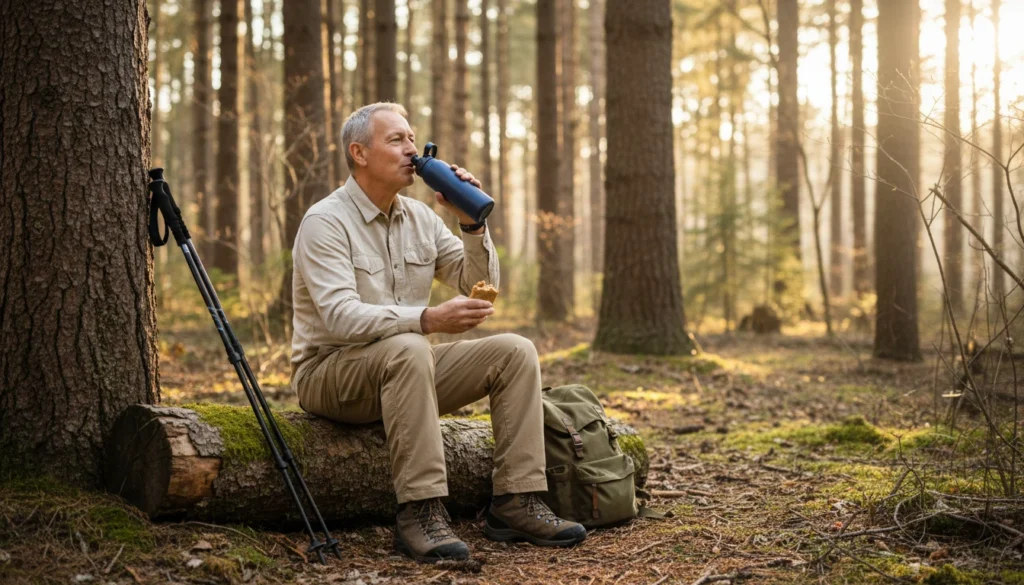
Hydration and weather management might be the most quietly important safety tips when hiking for retirees in this entire article. They affect your energy, judgment, balance, and comfort — which means they affect almost everything else about how your hike goes.
Drink regularly, even before you feel thirsty. This matters more for retirees because the thirst mechanism becomes less reliable with age — meaning you can be significantly dehydrated before your body sends a clear signal. I’ve been surprised by this more than once. You feel fine, then you don’t, and the gap between those two states is shorter than it used to be. Eat enough to keep your energy steady. Dress in layers so you can add or remove clothing as conditions change. Carry rain protection even if the sky looks harmless at the trailhead. Skies, like people, can change moods quickly and without much warning.
Signs of dehydration to watch for include thirst, dry mouth, fatigue, dizziness, and dark urine. If you notice any of these, stop, drink, rest in shade, and don’t push on until you feel genuinely better. The trail will still be there. Your health is the priority — always.
The hikers who seem the calmest on the trail are usually the ones doing the basics well. They’re not scrambling for water, not shivering because they waited too long to add a layer, not pretending they’re fine when they clearly need food. They stay a little ahead of the situation. That’s really the goal — and in retirement, it’s a goal very much within reach.
Frequently Asked Questions
What should I include in my emergency kit for hiking as a retiree?
Bring a headlamp, whistle, first-aid supplies, emergency blanket, fire starter, extra snacks, navigation tools, water purification backup, and any personal medications. Adjust for weather, distance, and your specific health needs.
How can I prepare for sudden weather changes while hiking?
Check the forecast right before you leave, pack layers, and carry waterproof gear. Also pay attention to what the sky is doing while you hike — not just what the app said earlier that morning.
What are the best practices for retired hikers with joint issues?
Use trekking poles for balance and knee support, choose trails with moderate elevation gain, warm up before starting, and don’t hesitate to turn around if pain develops. Descents are often harder on joints than ascents — pace accordingly.
How can I improve my navigation skills for hiking?
Practice on easier, familiar trails first. Learn to read a topographic map, use a compass, and treat GPS as a helpful tool rather than your only plan. Many outdoor clubs offer navigation workshops specifically for older adults.
What should I do if I encounter wildlife while hiking?
Stay calm, keep your distance, and back away slowly. Follow local guidance for the species in that area and avoid sudden movement or crowding the animal.
How can I ensure my hiking group stays safe and together?
Use a buddy system, agree on pace before you start, regroup at regular intervals, and communicate early when someone needs rest or wants to change plans. Make honesty easy and normal.
What are the signs of dehydration while hiking, and how can I prevent it?
Watch for thirst, dry mouth, fatigue, dizziness, and dark urine. Prevent it by drinking regularly throughout the hike — not just when you feel thirsty — eating enough, and slowing down when heat builds.
Final Thoughts on Safety Tips When Hiking for Retirees
At the end of the day, the most useful safety tips when hiking for retirees are the ones that become habits. Pack smart. Check the weather. Bring enough water. Learn your route. Respect your limits. Pay attention.
That’s not flashy advice. It’s better than flashy advice. It works — consistently, on easy trails and hard ones, in good weather and uncertain weather, alone and with a group.
Hiking in retirement should leave you tired in a satisfying way, not stressed in a preventable way. A little preparation gives you more room to enjoy the view, laugh at the muddy parts, eat your trail snack like it’s a five-star meal, and head home with good stories instead of regrettable ones.
You’ve spent decades earning the freedom to be out there. A little preparation makes sure you get to keep enjoying it — trail after trail, season after season, for as long as your boots hold out. And honestly? That’s a pretty wonderful thing to look forward to.
What’s your go-to hiking safety habit? Drop it in the comments — I’d love to hear what works for you on the trail.






4 Comments
Comments are closed.