
Travel Etiquette for Retirees: Your Complete Guide to Being a Respectful and Enjoyable Traveler in Retirement
Master travel etiquette for retirees — from airport manners and plane behavior to cultural customs and dining tips that make every trip smoother and more meaningful.
Let me tell you something nobody puts on a travel brochure: the most memorable trips I’ve taken weren’t the ones with the best itineraries. They were the ones where I showed up as a decent human being — curious, humble, and at least somewhat aware that the world didn’t pause its regular programming just because I arrived with a carry-on and a bucket list.
Travel etiquette has a reputation problem. It sounds like something your high school principal would hand out in a pamphlet — dry, rule-heavy, and about as exciting as reading the terms and conditions on a hotel loyalty card. Nobody frames it and hangs it on the wall. Nobody quotes it at dinner parties. And yet, after years of traveling in retirement, I’ve come to believe it’s the quiet superpower behind every great trip.
It’s the difference between being the traveler people are genuinely happy to help — and the one they’re still talking about in the group chat three days later. (“Did you see what that tourist did at the temple? I can’t.”)
In retirement, the stakes feel a little different too. You’ve worked hard for this time. These trips aren’t stolen long weekends squeezed between back-to-back meetings. They’re the real thing — the destinations you circled in magazines, the cultures you’ve been curious about for decades, the adventures you promised yourself when the calendar finally cleared. Getting the etiquette right means you actually get to enjoy all of it, instead of spending half your trip wondering if you just accidentally offended someone.
So consider this your retirement travel etiquette cheat sheet — written by someone who has made the mistakes so you don’t have to. (You’re welcome. It was an educational experience for everyone involved.)
Key Takeaways
- Travel etiquette for retirees starts before you board — research cultural norms, dress codes, and local customs before you arrive.
- Learning just five phrases in the local language signals respect and consistently improves how locals respond to you.
- The middle seat gets both armrests. This is not up for debate.
- Tipping customs vary dramatically by country — a quick search before you land saves you from accidentally insulting or stiffing someone.
- Chopstick etiquette, eating hand customs, and table manners are hyper-local — watch what locals do and follow their lead.
- Photography etiquette means asking first, respecting “no photos” signs, and never treating people or ceremonies as props.
- When you make a cultural mistake — and you will — a simple apology and a behavior adjustment is all that’s needed. No spiral required.
- Being proactive about your health needs (medications, mobility aids, extra boarding time) is both self-care and good etiquette for everyone around you.
- The best travel etiquette isn’t about avoiding bad behavior — it’s about choosing the small, good behaviors that make travel feel human.
Why Travel Etiquette Matters More in Retirement
I used to treat travel like a personal adventure movie where I was the main character and everyone else was background. Then I started paying attention — and I realized something slightly uncomfortable: for the people who live in the places we visit, we are the background. We’re the ones wandering slowly in front of their grocery store, blocking the sidewalk to take photos of a building they walk past every single day without a second glance.
That shift in perspective is where travel etiquette begins. It’s not about memorizing a rulebook. It’s about remembering that when you travel, you’re walking through someone else’s home, commute, grocery store, or place of worship. You’re a guest. And in retirement, when you finally have the time to travel slowly and meaningfully, that awareness becomes even more valuable — because you actually have the bandwidth to act on it.
Who benefits most from practicing travel etiquette? Honestly, everyone — but retirees especially. You’re no longer rushing through airports on a tight business schedule, checking your phone every four minutes, and eating a sad airport sandwich over a rolling suitcase. You have time to be present, to notice, to connect. That’s exactly when etiquette stops being a checklist and starts being a philosophy.
A study published in the Journal of Travel Research found that tourists who were perceived as respectful and culturally aware reported better interactions with locals and significantly higher overall trip satisfaction. In plain language: when you practice basic travel etiquette, people treat you better, and your trip genuinely feels better. That’s not a small thing when you’ve been planning this trip for years — possibly decades.
On a personal level, I’ve noticed that when I care about this stuff, I actually relax more. I’m not constantly wondering, “Am I being rude right now?” I’ve done enough homework to feel grounded, so I can enjoy where I am instead of silently panicking about it. And honestly? That peace of mind is worth more than any tour package, any upgrade, any fancy hotel breakfast.
Pre-Trip Prep: Setting Yourself Up for Success
Good travel etiquette for retirees starts before you ever board the plane. A little prep on your couch saves you a lot of weirdness later. Think of it as the difference between showing up to a dinner party knowing the host’s name — and showing up and calling them “hey you” all night while helping yourself to their good wine.
What Should You Learn Before You Travel?
If I had to pick one habit that consistently improves my trips, it’s this: learn a handful of words in the local language. Nothing fancy. No need to enroll in a class or download seventeen apps. Just:
- Hello
- Please
- Thank you
- Sorry / Excuse me
- Do you speak English?
That’s it. Five phrases. You can learn them on the flight over.
I’ve mangled “thank you” in half a dozen languages and still watched people light up because I tried. It’s not about perfection — it’s about effort. Language researchers talk about “effort signals,” those small gestures that show you’re trying to meet someone halfway. Even a clumsy “grazie” or “arigato” says, “I know this is your home, not my theme park.” And there’s a selfish perk: people are usually kinder and more patient when they see you making an effort.
As Condé Nast Traveler’s roundup of seasoned retiree travelers confirms, even just saying “Good morning” in the local language can genuinely stun people — in the best possible way. One traveler described locals looking at her like she’d just performed a small miracle. All she said was “Bonjour.” That’s the power of showing up with a little effort instead of a lot of entitlement.
Where Should You Research Cultural Norms?
The other pre-trip power move is checking basic cultural norms. Ten minutes of research — seriously, just ten minutes — can tell you:
- How modestly people typically dress in your destination
- Whether shoulders and knees need to be covered at religious sites
- If you’ll need to remove shoes in temples, mosques, or private homes
- Any gestures or behaviors that are considered genuinely rude (some of them will surprise you)
I now travel with a permanent “respect outfit” — breathable pants or a long skirt, and a light top that covers my shoulders. That combination has gotten me into churches in Italy, temples in Thailand, and mosques in Turkey without scrambling to buy an emergency scarf from a tourist stand at the entrance. (Those scarves are always overpriced, slightly scratchy, and come in exactly one color that doesn’t go with anything you’re wearing.)
My rule of thumb: if I’d feel weird wearing it to meet someone’s grandparents for the first time, it’s probably not my best choice for sacred or formal spaces. Simple filter. Works every time.
Airport Etiquette: The First Hurdle (and Opportunity)
Airports are already stressful. They’re loud, confusing, and somehow always smell like a combination of fast food and low-grade anxiety. Travel etiquette is how we avoid turning them into full-contact sport — and how we arrive at the gate still feeling like a person.
How Do You Get Through Security Without Becoming “That Person”?
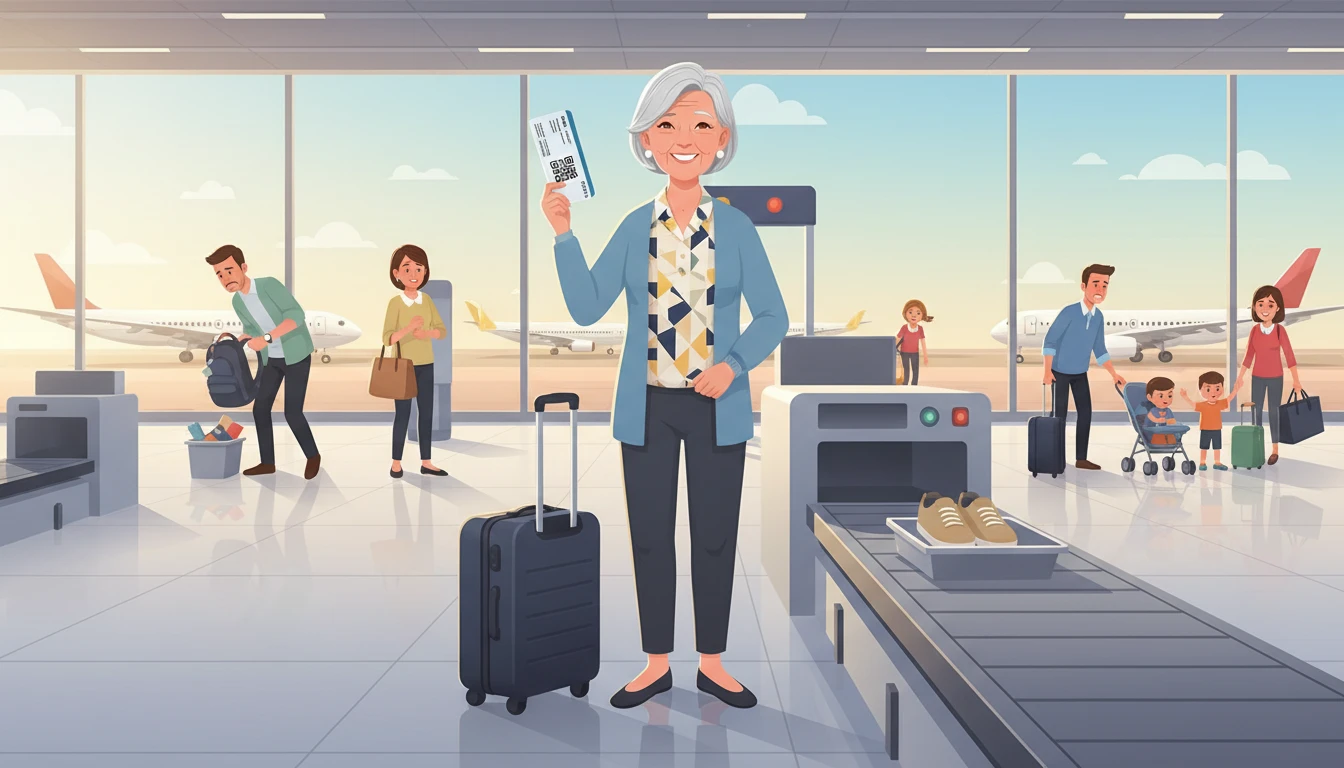
Most security-line chaos comes from one thing: people reaching the bins and acting surprised by rules that have been the same for decades. The shoes! The liquids! The laptop! Every time, like it’s brand new information.
A smoother, more considerate version looks like this:
- Boarding pass and ID ready before you reach the agent — not while you’re standing in front of them
- Liquids in an easy-to-grab bag, not buried at the bottom of your carry-on under three sweaters
- Laptop and large electronics accessible
- Pockets mostly empty before you walk through the scanner
None of that is dramatic. But when you do it, you feel oddly calm — and so does the line behind you. Security staff also tend to be friendlier when you’re not creating your own personal traffic jam. I’ve had agents crack jokes and wave me through with a smile simply because I wasn’t a disaster at the bins. Low bar. Genuinely high reward.
Why Does Gate Behavior Matter?
Once you reach the gate, airport etiquette shifts to how you share space with strangers who are all equally tired and slightly over it. A few things worth remembering:
- Don’t turn three chairs into your personal luggage storage when people are standing
- If you’re taking a call, keep your voice at “coffee shop” level, not “karaoke bar at midnight”
- Don’t crowd the boarding lane twenty minutes early like you’re trying to rush the stage at a concert
I’ve also learned to glance at the screens more than I think I need to. Gates change, times shift, and good travel etiquette includes not shouting “Wait, is this still going to Madrid?!” while sprinting across the terminal at the last second. I have done this. It was not my finest moment. The gate agent was very kind about it. I was not calm.
On the Plane: Navigating the Middle Seat and Everything Else
If there were a World Cup of travel etiquette, it would be played on airplanes. Close quarters, strong opinions, questionable smells, and the kind of intimacy with strangers that nobody actually signed up for. This is the big leagues. And retirement doesn’t exempt you from the unwritten rules — if anything, it gives you more time and perspective to finally get them right.
Who Gets the Armrests?
Let’s settle this one decisively, once and for all, so we can all move on with our lives: the person in the middle seat gets both armrests. That’s their compensation package for drawing the short straw. Window seat has a wall and a view. Aisle seat has space and the freedom to stretch a leg. Middle seat has hope — and elbow room, if the people beside them are decent human beings who understand basic fairness.
When I draw the middle, I silently pray my neighbors know this. When I have the aisle or window, I shift slightly to give the middle person first dibs. It’s a tiny, unspoken piece of travel etiquette, but it can mean the difference between a tolerable flight and three hours of passive-aggressive elbow jousting at 35,000 feet. Nobody wins that game. Nobody.
When Is It Okay to Recline?
Reclining is where airplane debates go to die. People have strong feelings. Manifestos have been written. Friendships have been tested. Here’s my personal framework, which I offer humbly and without apology: yes, the seat reclines, and you’re allowed to use it. But you’re also responsible for how you use it.
Before I recline, I do a quick, subtle glance behind me. Is the person working on a laptop? Balancing a drink? Eating? If yes, I wait or recline very slowly so I’m not catapulting their stuff into their lap. On short flights, I usually skip reclining unless I really need it. On long-haul flights, everyone’s going to recline eventually — doing it gently and thoughtfully is the etiquette part. It’s not about whether you recline. It’s about whether you do it like a considerate adult or like you’re trying to win something.
Why Headphones Are Non-Negotiable
I wish this weren’t necessary to say, but here we are, in the year we’re in, still having this conversation: if it makes sound, it needs headphones. No one wants to listen to your movie, your game, or your voice messages at full volume. Even if you have genuinely excellent taste in shows, the person in 23B did not sign up for a communal screening. This applies to phone calls too — if you must take one, keep it short, keep it quiet, and maybe step toward the galley if you can. The rest of us will be grateful in the quiet, dignified way of people who are pretending to sleep.
How Should You Treat the Crew?
Flight attendants are doing about twelve jobs at once: safety expert, server, mediator, comfort provider, emergency responder, and occasional therapist for the person in 14C who is absolutely terrified of turbulence and needs someone to tell them it’s fine every twenty minutes. The least we can do is not treat them like vending machines with arms.
Basic travel etiquette with crew:
- Make eye contact when you talk to them — they’re people, not appliances
- Say “please” and “thank you” — every single time, without exception
- Follow instructions without arguing, sighing dramatically, or explaining why your situation is different
I try to say a quick “Thanks so much, have a good rest of your day” when I deplane. It takes three seconds. After hours of dealing with every kind of human behavior in a pressurized tube hurtling through the sky, that tiny bit of kindness can be a quiet reset for everyone. And honestly, it just feels good to be the person who says it.
Public Transportation and Local Travel: Be the Traveler Everyone Likes
Once you’re on the ground, buses, trams, trains, and metros are where you meet the real, everyday version of a place. This is rush hour, school runs, grocery trips — real life, not the postcard version. And how you show up here says a lot about the kind of traveler you actually are, as opposed to the kind you think you are.
Who Should You Offer Your Seat To?
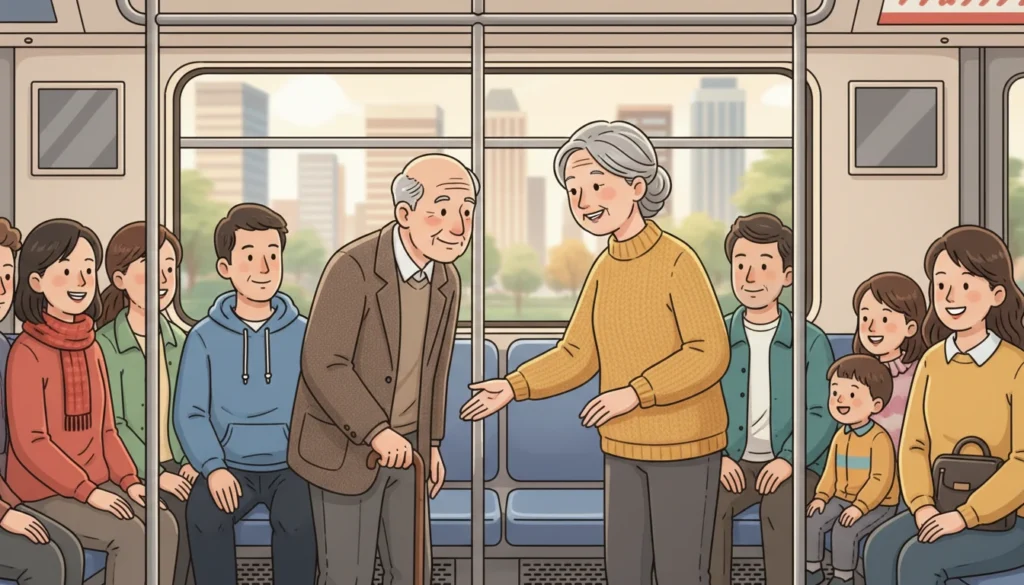
One of the most universal pieces of travel etiquette for retirees is offering your seat to someone who obviously needs it more: older adults, pregnant people, someone with a cane, or a parent holding a child who looks ready to melt into the floor and take everyone down with them. In some cities, like Seoul or Singapore, priority seats are clearly marked and culturally enforced — people take this seriously. Even if you’re in a regular seat, it’s worth keeping an eye out.
Standing for ten minutes so someone else can sit is not a hardship. It’s basic decency. And in retirement, you’ve earned enough perspective to know the difference between inconvenience and actual sacrifice.
Where Should Your Backpack Go?
In a crowded bus or train, your backpack becomes a wrecking ball if you leave it on your back. I’ve absolutely been guilty of this — turning around and nearly knocking into someone because I forgot I was effectively wearing furniture. The look on their face was polite. Their eyes were not.
Better move: take it off and hold it in front of you or between your legs. It shrinks your “person radius” considerably and makes the ride easier for everyone around you. It’s a small thing. It matters more than you’d think.
Why Blocking Doors and Aisles Is a Bigger Deal Than You Think
Doors and aisles are not hangout spots. They’re not the place to pause and check your map, have a conversation, or figure out which stop is yours. If you’re not getting off at the next stop, step to the side so people can get on and off quickly. Same logic for escalators and moving walkways: if you’re standing, stand to one side so people in a hurry can pass on the left.
And please — have your ticket, pass, or payment method ready before you reach the gate or driver. Not almost ready. Actually ready. The line behind you will silently thank you in the universal language of not sighing loudly.
Dining Etiquette: Eating Your Way to Cultural Connection
Food is the fun part of travel. It’s also where travel etiquette gets hyper-local in the best possible way. What’s polite at one table is baffling at another. What’s rude in one country is enthusiastically encouraged in the next. This is where paying attention pays off — literally and figuratively — and where some of the best travel memories get made.
What’s the Right Way to Tip Abroad?
Tipping is one of those areas where you can accidentally offend people by doing what feels completely “normal” to you. A quick snapshot:
- United States: 15–20% at restaurants is standard and expected — not optional
- Japan: Tipping can feel awkward or even rude — good service is considered part of the job, not something that needs a bonus on top
- Many European countries: Service may be included in the bill, but rounding up or leaving a small extra amount is appreciated and warmly received
Before I land somewhere new, I do a fast search: “tipping etiquette in [country].” It takes thirty seconds and saves me from stiffing a server who deserved better or forcing money on someone who genuinely doesn’t want it. Both outcomes are awkward. Neither is necessary. Neither makes for a good story.
How You Eat Matters as Much as What You Eat
Travel etiquette at the table isn’t just about what you eat — it’s how you eat it. In many Middle Eastern, African, and South Asian cultures, people traditionally eat with their right hand and avoid using the left for food. In East Asia, chopstick etiquette gets specific in ways that matter:
- Don’t stick chopsticks straight up in rice — it resembles a funeral ritual and carries real weight
- Don’t point at people or wave them around like a conductor’s baton mid-sentence
- Don’t pass food from one pair of chopsticks to another — also a funeral association, and one people notice
In Japan, slurping noodles is not only fine — it’s often seen as a genuine sign that you’re enjoying your meal. Try that in a quiet café in France and you might get a look that could curdle cream at twenty paces. My go-to move: look around, see what locals are doing, and copy that. It’s real-time, live-action etiquette training, it’s free, and it’s honestly kind of fun once you start paying attention.
When in Doubt, Just Ask
If you’re not sure how something is meant to be eaten, just ask: “What’s the best way to eat this?” or “Is there anything I should know about this dish?” I’ve had servers walk me through how to wrap food, what sauce goes with what, and which parts are traditionally eaten by whom. Those little explanations end up being some of my favorite travel memories — the kind you tell at dinner parties back home for years, the ones that make people lean in and say, “Wait, really? Tell me more.”
Respecting Local Culture and Customs: The Heart of Travel Etiquette for Retirees
This is where travel etiquette goes deeper than just “being polite.” It’s about how you show up in someone else’s culture — with humility instead of entitlement, with curiosity instead of judgment, with the quiet understanding that your way of doing things is not the only way, and possibly not even the best way for this particular place.
What Should You Wear — and Where?
What feels like a regular vacation outfit might land very differently in another context. Common expectations:
- Religious sites: Covered shoulders and knees; sometimes head coverings required — and this isn’t a suggestion
- Conservative areas: Avoid very tight, very short, or very revealing clothing
- Beach vs. city: What’s fine on the sand may feel jarring or disrespectful downtown, especially in smaller or more traditional communities
You don’t have to dress like a local to be respectful. You just have to ask, “Does this fit the setting I’m walking into?” That one question will steer you right most of the time. And if you’re ever genuinely unsure, err on the side of more coverage. You can always take a layer off. You cannot conjure one from thin air, and the tourist-stand scarves, as I’ve mentioned, are scratchy.
Why Photography Etiquette Is More Important Than Ever
We live in a world where everything is camera-ready, but not everyone wants to be photographed — especially not by a stranger on vacation who’s treating their neighborhood like a film set. A few simple photography etiquette rules that I take seriously:
- Ask before taking photos of people, especially in rural or traditional areas — a smile and a gesture toward your camera goes a long way
- Respect “no photos” signs in museums, shops, and religious spaces — they mean it, and they’re not suggestions
- Don’t treat people or ceremonies like props for your social feed — if you wouldn’t want someone doing it to you, don’t do it to them
I’ve had locals gladly pose after I asked — and I’ve had people politely say no. Both answers are completely fair. The asking is the important part. It’s the difference between being a curious traveler and being a tourist with a camera who treats the world like a backdrop for their Instagram grid.
How Volume and Gestures Translate Across Cultures
Different cultures have different default volumes, and what feels like a perfectly normal speaking voice to you might feel startlingly loud somewhere else. In quieter cultures — Japan, parts of Northern Europe, many religious spaces — booming laughter on a packed train stands out fast. When I’m not sure, I start a little quieter and adjust based on what I see around me. It’s not about suppressing yourself. It’s about reading the room — or in this case, the country.
Same for gestures: big pointing, snapping fingers to get attention, or summoning motions with a single finger don’t always translate well. In some cultures, they’re considered rude or even aggressive. Neutral, calm movements are the safest baseline until you get a feel for the place. When in doubt, use your words — politely, at a reasonable volume.
Handling Cultural Differences with Grace
You can do everything “right” and still get something wrong. That’s part of the deal. The real test of travel etiquette isn’t whether you never mess up — it’s what you do after you realize you did. And trust me, you will mess up. I have. Repeatedly. In multiple countries. On multiple continents. Once in a way that involved shoes, a mosque, and a very patient man who pointed at my feet with the expression of someone who had seen this exact thing happen a hundred times before.
Research published in the International Journal of Intercultural Relations documents what’s known as the U-curve of cultural adjustment: initial excitement, followed by a dip of frustration and disorientation, then gradual adaptation. Knowing the dip is coming makes it easier to ride out. And knowing how to recover gracefully from a cultural misstep is just as important as trying to avoid them in the first place.
If someone corrects you or you notice you’ve broken a norm:
- Offer a simple, genuine “Sorry about that” — no elaborate explanation needed, no lengthy backstory about how it’s different where you’re from
- Adjust your behavior — cover up, move, lower your voice, stop taking photos
- Don’t spiral into a long monologue about your intentions, your values, or your travel history
Most people don’t expect you to be an expert on their culture. They just want to see that you care enough to listen and adapt. I’ve made all kinds of mistakes: walking into a mosque with shoes on, talking too loudly on a quiet tram, reaching with the wrong hand at dinner. Every time, a quick apology and a change in behavior reset the moment. Nobody held a grudge. Most people smiled. One man in Istanbul actually laughed and helped me find the shoe rack. People are generally kind when you’re genuinely trying.
If you’re still figuring out where to go and want destinations that are genuinely welcoming and culturally rich, the Vanika guide to the best places for African Americans to retire abroad covers not just destinations but the cultural and community dimensions of traveling abroad that most guides skip entirely.
Random Acts of Kindness: Small Gestures, Big Impact

My favorite part of travel etiquette for retirees isn’t in any official guide: the unrequired, quiet kindnesses that make travel feel human. The stuff nobody grades you on but everybody notices. The things that don’t cost anything but somehow mean everything.
Things like:
- Holding a door for someone juggling bags and a coffee they’re clearly already regretting
- Offering to switch seats so a couple or family can sit together — without making it a whole thing
- Helping another traveler decipher a transit map you just figured out yourself, five minutes ago, with great difficulty
- Thanking cleaning staff or bus drivers on your way out — genuinely, not performatively, not as a thing you do so people see you doing it
I’ve had strangers in foreign cities walk me to the right platform, translate on my behalf, share snacks on overnight trains, and make sure I got off at the right stop. None of that was in their job description. It’s just what decent humans do for each other when they’re paying attention and not too busy staring at their phones.
Travel etiquette isn’t only about avoiding bad behavior. It’s also about choosing the small, good behaviors that quietly say, “We’re in this together, even if we’ll never see each other again.” That’s the part I love most about it. That’s the part that stays with you long after the trip is over.
Travel Etiquette and Your Health: A Retirement-Specific Consideration
Here’s something that doesn’t come up in most travel etiquette guides but matters a lot for retirees: being considerate of your own health needs while also being considerate of others. These two things aren’t in conflict — they actually go hand in hand, and getting this right is one of the most underrated forms of travel etiquette there is.
Why does this matter? Because when you’re unprepared — scrambling for medications at security, holding up the boarding line because you need extra time you didn’t request in advance, trying to explain a medical situation to someone who doesn’t speak your language while a line of frustrated travelers forms behind you — it affects everyone around you. A little advance planning is both self-care and good manners. It’s the rare situation where being kind to yourself is also being kind to strangers.
According to a study in the Journal of Travel Medicine, about 8% of international travelers experience a health issue serious enough to need medical attention abroad. For seniors, that number warrants preparation, not panic. The goal isn’t to travel scared — it’s to travel smart, so you can travel freely.
Practical etiquette around health on the road:
- If you need extra time at security or boarding, request assistance in advance — don’t wait until you’re holding up the line and everyone is doing the polite version of staring
- Keep medications in your carry-on, clearly labeled, so you’re not scrambling or creating delays at the worst possible moment
- If you’re traveling with a mobility aid, notify airlines and hotels ahead of time so accommodations are ready when you arrive — not something you’re negotiating at the check-in desk
Being proactive about your needs isn’t just good for you — it’s considerate of everyone else’s time and experience too. And if you want a deep dive into packing smart for retirement travel, including medications and mobility considerations, How to Pack for Travel Abroad for Retirees covers it in more detail than any generic packing list ever will.
The Bigger Picture: Why Etiquette Makes Retirement Travel Richer
There’s a reason travel etiquette matters more in retirement than it did when you were rushing through airports on business trips, eating sad sandwiches, and counting down the days until you could actually go somewhere you wanted to go. You have time now. Real time. Time to linger over a meal, to get lost on purpose, to sit in a square and just watch the world go by without checking your phone every three minutes.
And that’s exactly when etiquette stops being a checklist and starts being a way of moving through the world — slowly, intentionally, with your eyes open.
Rick Steves, who has spent decades helping travelers navigate the world with respect and curiosity, puts it simply: the best travelers are the ones who show up with humility and genuine interest in the people and places they’re visiting. That’s not a skill you develop overnight. But retirement gives you the time and the perspective to actually practice it — and to enjoy the results in a way that a two-week vacation squeezed between work obligations never quite allowed.
When you travel with awareness — when you learn a few words, dress thoughtfully, tip appropriately, eat curiously, and recover gracefully from your inevitable mistakes — you don’t just avoid awkward moments. You build real connections. You leave places a little better than you found them. And those places leave their mark on you in ways that no itinerary can plan for and no highlight reel can fully capture.
Wrapping It Up: Let Travel Etiquette Bring Out Your Best Self
Travel etiquette for retirees can sound like a long list of rules, but underneath all of it, it’s really just this: be aware, be respectful, be kind. Show up like a guest, not a conqueror. Be curious, not demanding. And when you mess up — because you will, and that’s okay — own it with grace and move on.
When you:
- Learn a few local phrases before you arrive
- Pay attention to how people dress and behave around you
- Share space thoughtfully in airports, planes, and trains
- Eat and tip in ways that fit the culture you’re visiting
- Ask before you photograph
- Own it gracefully when you mess up — and you will, and it will be fine
…you become the kind of traveler people are genuinely happy to host. You also get better stories. The conversations that start with “How do I say this properly?” or “What’s the right way to eat this?” usually lead to the memories you tell for years — the ones that make people lean in at the dinner table and say, “Wait, what happened next?”
You don’t have to be perfect. You won’t be. I’m definitely not. But if you travel with curiosity and humility, and let travel etiquette be your quiet guide, you’ll leave places a little better than you found them — and those places will leave their mark on you in the best possible way.
So pack your bag, do a tiny bit of homework, and go see the world. Just remember: you’re not the main character everywhere you go. And that, oddly enough, is what makes retirement travel so good.
Happy travels — and may your flights be on time, your middle-seat neighbors be considerate, and your meals be just adventurous enough to brag about later.




4 Comments
Comments are closed.