
Cheap Summer Vacations for Retirees: 20 Budget-Friendly Destinations That Deliver the Real Thing
Cheap summer vacations for retirees don’t have to feel like a compromise — these 20 destinations prove you can travel comfortably, richly, and affordably in 2026.
I have a confession to make, and I’m going to lead with it because I think a lot of you will recognize yourselves in it.
For the first couple of years after I retired, I did what a lot of people do: I looked at travel prices, quietly panicked, and talked myself into staying closer to home. “Maybe next year,” I’d say, as if next year came with a guaranteed discount on flights to Vietnam and a coupon for existential courage. It doesn’t, by the way. I checked. Repeatedly.
What finally changed things wasn’t a windfall or a lucky credit card sign-up bonus or some sudden burst of financial confidence. It was a conversation with a retired teacher I met at a community event — the kind of event you go to mostly because there’s free coffee and you’ve run out of excuses not to leave the house. She’d just come back from six weeks in Eastern Europe. Six weeks. She’d stayed in charming guesthouses, eaten incredibly well, visited castles and thermal baths and medieval town squares that looked like they’d been designed specifically to make you feel like you were living inside a painting — and she’d spent less per day than I was spending on groceries.
I sat there with my coffee going cold, doing the math in my head, and thinking: I have been doing this completely wrong. Not just the travel part. The whole mental framework around what retirement travel was supposed to look like.
Here’s what I’ve learned since that conversation: cheap summer vacations for retirees aren’t about cutting corners or white-knuckling your way through a trip on a shoestring. They’re about cutting in the right direction — toward destinations where your retirement budget goes further, your pace is respected, and the experience is richer than anything a resort package could manufacture. The resort package, by the way, will also charge you $18 for a poolside cocktail and call it “all-inclusive.” I’m not bitter. I’m just informed.
This guide pulls together 20 destinations where that’s not just possible — it’s the norm. I’ll walk you through regions where you can travel comfortably on $25–$50 a day, plus practical strategies for booking, saving, and planning without turning your trip into a color-coded spreadsheet. Unless that’s your love language, in which case: live your truth, laminate it, and bring it in a waterproof sleeve.
Why Budget Destinations Are Perfect for Retired Travelers

Let’s clear up one myth right away: summer doesn’t automatically equal expensive. Yes, if you’re trying to hit Santorini, the Amalfi Coast, or any major theme park in July, your credit card may start smoking and your bank may send you a concerned text. But while those classic spots surge in price and crowd density, other parts of the world quietly slide into their most budget-friendly season — and retirees, with flexible schedules and zero school holiday constraints, are perfectly positioned to take advantage of that in ways working travelers simply cannot.
Here’s what’s happening behind the scenes while everyone else is fighting over the last sun lounger in Positano:
- Southeast Asia heads into monsoon season, which sounds dramatic but usually means short afternoon rain bursts, lush green landscapes, and significant drops in hotel prices that make you feel like you’ve found a secret.
- Eastern Europe warms up beautifully without reaching the price madness of Western Europe’s Mediterranean coasts, where a glass of orange juice can cost you a small piece of your soul.
- South America and Southern Africa enter winter — ideal for hiking and outdoor adventures, and nowhere near sky-high prices.
A 2023 report from the Adventure Travel Trade Association found that travelers who intentionally chose “counter-seasonal” destinations saved an average of 30–40% on overall trip costs compared to those following the usual summer hotspots (ATTA). In other words: being a little contrarian isn’t just a personality trait in retirement — it’s a legitimate budget strategy with data behind it.
And here’s the retirement advantage nobody talks about enough, the one that took me embarrassingly long to fully appreciate: you can travel on a Tuesday in June. You can stay three weeks instead of ten days. You can leave when prices drop and come back when they rise again. You can book the Wednesday flight that costs $180 less than the Saturday one because you have absolutely nowhere to be on Thursday morning except wherever you want. That flexibility is worth more than any loyalty points program ever invented, and it’s entirely yours now. No permission required. No vacation days to count. No manager to email.
When I talk about budgets in this article, I’m including the basics — accommodation, local transport, food, and a few activities. The goal isn’t to see how uncomfortable you can be on $20 a day or to turn travel into a competitive sport of deprivation. It’s to show that in the right destinations, $25–$45 per day can feel surprisingly, almost embarrassingly generous. Like “I ordered dessert, tipped well, bought a small souvenir, and still came in under budget” generous. That kind of generous.
Southeast Asia: Where Your Retirement Budget Feels Like a Superpower
If cheap summer vacations for retirees had a home base — a spiritual headquarters, if you will — it would sit somewhere between Vietnam and Thailand, probably at a small café table with a $1 iced coffee and a ceiling fan doing its best.
Yes, it’s monsoon season in many of these places from June through September. That sounds ominous until you realize it usually means a heavy afternoon rain, cooler evenings, and discounts that make you double-check the price because surely this can’t be right.
I still remember my first Southeast Asia monsoon trip. I pictured weeks of nonstop rain and cabin fever — me, trapped in a guesthouse, watching water pour down the windows and regretting every decision I’d ever made, starting with not bringing better waterproof shoes. Reality? It poured for an hour in the afternoon while I sat in a café with a $1 iced coffee and questionable Wi-Fi, then the skies cleared and everything smelled like rain and jasmine and possibility. As a retiree with nowhere to rush and no one waiting on a report from me, I could absolutely live with that. And I did, happily, for weeks. I came home tan, well-fed, and slightly annoyed that I’d waited so long.
1. Vietnam: Living Well on $25–$30 a Day
Vietnam is one of those countries that makes you quietly question your life choices back home — not in a bad way, but in a “why did I wait so long and what else have I been wrong about?” way that hits somewhere around day three, usually over a bowl of pho that costs less than a dollar and tastes better than anything you’ve paid $15 for at home.
In Hanoi, I’ve stayed in guesthouses with rooftop terraces, free breakfast, and genuinely warm staff for $10–$12 a night. That’s not a typo. A steaming bowl of pho on the street? $1.50 — and somehow better than the version at home that comes with mood lighting, a minimalist menu, and a side of existential regret about your rent. The gap between what you pay and what you get in Vietnam is almost offensive in the best possible way, like the universe is apologizing for something.
With a daily budget of $25–$30, retired travelers can sleep comfortably, eat three satisfying meals, use local transport, and still squeeze in boat trips, street food tours, and museum visits without doing any mental math at the end of the day. That mental math freedom — the ability to order the thing without calculating whether you can afford it — is deeply underrated as a travel experience. It’s also, I’d argue, one of the purest forms of retirement joy available.
Summer highlights for retirees:
- Cruising Ha Long Bay’s limestone formations on a budget overnight tour — at a pace that actually lets you absorb what you’re seeing rather than just photograph it and move on
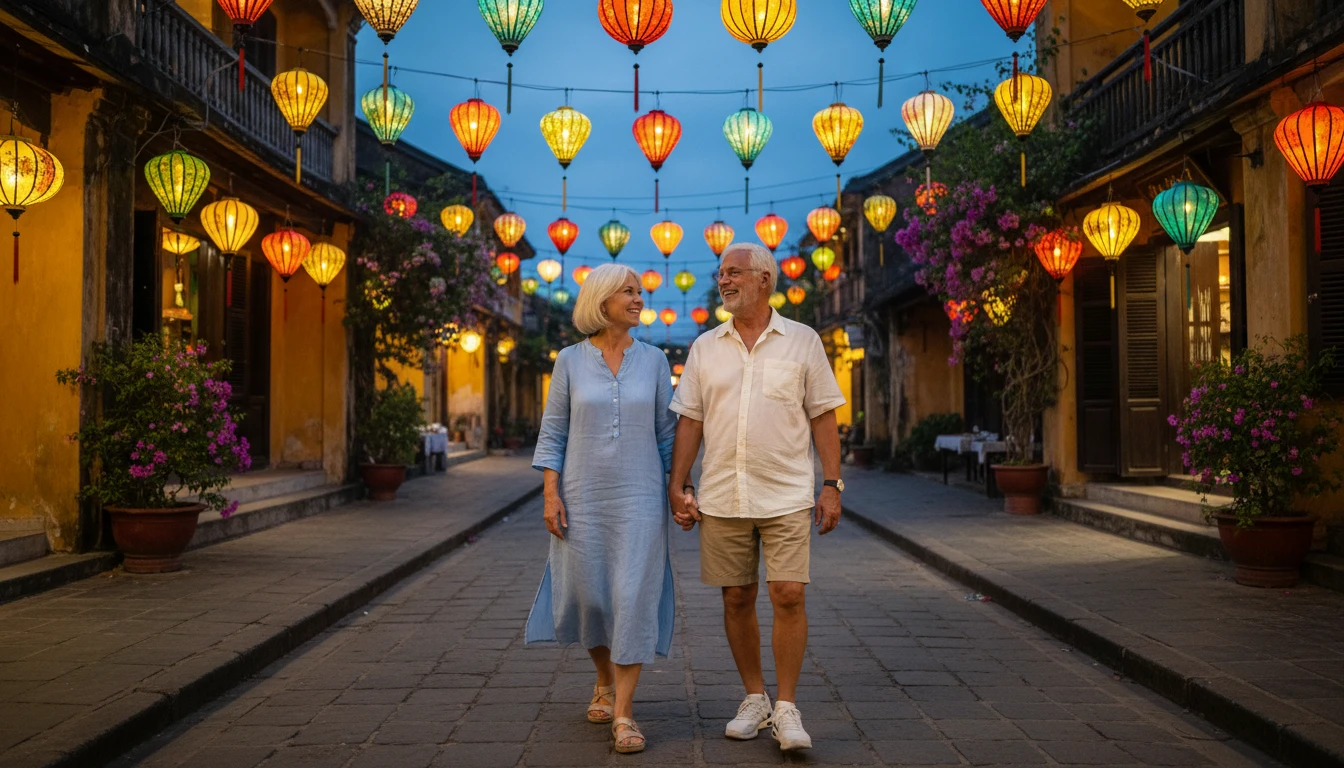
- Wandering Hoi An’s lantern-lit streets in the evening, when the light is soft and golden and the crowds thin out and the whole place feels like a dream someone had about a dream
- Exploring Ho Chi Minh City’s markets and history without a tour group breathing down your neck or a schedule that treats you like a package to be delivered
One of my favorite Vietnam memories: sharing an overnight train cabin with a Vietnamese grandmother who kept refilling my plate with homemade spring rolls from a container she’d clearly packed specifically for this journey. We didn’t share a common language beyond smiles and gestures, but she had “you’re too skinny, eat more” energy that required absolutely no translation whatsoever. I ate four spring rolls and felt genuinely cared for by a complete stranger on a moving train in a country I’d only just arrived in. That’s Vietnam. And it cost me about $12 for the train.
2. Cambodia: Angkor Wat Without the Angkor Price Tag
Cambodia is where cheap summer vacations for retirees go from “affordable” to “is this a typo, and if so, whose favor is it in?” You’re looking at roughly $20–$25 a day if you keep it simple — and in Cambodia, simple is often spectacular in ways that expensive rarely manages to be, no matter how hard it tries.
In Siem Reap, clean guesthouses start around $6–$10 per night. Street food and local restaurants keep meals in the $2–$4 range. The big “splurge” is your Angkor Wat pass — but even that feels worth every cent when you’re standing in front of temples that have survived empires, invasions, jungle, and more sunrises than you’ll ever count. Some things earn their price tag just by existing, and Angkor Wat is absolutely one of them.
Retiree tip: Hit the temples early morning, take a long midday break (pool, nap, or iced coffee — all equally valid and equally wonderful life choices), then head out again in late afternoon. You’ll avoid the worst heat, see fewer crowds, and catch the most beautiful light for photos. I once stood almost alone in front of a massive tree root curling around a temple wall, the jungle slowly reclaiming something humans had built and then abandoned, and I thought: where is everybody, and how is this my life right now? That entire day cost me about $28. I’ve spent more than that on a mediocre airport sandwich and a magazine I didn’t finish.
3. Laos: Slow Travel, Low Prices, Perfect Retirement Pace
Laos is the introvert of Southeast Asia — quieter, slower-paced, and ridiculously charming in a way that sneaks up on you gradually, like a good book you didn’t expect to love. It’s also ideal for retirees who want cheap summer vacations that don’t involve dodging selfie sticks every five seconds, competing for the last sun lounger at a pool that’s already at capacity, or pretending to enjoy a “cultural experience” that’s been packaged and sold seventeen times over.
Expect daily costs around $20–$25 in Luang Prabang, where you can visit golden temples, watch the daily monk alms procession at dawn (genuinely moving, even if you’re not religious — maybe especially if you’re not), take boat rides on the Mekong, and swim at waterfalls that look suspiciously like they were designed by a screensaver from 2003, in the absolute best possible way.
When I stayed in Luang Prabang, my days fell into a lovely, unhurried rhythm that I didn’t plan and couldn’t have manufactured: early morning temples, a $2 breakfast with strong coffee that tasted like it meant business, lazy hours by the river reading or just watching the water go by and thinking about nothing in particular, then night markets and street food in the evening. It was the closest I’ve ever come to accidentally moving to another country because I just never got around to leaving. My return flight felt like a personal betrayal. I booked it, sat at the gate, stared at my boarding pass, and genuinely considered missing it on purpose. I didn’t. But I thought about it seriously.
4. Northern Thailand: Culture, Comfort, and Cooler Temperatures
Thailand has a reputation for wild beach parties and neon-lit chaos. If that’s your thing, no judgment whatsoever — you’ve earned the right to do whatever you want in retirement, full stop. But if your goal is a cheap summer vacation with more culture, more comfort, more genuine human connection, and fewer people trying to sell you neon buckets at 2 a.m., northern Thailand — especially Chiang Mai — delivers better value, cooler temperatures, and a pace that suits retired travelers in a way that feels almost designed for us.
A comfortable $30–$35 daily budget covers guesthouses, legendary street food, and day trips to waterfalls, mountains, and temples that have been standing longer than most countries have existed and will probably outlast most things we consider permanent. I once took a $25 cooking class in Chiang Mai that included a market tour, all ingredients, and a feast at the end that I was genuinely proud of, despite having contributed mostly enthusiasm and very little skill. The instructor corrected my tragic attempts at stir-fry with the patience of someone who has seen a lot of hopeless tourists and still, somehow, believes in them. I walked out feeling like I could open a tiny restaurant in my kitchen at home. I cannot. But the confidence was real and I’m keeping it indefinitely.
5. Philippines: Thousands of Islands, Surprisingly Affordable
The Philippines is enormous — more than 7,000 islands — and packed with white-sand beaches and turquoise water that look like they were stolen from a stock photo library and then made real by someone who wanted to prove a point. The best part? Many areas remain very budget-friendly, even in summer, even for retirees who want a proper bed, a working shower, and maybe a fan that actually moves air.
On about $30–$40 a day, retired travelers can stay in simple beach bungalows, island-hop on local boats that feel like a genuine adventure rather than a tourist transfer, and snorkel or dive without the budget taking a hit that ruins the rest of the trip and makes you do math on the beach. I still think about a $5 grilled fish dinner I ate on the beach in El Nido while watching the sun set behind jagged limestone cliffs that looked like they’d been placed there specifically for this moment. I checked the bill twice because I was convinced they’d missed a zero — or forgotten to add the “ocean view surcharge” that would have been mandatory, unapologetic, and at least $30 back home.
Eastern Europe: Europe’s Best-Kept Budget Secret for Retirees

If you’ve ever dreamed of a European summer but nearly fainted at hotel prices in Paris or Rome or anywhere within a reasonable distance of the Mediterranean, Eastern Europe is your new best friend — the kind that shows you a genuinely great time, never makes you feel broke, always knows a better restaurant than the one in the guidebook, and somehow makes you feel like you’ve discovered something most people haven’t figured out yet.
The first time I did an Eastern Europe summer loop, I kept waiting for the catch. Surely something had to be terrible at these prices? The beds would be uncomfortable. The food would be disappointing. The Wi-Fi would be a cruel joke. The locals would be unfriendly. Something. Spoiler: none of that happened. Not even close. Just great value, excellent food, genuinely warm people, and the quiet, slightly smug satisfaction of knowing you were getting the full European experience — history, architecture, café culture, cobblestones, the whole thing — without needing a small loan to fund it.
6. Bulgaria: Black Sea Beaches Without the Price Shock
Bulgaria is one of those countries that quietly overdelivers on every front and then acts like it’s no big deal, like it’s been this good the whole time and it’s slightly puzzled that more people haven’t noticed. Summers on the Black Sea coast are warm and sunny, and cities like Sofia and Plovdiv offer history, architecture, and café culture without the souvenir-shop overload you get in more famous destinations where every third storefront sells the same refrigerator magnets.
You’re looking at $35–$40 a day for mid-range hotels, hearty local meals, and inexpensive transport between cities. Plovdiv’s old town feels like walking through a painting — colorful houses, Roman ruins, and hidden cafés around every corner that seem to exist specifically for people who want to sit quietly with a good coffee, watch the world go by, and feel like they’ve figured something out that most people haven’t. I stayed at a small family-run hotel where the owner insisted I try homemade yogurt with honey every morning. I nodded politely the first time, mostly to be agreeable. Then I tasted it and immediately started calculating whether I could retire here instead of just visiting. The math was surprisingly compelling.
7. Romania: Castles, Mountains, and Very Manageable Prices
Romania doesn’t always make the top-ten summer vacation lists, which is honestly great news for your wallet, your sanity, your ability to actually enjoy a place without fighting through crowds, and your general sense of having discovered something the algorithm hasn’t ruined yet. A daily budget of $30–$35 goes a long way in cities like Brașov, Sibiu, and Bucharest.
In Transylvania, retirees can wander through medieval towns framed by mountains that look like they were borrowed from a fairy tale, visit castles that look straight out of a film (because several of them have been), and hike in cool, forested areas while the rest of Europe bakes and complains about it on social media. Bucharest adds big-city energy — cafés, galleries, parks, a surprisingly good food scene that nobody warned me about — at prices still noticeably lower than Western capitals. I had a full dinner there — starter, main, dessert, and a drink — for less than what I usually pay for a single main course in London. My wallet and I shared a meaningful look across the table. It was a good moment. A genuinely good moment.
8. Hungary: Budapest’s Thermal Baths and Beyond
Hungary hits that sweet spot between “developed enough to be easy” and “affordable enough to be genuinely fun” — a combination that’s rarer than it should be and worth celebrating when you find it. Expect $40–$45 a day in Budapest, less if you venture into the countryside where the prices drop and the pace slows down in the best possible way and nobody is in a hurry about anything.
Summer highlights for retired travelers:
- Thermal baths — perfect for soaking away long travel days, genuinely good for aging joints (I say this with zero shame, complete sincerity, and the personal experience of someone whose knees have opinions about stairs), and deeply, profoundly relaxing in a way that’s hard to explain until you’ve done it
- Evening walks along the Danube with some of Europe’s most beautiful city views, best experienced slowly with no particular destination in mind and nowhere you need to be
- Ruin pubs — bars built in old courtyards that feel like adult Playgrounds with fairy lights, mismatched furniture, plants growing through the walls, and very good beer at prices that make you want to stay another round
Lake Balaton is a wonderful summer escape: laid-back towns, warm water, and far fewer international tourists than Mediterranean coasts. I spent a day swimming, eating fried dough by the lake, and people-watching with the focused dedication of someone who has nowhere else to be and has fully accepted that this is their entire agenda. My biggest regret was not scheduling three more days to do exactly that. Four days of fried dough by a lake is a perfectly valid retirement activity, and I will defend that position to anyone who challenges it.
9. Poland: Beautiful, Historical, and Surprisingly Affordable
Poland has quietly become one of Europe’s best value destinations for summer travel, and I’m slightly annoyed at myself for not figuring this out sooner. In Kraków, Wrocław, and Gdańsk, a $35–$40 daily budget covers comfortable accommodation, filling meals, museum visits, and day trips that feel like they should cost twice as much and somehow don’t.
Kraków’s old town is storybook-pretty in a way that makes you want to slow down and actually look at things rather than just photograph them and move on to the next thing. The nearby Wieliczka Salt Mine makes a genuinely fascinating day trip — an entire underground world carved from salt, which sounds strange until you’re standing inside a cathedral made of it and your brain quietly gives up trying to process what it’s seeing and just decides to be amazed instead. I still remember eating a plate of raspberry-filled pierogi in Kraków for about $4 and wondering if there was a way to legally adopt the cook. There wasn’t. I asked.
Note: The Auschwitz-Birkenau memorial is a powerful and important visit for many retirees. It’s heavy and it stays with you in ways you don’t fully anticipate — but it’s worth it, and it matters.
10. Czech Republic: Beyond Prague’s Crowds
Prague is gorgeous and absolutely worth seeing — I won’t pretend otherwise, because it genuinely is. But prices have climbed considerably with its popularity, and the crowds in peak summer can make it feel more like a theme park than a city, more like a backdrop for other people’s Instagram content than a place where actual life happens. The rest of the Czech Republic still offers excellent value, and often more peace, more quiet, and more of the “real” experience that most of us are actually looking for when we travel.
In smaller cities like Český Krumlov or Brno, expect around $40–$50 a day for guesthouses in historic centers, excellent beer that costs less than water did in some places I’ve been (and tastes considerably better), and summer festivals that feel genuinely local rather than performed for tourists who’ve been bused in from somewhere else. Český Krumlov’s old town curves around a river like it’s posing for photos, and in summer you’ll see people drifting by on rafts while church bells ring overhead and the whole scene feels like a film set — except your bank account stays firmly in reality, which is a combination I will always, always choose.
Central & South America: Color, Culture, and Low Costs

If you like your retirement travel with a side of volcanoes, jungles, and colonial towns that look like someone spilled a paint set on them in the best possible way and then decided to leave it, Central and South America are packed with options — especially if you aim for higher-altitude areas where winter means comfortable temperatures rather than extreme cold and your budget means something genuinely significant.
Latin America is where I first realized travel didn’t have to be expensive to be extraordinary. I arrived in Guatemala with a tight budget and mild panic — the kind of panic that makes you check your bank balance three times before ordering anything — and left with the very smug realization that my money went further there than it ever did at home. That realization changed how I thought about retirement travel entirely. And I’ve been chasing that feeling, and finding it, ever since.
11. Guatemala: Mayan Ruins and Lake Views
Guatemala is one of the most affordable destinations that makes budget-conscious retirees genuinely light up — and then immediately start planning a return trip before they’ve even left, which is the truest sign of a place that’s gotten under your skin. With $25–$30 a day, you can stay in guesthouses around Lake Atitlán or in Antigua, eat local food for a few dollars a meal, and visit Mayan ruins like Tikal that will make you feel very small in the best possible way — the kind of small that’s actually clarifying rather than diminishing.
Lake Atitlán, ringed by volcanoes and dotted with villages that each have their own distinct personality, is one of the most beautiful and budget-friendly spots in the entire region. I once rented a lakeside room with a balcony and hammock for less than what I usually pay for a mediocre hotel breakfast at home — the kind of breakfast where the eggs are fine and the coffee is technically coffee and you eat it because it’s included and you’ve already paid for it. Waking up to volcano views is considerably more fun than waking up to email notifications — a comparison I no longer have to make, thankfully, and one I don’t miss even slightly.
12. Nicaragua: Underrated and Exceptionally Affordable
Nicaragua often gets overshadowed by Costa Rica, which is louder about its charms and considerably more expensive about them too. For retirees chasing cheap summer vacations, Nicaragua gives you more for less — more culture, more adventure, more value, and more of the feeling that you’ve found something most people haven’t gotten around to discovering yet, which is its own particular pleasure.
On $25–$30 daily, you can explore colorful colonial cities like Granada and León where the architecture is beautiful and the pace is unhurried, visit Pacific beaches that haven’t been fully discovered by the resort industry yet, and find guesthouses with pools and ocean views for under $15 a night. The country rewards slow, curious travelers who aren’t in a rush — which, in retirement, is exactly what you are. I spent a day in Nicaragua that cost me less than parking back home and involved considerably more adventure, better food, and a conversation with a local fisherman that I still think about. The math still makes me happy every time.
13. Colombia: Big Value, Big Personality
Colombia has become a genuine favorite among retired travelers, and it’s easy to see why once you’ve been there and experienced it for yourself rather than just reading about it. With $30–$35 a day, you can split your time between Cartagena’s walled city and Caribbean atmosphere that feels like it was designed to make you feel good, Medellín’s perfect climate and efficient metro system that makes getting around genuinely easy, and coffee region towns like Salento surrounded by impossibly green hills that look like they were painted by someone who’d never seen an ugly color and didn’t know such a thing existed.
Coffee tours are surprisingly affordable, and the quality is obviously exceptional — this is the source, after all, not some distant imitation trying its best. One of my best travel days ever was spent hiking through the Cocora Valley among towering wax palms that seemed to go on forever, then refueling on a huge plate of local food for under $6 that I ate with the appetite of someone who’d earned it. Every direction looked like a desktop background. I took approximately 400 photos and regret absolutely none of them, not even the blurry ones.
14. Bolivia: South America’s Budget Champion
If you want your retirement budget to work overtime — like, genuinely put in extra hours, stay late, skip lunch, and still come home with money left over — Bolivia is your place. Daily budgets of $20–$25 are very realistic here, covering the surreal white expanse of Salar de Uyuni that looks like the earth forgot to finish itself, La Paz’s dramatic markets where everything is for sale and nothing costs what you’d expect, and Lake Titicaca from the Bolivian side where the altitude and the light do something to the colors that I still can’t fully explain.
Multi-day salt flat tours — including transport, meals, and basic accommodation — are often cheaper than a single day trip in more famous destinations. The altitude will humble you in ways you didn’t expect and can’t fully prepare for, no matter how many articles you read about it beforehand. Your wallet, however, will be absolutely thriving, and that’s a trade-off most retirees are very willing to make once they understand what they’re getting in return.
15. Mexico (Non-Resort Edition)
Mexico is a huge country, and while resort zones can get pricey and occasionally feel like a slightly sunnier version of an airport mall where everything is designed to separate you from your money in the most pleasant way possible, other regions are exceptional value for retired travelers who want culture over cocktail pools and real food over buffet lines. In cities like Oaxaca, Guanajuato, or inland parts of the Yucatán, you can thrive on $35–$40 a day with family-run guesthouses, endless market food, and rich culture at every turn that doesn’t feel packaged or performed.
Oaxaca in particular is a dream if you love food and art — and if you don’t love food and art, I’m genuinely not sure what to tell you, and I say that with warmth. I still think about a $3 tlayuda I had at a night market there: a giant toasted tortilla loaded with beans, cheese, and toppings that somehow managed to be both humble and extraordinary at the same time, the way the best food always is. I finished it and briefly considered ordering a second one purely for scientific research. The science was inconclusive. The tlayuda was perfect. I think about it more than I probably should.
Africa & the Middle East: Big Experiences, Surprisingly Affordable
Some of the most memorable cheap summer vacations for retirees I’ve encountered — the ones people talk about for years afterward, the ones that change how you think about what travel can be — were in places people assume are either too expensive or too complicated or too far outside their comfort zone. Often, they’re none of those things. They just haven’t made it onto the mainstream summer destination lists, which is honestly part of their charm and a significant part of why they’re still affordable and still feel like a genuine discovery.
16. Morocco: Chaos, Charm, and Low Costs
Morocco mixes North African, Arab, and European influences into one very colorful, very sensory, occasionally overwhelming package — and I mean that as the highest possible compliment, the kind you give to experiences that are too alive to be comfortable and too beautiful to look away from. Summer is hot, but with smart planning and a daily budget of $30–$35, it’s absolutely manageable and deeply rewarding for retirees who want something genuinely different from anything they’ve experienced before.
You can get wonderfully lost in Marrakech’s medina (and I mean that literally — bring a map, ignore it, and trust that you’ll find your way out eventually, which you will, and the getting lost is half the point), escape to the Atlas Mountains for cooler air and views that make you understand why people have been painting mountains for centuries, or settle into coastal towns like Essaouira where the ocean breeze does most of the work and the pace is gentle enough to actually breathe. Traditional riads — historic homes turned into guesthouses — give you a real sense of place that no chain hotel can replicate, no matter how many throw pillows they add or how artfully they arrange the complimentary toiletries.
Some of my favorite travel evenings have been from riad rooftops, sipping mint tea while the city hums below and the call to prayer echoes across the rooftops in waves. It’s one of those “I’m really here” moments that stays with you long after you’re home, folding laundry and wondering when you can go back and whether it would be weird to go back immediately.
17. Egypt: Ancient History on a Modern Budget
Egypt is one of those bucket-list destinations that people assume is expensive, complicated, and probably better left to younger travelers with more energy and fewer opinions about hotel pillows. It really doesn’t have to be any of those things — and for retirees who’ve always wanted to see the pyramids, this is genuinely good news worth sitting with for a moment and letting sink in. On $25–$30 a day, you can visit the Pyramids and Egyptian Museum, travel to Luxor for temples and tombs that will rearrange your sense of scale, and squeeze in Red Sea beach time that costs a fraction of what you’d pay in the Mediterranean.
Summer is hot — no way around it, and I won’t pretend otherwise or dress it up with euphemisms — but that’s also why prices and crowds drop significantly. Early morning sightseeing, good hydration, and a long midday rest make it very manageable. Seeing the pyramids without a wall of tour buses blocking your view is worth every early alarm and every bead of sweat, and I say that as someone who is not naturally a morning person and has strong feelings about alarm clocks.
I remember standing in front of the Great Pyramid, half melting, half amazed, thinking: people built this without power tools, without cranes, without project management software, and I’m sweating just walking around it. Humbling doesn’t begin to cover it. Magnificent does. Both things were true at the same time, and I wouldn’t trade that moment for anything — not even air conditioning, which is saying something given the temperature.
18. Jordan: Petra and the Desert
Jordan sits at a slightly higher price point than some destinations on this list, but for what you get — and I mean this sincerely — it’s still strong value that feels like more than you paid for. Around $40–$45 daily if you’re thoughtful about it. Retirees can spend a full day (or two, or three — seriously, give it the time it deserves) exploring Petra, camp under the stars in Wadi Rum in a way that makes you feel like you’ve landed on another planet and aren’t entirely sure you want to leave, and explore Amman’s café and food scene at a genuinely relaxed pace that the city seems to encourage.
The Jordan Pass, which bundles visa fees and entry to major sites, helps keep costs from creeping up unexpectedly and is worth every cent for the peace of mind alone. Walking through the narrow Siq — the canyon that leads to Petra — and seeing the Treasury appear in front of you is one of those rare “famous” travel moments that actually lives up to the hype every single time, for every single person I’ve ever spoken to who’s been there. Some places earn their reputation through sheer, undeniable magnificence. Petra is absolutely one of them, and standing in front of it, you’ll know it immediately.
Unconventional Summer Spots: When Off-Season Works in Your Favor
Sometimes the best cheap summer vacations for retirees happen when you zig while everyone else zags — when you look at the map, notice the place nobody’s talking about, and think: what if that’s exactly where I should go? What if the crowd is wrong, and the quiet place is the right one?
These destinations may not scream “July trip!” at first glance. But they’re fantastic for retired travelers who enjoy having more of a place to themselves, who’ve earned the right to be a little unconventional, and who’ve stopped needing their travel choices validated by a top-ten list or a friend’s Instagram feed.
19. Patagonia in Winter (a.k.a. Northern Summer)
In June–August, Patagonia is in winter, which sounds bizarre if you’re used to summer meaning beach and sunscreen and the smell of coconut oil and the sound of other people’s children. But for retirees who love hiking and dramatic scenery and the particular satisfaction of standing somewhere that feels genuinely wild and untouched and slightly indifferent to your presence, it can be extraordinary — and considerably cheaper than peak season when everyone else has the same idea.
Expect lower prices on accommodation and tours, fewer crowds on popular trails, and crisp, clear days when the weather cooperates in ways that feel like a gift you didn’t earn but are very grateful for. The key is packing proper layers and staying flexible with your itinerary — which, in retirement, you can actually do without anyone sending you a calendar invite about it. On the right day, standing in front of Fitz Roy or Torres del Paine with snow-capped peaks and very few other hikers feels like winning some secret travel lottery that most people don’t even know exists. Yes, your nose might be cold. No, you won’t care even slightly. You’ll be too busy being amazed.
20. Baltic States: Northern Europe Without the Northern Prices
Estonia, Latvia, and Lithuania don’t always get top billing in summer travel guides, which is a genuine oversight that works entirely in your favor and I’m not going to be the one to fix it by shouting about it too loudly. They’re lovely in summer — long golden evenings that seem to go on forever, outdoor markets, medieval old towns that feel like they’ve been preserved in amber and handed to you as a gift — and considerably lighter on the wallet than Scandinavia, where a cup of coffee can make you briefly reconsider your life choices.
In cities like Tallinn, Riga, and Vilnius, a daily budget of $35–$40 covers centrally located accommodation, café-hopping, market food, and day trips to beaches or national parks that most tourists haven’t found yet and probably won’t for a while. Tallinn’s old town alone is worth the trip — medieval walls, towers, and winding streets that feel like they’ve been waiting centuries for you to show up with a camera and nowhere to be and all the time in the world. I went for “a couple of days” and ended up extending my stay twice, which is the highest compliment I know how to give a destination. I give it without hesitation and without apology.
Smart Money-Saving Strategies for Retired Travelers
Knowing the right destinations is half the battle. The other half is planning smart so you get maximum value without turning your trip into an extreme couponing challenge — or a source of stress that defeats the entire purpose of going somewhere in the first place and makes you wonder why you didn’t just stay home with a good book and a comfortable chair.
Booking and Timing Tips
A few patterns I’ve seen consistently while hunting for cheap summer vacations for retirees, tested across more trips than I can count:
- Book flights 6–8 weeks out for many international routes — Skyscanner’s data backs this up for popular corridors (Skyscanner), and it’s held true in my experience more often than not
- Travel midweek — Tuesday and Wednesday flights often come in cheapest, sometimes dramatically so, for reasons that remain mysterious but reliable and worth exploiting
- Use flexible date searches to see which days are significantly cheaper before committing to anything — sometimes shifting by one day saves you $100 or more
- Look at secondary airports — flying into a nearby city and taking a bus or train can save real money and often adds a bonus destination you hadn’t planned on, which is one of my favorite kinds of travel accident
For accommodation:
- Prioritize places with free breakfast and kitchen access — that alone can save $15–$25 a day, which adds up to genuinely significant money over two or three weeks
- Mix it up: a few nights in guesthouses for atmosphere and the chance to talk to other travelers, a few in private rooms for proper rest and the ability to spread your things out without apology
- For stays of a week or more, apartment rentals often undercut hotels and give you a fridge for your snacks, which is genuinely important and I will not apologize for saying so because snacks matter
Cutting Daily Costs Without Cutting Enjoyment
- Eat like a local. Street food and markets are almost always cheaper and often better than tourist-facing restaurants that exist primarily to separate you from your money in a pleasant, well-lit environment
- Use public transport. Buses, trams, and metros are your best friends in budget destinations — and often more interesting than a taxi, because you’re actually in the city rather than passing through it behind glass
- Walk when you can. It saves money, it’s good for you, and it’s genuinely the best way to actually see a place rather than just pass through it at speed with your face in your phone
- Skip the international coffee chain habit. Local coffee is cheaper, more interesting, and supports the community you’re visiting rather than a corporation that doesn’t need your help and won’t remember you were there
I also love free walking tours (tip-based) as a first-day activity in any new city. You get history, orientation, and practical tips from someone who actually lives there and cares about the place — plus the chance to ask “where do you eat?” which is, without question, the most important research question available to any traveler anywhere. Every genuinely good meal I’ve had on a budget trip started with that question, asked of the right person at the right moment.
Choosing Activities That Deliver Real Value
Some of the best travel experiences don’t require VIP passes or skip-the-line tickets or any of the other things that exist primarily to make you feel like you’re missing out if you don’t buy them:
- Hiking in national parks or mountain regions where the entrance fee is minimal and the experience is maximum
- Visiting public beaches and viewpoints that cost nothing and deliver everything, including the particular satisfaction of not having paid for them
- Exploring neighborhoods and local markets at your own pace, with no guide telling you where to look and no schedule telling you when to leave
- Joining free festivals or summer events that locals actually attend and care about, where you’re a participant rather than an audience
City passes can be worth it if you’ll genuinely use them. A quick rule I’ve developed: add up the costs of the sights you actually want to visit. If the pass saves money and includes transport, great — buy it and use it. If you’re stretching your schedule to “get your money’s worth,” skip it and spend the afternoon at a café instead. That’s not a failure. That’s retirement, and it’s exactly what you worked for, and it’s allowed.
Frequently Asked Questions About Cheap Summer Vacations for Retirees
Are cheap summer vacations for retirees actually comfortable?
Absolutely — and I say that as someone who has very strong opinions about mattresses. In the right destinations, $30–$45 a day covers comfortable accommodation, good food, local transport, and meaningful activities. It’s not about deprivation — it’s about choosing places where your money naturally goes further and your experience is richer for it.
What’s the best region for a first budget retirement trip?
Eastern Europe is often the easiest entry point — familiar enough to feel comfortable, affordable enough to be genuinely surprising, and rich in history and culture that rewards slow, curious travelers who aren’t in a hurry. Southeast Asia offers even better value but requires a bit more flexibility with climate and logistics, and a willingness to embrace the unexpected.
How do retirees save the most on flights?
Flexibility is your biggest advantage — and in retirement, you finally have it in abundance. Traveling midweek, using flexible date searches, booking 6–8 weeks out, and considering secondary airports can all reduce costs significantly. Travel rewards credit cards also help when used strategically and paid off monthly without fail.
Is it safe for retirees to travel to budget destinations?
Most of the destinations in this guide are well-established on the travel circuit with good infrastructure for visitors. As with any travel, research your specific destination, get comprehensive travel insurance, and register with your country’s embassy if traveling to more remote areas. Common sense and basic awareness go a long way.
What travel insurance do retirees need for budget travel?
Look for comprehensive coverage that includes medical evacuation, trip cancellation, and pre-existing condition coverage. Don’t skip this — it’s the one area where cutting costs can genuinely backfire in ways that are expensive and stressful and entirely avoidable. The peace of mind is worth every cent.
Can retirees travel Southeast Asia comfortably in monsoon season?
Yes, with the right expectations and a willingness to embrace the rhythm of it. Monsoon season typically means afternoon rain rather than all-day downpours. Morning sightseeing, a long midday rest, and late afternoon activities work beautifully. The trade-off is lower prices and fewer crowds — a very reasonable deal that most retirees, once they understand it, are very happy to make.
Key Takeaways
- Cheap summer vacations for retirees are genuinely possible — and often more rewarding than expensive alternatives that cost three times as much and deliver half the experience
- Southeast Asia, Eastern Europe, and Central/South America offer the best value for retired travelers in summer
- Retirees have a unique advantage: flexible schedules that allow midweek travel, extended stays, and counter-seasonal timing that saves real money without sacrificing real experience
- A daily budget of $25–$45 covers comfortable accommodation, good food, local transport, and meaningful activities in most of these destinations
- Smart booking (flexible dates, midweek flights, secondary airports) can reduce costs significantly without reducing the quality of what you’re doing
- The best budget travel experiences come from eating locally, using public transport, and choosing experiences over expensive rooms — and from being willing to go somewhere that isn’t on everyone else’s list
Final Thoughts on Cheap Summer Vacations for Retirees
Here’s what I want you to take away from all of this, the thing I wish someone had told me before I spent two years talking myself out of trips I could have been taking:
Cheap summer vacations for retirees are not about suffering through uncomfortable beds or surviving on instant noodles or pretending that “budget” is just another word for “good enough” and you should be grateful for whatever you get. They’re about choosing destinations where your retirement budget naturally goes further, then layering in smart planning so you can relax and actually enjoy the trip — which is, after all, the entire point of going somewhere, and the thing that gets lost when travel becomes stressful.
Whether you’re wandering lantern-lit streets in Hoi An, soaking in a thermal bath in Budapest, watching the sun set over Lake Atitlán, or standing in quiet, slightly sweaty awe in front of the pyramids in Egypt — you don’t need a luxury budget to have a luxury-feeling experience. You need the right destination, a little planning, and the willingness to go somewhere that isn’t on everyone else’s list. The willingness to be a little contrarian. The willingness to trust that the less-famous place might be the better one.
You’ve spent decades working toward this freedom. Use it. Go somewhere that surprises you. Eat the street food. Take the slow train. Stay an extra week because you can — because nobody is waiting for you to clock back in, and the only deadline you have is the one you set yourself, and you can change that one too.
And once you realize how far $35 a day can take you in the right place, it becomes very hard to go back to the old way of thinking about travel. Or retirement. Or what “enough” actually means when you’re finally free to define it yourself.
Which of these destinations is calling your name? Drop it in the comments — I’d love to hear where you’re planning to go next, and what finally made you decide to go.






One Comment
Comments are closed.