
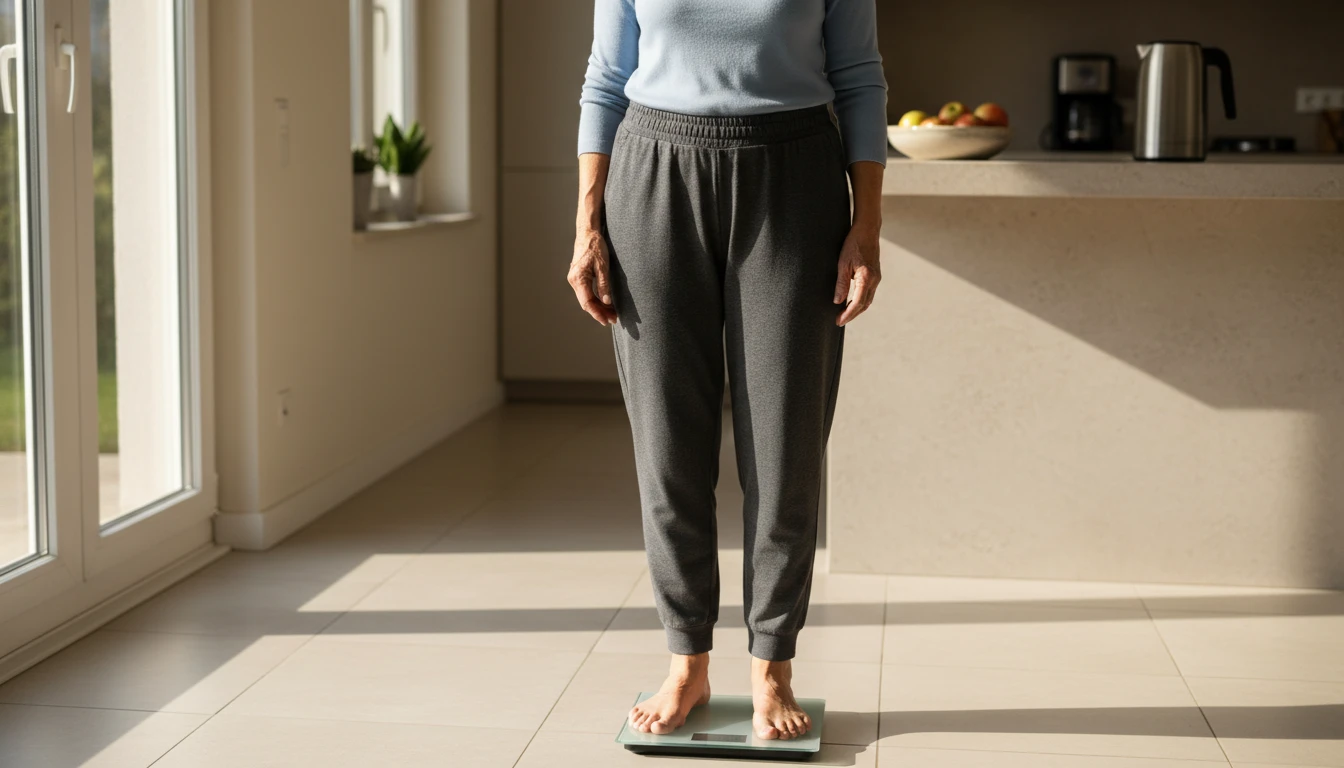
Healthy Weight Loss for Seniors: The Real Deal (No Gimmicks, No Guilt)
Discover what healthy weight loss for seniors actually looks like — from protein and strength training to sleep and stress — without crash diets, guilt, or pretending you’re fine.
Key Takeaways
- Healthy weight loss for seniors means losing 1–2 pounds per week through sustainable habits — not crash diets or starvation.
- A 2025 review in the Bulletin of the National Research Centre confirmed that rapid weight loss in older adults often causes muscle loss — making slow, strategic loss essential.
- A 2019 Cell Metabolism study found that ultra-processed foods caused people to eat 500 more calories per day than whole foods — even when calories were matched on paper.
- Strength training is non-negotiable for healthy weight loss for seniors — it preserves muscle, boosts metabolism, and keeps you functional. How to Build Muscle After 60 is the companion read.
- Research in the Annals of Internal Medicine showed that sleep-deprived dieters lost mostly muscle and water — not fat. Sleep is a weight loss strategy.
- Drinking water before meals was shown in Obesity research to significantly increase weight loss over 12 weeks — one of the simplest habits you can start today.
- Track habits, not just the scale. Progress shows up in energy, strength, and how your clothes fit long before the number cooperates.
- For building sustainable eating habits that actually stick, Lifestyle Eat: Your Practical Guide and The Adult Food Pyramid are both worth reading alongside this one.
Let me guess: you’ve probably Googled “healthy weight loss for seniors” at some point — maybe late at night, maybe right after a doctor’s appointment where someone used the phrase “at your age” in a tone that felt a little too pointed. Maybe you’ve already tried a few things. Maybe more than a few. And maybe you’re tired — not just of the diets, but of the whole exhausting cycle of starting, stopping, blaming yourself, and starting again.
I get it. I really do. I’ve watched people I care about go through that cycle more times than I can count — smart, capable, disciplined people who weren’t failing the diet. The diet was failing them. And I’ve been in my own version of it — the one where you’re technically “eating healthy” but also somehow miserable, hungry by 10 a.m., and quietly fantasizing about a warm dinner roll.
So here’s what I want to do: skip the lecture, skip the shame spiral, and just talk honestly about what healthy weight loss for seniors actually looks like — not in a brochure, not in a before-and-after Instagram caption, but in real life. On a regular Tuesday. When you’re tired and the fridge is full of leftovers and motivation is nowhere to be found.
If we keep it simple: healthy weight loss for seniors means losing around 1–2 pounds per week through realistic, sustainable changes in how you eat, move, sleep, and manage stress — without starving yourself, obsessing over every bite, or turning your life into one long “I’m on a diet” sentence.
But if that one-line answer fixed everything, you wouldn’t be here. So let’s dig in.
Why Everyone Gets Weight Loss Wrong (Including Past Me)
When I think about all the diets I’ve seen people try, it starts to sound like a strange buffet of suffering: the cabbage soup diet, keto done without a clue, juice cleanses that cost more than a weekend trip, and “detox teas” that mostly just make you hate your bathroom.
And for a while, most of them “work.” The scale drops quickly, your clothes feel looser, people start complimenting you. But behind the scenes? You’re hungry, tired, maybe a little snappy, and secretly counting down the days until you can eat like a normal human again.
Then it happens: the weight comes back. Sometimes more than before. And it’s easy to blame yourself — “I just don’t have discipline” — when the real problem is the approach.
I remember talking to a woman in her late sixties who had lost the same 25 pounds four separate times. Four times. She wasn’t lazy. She wasn’t weak. She was following plans that were never designed to be lived in — only survived. And every time the plan ended, life came back, and so did the weight. She’d look at me and say, “I know what to do. I just can’t seem to keep doing it.” And I’d think: that’s not a willpower problem. That’s a plan problem.
We’ve been sold this idea that healthy weight loss means:
- Faster is better
- Suffering equals success
- Your body is a machine that just needs the right “hack”
But your body isn’t a machine; it’s more like a suspicious roommate. The second it senses that food is suddenly scarce, it doesn’t say, “Cool, let’s get shredded.” It says, “We’re under attack. Save everything.”
There’s a well-known study in the journal Obesity that followed contestants from “The Biggest Loser.” Six years later, most had regained a lot of the weight — and their metabolisms were still slower than expected, burning about 500 fewer calories per day than someone their size “should.” That’s not laziness. That’s your biology doing its job: protecting you from what it thinks is starvation.
So if you’ve ever wondered, “Why is this so hard?” the honest answer is: because your body is trying to keep you alive. That’s not a flaw; it’s literally the survival system that got humans this far.
And here’s the part that matters specifically for seniors: after 60, your body is also dealing with sarcopenia — the gradual, sneaky loss of muscle mass that happens with age whether you’re dieting or not. A 2025 review published in the Bulletin of the National Research Centre confirmed that intentional weight loss in older adults, while beneficial for managing conditions like diabetes and cardiovascular disease, often results in unintended muscle loss if not done carefully. That’s why healthy weight loss for seniors isn’t just about eating less — it’s about eating smarter, moving strategically, and protecting the muscle you’ve got.
So What Is Healthy Weight Loss for Seniors, Really?
Let’s go back to the main question: what does healthy weight loss for seniors actually look like when we strip away the marketing, the detox kits, and the “before and after” photos?
It’s:
- A moderate, sustainable calorie deficit (not slashing your intake in half)
- Enough protein, fiber, and healthy fats to keep you full and nourished
- Movement that builds muscle and supports your heart, not just burns calories
- Habits you can imagine keeping for years, not just “until the wedding”
The CDC lands on that 1–2 pounds per week guideline for a reason. It’s not as flashy as “Drop a dress size in 5 days,” but it’s the pace where you’re mostly losing fat, not muscle, and where your metabolism doesn’t go into full “I live in a cave now” mode.
I’ll be real with you: when I stopped treating weight loss like a sprint and started treating it like building a lifestyle, something shifted. Not overnight — more like a slow, quiet shift over a few months. I stopped obsessing over every meal. I wasn’t dragging myself through workouts powered only by caffeine and regret. The weight came off more slowly — but it stayed off. And I actually felt like a human being the whole time.
That’s the version of this I want for you.
The Math That Actually Matters (Without Making Your Head Hurt)
I promise, no scary equations. But understanding the basics really helps you see what healthy weight loss for seniors looks like in practice.
To lose about one pound of fat, you need a total deficit of roughly 3,500 calories. Spread over a week, that’s:
- About 500 calories per day for 1 pound per week
- About 1,000 calories per day for 2 pounds per week
Now, that doesn’t mean you should just eat 1,000 fewer calories and suffer through it. The smarter approach is a blend: eat a bit less, move a bit more.
Maybe you cut 300 calories from your daily intake — like skipping the sugary drinks and the oversized afternoon snack — and burn another 200 through walking or a workout. That’s still 500 per day, but way less miserable than trying to white-knuckle your way through a crash diet while everyone around you is eating normally and looking annoyingly happy about it.
And here’s where it gets interesting: technically, a calorie is a calorie. But in your body, not all calories act the same.
A 2019 study in Cell Metabolism had people eat either ultra-processed foods or minimally processed whole foods. The meals were matched for calories, sugar, fat, fiber, and protein. On paper, they were “the same.” In real life? The ultra-processed group ate about 500 more calories per day and gained weight, while the whole-food group naturally ate less and lost weight.
So yes, energy balance matters. But if you’re wondering what healthy weight loss for seniors looks like in practice, it’s not just “eat less.” It’s “eat better, so your body and brain naturally help you out.” That’s a very different — and much more livable — game.
The Building Blocks of Healthy Weight Loss for Seniors

Let’s get out of theory and into your actual day. What does healthy weight loss for seniors look like when you’re staring into your fridge at 6 p.m. wondering what to eat and whether cereal counts as dinner?
It comes down to a few simple pillars: food, movement, mindset, sleep, and stress. Nothing here is revolutionary — which is kind of the point. The basics work. They’re just not as exciting to sell, so nobody puts them on a billboard.
Nutrition That Doesn’t Make You Miserable
If your plan is “chicken, broccoli, and sadness,” it’s going to be a very short plan.
1. Prioritize protein.
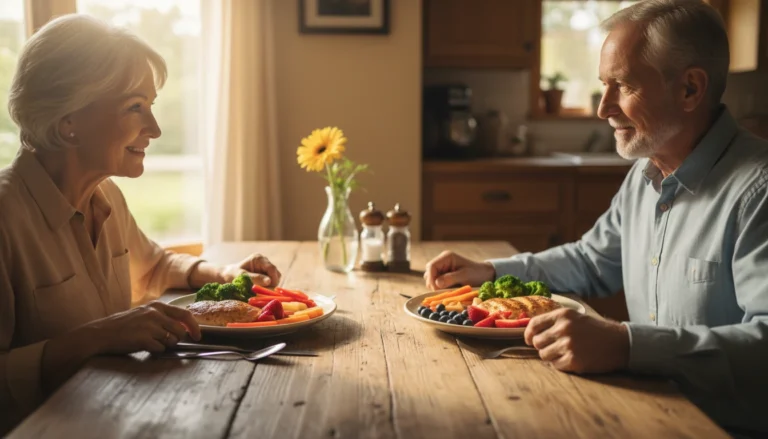
Aim for roughly 0.7–1 gram of protein per pound of body weight (or per pound of goal weight if you’re starting higher). Protein keeps you full longer, helps preserve muscle while you’re in a calorie deficit, and burns more calories during digestion than carbs or fat.
When I intentionally bumped my protein — adding eggs at breakfast, Greek yogurt as a snack, a proper portion of chicken or fish at dinner — my 3 p.m. crash basically disappeared. I wasn’t staring at the pantry with that “must eat everything immediately” feeling. I just felt steady. Not glamorous, but incredibly helpful. Steady is wildly underrated.
2. Fill up on fiber.
Vegetables, fruits, whole grains, beans, and lentils are your friends here. Most people only get around 15 grams of fiber a day; the sweet spot is more like 25–35 grams. More fiber means better digestion, more stable blood sugar, and feeling full on fewer calories.
Instead of thinking, “What can I cut?” start asking, “Where can I add fiber and protein?” It’s a much less depressing game — and it actually works. If you want a practical framework for building meals around the right foods, The Adult Food Pyramid: A Practical Guide breaks it down in a way that’s actually usable — no spreadsheets, no food scales, no suffering required.
3. Don’t fear fat.
Healthy fats — like avocados, olive oil, nuts, seeds, and fatty fish — help with hormone production, brain function, and nutrient absorption. Going back to fat-free everything (hello, 1990s) is not the move if you’re looking for healthy weight loss for seniors. You’ll just end up hungry, cranky, and deeply resentful of everyone eating normally around you.
4. Stay hydrated.
I used to think “drink more water” was just generic wellness wallpaper advice — the kind of thing people say when they don’t have anything better to offer. Then I noticed how often I was reaching for food when I was actually just thirsty. Research published in Obesity found that people who drank about 16 ounces of water before meals lost significantly more weight over 12 weeks than those who didn’t. It’s such a small, doable habit that stacks quietly in your favor — and it costs nothing.
For a deeper look at building sustainable eating habits that actually fit real life — not just the “I’m motivated on a Monday morning” version of your life — Lifestyle Eat: Your Practical Guide on How to Build Sustainable Eating Habits is worth bookmarking.
Movement That Actually Feels Good
Here’s a radical thought: what if movement wasn’t punishment for what you ate, but something you do because it feels good and makes your life better?
Strength training: the unsung hero.
I used to think weight loss = cardio. Full stop. Treadmill, elliptical, repeat until miserable. But building and preserving muscle is one of the most important parts of healthy weight loss for seniors — especially because sarcopenia is already working against you quietly, every single year, whether you’re paying attention or not.
Muscle burns more calories at rest than fat, helps keep your metabolism from tanking, and makes you stronger and more capable in ways that show up in real life — carrying groceries, climbing stairs, getting up off the floor without making a sound that concerns your family. Aim for 2–3 strength sessions a week that hit all major muscle groups. You don’t need to live in the gym. Basic compound movements and progressive overload go a long way.
If you want a full breakdown of what actually works for building strength after 60 — including specific exercises, protein timing, and how to avoid wrecking yourself in the process — How to Build Muscle After 60: What Actually Works (And Why It’s Not Too Late) covers it in detail.
And no, you won’t “get bulky” by accident. That’s like worrying you’ll wake up as a concert pianist because you bought a keyboard.
Cardio for health (and mood), not just calorie burn.
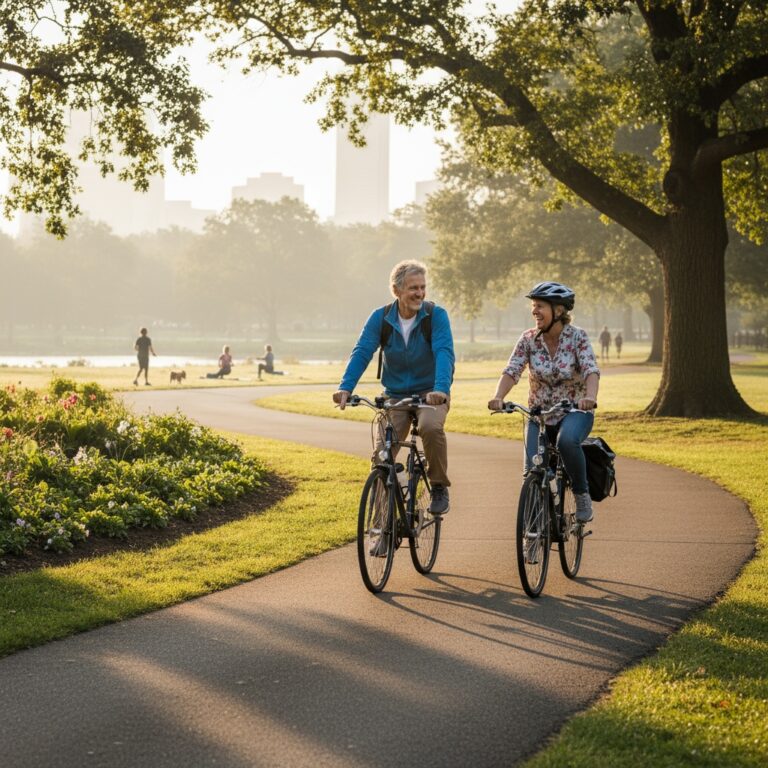
Cardio supports heart health, improves endurance, and can be a massive stress reliever. The key is: pick something you don’t hate. Walking, cycling, dancing, swimming, hiking — they all count. The best form of cardio is the one you’ll actually do next week, and the week after that, and the week after that.
I tried to make myself a “runner” for years. I bought the shoes, downloaded the apps, made the playlist, hated every single second. Once I gave myself permission to hike and lift instead, I suddenly became “consistent.” Funny how that works when you stop forcing yourself to do things you genuinely dislike.
Move more throughout the day.
Formal workouts matter, but so does everything else: taking the stairs, walking while on calls, parking a little farther away, getting up from your chair regularly. This everyday movement — NEAT (Non-Exercise Activity Thermogenesis) — can add up to hundreds of calories burned a day. In the healthy weight loss for seniors equation, it’s one of the quiet superstars that nobody talks about enough, probably because it doesn’t sell gym memberships.

The Mental Game Nobody Talks About
If weight loss were just about knowing what to do, we’d all be done by now. The “how” is everywhere — books, podcasts, apps, your neighbor who lost 30 pounds and now won’t stop talking about it. It’s the “doing it consistently without losing your mind” part that trips us up.
Ditch the All-or-Nothing Thinking
One of the biggest traps I’ve seen — and fallen into myself, more times than I’d like to admit — is the “Well, I blew it, might as well go all in” mindset.
You eat one cookie: “Day’s ruined, might as well finish the box.” You miss one workout: “Week’s ruined, I’ll start Monday.” You have a rough week: “Month’s ruined, I’ll start in January.”
Psychologists call this the “abstinence violation effect.” I call it the “well, screw it” spiral. And it’s responsible for more abandoned weight loss attempts than any lack of willpower ever was.
Here’s the reframe that changed everything for me: one choice is just one choice. It’s a data point, not a verdict. Healthy weight loss for seniors isn’t about never messing up; it’s about how quickly and kindly you recover.
The first time I genuinely treated a “bad” meal as just… a meal — not the end of the world, not a moral failure, not evidence that I’m fundamentally broken — it was wildly freeing. I had cake at a birthday, enjoyed every bite, went back to my usual routine the next day. No spiral, no “I’ll restart next month.” Just life. Turns out life is a lot more sustainable than a diet.
Focus on Behaviors, Not Just the Scale
Your weight can swing a few pounds in either direction based on sodium, hormones, carbs, and even how recently you went to the bathroom. If that number is the only thing you track, you’re basically letting a moody, unreliable roommate run your emotions every morning.
Instead, healthy weight loss for seniors focuses more on:
- Did I hit a reasonable protein target today?
- Did I eat some vegetables?
- Did I move my body in some way?
- Did I get decent sleep?
- Did I handle stress in a way that didn’t involve inhaling a family-size bag of chips?
When I started tracking habits instead of just weight, everything made more sense. Even on weeks where the scale didn’t move — or moved in the wrong direction — I could see: “Okay, I worked out four times, I slept better, and my meals were 80% on point.” That’s progress, whether or not the scale feels like cooperating that day. And most of the time, it catches up eventually.
The Role of Sleep and Stress (Yes, Really)

I used to put sleep and stress in the “nice to fix someday” category — right next to “organize the garage” and “call the dentist.” Then I realized they were quietly undermining everything else I was doing.
Sleep: The Secret Weapon
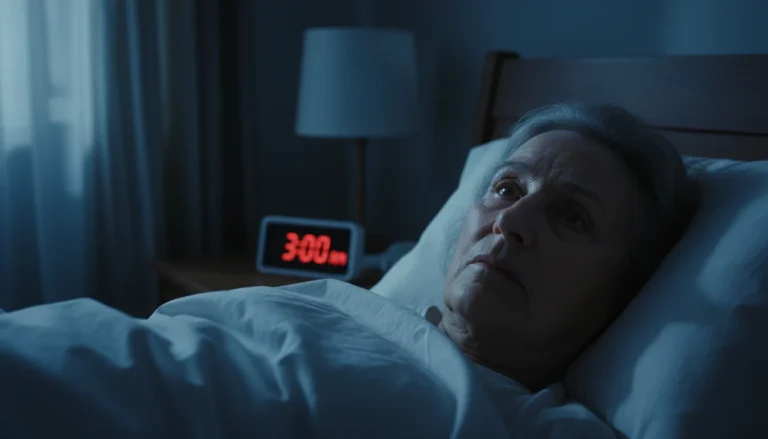
If you’re trying to achieve healthy weight loss for seniors and you’re consistently getting 4–5 hours of sleep, your body is basically playing on hard mode — and losing before the day even starts.
When you’re sleep-deprived, ghrelin (the “I’m hungry” hormone) goes up, leptin (the “I’m full” hormone) goes down, and cravings for high-calorie, high-sugar foods go way up. You’re not weak. You’re not undisciplined. You’re just running on a system that’s been chemically tilted against you — and then blaming yourself for it.
A study in the Annals of Internal Medicine showed that when dieters slept enough, over half the weight they lost was from fat. When they were sleep-deprived, only about a quarter of the loss was fat — the rest was muscle and water.
So yes, going to bed earlier is one of the most underrated strategies for healthy weight loss for seniors. It’s not lazy. It’s strategic. And it might be the one thing you haven’t tried yet — because nobody’s selling it.
Stress: The Silent Saboteur
Chronic stress pumps out cortisol, which increases appetite, promotes fat storage (especially around your midsection), and makes emotional eating way more tempting. It’s like your body decides that if the world is falling apart, it might as well have snacks.
I noticed a pattern in my own life: during the most stressful stretches, I’d gain or stall, even when the food looked “the same” on paper. My body was basically on high alert, trying to protect me from a threat it couldn’t name. And no amount of willpower was going to override that biology.
Healthy weight loss for seniors doesn’t mean eliminating stress (if you figure that out, please write a book and send me a copy). It means finding ways to regularly dial it down a notch: walks without your phone, short breathing exercises, time outside, lifting weights or doing yoga, talking stuff out instead of bottling it up until it explodes at an innocent family dinner. It doesn’t have to be perfect. It just has to be intentional and consistent enough to matter.
What Healthy Weight Loss for Seniors Isn’t
Sometimes it’s easier to define what healthy weight loss for seniors looks like by clearing out what it is not.
It’s not 1,200 calories a day for everyone.
For most adults, especially if you’re active, 1,200 calories is basically a famine. It might make the scale move fast, but your metabolism and mood won’t thank you — and neither will the people who have to spend time with you.
It’s not cutting out entire food groups (unless medically necessary).
Carbs aren’t evil. Fats aren’t evil. Even sugar isn’t “evil.” The dose and the context matter. Unless your doctor has told you otherwise, balance beats restriction every single time.
It’s not magic pills or detox teas.
If there really were a safe, effective pill that solved weight for everyone, it wouldn’t be hiding in online ads between videos of people doing questionable things. The weight loss supplement industry is full of overpromises and under-tested products. Be careful — and be skeptical.
It’s not punishment.
Exercise isn’t a court sentence for eating dessert. Food isn’t a bribe to earn your own basic care. In a truly healthy weight loss for seniors journey, you’re learning to work with your body, not fight it. That shift in framing changes everything.
Creating Your Healthy Weight Loss Plan
So how do you actually design a plan around what healthy weight loss for seniors looks like instead of just hoping for the best?
Here’s a simple framework you can adapt.
Step 1: Calculate a Starting Point
Use an online calculator to estimate your Total Daily Energy Expenditure (TDEE) — basically how many calories you burn on an average day. Then subtract ~300–500 calories to set a manageable deficit. Don’t treat this number like it’s carved in stone. Think of it as a starting hypothesis. Your body’s feedback over the next few weeks is the real data.
Step 2: Set Up Your Nutrition
Once you know your approximate calories, build your meals around protein in every meal, plenty of fiber-rich plants, some healthy fats, and mostly whole or minimally processed foods.
I like the 80/20 rule: 80% of what I eat is nutrient-dense and aligned with my goals; 20% is flexible. That’s how you answer “what does healthy weight loss for seniors look like” without also signing up for “what is never eating pizza again.” Because life without pizza is not a life I’m interested in.
Meal prep doesn’t have to mean 7 identical containers of chicken and rice. It can be as simple as cooking a batch of protein, chopping some veggies, and having quick, healthy options visible and ready. You’re just making the healthy choice the easy choice — and the unhealthy choice slightly more inconvenient.
Step 3: Design Your Movement Plan
A basic, effective template for healthy weight loss for seniors:
- 2–3 strength training sessions per week
- 150 minutes of moderate cardio per week (or 75 minutes vigorous)
- Daily movement (walks, steps, general activity)
If that sounds like a lot, start smaller. Even 10–15 minutes a day of something is better than waiting for the “perfect” time to do a full routine. Consistency beats intensity, every time. A 20-minute walk you actually do beats a 90-minute workout you keep postponing.
I treat my workouts like appointments now. They go in my calendar with reminders. It’s amazing how much more often they happen when they’re scheduled like something that actually matters — because they do.
Step 4: Track Progress (Without Obsessing)
Here’s a balanced way to monitor how your healthy weight loss for seniors journey is going:
- Weigh yourself once a week under similar conditions (same day, time, clothing)
- Take measurements or photos every few weeks
- Track habits: workouts, steps, water, sleep, protein
The scale is just one data point. How your clothes fit, how strong you feel, your energy levels, and even your mood are all part of the progress picture. Some of the best weeks I’ve had didn’t show up on the scale at all — but I felt them everywhere else.
Step 5: Adjust When Needed
If after 2–3 weeks you’re exhausted, hungry all the time, and miserable — your deficit may be too big. If absolutely nothing is changing (and you’re being honest about habits) — you may need a slightly larger deficit or a bit more movement.
Sometimes, especially after long periods of dieting, your body benefits from a short “diet break” — a week or two at maintenance calories with solid food quality — before you continue. That’s also part of what healthy weight loss for seniors looks like: knowing you’re allowed to ease off the gas instead of flooring it forever and wondering why you’re running on empty.
The Long Game: Maintenance Matters More Than Loss
Here’s the part most people skip: losing the weight is one thing; keeping it off is another game entirely.
Research suggests a large percentage of people who lose significant weight regain it over time — not because they’re weak, but because they go back to the old habits that created the weight in the first place. The diet ends. Life resumes. And slowly, quietly, the weight follows.
Healthy weight loss for seniors doesn’t really have a finish line. That sounds depressing at first, but it’s actually freeing. You’re not “on” or “off” a diet. You’re building a lifestyle that lets you enjoy food, keeps you healthy and energized, and supports the weight range where you feel and function best.
I’ve maintained my own loss not because I discovered some magical maintenance hack, but because the way I lost the weight is pretty close to how I live now: mostly whole foods, some fun foods, regular movement I actually like, reasonable sleep most nights, and ongoing work on stress and mindset. It stopped being a “program” and just became “my normal.” That’s the goal — not a finish line, but a new normal you actually want to live in.
When to Get Professional Help
There are times when the most “healthy” thing you can do for weight loss is ask for support.
It may be wise to talk to a professional if:
- You have a lot of weight to lose (say, 50+ pounds)
- You’re dealing with conditions like diabetes, PCOS, or heart disease
- You have a history of disordered eating or body image struggles
- You’ve tried many times and feel stuck or defeated
- You’re considering medication or surgery
A registered dietitian can tailor a plan to your body and your preferences. A personal trainer can build a routine that matches your level and prevents injury. A therapist can help with the emotional side, which is often the missing piece that nobody talks about — because it’s easier to sell a meal plan than to sit with the harder stuff.
There’s zero shame in that. If anything, it’s one of the smartest things you can do. Asking for help isn’t giving up — it’s leveling up.
The Bottom Line: What Does Healthy Weight Loss for Seniors Look Like?
So, after all this, what does healthy weight loss for seniors actually mean?
It means:
- Losing about 1–2 pounds per week on average
- Creating a moderate calorie deficit without starving
- Eating enough protein, fiber, and healthy fats
- Moving your body regularly, with both strength and cardio
- Respecting sleep and managing stress
- Building habits you can see yourself living with long-term
It’s slower than the crash diets. It’s less dramatic than the before-and-after stories on social media. It requires patience, consistency, and a good dose of self-compassion — which, for the record, is not the same as giving up. It’s actually the thing that keeps you going when the scale doesn’t cooperate and life gets in the way.
Some days you’ll nail it. Other days you’ll eat dessert for dinner and forget what a vegetable looks like. That’s okay. Healthy weight loss for seniors isn’t about perfection — it’s about direction. And direction, maintained over time, is everything.
You don’t need to wait for Monday, the first of the month, or a new year. You can start with one small step today:
- Add a serving of protein to your next meal
- Go for a 10-minute walk
- Go to bed 30 minutes earlier
- Drink a glass of water before you eat
Stack those little things over time and you’ll start to see why real, healthy weight loss for seniors doesn’t feel like punishment. It feels like finally working with your body instead of against it.
And if you’re wondering whether it’s worth the effort? Speaking as someone who’s been on the “diet hamster wheel” and finally stepped off: yes. A hundred times yes.
Now, if you’ll excuse me, I’ve got a workout on the calendar — and tacos planned for dinner afterward. Because balance isn’t cheating on your goals; it’s how you make them livable.

2 Comments
Comments are closed.