
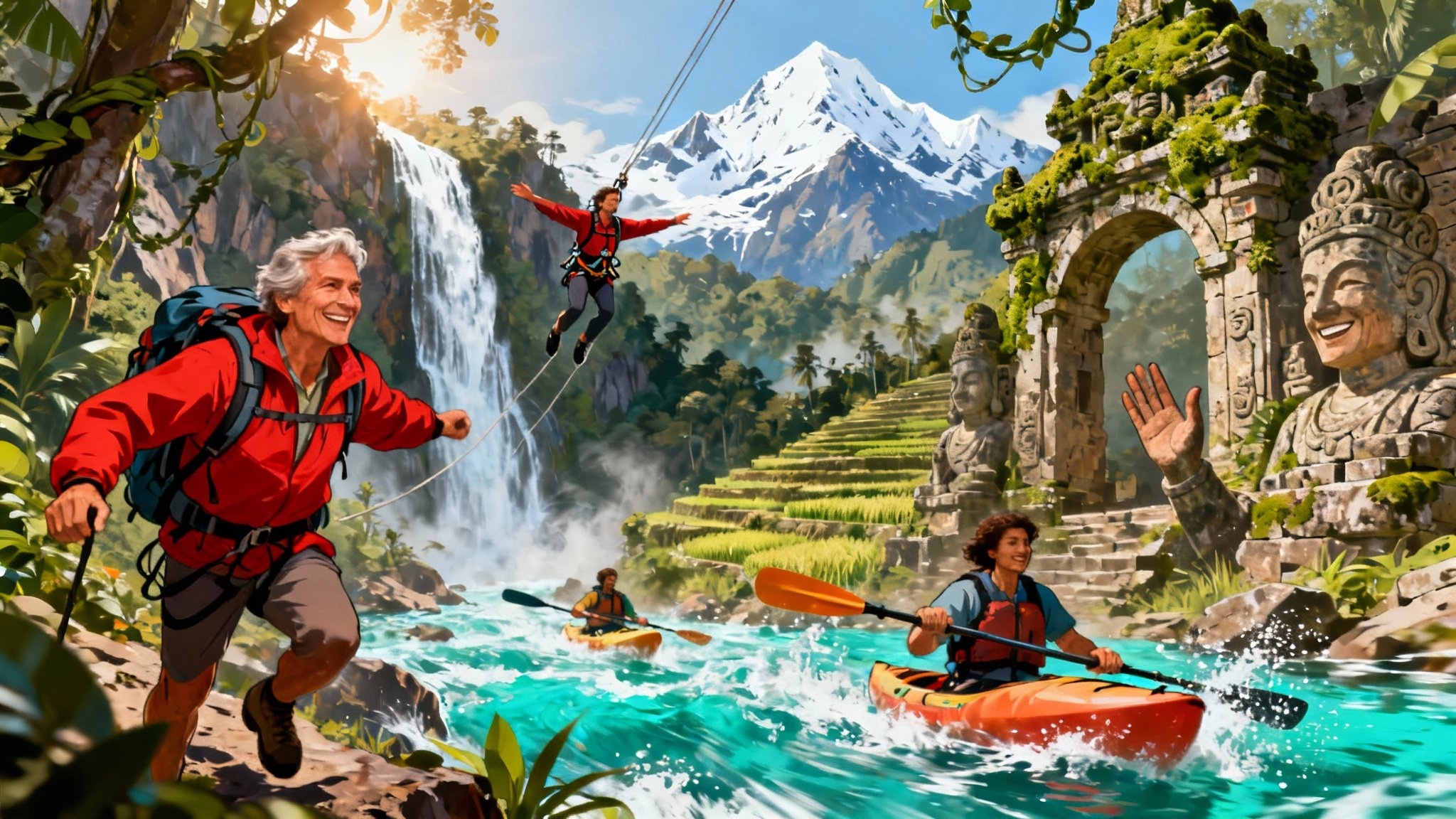
Retirement Adventure Tourism: Thrilling Adventures and Active Travel for a Meaningful Retirement
Retirement adventure tourism is really just a simple idea: retirement doesn’t have to mean slowing down unless you want it to. For a growing number of retirees, it’s become a chance to finally do the kinds of trips that once felt “for later”—the hiking, the walking, the exploring, the learning, the moving through the world at a slower but more meaningful pace.
Instead, retirement is becoming something far more active, curious, and surprisingly bold. That’s where retirement adventure tourism comes in—a way of traveling that keeps the body moving, the mind engaged, and life feeling a lot less “paused.”
It’s not about chasing danger or proving anything. It’s about realizing that the freedom you’ve earned doesn’t have to look like stillness. Sometimes it looks like hiking through a misty forest in Costa Rica, cycling through vineyards in France, or gently kayaking through glassy Alaskan waters while watching the world wake up around you.
And honestly, it feels less like “starting over” and more like finally having time to live the way you always wanted.
Why Retirement Adventure Tourism Is Growing So Fast
Something interesting has shifted in travel over the last decade. Retirees today are not the same as previous generations. They are healthier, more active, and more interested in meaningful experiences than passive sightseeing.
Industry research reflects this shift clearly. The adventure travel sector has expanded rapidly over the past decade, now worth hundreds of billions globally, driven in part by older travelers choosing experience over luxury consumption. A useful overview of these trends comes from the World Food Travel Association’s broader tourism insights, which highlight how travelers increasingly prioritize authenticity, local connection, and meaningful experiences over passive tourism models:
WFTA 2024 State of the Industry Report
What this means in simple terms is this: people don’t just want to see places anymore. They want to do something in them.
And retirement gives them the one thing they never had enough of before—time.
Adventure Doesn’t Mean Extreme (And That’s the Point)
There’s a misconception that “adventure tourism” automatically means jumping off cliffs or climbing Everest.
In reality, most retirement adventure tourism falls into something much more approachable. The industry often calls it “soft adventure,” which simply means guided, structured, and accessible experiences that still feel exciting without being overwhelming.
It might be a guided nature walk where someone explains the ecosystem in real time. It could be a cycling trip where e-bikes quietly help you up the hills. It might even be a wildlife safari where the biggest challenge is remembering to breathe slowly when you see elephants for the first time in the wild.
The beauty of it is that you don’t need to be an athlete. You just need curiosity.
And most operators today design experiences specifically around comfort, pacing, and safety. This isn’t about pushing limits—it’s about expanding them gently.
Soft Adventure: Where Most Retirees Begin (and Stay)
Soft adventure is where retirement travel becomes genuinely enjoyable for most people because it balances activity with comfort.
Think about walking through national parks in New Zealand where every turn looks like a film scene. Or exploring the countryside in Italy where a cycling route somehow always ends near incredible food. Or floating through Costa Rica’s rainforest canopy on a zip line that feels thrilling but still completely safe.
Even simple activities like walking tours, cooking classes, and wildlife excursions become meaningful when you have time to actually absorb them.
The World Food Travel Association notes a similar trend in culinary tourism—travelers increasingly want experiences rooted in place, not just observation. That mindset overlaps heavily with adventure travel as well.
What connects all of this is participation. You’re not watching life from a distance anymore. You’re in it.
Hard Adventure: Yes, Some Retirees Still Want More
Not everyone slows down in retirement. Some people finally speed up.
Hard adventure tourism exists for those who want deeper physical challenge—multi-day hikes, high-altitude trekking, technical climbing, or long-distance expeditions.
And surprisingly, retirees do participate in these experiences more often than people expect.
The difference is preparation. Training becomes more intentional. Planning becomes more careful. And pacing becomes the secret ingredient.
What’s interesting here isn’t the difficulty of the activity—it’s the mindset shift. Many retirees discover that challenge feels different when it’s chosen freely rather than demanded by a career or schedule.
There’s no pressure anymore. Only curiosity.
The Real Benefit Isn’t Physical—It’s Emotional
Something changes when people start traveling this way in retirement.
At first, they talk about the scenery. The mountains, the oceans, the wildlife.
But after a while, the story shifts.
They start talking about confidence. About feeling capable again. About rediscovering parts of themselves that routine had slowly muted over the years.
Adventure travel naturally creates small moments of challenge—navigating a new place, trying a new activity, adapting to unfamiliar environments. Each moment builds a quiet sense of resilience.
And there’s something powerful about that in retirement. It replaces the structure of work with something softer but still meaningful: exploration.
Even organizations like the Adventure Travel Trade Association emphasize this balance of challenge and accessibility in modern travel design, showing how the industry has evolved to meet older and more diverse travelers where they are:
Adventure Travel Trade Association
Where Retirement Adventure Tourism Feels Best
Certain destinations naturally lend themselves to this kind of travel.
Costa Rica is often a favorite because it combines accessibility with incredible biodiversity. You can go from rainforest walks to volcano viewpoints to hot springs all in a single trip.
New Zealand offers a similar balance but with more dramatic landscapes and structured tourism infrastructure that makes active travel easy even for beginners.
Europe works beautifully for slower adventure—walking tours in Portugal, cycling in France, cultural trekking in Italy. Everything feels active without feeling rushed.
Canada and Alaska offer wide-open nature, wildlife encounters, and gentle physical exploration through hiking or kayaking.
And then there are destinations like Iceland or Patagonia, which lean more dramatic, for retirees who want something a little wilder but still fully supported by guides and logistics.
The key idea isn’t the destination—it’s the pace. Retirement adventure tourism is flexible by design.
Safety Is Built In (Not Left to Chance)
A common worry is that adventure travel sounds risky.
In reality, reputable operators are heavily structured around safety. Guides are trained, routes are planned, risks are assessed, and equipment is maintained to professional standards.
Most experiences are designed so participants can focus on enjoyment, not logistics.
Still, preparation matters. Staying active before a trip, understanding your limits, and choosing reputable companies all make a big difference.
Travel insurance is also essential, especially for remote or physically active trips. It’s not exciting, but it’s part of what makes adventurous travel sustainable in the long run.
Adventure Travel Also Supports Local Communities
One of the most overlooked parts of adventure tourism is its economic impact.
Unlike large resort-based tourism, adventure travel tends to rely heavily on local guides, small businesses, and community-based services. That means more of your spending stays in the region you’re visiting.
Local guides share knowledge you wouldn’t get otherwise. Family-run lodges provide hospitality rooted in place. Small businesses supply food, transport, and cultural experiences.
So your trip doesn’t just feel meaningful—it often is meaningful beyond your own experience.
How to Actually Start
The biggest mistake people make is overthinking the first step.
You don’t need a grand expedition right away. You don’t need to “prove” anything.
Start small.
A guided hike. A weekend walking tour. A cycling trip. A nature-focused holiday where activity is part of the rhythm, not the entire challenge.
Then build from there.
Retirement adventure tourism works best when it grows with you, not ahead of you.
Final Thought
Retirement adventure tourism isn’t about staying young.
It’s about staying engaged.
It’s about realizing that life doesn’t suddenly become smaller after a certain age—it just becomes more flexible.
You can still explore. You can still learn. You can still surprise yourself.
And sometimes, the best part isn’t the destination at all. It’s the quiet realization somewhere along the trail, river, or road that you didn’t slow down nearly as much as you were told you would.
You just finally started moving on your own terms.


2 Comments
Comments are closed.