

Embracing a Naturalistic Lifestyle in Retirement: Your Practical Guide to Living in Harmony with Nature
A naturalistic lifestyle in retirement means simpler food, cleaner air, and more time outdoors — here’s how to start without overhauling your entire life.
I didn’t come to natural living because I read a manifesto or had a spiritual awakening in a forest. I came to it because a friend’s eczema cleared up, her energy doubled, and she looked annoyingly good for someone who’d just turned sixty-three. I asked what changed. She set down her coffee, shrugged like it was the most obvious thing in the world, and said, “I just started paying attention to what I was putting in and around my body.”
That was it. No dramatic backstory. No cabin in the woods. No chickens (yet — though I won’t rule it out).
I drove home that afternoon half-convinced she’d joined a cult and half-convinced she was onto something. Turns out it was the second thing. That one conversation sent me down a rabbit hole — the research, the label-reading, the DIY cleaning experiments that occasionally smelled like a salad dressing gone catastrophically wrong. And what I found genuinely surprised me: a naturalistic lifestyle isn’t a personality overhaul. It’s a series of small, practical shifts that compound quietly over time. Better sleep. Fewer headaches. A home that doesn’t smell like a chemical plant. More mornings outside — which, as it turns out, is one of the most underrated gifts retirement actually hands you, if you’re paying attention.
This guide is everything I wish someone had handed me at the start: what works, what’s overhyped, what the research actually says, and how to build habits that stick even on “popcorn-for-dinner” weeks. Because those weeks happen. And a good system survives them.
Key Takeaways:
- A naturalistic lifestyle is about consistent, doable shifts — not perfection or dramatic overhauls
- Two hours in nature per week is linked to measurably better health and wellbeing
- Indoor air is often 2–5x more polluted than outdoor air — small swaps make a real difference
- Habit formation takes a median of 66 days; give yourself a runway, not a deadline
- Start with cleaning products — they’re cheap, easy to DIY, and have immediate air-quality benefits
- The “Dirty Dozen” list is your best friend for spending organic dollars wisely
- “Natural” on a label means almost nothing; look for third-party certifications instead
What a Naturalistic Lifestyle in Retirement Actually Means (No Butter Churning Required)
Let’s clear something up right away, because I know what you’re picturing: natural living is not grinding flour at dawn, weaving hemp by candlelight, or naming your chickens. Though if you’ve already named your chickens, I respect the commitment and I’d love to hear the names.
It’s choosing simpler, closer-to-nature options most of the time. Whole foods over ultra-processed. Plant-based cleaners instead of chemical cocktails. Fewer synthetic fragrances and additives floating around your daily environment. It’s also about daily rhythms — more morning light, regular movement, honest rest — letting your body run the way it was designed to. And retirement, finally, gives you the time to actually do that. No alarm clock. No commute. Just you, your morning, and the radical possibility of doing things differently.
Four pillars keep this sane and sustainable:
- Sustainability: choices that reduce waste and value longevity
- Mindful consumption: buying less, choosing better
- Chemical reduction: minimizing unnecessary exposure in food and home
- Environmental harmony: aligning daily life with natural systems
Here’s the thing nobody tells you upfront: marketing has completely hijacked the word “natural.” I once bought a “natural” face wash that read like a chemistry lab manual — synthetics galore, $28 price tag, and a label so smug it practically winked at me. I stood in the store aisle for a full three minutes squinting at the ingredients like I was decoding a government document, while a teenager stocking shelves watched me with quiet concern. The lesson? Read ingredients, not buzzwords. Look for short, recognizable lists and third-party certifications — EWG Verified, Made Safe, USDA Organic where relevant. It’s not about perfection. It’s about informed choices that work for your actual life, not some idealized version of it that involves a linen apron and a composting system.
How It Differs from Minimalism or Veganism
Minimalism is about owning less. Veganism is about plant-based eating. A naturalistic lifestyle is more holistic — it touches food, home, air quality, light exposure, and how often you step outside to remind yourself the sky still exists. You can be a naturalistic liver who owns a lot of things and occasionally eats a burger. The goal is harmony, not purity. Nobody’s grading you, and there’s no certificate at the end.
Why It Matters — Especially in Retirement

I didn’t buy into this because it sounded fun. I got curious because of my friend, and then I looked at the science — because I’m the kind of person who needs to understand why before I’ll actually change anything. Here’s what actually held up:
Two hours in nature per week is a genuine sweet spot. A large UK study of over 19,000 people found that spending roughly 120 minutes weekly in natural environments is linked with significantly higher self-reported health and wellbeing (White et al., Scientific Reports, 2019). It doesn’t need to be all at once — daily walks count. And retirement makes those walks possible in a way that a 9-to-5 schedule never really did. That’s not a small thing. That’s actually one of the best arguments for taking retirement seriously as a health opportunity, not just a financial one.
Indoor air is more of a problem than most people realize. The EPA reports that indoor air can be 2–5 times more polluted than outdoor air, largely due to off-gassing from products and materials we use every single day without thinking twice. That’s a genuinely uncomfortable statistic when you consider how much time retirees spend at home — especially in winter, when the windows stay shut and the candles come out.
Plants help — with realistic expectations. NASA’s classic chamber studies showed certain plants can remove VOCs in sealed environments. In real homes, the effect is more modest, but plants contribute to a calmer microclimate and are genuinely lovely to have around. Pair them with ventilation and source control for actual results. Don’t expect your pothos to single-handedly save your lungs. It’s doing its best. Appreciate it anyway.
Habits take longer than a week. A study in the European Journal of Social Psychology (Lally et al., 2009) found it takes a median of 66 days to form a new habit — with a wide range depending on complexity. Translation: give yourself a runway, not a deadline. This is especially worth remembering in retirement, when there’s no external pressure forcing a schedule. You’re building a life, not hitting a quarterly target. The pace is yours to set.
The practical shifts people actually notice: fewer headaches after ditching synthetic fragrances, better sleep with evening light hygiene and whole-food meals, and calmer energy when you’re not cleaning with something that could double as paint stripper. Small things. Real things. The kind that don’t make headlines but quietly change how you feel by Tuesday.
Foundation Steps: How to Start Without Burning Out
Let’s skip the overhaul fantasy. The fastest way to quit is trying to change everything on a random Tuesday because you watched a documentary and felt inspired. I’ve done this. I once reorganized my entire pantry at 10pm after a particularly compelling episode about food additives. By Thursday, I’d eaten half of what I’d thrown out. It doesn’t end well.
Step 1: Do a simple home audit.
Use the Think Dirty app or EWG’s Skin Deep database to scan a handful of products you use daily. Focus first on items that touch your skin or air every day: cleanser, moisturizer, body soap, all-purpose cleaner, laundry detergent, candles, and air fresheners. You might be surprised — or mildly horrified. Either way, knowledge is power, and you can’t unsee it, which is honestly the point.
Step 2: Prioritize high-impact swaps.
Replace as things run out — this saves money and lets your body adjust gradually. Start with cleaning products. They’re cost-effective, easy to DIY, and have immediate air-quality benefits. Plus, making your own cleaner feels oddly satisfying, like you’ve unlocked a life skill nobody taught you in school and you’ve been overpaying for decades.
Step 3: Budget smartly.
Expect an initial $150–$300 to replace key items over a month or two. After that, costs typically drop because natural solutions last longer — castile soap is an absolute workhorse that I’ve been buying in the same giant bottle for months — and you buy fewer single-problem products. The math eventually works in your favor. It just takes a little patience upfront.
Step 4: Pick one category and win it.
Cleaning → Personal Care → Pantry Staples → Bedding/Air → Lighting/Routine. Success in one area builds momentum for the next. I call it the positive domino effect, and it’s the only reason I didn’t quit after my first batch of DIY cleaner smelled aggressively like a pickle jar and I had to explain to my spouse why the kitchen smelled like a deli.
Food and Nutrition: Eating Naturally Without Going Broke
Food is where natural living can feel both exciting and expensive. Strategy is everything — and a little planning goes a long way toward keeping this enjoyable rather than stressful.
Buy Organic Where It Actually Matters
The Environmental Working Group’s Dirty Dozen list is your best friend here. Produce like strawberries, spinach, kale, peaches, apples, and grapes consistently test higher for pesticide residues — these are worth buying organic when you can. For many other items, conventional is a perfectly sensible, lower-cost choice. It’s not all-or-nothing; it’s impact per dollar. Spend wisely, not anxiously. Anxiety is not a health food.
Shop Smarter, Not Fancier
- Farmers markets often beat grocery store organics by 15–20% and deliver peak freshness — and for retirees with flexible mornings, they’re also a genuinely enjoyable outing. Fresh air, good produce, someone selling honey, and usually a dog you’re allowed to pet. Honestly, it’s a perfect morning.
- Frozen fruits and vegetables are nutrient-dense and budget-friendly; don’t overlook them just because they’re not glamorous. They were picked at peak ripeness and flash-frozen. They’re not giving up on you.
- Bulk bins cut packaging and unit cost for staples like oats, rice, beans, and nuts — and there’s something quietly satisfying about filling your own jars, like you’re a person who has their life together
Whole Food Swaps That Actually Stick
- Sweet cravings → dates, fresh fruit, or dark chocolate (skip the artificial sweetener aisle — those labels are their own adventure and not a fun one)
- Snack attack → nuts, seeds, roasted chickpeas, or homemade popcorn; all of which are genuinely good and none of which require a culinary degree
- Drinks → water, herbal tea, or sparkling water with citrus; your kidneys will quietly thank you and never once complain about the switch
Store in Glass When You Can
Glass containers — Pyrex, Anchor Hocking — prevent plastic leaching and keep leftovers genuinely fresh. Yes, it’s an upfront cost. Yes, it pays off in longevity and fewer “orange-stained mystery containers” situations that haunt the back of your fridge like a cautionary tale. Retirees who’ve already simplified their kitchens often find this swap surprisingly satisfying — it just looks better, and looking at a tidy fridge full of glass jars is a small, underrated joy.
If you’re thinking about how nutrition fits into the bigger picture of healthy aging, there’s a comprehensive look at eating well as you get older on this site that pairs well with everything in this section — practical meal strategies that actually hold up over time, not just in theory.
Creating a Naturalistic Home Environment
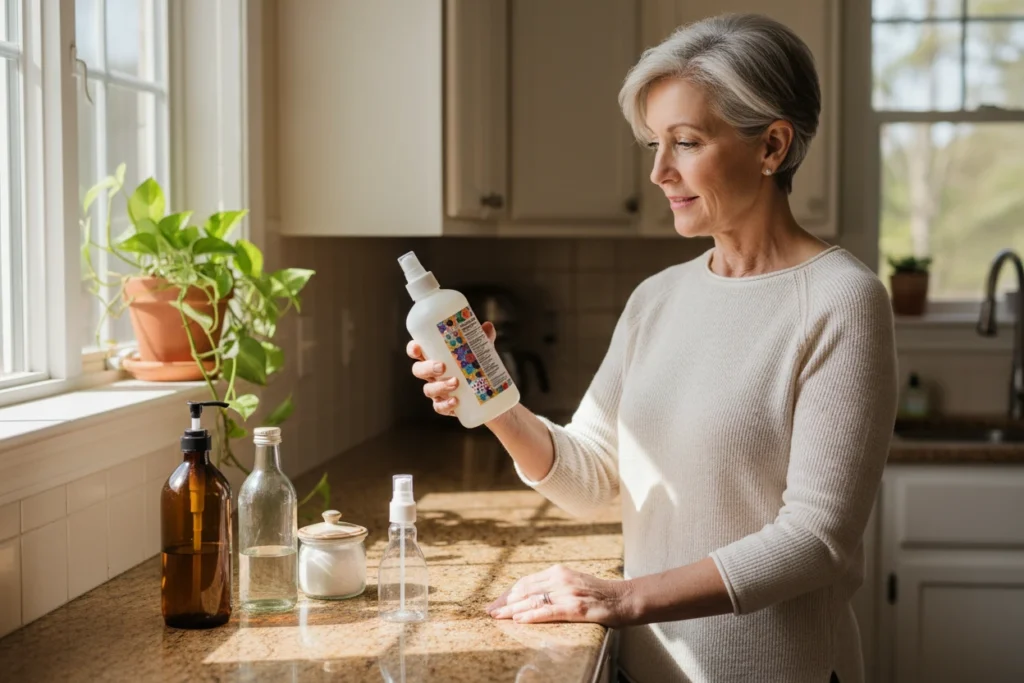
A home that supports a naturalistic lifestyle isn’t sterile or austere. It’s practical, breathable, and a little quieter on your senses — which, after decades of busy, is exactly what retirement deserves. Think less “showroom” and more “place where you actually feel good.”
Natural Cleaning Products That Actually Work
You can clean basically your whole house with three items: white vinegar, baking soda, and castile soap. I know that sounds like a Pinterest fantasy, but I’ve been doing it for years and my house is genuinely clean. My guests have not complained. Here are the go-to recipes:
- All-purpose (not for stone): 1 cup water + ½ cup vinegar + 10–15 drops lemon essential oil
- Stone-safe surface cleaner: 2 cups warm water + 1 tsp castile soap
- Soft scrub: ½ cup baking soda + enough castile soap to form a paste
- Glass cleaner: 1 cup water + 1 cup vinegar; add 1 tbsp isopropyl alcohol for streak-free results
Prefer store-bought? Look for concentrate systems with full ingredient transparency. Branch Basics and Blueland have both held up well in my experience — and the refill model means less plastic guilt every time you reorder. Pro tip: label your DIY bottles with use-cases — “Not for stone” saves future-you from a marble mishap that is very hard to explain to a houseguest who’s just watched you confidently spray the wrong thing.
Safety note: Vinegar on natural stone causes etching. Also, essential oils should be diluted and used with caution around pets — some are particularly unsafe for cats, who will judge you regardless of what you use.
Improve Air Quality Without Going Full Lab Tech
- Ventilate: crack windows 10 minutes a day when outdoor air quality is good — it costs nothing, takes almost no effort, and makes a real difference in how a room feels
- Source control: skip synthetic fragrance sprays and paraffin candles; choose beeswax or coconut/soy with cotton or wood wicks; your nose will adjust and eventually prefer it
- Plants: snake plant, pothos, spider plant, peace lily — easy-care, lovely, and genuinely calming to have around. They won’t single-handedly purify your air, but they make the room feel more alive, which counts for something on a grey Tuesday
Choose Natural Textiles Where It Counts
Bedding and towels sit against your skin for hours — great places to go natural. Organic cotton, linen, bamboo, and hemp breathe better, last longer, and won’t off-gas like certain synthetics. For retirees who’ve already invested in a good bedroom setup, this is a natural next step. And if you’re still working on the bedroom itself, there’s a solid guide on designing a bedroom that actually supports rest in retirement that covers this territory well — comfort and function, not just aesthetics, because a beautiful room that doesn’t help you sleep is just an expensive problem.
Naturalistic Personal Care: Cutting Through the Marketing Noise
Personal care can feel like the Wild West — lots of claims, not a lot of regulation, and an overwhelming number of products that all promise to make you look like you’ve been sleeping eight hours a night (which, ironically, is what most of us actually need and what no serum can replace). A few guidelines keep it simple:
Ingredients to minimize: parabens, phthalates (often hidden in “fragrance” — that one word can represent dozens of undisclosed chemicals), SLS/SLES, formaldehyde releasers.
Labels to look for: EWG Verified, Made Safe, fragrance-free or naturally scented with clear disclosure. If a brand is proud of their ingredients, they’ll show them to you.
Brand tiers by budget:
- Drugstore-friendly: Acure, Alba Botanica (check individual SKUs for fragrance transparency — not all of them are equal)
- Mid-range: Ilia (makeup), Weleda (skincare and body — the skin food cream has a cult following for a reason)
- Concentrate/refill-friendly: Plaine Products (body and hair refills), By Humankind (deodorant, mouthwash tabs — genuinely good and the packaging is satisfying to use)
A minimalist routine that works:
- Cleanse: oil cleansing with jojoba, or a gentle non-SLS cleanser
- Tone: diluted apple cider vinegar (1:4 with water) if your skin tolerates it — if it doesn’t, skip it; not everything works for everyone
- Moisturize: rosehip or squalane oil, or an EWG-verified cream
Transition slowly — swap one product at a time to avoid skin chaos and to actually see what’s doing the heavy lifting. Your skin has been through a lot. It’s been with you this whole time. Give it a little grace.
Getting Outside: Building Your Connection with Nature

You don’t need to summit a mountain or become “outdoorsy” to live in harmony with nature. You don’t need hiking poles or a trail map or a fleece vest with seventeen pockets. You just need to go outside more than you currently do, which for most of us is a lower bar than we’d like to admit.
The 120-minute rule: Aim for about two hours total per week (White et al., 2019). That could be 20 minutes a day walking, sitting in a park, or gardening. Retirement makes this genuinely achievable in a way that working life rarely did — and that’s worth taking seriously, not squandering on extra screen time. The research is clear. The sky is right there. Go look at it.
Create rituals: coffee on the balcony at sunrise, evening strolls, weekend farmers market walks. These aren’t just pleasant — they’re structurally good for you. And they give your days a shape that retirement sometimes lacks, especially in the early months when the freedom feels a little formless.
Optional grounding: Some people find barefoot time on grass or sand relaxing. Evidence is mixed, but it’s low-cost and low-risk. If it calms you, that’s reason enough. Nobody needs a peer-reviewed study to justify standing in the grass in the morning. Just do it.
Bonus: Keep a tiny nature journal — first leaf-out, migrating birds, the world’s sassiest squirrel who has claimed your bird feeder as his personal buffet. It’s a gentle way to notice seasons and to remind your brain that life exists beyond your inbox. And if you find that getting outside is one of the best parts of your day, you might enjoy what we’ve written about staying active outdoors with other people — because the social element turns a solo habit into something you genuinely look forward to, and retirement is a lot better with people in it.
Making Habits Stick: The Systems That Actually Work
Motivation gets you started. Systems keep you going. I’ve learned this the hard way, usually around week three of something I was very enthusiastic about in week one and have completely forgotten by week five.
- Habit stacking: attach a new action to an existing one. “After I make coffee, I water the plants.” “After I brush my teeth, I prep tomorrow’s fruit.” It sounds almost too simple. It works anyway. The brain loves a cue.
- Track it: apps like Streaks or Habitica turn momentum into a game. I’m more competitive with myself than I care to admit, and I’ve used this shamelessly to keep streaks alive through weeks when I had zero intrinsic motivation.
- Environment design: put the vinegar spray where you actually clean; keep nuts and fruit at eye level; leave shoes by the door to nudge evening walks. Make the good choice the easy choice, because willpower is a finite resource and it runs out around 4pm.
- The 80/20 rule: most of the benefits come from consistent, not perfect. Travel shampoo won’t ruin your life. Neither will a bag of neon-orange chips on a road trip. Enjoy the chips. Life is long and chips are good.
- Remember the 66-day median: give habits a couple of months to go from “new” to “normal.” That’s not a long time in the context of a retirement that could span decades. You have the time. Use it without rushing it.
Overcoming the Real Obstacles
Budget: Start with high-impact, low-cost swaps — DIY cleaners, Dirty Dozen organics, bulk staples, glass jars over time. Spread purchases over 4–8 weeks so it doesn’t feel like a splurge. It’s a transition, not a shopping spree, and the goal is to spend less over time, not more.
Time: Batch on Sundays — mix a month of cleaner, wash and chop vegetables, refill pantry jars. Pair it with a favorite show and call it self-care. It genuinely is, and it’s a lot more enjoyable than it sounds when you stop treating it like a chore and start treating it like a ritual.
Family buy-in: Lead with benefits people actually feel — fewer headaches, a better-smelling home, lower bills over time. Avoid purity tests or guilt language. Nobody wants to be lectured at dinner, and nobody changes because they felt bad about their laundry detergent. They change because something felt better.
Access: If local options are limited, online vendors with refills or bulk co-ops are worth exploring. You don’t need a specialty health food store to do this well. You just need a browser, a little patience, and the willingness to try something new — which, if you’ve read this far, you clearly have.
Your Quick-Start 30-Day Plan
Week 1: Audit + First Wins
- Scan 10 everyday products with EWG or Think Dirty — prepare to be mildly scandalized
- Mix an all-purpose cleaner (label it “Not for stone” — future you will be grateful)
- Three 20-minute nature sessions — morning walk, park bench, backyard. Whatever’s closest and easiest.
Week 2: Kitchen and Storage
- Prioritize Dirty Dozen organic; buy frozen for budget wins
- Add 2–3 glass containers; set a simple meal plan that doesn’t require a culinary degree
- Four nature sessions — try a new route if you’re feeling adventurous
Week 3: Personal Care
- Replace 2 daily-use items (cleanser, moisturizer, or deodorant — pick the one that bothers you most)
- Start one herb pot — basil or mint are forgiving, useful, and smell wonderful every time you walk past them
- Five nature sessions
Week 4: Air and Habits
- Add one easy plant (snake plant or pothos — both are nearly impossible to kill, which I say from experience)
- Ventilate 10 minutes a day when air quality is decent
- Habit stack one natural action to a daily routine
- Review what worked; choose two upgrades for next month. Then actually celebrate the wins, however small. You did something.
Good / Better / Best Swaps (Cheat Sheet)
Cleaning
- Good: DIY vinegar + baking soda + castile soap
- Better: Concentrates with refill systems (Branch Basics, Blueland)
- Best: Refill shop + microfiber cloths + stone-safe neutral cleaner
Food
- Good: Dirty Dozen organic; frozen veggies; bulk grains
- Better: Farmers market + weekly batch cooking
- Best: CSA share + glass storage + seasonal menus
Personal Care
- Good: Fragrance-free basics; avoid parabens and SLS
- Better: EWG Verified or Made Safe products
- Best: Minimal routine with vetted actives, plus DIY where it makes sense
FAQ
How much does it really cost to switch?
Expect $150–$300 in the first 4–8 weeks as you replace high-impact items. After that, most people spend less per month thanks to concentrates, refills, and fewer one-off products. It’s an investment that pays back quietly — the way the best ones usually do.
Are natural products actually effective?
Often, yes — especially for cleaning and basic skincare. Some have a learning curve (natural deodorant, I’m looking directly at you and your two-week adjustment period). Give it 2–3 weeks and adjust as needed. Your body will adapt. It’s more resilient than you think.
What about travel and eating out?
Pack a few essentials — a soap bar, some snacks — scan menus for whole-food options, and release the need for perfection. Progress over purity, always. A vacation is not a test, and a restaurant meal is not a moral failing.
What labels actually matter?
“Natural” is vague. “Non-toxic” isn’t regulated. Look for USDA Organic (food), EWG Verified, Made Safe, or clear full-ingredient disclosures. When in doubt, shorter ingredient lists are usually a good sign — and if you can’t pronounce half of them, that’s worth paying attention to.
When will I see results?
Sleep and energy can shift in 2–4 weeks. Skin in 6–8 weeks. Digestion and hormonal balance in 3–6 months. The timeline varies — stick with what’s working and don’t expect everything at once. This is a long game, and retirement is genuinely the perfect time to play it with patience.
Conclusion: Small Shifts, Long Payoff
A naturalistic lifestyle isn’t a destination you arrive at — it’s a direction you keep moving in. And retirement, with its reclaimed time and recalibrated priorities, is genuinely one of the best moments in life to start moving that way.
You don’t need to overhaul everything. You need to swap one cleaner, take one morning walk, read one ingredient label. Then do it again. The compounding effect of small, consistent choices is quiet but real — and over months and years, it adds up to a home that feels better, a body that functions better, and a daily life that’s more aligned with how you actually want to spend this chapter.
My friend who started all of this? She’s still annoyingly healthy. Still glowing. Still shrugging like it’s no big deal. And honestly, she’s right — it isn’t a big deal. It’s a lot of small deals, made consistently, over time.
I’ll be on my balcony with a cup of herbal tea, watching the birds, pretending my snake plant is doing serious air purification work. Come join me. There’s room, and the tea is good.






One Comment
Comments are closed.