
Bedroom Interior Styles: A Retiree’s Ultimate Guide to Creating a Dreamy Retreat
Explore bedroom interior styles perfect for retirees — cozy, functional, and deeply personal spaces designed for rest, comfort, and the life you’ve earned.
Bedroom Interior Styles: What Every Retiree Should Know About Designing for Real Rest
I have a confession.
For most of my adult life, my bedroom was an afterthought. A place I fell into at the end of the day, exhausted, still half-dressed, with a phone in my hand and a to-do list running on a loop in my head. The nightstand was a graveyard of half-read books, charging cables, and a water glass I kept meaning to take back to the kitchen. The chair in the corner? Don’t even ask about the chair.
Then retirement happened — and everything changed.
Suddenly, the bedroom wasn’t just where I collapsed. It became where I read for hours without guilt. Where I napped without setting an alarm. Where I finally, after decades of rushing through it, had the time and the mental space to ask: what do I actually want this room to feel like?
That question changed everything.
Because here’s what nobody tells you before retirement: the bedroom becomes one of the most important rooms in your home. Not just for sleeping — though sleep matters enormously, and we’ll get into that — but for resting, recovering, reading, thinking, and simply being still in a way that working life rarely allowed. It’s where your day begins and ends. It’s the room that bookends everything. And if it doesn’t feel like you — truly, deeply, unmistakably you — you feel it. Maybe not consciously, but you feel it.
A 2021 study in the Journal of Environmental Psychology confirmed what good designers have always known: bedrooms that reflect personal identity correlate with better relaxation and sleep satisfaction. When the room feels like yours, your brain stops bracing and starts resting. And in retirement, that’s not a luxury. That’s the whole point.
Key Takeaways:
- Your bedroom design directly affects sleep quality, relaxation, and daily wellbeing — especially in retirement.
- The best bedroom interior styles for retirees balance aesthetics with function, comfort, and ease of movement.
- Lighting, color, texture, and layout all play a role in creating a space that supports genuine rest.
- You don’t need a full renovation — strategic, budget-friendly upgrades can transform how a room feels.
- Personal touches matter more than trends. The room should tell your story, not a showroom’s.
- Small spaces can be just as restful and beautiful as large ones with the right approach.
Why Bedroom Interior Styles Matter More in Retirement
Let me paint you a picture of what retirement does to your relationship with your bedroom.
In your working years, you were in and out. You slept, you showered, you grabbed whatever was on the chair (we all had the chair), and you left. The bedroom was a pit stop, not a destination. It didn’t need to be beautiful — it just needed to have a bed.
Retirement changes that equation completely.
Now you’re in the bedroom for slow mornings with coffee and a book. For afternoon naps that nobody can judge you for. For quiet evenings when you want to wind down without the noise of the rest of the house. For recovery days when your body asks for rest and you finally — finally — have the freedom to give it what it needs.
That’s a completely different relationship with a room. And it deserves a completely different approach to design.
The right bedroom interior style can support better sleep (which, as we know, gets trickier with age — our sleep architecture shifts, we wake more easily, we need more intentional conditions to rest well). It can reduce the visual stress that quietly raises cortisol without you even realizing it. It can create a space that restores you — not just physically, but emotionally — every single time you walk through the door.
There’s also the practical side, which I think gets buried under all the pretty mood boards and paint swatches. As we age, our needs shift in ways we don’t always anticipate. Lighting that was perfectly fine at 40 feels dim and straining at 65. Furniture that looked great in a larger home can crowd a downsized space and turn a peaceful bedroom into an obstacle course with decorative pillows. Flooring that was easy to navigate at 50 becomes a genuine hazard at 70 if the rug isn’t properly secured.
Good bedroom design in retirement isn’t just about pretty. It’s about living well, safely, and comfortably in a space that grows with you — and keeps showing up for you, year after year.
If you’re thinking about how your home fits your retirement lifestyle more broadly, it’s worth reading how to create a retirement-friendly home for a bigger-picture look at designing spaces that truly support this chapter of life.
The Building Blocks: What Makes Any Bedroom Style Work for Retirees
Before we dive into specific styles — and we’re going to have fun with those — let’s set up a foundation. Because in retirement, the room needs to live well, not just look well. A beautiful room that’s hard to navigate at 6 a.m. is just a pretty problem with good lighting.
- Function first: Can you move through the room safely without toe-stubbing? Is there a spot for everything — including the reading glasses, the water glass, the book you’re halfway through, and the other book you started because the first one got slow in chapter four?
- Ease of movement: Clear pathways of at least 24–36 inches around the bed. No furniture with sharp corners at shin height. Rugs that lie flat and don’t slide. Your shins have been through enough.
- Lighting that works for your eyes: Layered lighting — not just one overhead fixture that makes everything look like a waiting room — so you can read comfortably, navigate safely at night, and wind down gently in the evening.
- Aesthetic clarity: Choose a point of view and commit to it. A clear style creates a calm mind. Visual chaos is the enemy of rest, and rest is the whole reason we’re doing this.
- Personal resonance: The room should carry your stories — not look like a showroom screenshot or a hotel room that forgot to have a personality.
I build every bedroom around five choices: a cohesive color palette, right-sized furniture, layered bedding, layered lighting, and window treatments that actually do their job. Get those five right, and the rest falls into place.
Popular Bedroom Interior Styles — and How to Make Them Work for Retirement
Contemporary Bedroom: Clean, Calm, and Uncluttered
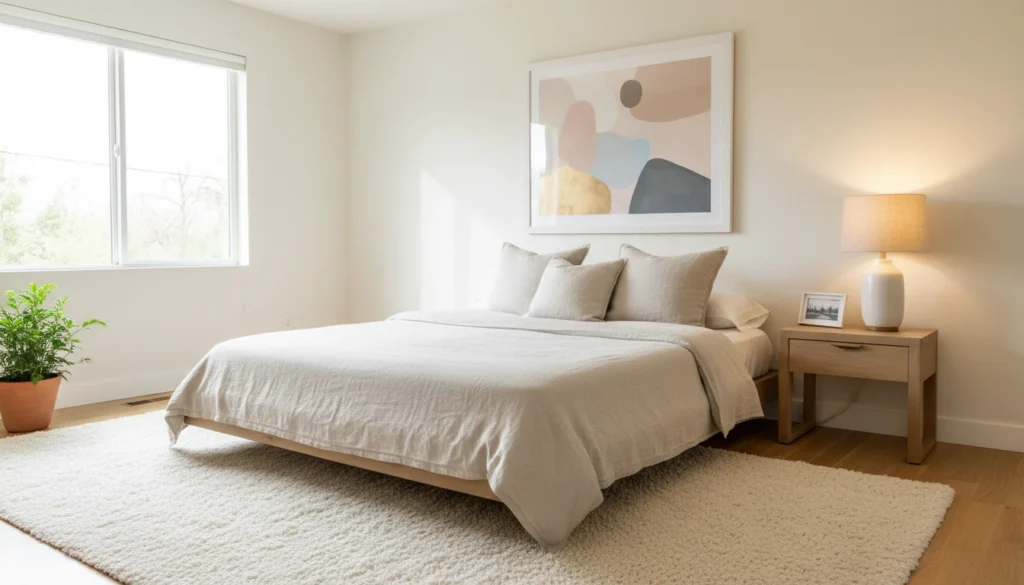
Contemporary bedroom interior styles are built on clean lines, breathing room, and just-right restraint. For retirees, this style is a natural fit — it’s visually quiet, easy to maintain, and creates the kind of calm that makes a room feel like a deep breath you didn’t know you were holding.
I visited a friend’s contemporary bedroom not long ago and my shoulders dropped the moment I walked in. Low-profile bed. Linen duvet in warm oat. One oversized abstract print on the wall — nothing else. No clutter. No noise. Just space. I stood there for a moment and thought: this is what my nervous system has been asking for. I thought about that room for weeks.
How to pull it off:
- Keep walls neutral; add warmth with a wool rug, linen bedding, and wood nightstands.
- Choose sleek hardware — matte black, brushed nickel, or soft brass.
- Pick one star: an oversized art piece, sculptural lamp, or ridged headboard. One. Resist the urge to add seven.
- Hide the chaos: baskets in nightstands, lidded boxes on dressers, under-bed drawers for everything that doesn’t need to be seen.
Retirement bonus: Minimal surfaces mean less dusting, less clutter, and less visual noise — all of which support better sleep and easier daily living. Fewer things to manage means more energy for the things that actually fill your days with joy.
Cozy Farmhouse: Rustic, Warm, and Deeply Restful
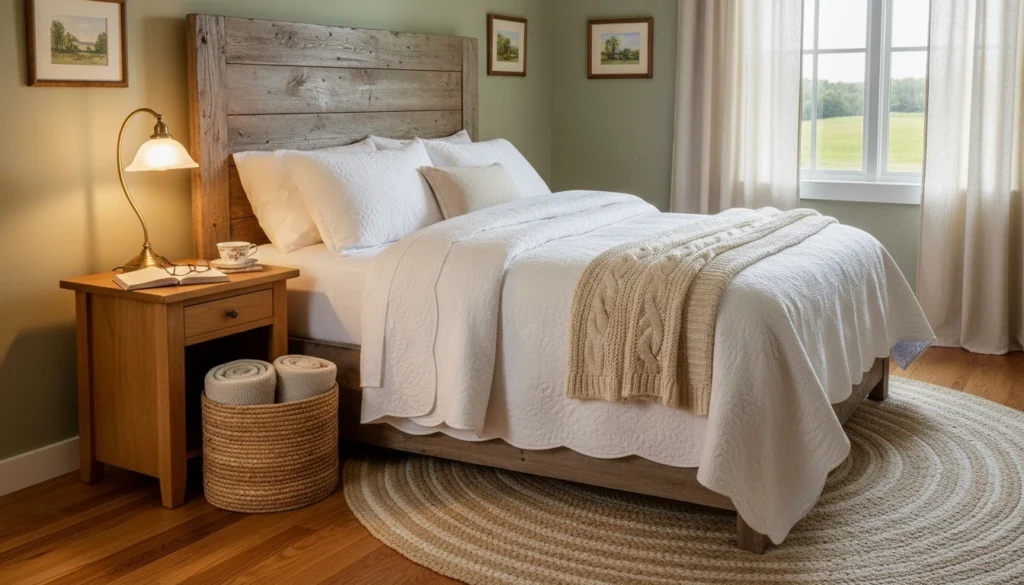
Farmhouse bedrooms feel like a hug from someone who also made you soup and didn’t ask anything of you in return. Natural wood, vintage finds, and textures that invite you to exhale and stay a while — possibly forever.
I stayed in a farmhouse Airbnb once with a reclaimed headboard and quilts so cozy I genuinely considered “forgetting” my return flight. Not misplacing it. Forgetting it. On purpose. It felt like Sunday afternoon, every single day, and I’ve been chasing that feeling in my own home ever since.
For retirees, farmhouse style has a particular magic: it’s warm without being fussy, personal without being cluttered, and it ages beautifully — just like the people who live in it.
Make it work:
- Pair soft whites and creams with honey oak, walnut, or reclaimed timbers.
- Mix old and new: a vintage dresser with new cloud-soft bedding. The contrast is the charm.
- Choose easygoing window treatments — cotton curtains or wood blinds that don’t require a manual to operate.
- Add character with woven baskets, antique lamps, and a patterned kilim or braided rug.
Retirement bonus: Farmhouse style celebrates collected-over-time pieces — which means your grandmother’s quilt, your travel finds, and your favorite worn-in chair all belong here. No need to start from scratch. Everything you’ve gathered over a lifetime suddenly has a home, and a story worth telling.
Boho Bedroom: Eclectic, Soulful, and Layered
Boho is the extrovert of bedroom interior styles — pattern-happy, color-friendly, and proudly “collected over time.” For retirees with a lifetime of travel, experiences, and treasured objects, boho is practically a love language. It’s the style that says: “I’ve been places. I’ve done things. I kept the textiles. And I regret nothing.”
What to do:
- Start with a calm base (white walls, natural wood floors) so your layers pop without overwhelming the senses.
- Mix patterns confidently: geometrics with florals, stripes with paisleys. Trust your eye — it’s been developing for decades.
- Layer rugs — jute plus a Moroccan print is magic. I don’t make the rules; I just enthusiastically report them.
- Add life with plants. Real ones. (Snake plants forgive benign neglect, which is a feature, not a bug, and I say this with love.)
- Bring in personal artifacts — travel textiles, vintage mirrors, handmade ceramics from that pottery class you finally had time to take.
Retirement bonus: Boho style is the perfect home for a lifetime of meaningful objects. Every piece tells a story, and in retirement, you finally have the time — and the audience — to tell them all.
Minimalist Bedroom: Intentional, Peaceful, and Practical
Minimalism isn’t about owning less — it’s about removing what competes with rest. Research from Princeton’s Neuroscience Institute suggests visual clutter competes for attention and raises stress. A minimalist bedroom is a quiet gift to your nervous system — like handing your brain noise-cancelling headphones at the end of a long, full, beautiful day.
I know “minimalist” can sound cold. Sterile. Like a room that’s afraid of personality. But done right, it’s the opposite — it’s warm, intentional, and deeply personal. It’s just that every single thing in it earns its place.
How to keep it warm, not sterile:
- Stick to a tight palette with tonal shifts — warm white, mushroom, oat. Let the shades do the work.
- Use natural textiles (cotton, linen, wool) and one great wood tone. Warmth comes from texture, not quantity.
- Embrace closed storage. Out of sight equals out of mind equals better sleep. This is not a suggestion.
- Keep decor purposeful: a book you’re reading, a ceramic tray, a single branch in a vase. That’s it. That’s the whole beautiful thing.
Retirement bonus: Less stuff means less to manage, less to clean, and less visual noise at the end of the day. Minimalism and retirement are a surprisingly natural pair — both are about choosing, deliberately and joyfully, what actually matters.
Glam Bedroom: Luxe, Layered, and a Little Dramatic
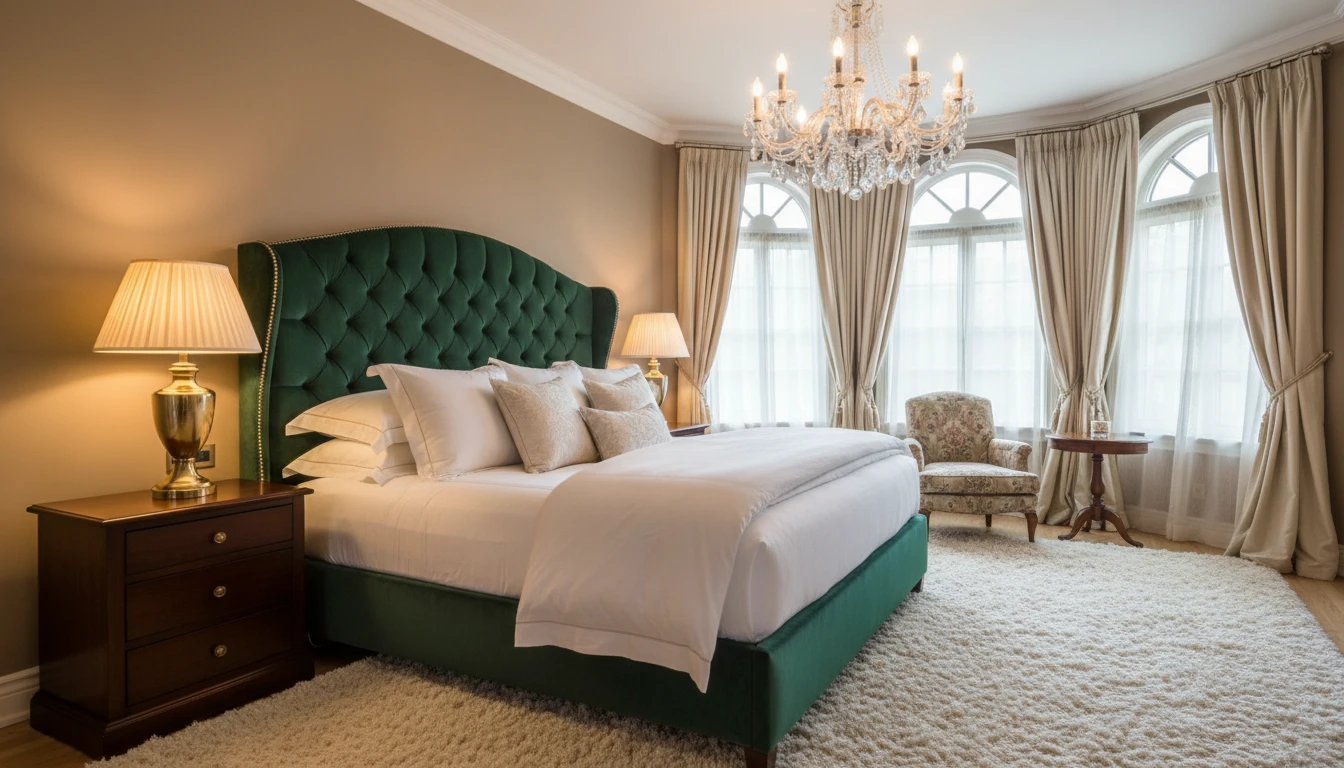
If your inner voice says “bring the velvet,” I am here to tell you: listen to it. Glam bedroom interior styles are about delicious textures and light-catching details — gloss where it counts, balance everywhere else. Think “effortlessly fancy,” not “hotel lobby that swallowed a disco ball and didn’t apologize.”
And honestly? After decades of practical, sensible, everyone-else-first living — after years of choosing the responsible option, the durable option, the easy-to-clean option — a little glamour in your own bedroom isn’t just allowed. It’s earned. You put in the years. The velvet headboard is yours. Take it.
The formula:
- Anchor with a plush headboard (velvet or tufted linen) against a neutral wall. Let it be the star.
- Add metallic accents — brass, chrome, or antique gold in small, repeated doses. Restraint is the secret ingredient that makes glam feel luxe instead of loud.
- Choose statement lighting: a chandelier or artful sconces that make you feel like you’re somewhere special every single night.
- Ground with a soft, high-pile rug and crisp bedding so the whole thing feels intentional, not overwhelming.
Retirement bonus: You’ve spent a lifetime being sensible. The glam bedroom is your permission slip to be a little indulgent — in the room that’s entirely, finally, unapologetically yours. You’ve more than earned it.
Coastal Bedroom: Breezy, Bright, and Effortless
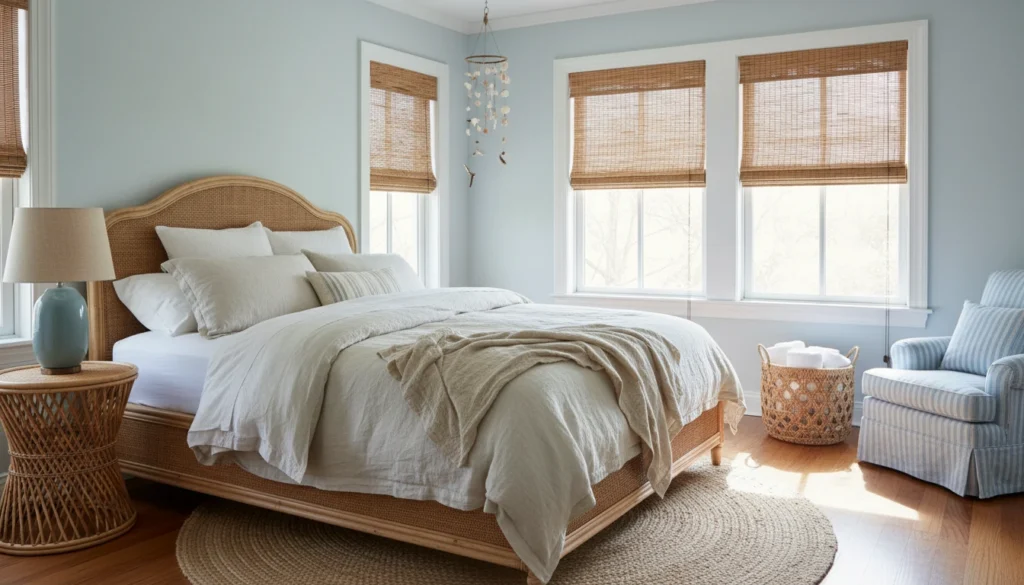
No beach required — though if you have one nearby, I’m not even a little bit jealous. Coastal bedroom interior styles channel sea-and-sand palettes, relaxed textures, and generous daylight. The key is restraint — hint nautical, don’t theme-park it. One driftwood lamp is charming. Twelve anchors is a maritime museum that forgot to charge admission.
For retirees, coastal style offers something particularly valuable: it feels like vacation, every single day. And in retirement, that’s not a bad baseline to aim for. Permanent vacation energy, right in your own bedroom.
Your checklist:
- Build around soft blues, seafoam, sand, and cloud white.
- Choose rattan or white oak furniture; layer linen and cotton for that effortless, just-back-from-the-beach feeling.
- Let light in with sheers or woven shades that filter rather than block.
- Add texture with seagrass baskets and a light jute rug underfoot.
Retirement bonus: Coastal style is inherently relaxed and low-maintenance — which means more time enjoying the room and less time fussing over it. More hammock energy, less housekeeping energy. That’s the retirement dream right there.
Choosing the Right Bedroom Interior Style for Your Retirement
Decision fatigue is real — especially when you’re staring at seventeen Pinterest boards, a paint chip collection that has quietly colonized the kitchen table, and approximately four hundred throw pillow options that all look slightly different but somehow the same.
Here’s the gentle path through it:
- Audit your habits honestly. Do you read in bed every night? Need blackout curtains for afternoon naps? Have cold feet that demand a rug from October through April? Design for how you actually live, not how you imagine you might live in a more organized, more disciplined parallel universe.
- Name your top three feelings. Calm. Cozy. Airy. Grounded. Luxe. Nostalgic. Serene. Pick three and let them guide every single decision. When in doubt, come back to the feelings.
- Build a palette you could live with for three years. If you hesitate at the paint store, soften a shade. Hesitation is data. Your gut is telling you something.
- Test with low-risk moves first. An accent wall, new lamps, upgraded bedding. Live with it for a few weeks before committing to furniture you’ll need a forklift — and a very patient return policy — to deal with.
- Hybridize freely and without guilt. Contemporary plus farmhouse equals warm modern. Minimal plus boho equals clean-but-collected. You’re allowed to mix. You’re allowed to break every rule in this article. It’s your room, and you’ve spent a lifetime earning the right to make it exactly what you want.
Essential Elements That Elevate Any Bedroom Interior Style
Accent Walls: Small Change, Big Impact
Accent walls are exclamation points — use them sparingly and intentionally, and they can completely transform a room. A deep blue behind the headboard cocoons the space and makes the bed feel like a destination. Wood cladding adds depth and warmth without visual noise.
I tried peel-and-stick grasscloth in a rental once — big texture, no heartbreak, deposit survived intact. My wall looked rich and intentional. My landlord never knew. I consider it one of my finer personal achievements.
Style-by-style inspiration:
- Contemporary: saturated paint or geometric wallpaper
- Farmhouse: shiplap or whitewashed wood
- Minimalist: same color family, one shade deeper, matte finish — subtle and sophisticated
- Boho: botanical or global-inspired print
- Coastal: horizontal planking in soft white or misty blue
- Glam: metallic grasscloth or velvet paneling
Layered Bedding: Comfort You Can See and Feel
A well-made bed is future-you’s nightly love note. The stack: breathable sheets, a down or down-alternative duvet, a textured quilt or coverlet, and a throw for style plus those unpredictable temperature swings that retirement age has a particular talent for introducing at 2 a.m.
Mix unfussy neutrals with one bolder tone so it’s inviting, not busy. The bed should look like somewhere you genuinely want to be — not a display at a home goods store that nobody is allowed to touch.
For retirees specifically: please invest in your bedding. You are spending more time in it than ever before, and your body will absolutely notice the difference between scratchy polyester and soft, breathable linen. This is not the place to save money. Seasonal tip — linen in summer, wool in winter. And don’t underestimate pillows. Your neck has opinions, it has had them for years, and it will file a formal complaint if you continue to ignore them.
Window Treatments: Form, Function, and Sleep
Great window treatments bridge “nice” and “nailed it.” They soften edges, control light, add texture, and — for retirees who nap, rest during the day, or are sensitive to early morning light sneaking in at 5:47 a.m. like an uninvited guest — they are genuinely, practically important.
What to consider:
- Light control: Blackout liners for sleep and napping; sheers for daytime privacy and soft, flattering light that makes the room glow without glaring.
- Mounting: Hang high and wide to visually enlarge windows and make ceilings feel taller and more generous than they are.
- Style: Roman shades for tailored looks; ripple-fold drapes for modern polish; woven woods for organic warmth that works in almost any style.
Research published in Sleep Health (2019) found that evening exposure to bright light can disrupt circadian rhythms and delay melatonin production. Translation: dim the lights in the evening, let your window treatments do the heavy lifting at night, and stop apologizing for the blackout curtains. They are doing important work.
Lighting Layers: One Switch Is Never Enough
This is especially important for retirees, and I want to say it clearly: one overhead light is not a lighting plan. It’s a starting point that someone gave up on.
As eyes age, they need more light for tasks — but too much harsh light in the evening disrupts sleep. The solution is layers, not just brighter bulbs.
Create three: ambient (overhead), task (bedside lamps or sconces for reading), and accent (picture lights, small lamps, LED strips for a gentle, winding-down glow that signals to your brain that the day is ending). Add dimmers so the same room can go from “find my glasses” to “wind down for the night” without drama, fumbling, or a flashlight.
Pro move: swing-arm sconces free up nightstand space, look intentional, and position light exactly where you need it for reading. Warm bulbs (2700K–3000K) flatter everything — including your mood at 10 p.m. when you’re trying to convince yourself to put the book down and actually sleep.
Furniture That Fits — Literally
Scale matters enormously, and it matters more in retirement when many people are downsizing from larger homes and trying to fit a lifetime of furniture into a more intimate space. A king bed in a small room eats your floor plan for breakfast and leaves no room for safe, comfortable navigation. Measure first. Fall in love second. This order matters.
Layout basics that rarely fail:
- Center the bed on the longest wall when possible — it anchors the room and creates balance.
- Leave 24–36 inches for walkways — wider if mobility is a consideration now or might be in the future.
- Keep nightstands within 3 inches of mattress height for easy, comfortable reach at any hour.
- Add under-bed drawers or a storage bench when closet space is tight.
Retirement-specific tip: If aging-in-place is part of your plan — and for many retirees, it is — consider furniture height carefully and honestly. Beds that are too low are genuinely hard to get in and out of, especially first thing in the morning. Nightstands that are too high create awkward reaching at midnight when you just want your water glass. Small, thoughtful adjustments now prevent big, frustrating problems later. Future-you will be grateful.
Bringing It Together: Making Your Bedroom Cohesive and Unmistakably You
Cohesion isn’t boring — it’s intentional. And intentional spaces feel restful in a way that chaotic, “I’ll figure it out eventually” spaces simply don’t, no matter how many nice individual pieces they contain.
- Color discipline: Pick 3–5 core colors and stick to them throughout the room. Every piece should feel like it belongs to the same family, even if they’re different styles or eras.
- Texture variety: Smooth (glass, metal) plus nubby (bouclé, linen) plus grounded (wood, jute) — variety creates visual interest without visual noise. The contrast is what makes it feel rich.
- Repetition: Echo a metal finish or wood tone at least twice. It creates rhythm without effort and makes the room feel designed rather than accidentally assembled.
- Personal touches: Art you love, photos that make you smile, a found object with a story worth telling. That’s the heartbeat of the room — and in retirement, you have a lifetime of heartbeats to choose from. Use them.
I do a “10-foot test”: stand in the doorway and scan the room. If your eyes ping-pong between too many competing elements, edit. If they flow naturally toward the bed, you’re close. Then the “6 a.m. test”: can you navigate safely without acrobatics or stubbed toes? Fewer bruised shins equals success, and success is always the goal.
Mistakes to Skip (I’ve Made Them So You Don’t Have To)
- Buying the bed first without measuring the room. Every single time, heartbreak and a very awkward return.
- Treating the nightstand like a junk drawer with legs. It deserves better. So do you.
- Matching everything perfectly. It reads flat and a little sad. Mix tones, shapes, and textures — that’s where the life is.
- Skipping a rug in small rooms. A 5×8 under a full bed changes everything — including how safe, warm, and grounded the floor feels underfoot at 6 a.m.
- Over-theming. A coastal room doesn’t need ten anchors. One is charming; ten is a maritime museum gift shop that got out of hand.
- Ignoring lighting until the room is done and then wondering why it doesn’t feel right. Lighting is not an afterthought. It is the mood. It is the whole thing. Plan it early.
Budget-Friendly Ways to Refresh Your Bedroom Interior Style
You don’t need a renovation budget — or a renovation timeline — to transform how a room feels. Some of the most impactful changes cost almost nothing.
Upgrades with outsized impact:
- Paint the headboard wall — one can, one afternoon, completely different room. It’s almost unfair how well this works, and I say that as someone who has done it more than once.
- Swap lamp shades for better proportions and softer light diffusion. The difference is immediate.
- Upgrade to linen or percale sheets — you’ll feel the difference the first night, and you’ll wonder why you waited so long.
- Add a large mirror to bounce light and make the room feel larger, brighter, and more open.
- Replace builder-grade knobs with pretty hardware — small detail, surprisingly big personality shift.
- Layer a smaller vintage rug over a large neutral one for instant warmth, texture, and the feeling that the room was designed by someone with very good taste.
Pro tip for retirees: Spend on what you touch every single night — sheets, pillows, mattress. Save on accent tables and decorative pieces you’ll swap as your taste evolves and your space changes. Your back, your sleep quality, and your future self will thank you for getting your priorities in exactly the right order.
Tiny Rooms, Big Style: Small-Space Solutions for Downsized Retirement Living
Many retirees are working with smaller spaces than they had before — and I want to say this clearly: that is not a limitation. It is an invitation to be intentional in a way that larger spaces rarely demand, and intentional spaces are almost always more beautiful.
- Use wall-mounted shelves as nightstands to free up floor space and keep pathways clear and safe.
- Choose a bed with integrated drawers to eliminate the need for a separate dresser and reclaim precious square footage.
- Hang curtains to the ceiling to stretch the wall visually and make the room feel taller, more generous, more like a room that chose its proportions on purpose.
- Pick two main colors and one accent to keep the space cohesive, calm, and easy on the eyes — especially important in smaller rooms where too many colors compete.
- Opt for sconces over table lamps to free up surface space for the things that actually matter.
- Use mirrors strategically — a large mirror on one wall can effectively double the perceived size of a small room and make it feel like an entirely different, much more spacious space.
The Research Corner: Why Good Bedroom Design Is Good for Your Health
This isn’t just about aesthetics — and I think it’s important to say that out loud. There’s real, peer-reviewed science behind why bedroom interior styles matter, especially as we age.
- Identity-fit matters: Bedrooms aligned with personal style correlate with relaxation and sleep satisfaction (Journal of Environmental Psychology, 2021).
- Clutter equals cognitive load: Visual clutter impairs focus and raises stress levels in measurable, documented ways (Princeton Neuroscience Institute, 2011).
- Evening light hygiene: Bright evening light can delay melatonin production and disrupt sleep timing, affecting how quickly you fall asleep and how deeply you stay there (Sleep Health, 2019).
All of which backs up what good design quietly whispers every time you walk into a room that feels right: you’re safe. You’re home. Rest now. In retirement, that message matters more than it ever has — because rest isn’t something you’re stealing anymore. It’s something you’ve earned.
If you’re working on building a retirement lifestyle that supports your health and wellbeing from the inside out, you might also enjoy reading healthy habits for a fulfilling retirement — because great sleep and a great bedroom are just two pieces of a much bigger, much more beautiful picture.
Final Thoughts: Your Bedroom, Your Rules, Your Retirement
Here’s what I want you to take away from all of this:
Your bedroom should feel like the best exhale of your day.
Not a showroom. Not a hotel. Not someone else’s Pinterest board. Yours. With your colors, your textures, your stories on the walls, and your particular brand of cozy built into every corner.
In retirement, you finally have the time to get this right. You have the freedom to choose what actually matters to you — not what’s practical, not what’s easy to clean, not what everyone else is doing. You. Pick a style, or blend two, that fits who you are right now. Start with one upgrade, live with it, let it settle, then take the next step when you’re ready.
And if you walk into your bedroom one evening, set down whatever you’re carrying, and involuntarily exhale?
You’ve nailed it. That’s the whole test. That’s the whole beautiful goal.
The laundry can wait until tomorrow. Your future self, sleeping soundly in a room that finally, genuinely feels like home, won’t mind at all.
Sweet dreams — and may your pillow always be the cool side.