
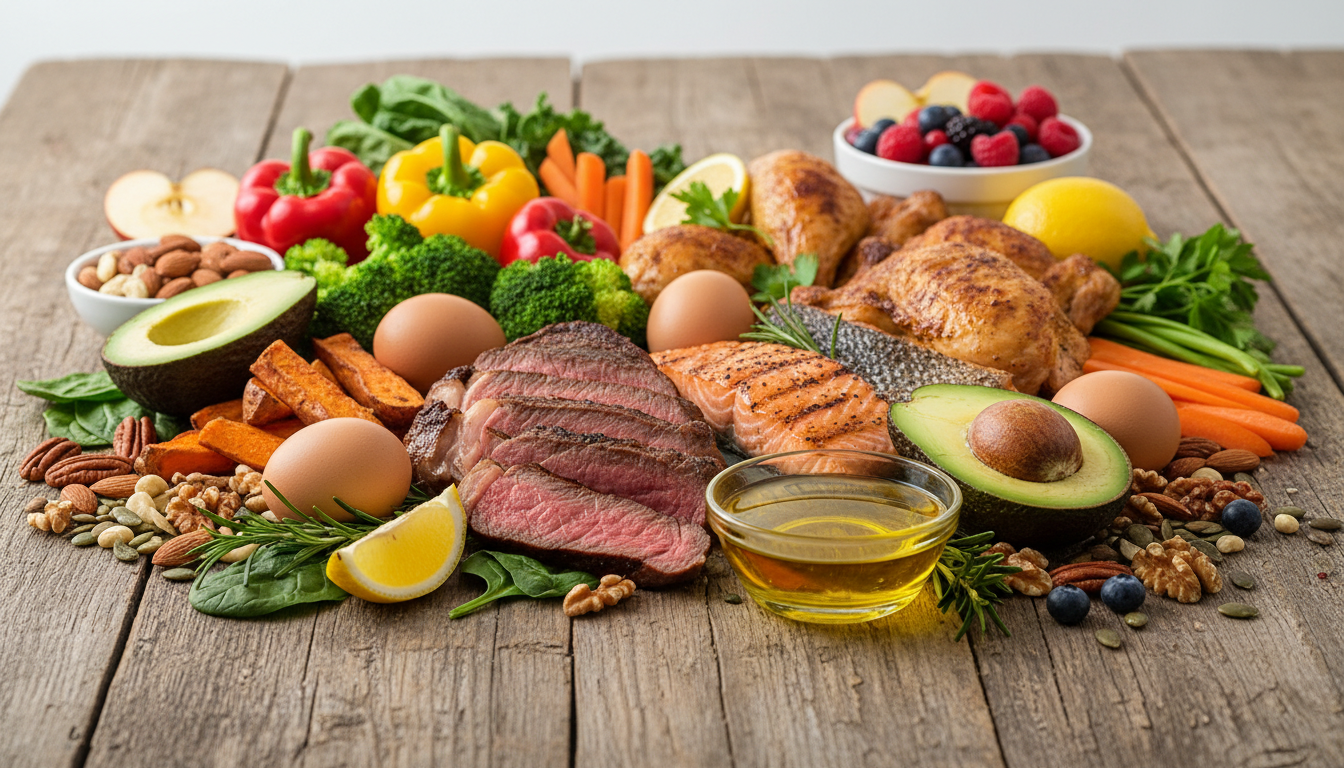
The Paleo Diet for Seniors: A Real-World Guide to Eating Like Your Ancestors in Retirement (Without Living in a Cave)
Curious about the paleo diet for seniors? This practical guide covers what to eat, what to skip, and how to make it work in real retirement life — no perfection required.
Key Takeaways
- The paleo lifestyle focuses on whole, minimally processed foods — meat, fish, eggs, vegetables, fruit, nuts, and seeds
- For retirees, the biggest win is often surprisingly simple: fewer cravings, more stable energy, and less bloating
- Paleo removes grains, legumes, and most dairy — not because they’re villains, but because they’re post-agricultural additions your body may handle less gracefully as it ages
- Research suggests paleo-style eating may support blood sugar control, reduce inflammation, and help with weight management — all especially relevant after 60
- You don’t have to be perfect. Start with one or two swaps and build from there
- Always check with your doctor before making major dietary changes, especially if you’re managing existing health conditions
I want to tell you something I’ve never admitted in polite company.
The first time someone described the paleo lifestyle to me, I smiled, nodded, and then spent the next ten minutes quietly convinced they were describing a cult. A very meat-forward cult with strong opinions about bread.
Because that’s what it sounded like. Eat like a caveman. Avoid anything invented after the agricultural revolution. Possibly forage for your own berries. I pictured someone crouched over a fire, gnawing on something unidentifiable, looking deeply satisfied with their life choices while the rest of us ate sandwiches like normal people.
I was wrong. Embarrassingly wrong, as it turns out.
The paleo diet for seniors is, at its core, just a practical framework for eating real food. Not a performance. Not a personality. Not a reason to corner people at dinner parties and explain why their pasta is slowly killing them. Just a sensible, flexible approach to choosing foods that look like actual ingredients — and cutting back on the stuff that makes you feel like you swallowed a bag of wet cement by 2pm.
The basic idea: eat mostly meat, fish, eggs, vegetables, fruit, nuts, and seeds. Limit or avoid grains, legumes, most dairy, and anything that comes in a shiny package with seventeen ingredients you’d need a chemistry degree to pronounce. That’s it. That’s the whole thing. No membership required. No secret handshake.
Now, whether or not you care about the evolutionary theory behind it — and we’ll get there, I promise — most people who try the paleo lifestyle in retirement aren’t doing it because they want to reenact the Stone Age. They’re doing it because they want to feel better. Less bloated. Less tired. Fewer cravings. More stable energy throughout the day. A little more control over their appetite and their waistline, which seems to have developed opinions of its own somewhere around age 58.
All very relatable goals. Especially after 60, when the body starts making its opinions known in ways it never bothered to before. Your knees have thoughts now. Your digestion has a whole personality. That afternoon energy crash that used to be manageable? It’s gotten louder, more insistent, and significantly less polite.
This guide walks through where the paleo lifestyle came from, what the research actually says, how it applies specifically to retirees, and how to make it work on a regular Tuesday when you’re busy and hungry and everyone around you is ordering pizza and looking extremely happy about it.
What Is the Paleo Lifestyle and Where Did It Come From?

The paleo lifestyle is inspired by the general eating pattern of Paleolithic hunter-gatherers — the humans who lived before agriculture became widespread, roughly 12,000 years ago. The theory goes like this: humans evolved eating foods that existed before farming. Agriculture is, in evolutionary terms, a very recent development. So some researchers believe that eating closer to a pre-agricultural pattern may fit better with our biology — especially as we age and our bodies become less forgiving of foods they didn’t evolve alongside.
Here’s the part that’s useful even if evolutionary biology isn’t your thing: the paleo lifestyle tends to pull you away from ultra-processed foods and toward meals built from protein, vegetables, and natural fats. That shift alone — regardless of the history behind it — can make a noticeable difference in how you feel day to day. According to Paleo Leap’s guide for elderly adults, older adults in particular stand to benefit from optimal nutrition, and have a lot to lose from a diet full of processed food and low in nutrient content.
Which, if you think about it, is just a very polite way of saying: the stuff in the middle aisles of the grocery store is not doing you any favors.
Who Popularized the Paleo Diet?
Walter Voegtlin, a gastroenterologist, introduced early ideas about a hunter-gatherer style diet in the 1970s. Loren Cordain later brought it into mainstream nutrition conversations with The Paleo Diet, discussing how some agricultural foods may contribute to digestive irritation or inflammatory responses in certain people — particularly as the body ages and becomes less tolerant of foods it didn’t evolve alongside (Cordain, 2005).
Here’s what I want you to take from that: paleo is not about labeling foods as morally good or bad. It’s not a religion. It’s not a competition. It’s a framework — one you can use strictly, or one you can use as a starting point to figure out what makes your body feel its best. At this stage of life, that kind of self-awareness is genuinely valuable. Probably more valuable than any specific food rule anyone has ever handed you.
How Is Paleo Different from Keto?
People lump paleo and keto together constantly, and I get why — both reduce processed food and refined carbs. But they’re not the same plan, and the difference matters if you’re trying to figure out which one actually fits your life without making you miserable.
The paleo lifestyle is mostly about food quality and categories. It allows carbohydrates from fruit and starchy vegetables. Keto is mostly about macronutrient ratios — it restricts carbs enough to push the body into ketosis, a metabolic state where fat becomes the primary fuel source.
If you prefer a less math-heavy approach that still encourages whole foods, the paleo lifestyle is often easier to sustain long-term. If you’re aiming for ketosis for a specific health reason, keto is a different tool — and one worth discussing with your doctor first, especially after 60. Because some tools are great in the right hands and genuinely problematic in the wrong context.
What Do You Actually Eat on a Paleo Diet?
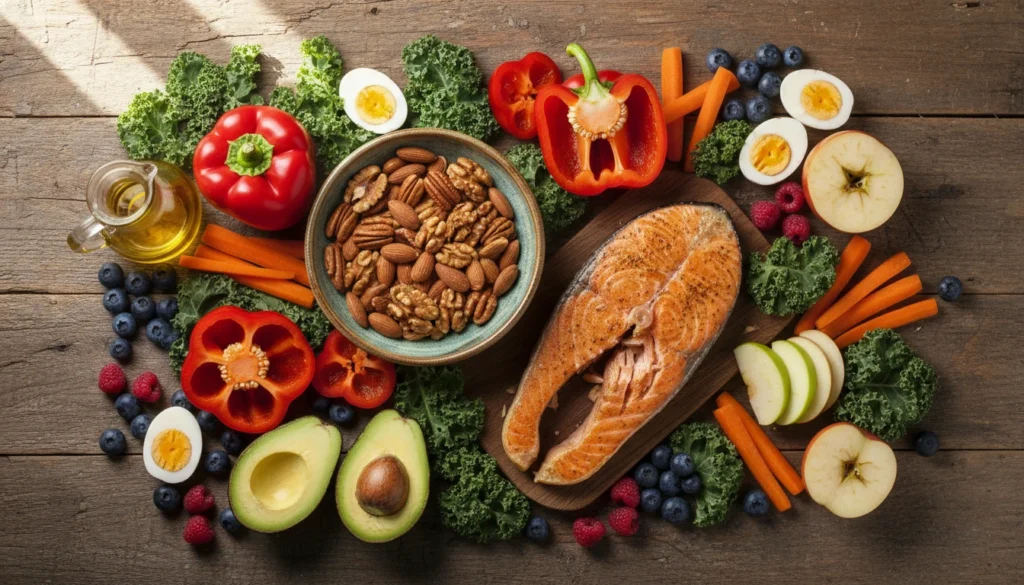
The paleo lifestyle is straightforward. Eat mostly whole foods. Avoid industrial food products. If you want a simple way to remember it, here’s the idea I keep coming back to: build meals from foods that are easy to recognize in their natural form, and limit foods that come in shiny packaging with long ingredient lists.
If your great-grandmother would have recognized it as food, you’re probably fine. If it requires a barcode and a paragraph of disclaimers, maybe think twice.
Foods Emphasized on a Paleo Diet
The paleo lifestyle emphasizes nutrient-dense foods that tend to keep people full and steady — which is especially helpful in retirement when you’re not running on the adrenaline of a packed work schedule anymore. Nobody’s stress-eating at their desk at 11am, but that doesn’t mean hunger isn’t still a factor. It just shows up differently now. Quieter. More patient. And then suddenly very loud at 4pm.
- Lean meats and seafood: Grass-fed beef, pasture-raised poultry, and wild-caught fish when possible. These are rich in protein, B12, iron, and the amino acids that support muscle maintenance — something that becomes increasingly important after 60, when muscle loss accelerates naturally whether you want it to or not. Your body is going to try to lose muscle. Your job is to make that harder for it.
- Vegetables: The more variety, the better. Leafy greens, root vegetables, cruciferous vegetables — they provide fiber, vitamins, minerals, and antioxidants. According to Texas Real Food’s senior paleo guide, prioritizing nutrient-dense vegetables is one of the most important adaptations for older adults following a paleo approach. Not the most exciting sentence ever written, but one of the more important ones.
- Fruits: Berries, apples, bananas, citrus — natural sources of fiber and antioxidants. Not something to fear, despite what some stricter paleo camps suggest. Fruit is not the enemy. Fruit is delicious and good for you and has been feeding humans for hundreds of thousands of years. Eat the fruit. Enjoy the fruit. Don’t let anyone make you feel guilty about a banana.
- Nuts and seeds: Convenient, satisfying, and a good source of healthy fats and fiber. A small handful goes a long way — which is good, because a large handful disappears in approximately forty-five seconds and then you’re standing in the kitchen wondering what happened.
- Healthy fats: Olive oil, avocado, coconut oil. These support brain health, hormone function, and satiety. They also make food taste significantly better, which matters more than people admit in nutrition articles. Food that tastes good is food you’ll actually eat. That’s not a small thing.
One personal tip that genuinely changed how I think about meals: stop treating vegetables like an afterthought. If you build your plate around vegetables first, then add protein and fat, meals feel more satisfying — and less like you’re white-knuckling your way through a diet while secretly resenting everyone who gets to eat normally. It’s a small mental shift that makes a surprisingly big difference.
Foods to Avoid on a Paleo Diet
Most paleo approaches avoid grains, legumes, and most dairy. They also avoid processed foods high in refined sugar, artificial additives, and preservatives.
The point isn’t to be perfect. The point is to reduce foods that tend to cause blood sugar swings and cravings, and replace them with foods that keep you satisfied. For retirees managing blood sugar, energy levels, or inflammation, that trade-off is often very much worth it.
And honestly? Once you stop eating the stuff that makes you feel terrible, you stop missing it as much as you thought you would. That’s not something I expected. But it’s consistently true.
What Does the Research Say About the Paleo Diet for Seniors?

Here’s where it gets interesting — and where I want to be completely straight with you about what the science actually shows, rather than overselling it like a late-night infomercial.
Blood Sugar Control and Weight Management
The paleo lifestyle tends to reduce refined carbohydrates and added sugar. In their place, meals include more protein, more fiber, and more healthy fat. That combination can help with satiety — you feel full sooner and stay full longer — and it can reduce the blood sugar spikes and crashes that leave you reaching for something sweet at 3pm like clockwork, every single day, as if your body has a standing appointment with the cookie jar.
A 2019 comparative analysis that looked at studies on ketogenic, paleolithic, and vegan diets reported weight loss benefits across all three approaches. In the studies sampled, people following a paleolithic-style diet lost up to 2.3 kilograms in three weeks. The biggest takeaway isn’t that paleo is magic — it’s that replacing processed foods with whole foods works. And for retirees who’ve spent decades eating whatever was convenient, that shift can feel genuinely transformative. Like someone turned the lights back on.
MedicSignal’s overview of the paleo diet for seniors notes that the diet’s emphasis on whole foods and lower carbohydrate intake may be particularly beneficial for older adults facing increased risk of type 2 diabetes — a condition that affects around 27% of adults over 65. That’s more than one in four people in your age group. Not a fringe concern. A very real one.
Inflammation and Gut Health
The paleo lifestyle removes many common sources of added sugar and processing. For some people, that alone reduces inflammation-related symptoms — joint stiffness, bloating, fatigue, skin issues. Things that a lot of us have quietly accepted as “just part of getting older” that may not have to be. That realization, when it hits, is a little bit annoying and a lot bit motivating.
Paleo also increases vegetables and fruit, which supports fiber intake and a healthier gut environment. A 2019 paper on the modern paleolithic diet noted that research on its specific effects on the gut microbiome is still limited, but suggested that shifting from a Western diet — low in fiber, high in processed foods — toward a paleo-style pattern may shift the microbiome in a direction associated with lower chronic disease risk factors (Barone, 2019).
In plain language: your gut may appreciate the upgrade. And if you’ve spent any time dealing with digestive discomfort in your 60s, you know exactly why that matters. Your gut has been very patient with you. It deserves better.
Cognitive Health and Aging
This one genuinely surprised me when I first came across it — and I don’t surprise easily when it comes to nutrition research anymore.
Paleo Leap’s research on paleo for the elderly references studies suggesting that high blood sugar levels are associated with significantly increased dementia risk in adults over 65 — and that a lower-carb, whole-food diet may help protect brain function over time. The Paleo Diet’s anti-aging research also highlights that lean muscle mass is one of the most important markers for healthy aging — and that animal protein, a cornerstone of the paleo approach, contains the highest concentrations of essential amino acids and creatine needed to build and maintain that muscle.
You want to stay sharp. You want to stay strong. You want to remember where you put your keys and be able to carry your own groceries at 75. What you eat has more to do with both of those things than most people realize — and more than most doctors have time to tell you in a fifteen-minute appointment.
Is the Paleo Diet Right for Seniors? Honest Pros and Cons

I want to give you the full picture here — not just the highlights reel. Because the paleo lifestyle, like anything worth doing, has real trade-offs. And you deserve to know what they are before you throw out your oatmeal.
The Real Benefits for Retirees
- Nutrient density: Paleo foods pack a lot of nutrition per calorie. As metabolism slows with age, this matters more than ever. You need just as many vitamins and minerals as you did at 40 — but in fewer calories. Paleo delivers that without requiring you to count anything, track anything, or download an app that judges your food choices.
- Muscle maintenance: High-quality protein supports muscle mass, which protects against falls, fractures, and the gradual physical decline that many people assume is just “part of getting older.” It doesn’t have to be. Muscle is something you can actively protect — and the earlier you start, the better.
- Blood sugar stability: Reducing refined carbs can smooth out the energy peaks and valleys that make afternoons feel like a slog. Stable blood sugar means more consistent energy, better mood, and fewer moments of standing in front of the fridge at 4pm wondering why you’re there and what you were looking for.
- Reduced inflammation: Many retirees report improvements in joint pain, bloating, and general fatigue when they cut processed foods and increase vegetables and healthy fats. Some describe it as feeling like themselves again — which, if you’ve been feeling off for a while, is a pretty compelling endorsement.
The Real Challenges
Home Care Assistance Dayton’s overview of paleo for seniors and Wellabe’s diet guide for people over 60 both point out some legitimate concerns worth knowing about before you dive in headfirst:
- Calcium and bone health: Dairy is a primary source of calcium, and excluding it without a plan can be risky for bone density — already a concern for postmenopausal women and older men. If you go paleo, make sure you’re getting calcium from other sources: leafy greens, canned salmon with bones, almonds, and fortified foods. Don’t just remove dairy and hope for the best.
- Fiber intake: Without grains and legumes, fiber can drop if you’re not intentional about loading up on vegetables and fruit. Constipation is already a common issue for older adults — don’t make it worse by accidentally cutting your fiber in half. Your future self will not thank you.
- Cost: Quality meat and fresh produce can be more expensive than a cart full of processed food. Budget-friendly strategies help: buy seasonal produce, use frozen vegetables (just as nutritious, significantly cheaper, and nobody needs to know), and choose less expensive cuts of meat. Chicken thighs over breasts. Ground beef over steak. Canned salmon over fresh. These are not compromises. These are smart choices.
- Existing health conditions: If you’re managing kidney disease, heart conditions, or other chronic issues, a high-protein diet may need modification. Always talk to your doctor before making major dietary changes. This is not optional advice. This is the part where I’m being completely serious.
How Does the Paleo Lifestyle Extend Beyond Food?
Here’s something I genuinely appreciate about the paleo approach: it doesn’t pretend that food is the only thing that matters. The paleo lifestyle often includes regular movement, better sleep, and stress management — because food is only one part of the health puzzle. And if you’ve ever eaten perfectly for a week while sleeping terribly and stressing about everything, you know exactly what I mean. The food helps. But it’s not the whole story.
You can eat perfectly and still feel off if you’re sleeping five hours a night and running on anxiety all week. Retirement is supposed to fix the stress part. But for a lot of people, the transition brings its own version of it — loss of structure, identity shifts, too much unscheduled time or not enough of the right kind. The paleo lifestyle, at its best, addresses all of it. Not just what’s on your plate, but how you’re actually living.
Exercise That Complements Paleo
Strength training pairs especially well with the paleo lifestyle because it supports muscle and metabolism — the two things that tend to decline fastest after 60. Cardio also fits well: walking, cycling, swimming, or running. Functional movement, mobility work, and time outdoors round it out nicely.
My personal opinion? Don’t overcomplicate this. The best exercise plan is the one you can actually repeat. A 30-minute walk every morning is worth infinitely more than an intense gym session you dread and eventually abandon. Consistency beats heroic workouts you only do twice. Every single time. Without exception. I cannot stress this enough.
Sleep and Stress Management
Good sleep supports recovery, appetite regulation, and mood. Stress management helps keep cravings and fatigue from driving food choices — because when you’re exhausted and overwhelmed, you don’t reach for a salad. You reach for whatever’s closest and most comforting. That’s not weakness. That’s just how humans work. We are not robots. We are tired, hungry people doing our best.
If your life is still chaotic even in retirement, start small. Set a consistent bedtime. Take a short walk outside in the morning. Put your phone down ten minutes earlier than usual. Those tiny choices add up more than people realize — and they compound over time in ways that are genuinely surprising. The math on small, consistent habits is almost unfairly good.
How to Start the Paleo Lifestyle in Retirement Without Losing Your Mind
Most challenges with the paleo lifestyle aren’t about willpower. They’re about planning. If you wait until you’re starving to figure out what to eat, you’ll choose whatever is easiest. That’s not a character flaw. That’s just biology doing its thing — and biology always wins when you’re hungry and unprepared. Always.
Simple Meal Prep Strategies
- Cook a few proteins at the start of the week — a batch of chicken thighs, some hard-boiled eggs, a piece of salmon. These become the foundation of quick meals for days without requiring you to think too hard at 6pm when you’re tired and your willpower is at its absolute lowest.
- Roast a big sheet pan of vegetables on Sunday. Toss them with olive oil, salt, and whatever herbs you like. They reheat beautifully and make every meal feel more complete without any extra effort. This is one of those habits that sounds small and turns out to be genuinely life-changing.
- Keep simple foods in your kitchen: canned fish, nuts, fresh fruit, pre-washed greens. When hunger hits, you want options that require zero effort and zero decision-making. Decision fatigue is real, and it peaks right around dinnertime.
Managing Cost
- Buy seasonal produce — it’s cheaper and often more flavorful than out-of-season alternatives that traveled 3,000 miles to get to your plate
- Frozen vegetables are just as nutritious as fresh and significantly less expensive — don’t let anyone make you feel bad about frozen broccoli. Frozen broccoli is a hero
- Choose budget-friendly cuts of meat: chicken thighs over breasts, ground beef over steak, canned salmon over fresh
- Eggs are one of the most nutrient-dense, affordable foods on the planet. Lean on them heavily and without apology. Eggs have been unfairly maligned for decades. They deserve better. So do you.
Navigating Social Situations
This is the one people worry about most, and it’s honestly the easiest to solve. At restaurants, choose grilled protein and vegetables. At dinner parties, eat a small meal beforehand or bring a dish you can enjoy. You don’t have to announce your dietary choices or make it a whole thing. Just quietly choose the options that work for you and enjoy the company.
Nobody needs to know you’re “doing paleo.” You’re just eating well. And that’s a perfectly normal, completely unremarkable thing to do. Save the explanations for people who actually ask — and even then, keep it short.
Common Misconceptions About the Paleo Lifestyle
“Paleo means eating only meat.” Not even close. The paleo lifestyle can include a wide variety of vegetables and fruit — and should. Vegetables are the foundation, not the afterthought. If your paleo plate is 80% meat, you’re doing it wrong and your gut is going to let you know about it.
“It has to be historically accurate.” It doesn’t. Humans ate differently depending on where they lived. The paleo lifestyle isn’t a history project — it’s a practical framework for reducing ultra-processed foods and eating more nutrient-dense meals. The cave is optional. Indoor plumbing is encouraged.
“It’s too restrictive to sustain.” It can be, if you treat it like a strict rulebook handed down from on high. But most people who stick with it long-term use it as a flexible guide, not a rigid law. Some include fermented dairy. Some eat occasional legumes. The 80/20 approach — paleo most of the time, flexible when life calls for it — is how most retirees make it work sustainably. And sustainably is the only way that actually matters. A perfect diet you quit in three weeks helps nobody.
Quick Reference: Paleo Food Guidelines
| Food Category | Eat Freely | Limit or Avoid |
|---|---|---|
| Proteins | Grass-fed beef, poultry, wild-caught fish, eggs | Processed meats, deli meats with additives |
| Vegetables | Leafy greens, root vegetables, cruciferous veggies | Corn (grain, not vegetable) |
| Fruits | Berries, apples, bananas, citrus | Dried fruits with added sugar |
| Fats | Avocado, olive oil, coconut oil, nuts | Trans fats, hydrogenated oils, seed oils |
| Grains | — | Wheat, rice, oats, bread, pasta |
| Legumes | — | Beans, lentils, peanuts, soy |
| Dairy | Small amounts of fermented dairy (optional) | Most conventional dairy |
| Sweeteners | Raw honey (sparingly) | Refined sugar, artificial sweeteners |
Frequently Asked Questions
What are some common misconceptions about the paleo diet?
The biggest one is that it’s all meat, all the time. In reality, vegetables and fruit are central to the paleo lifestyle. Another misconception is that it has to be perfect. It doesn’t. Flexibility is built into how most people actually live it — and that’s a feature, not a bug. The goal is progress, not purity.
How can I transition to a paleo lifestyle smoothly in retirement?
Start with simple swaps. Replace processed snacks with fruit or nuts. Replace sugary breakfasts with eggs and vegetables. Build a few easy meals you can repeat without thinking. Don’t try to overhaul everything at once — that’s how people burn out in week two and go back to their old habits by week three, feeling worse than when they started.
Can I enjoy social events while following a paleo diet?
Absolutely. Choose grilled proteins, salads, and vegetable sides. If you’re unsure what will be available, eat a small meal beforehand or bring a dish to share. You don’t have to make it a production — and you definitely don’t have to explain yourself to anyone. Your food choices are yours. Full stop.
What are some effective snacks for a paleo diet?
Fruit, nuts, seeds, hard-boiled eggs, raw vegetables, and unsweetened jerky are all solid options. Keep a few of these on hand and you’ll rarely be caught without something good to eat. Hunger is much easier to manage when you’ve already planned for it — and much harder to manage when you haven’t.
How does the paleo lifestyle impact long-term health for retirees?
The paleo lifestyle may support long-term health by reducing ultra-processed foods and increasing nutrient-dense meals. Long-term research is still limited, but many retirees report improvements in weight, energy, digestion, and joint comfort. The MedicSignal overview and Texas Real Food’s senior guide both highlight its potential for supporting healthy aging when adapted thoughtfully.
Is the paleo diet suitable for retirees with high physical activity levels?
Yes, with some adjustment. Active retirees may need more carbohydrates for energy and recovery — adding more fruit and starchy vegetables like sweet potatoes and squash can help. The paleo framework is flexible enough to accommodate higher activity levels without abandoning its core principles. It bends. It doesn’t break.
How can I ensure I get enough nutrients on a paleo diet after 60?
Eat a wide variety of vegetables, fruits, proteins, and healthy fats. Pay particular attention to calcium (leafy greens, canned salmon, almonds), vitamin D (fatty fish, sunlight, supplementation if needed), and fiber (vegetables, fruit, nuts). Variety is the most important thing — and, conveniently, the most enjoyable part.
Are there variations of the paleo diet I can try?
Yes. Some people follow a more flexible version that includes fermented dairy or occasional legumes. Others keep it strict. The version that works best is the one you can actually maintain — not the one that looks best on paper or impresses people at dinner parties. Real life beats theoretical perfection every time.
The Bottom Line
The paleo diet for seniors isn’t about recreating the Stone Age or following a perfect set of rules handed down by someone who’s never had to navigate a potluck or a holiday dinner. It’s about eating real food, most of the time, in a way that makes your body feel better than it did before.
For retirees, the timing is actually ideal — even if it doesn’t always feel that way. You have more control over your schedule, your kitchen, and your choices than you did during your working years. You’re not eating at your desk or grabbing whatever’s available between meetings. You have the time to cook, to shop thoughtfully, and to actually pay attention to how food makes you feel — which is something most of us never had the luxury of doing when we were busy and exhausted and just trying to get through the week.
Start small. Build meals around protein and vegetables. Keep simple foods in your kitchen. Pay attention to how you feel after a week, then two, then a month. You don’t need perfection. You need consistency — and a little curiosity about what your body is still capable of when you give it the right fuel.
You might be surprised by what’s still possible. I know I was. And I’m still a little annoyed it took me this long to figure it out.