
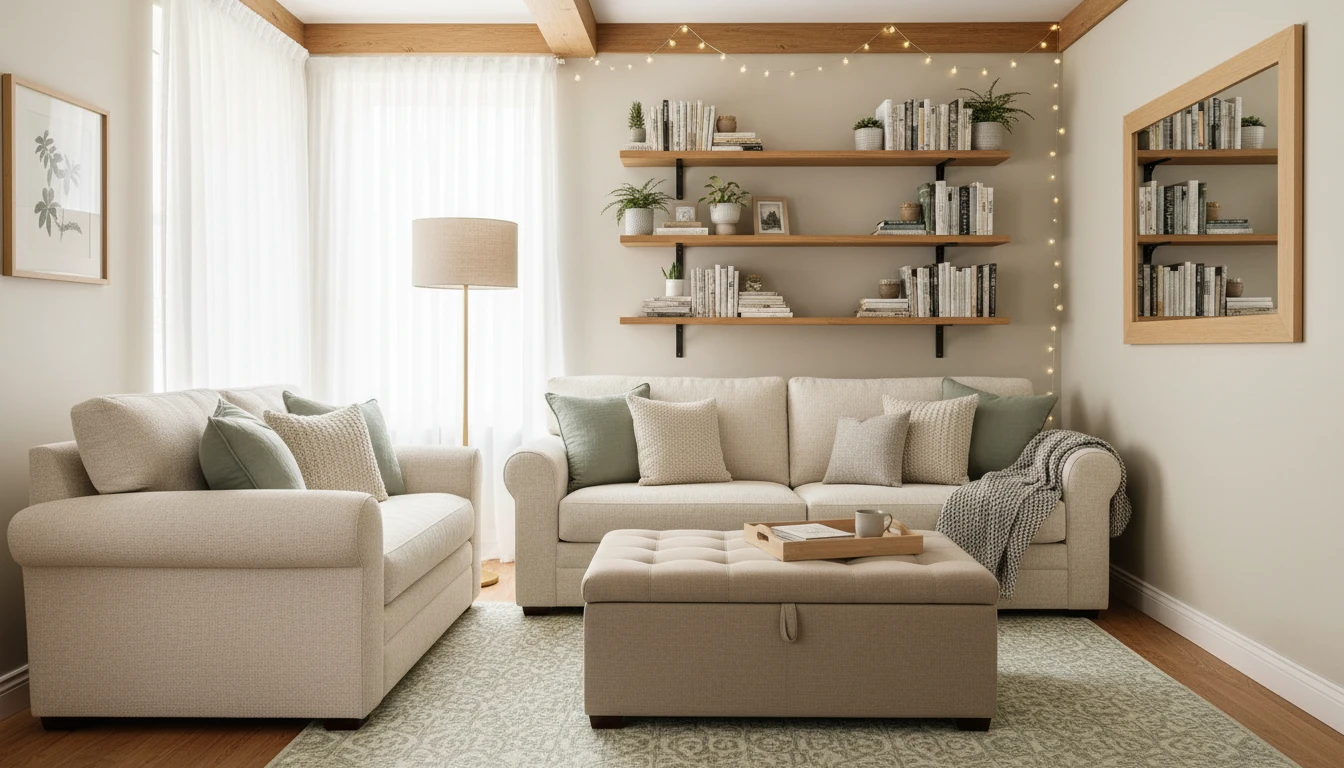
Small House Makeover Ideas for Seniors That’ll Make You Fall in Love With Your Retirement Home Again
Cozy, real-life small house makeover ideas for seniors to maximize space, style, and comfort—without needing a bigger home or a bigger budget.
Let me paint you a picture.
It’s a Tuesday afternoon. You’re retired. You’ve got nowhere to be, a cup of tea going cold on the counter, and you’re standing in the middle of your living room just… looking around. Not in a peaceful, “I love my life” kind of way. More in a “how did we accumulate all of this and where did the floor go?” kind of way.
Sound familiar? Because that was me. Exactly me. Right down to the cold tea.
I used to think my small house was the universe’s way of saying, “You’re doing fine… but not that fine.” You know the vibe: congratulations, here’s 900 square feet, a hallway that requires you to turn sideways, and a mysterious closet that somehow holds everything except what you’re actually looking for.
Then one day, a friend with a huge, shiny, Pinterest-perfect house came over, looked around my place, and said, “I love how everything is just right here. My house feels like a hike.” And something shifted. I stopped apologizing for my square footage and started getting genuinely obsessed—in a healthy-ish way—with smart small house makeover ideas.
Here’s what the design world doesn’t always say out loud: for retirees, a well-designed small home isn’t a compromise. It’s often the smarter choice. Lower maintenance. Lower bills. Less cleaning. More time for the things that actually matter—grandkids, hobbies, afternoon naps without guilt. A 2022 study in the Journal of Environmental Psychology found that people in smaller, well-organized homes often reported higher satisfaction than those in larger, cluttered ones. Science, backing us up. I’ll take it.
So if you’re tired of side-shuffling past furniture, wondering where your storage went, or just feeling like your home doesn’t quite fit your life anymore—you’re in exactly the right place. Let’s talk through small house makeover ideas that are practical, realistic, and don’t require a contractor, a lottery win, or a son-in-law with a truck and a free Saturday.
Why Small House Makeover Ideas Hit Different in Retirement
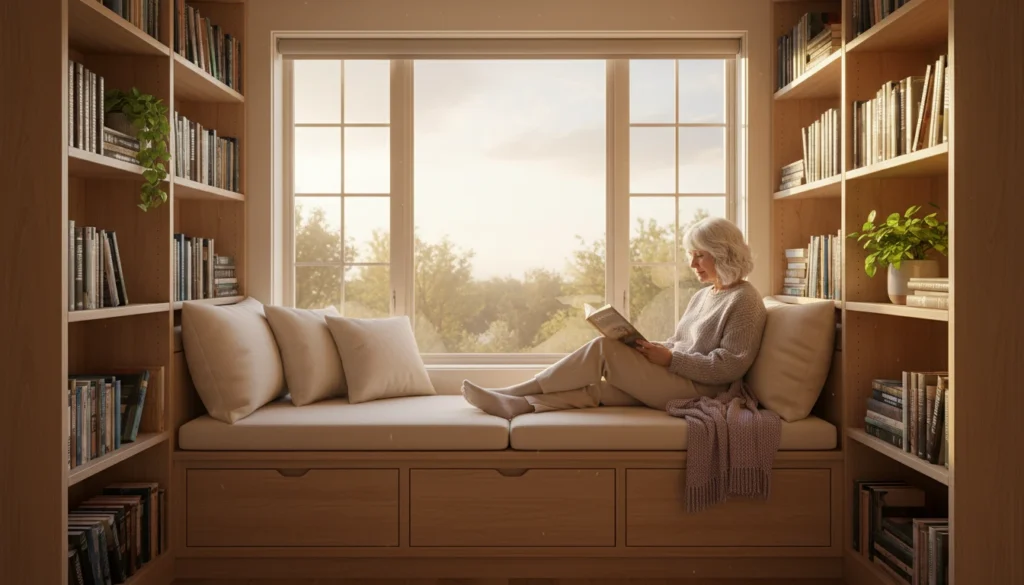
Here’s something nobody really prepares you for: retirement changes your relationship with your home.
When you were working, home was the place you came back to. Now? It’s the place you live in. All day. Every day. Which means the things that were mildly annoying before—the cramped kitchen, the cluttered hallway, the bedroom that never quite felt restful—suddenly feel a lot more urgent.
The average American home peaked at around 2,687 square feet in 2015, according to the U.S. Census Bureau. Since then, there’s been a real shift toward smaller, smarter spaces. And retirees are leading that charge—not because they have to, but because they’re realizing that a smaller, well-designed home is simply easier. On the body. On the budget. On the mind.
My sister figured this out when she traded her big rental house for a small apartment after she retired. She lost a guest room and half her closets. But she gained walkability, lower bills, and a place that finally felt like her. Watching her turn 750 square feet into something calm and genuinely beautiful is what sent me down this rabbit hole in the first place.
If you’re here, I’m guessing you want the same thing she found—and the same thing I eventually found too. A home that feels bigger, calmer, and more you. Without bulldozing walls.
Start With the Un-Sexy Hero: Decluttering on Purpose

I know. I know. “Declutter” shows up in every home improvement article like that one neighbor who shows up to every block party uninvited but somehow always brings the best potato salad. You can’t ignore it, and deep down, you know they’re right.
When it comes to small house makeover ideas, decluttering really is the foundation. You cannot layer great design on top of chaos. I’ve tried. It just looks like chaos with better lighting.
One weekend, I finally hit my limit. I opened a hallway closet and an avalanche of stuff came out—a yoga mat I hadn’t touched since 2019, three broken umbrellas, and a fondue pot I’d used exactly once. In 1987. That was the moment I decided the clutter had to go.
A research team from UCLA’s Center on Everyday Lives and Families tracked families in their homes and found a direct link between household clutter and elevated cortisol—the stress hormone. In a small house, that stress gets amplified because you see the stuff everywhere. In retirement, when your home is supposed to be your sanctuary, that’s the last thing you need.
The Three-Box Method That Actually Worked for Me
Here’s what finally worked—and I say this as someone who used to “organize” by shoving things into drawers and closing them very quickly before anything could fall out.
I grabbed three boxes and labeled them: Keep, Donate, and Maybe.
- Keep was for things I use or truly love. Not “might use someday.” Not “could come in handy.” Actually use. Actually love.
- Donate got the duplicates, the impulse buys, the gadget I swore I needed because an infomercial said so at 11pm.
- Maybe was my security blanket. The stuff I couldn’t quite let go of yet.
The rule: the Maybe box had to leave my everyday living space. Into storage it went, for three months. If I didn’t go hunting for anything in it during that time, the whole box went to donation—no peeking, no second-guessing, no “but what if.”
I’ve done this several times now. The wild part? I genuinely cannot remember what was in most of those boxes. Apparently if I don’t miss something for three months, I probably never needed it in the first place.
When the clutter finally cleared, my house didn’t get any bigger. But it felt like it did. And suddenly, all the other small house makeover ideas I’d been reading about could actually land.
Paint: The Cheapest Big Impact You’ll Ever Get
If small house makeover ideas had a star player—an MVP, a hall-of-famer, a “we couldn’t have done it without you”—it would be paint. It’s affordable, low-commitment, and you can transform a room in a weekend. Or two weekends, if you’re like me and underestimate drying times every single time without fail.
There’s this popular belief that small spaces must be painted white. Only white. Forever. Like we’re all living inside a cloud. White can be lovely, but “light and bright” doesn’t have to mean “clinical and boring”—especially in a retirement home where you want warmth and personality, not a waiting room.
I’ve had the best luck with soft, light tones that bounce light around without making the room feel flat: gentle greiges, pale blues, warm creams, muted greens. Designers talk about something called Light Reflectance Value (LRV)—colors with higher LRV bounce more light, which makes small rooms feel more open. You don’t need to memorize the term. Just know that lighter, warmer tones generally work better in small spaces than stark, cool whites.
The Accent Wall I Swore I’d Never Do
I used to roll my eyes at accent walls. They felt like the interior design version of a fad diet—trendy, dramatic, and probably something you’d regret in three years.
Then I tried one in my home office.
Three walls in soft gray. The wall behind my desk in deep navy. I figured if I hated it, I’d paint it back. Instead, every single person who walked into that room said some version of: “Wow, this feels bigger than I expected.”
That’s when it clicked. A darker accent wall creates depth, which tricks your brain into reading the room as larger. The key is choosing the right wall—the one your eye naturally lands on when you enter. Usually that’s the wall behind the bed, the sofa, or a major window.
It’s one of the fastest, cheapest small house makeover ideas you can try. And if it doesn’t work? A new coat of paint fixes almost anything. No contractor required. No son-in-law required either.
Furniture That Actually Earns Its Keep
In a big house, you can get away with a few “just pretty” pieces. In a small house, every piece of furniture has to justify its existence like it’s interviewing for a job. And in retirement, there’s an added layer: furniture should also be genuinely comfortable, easy to get in and out of, and practical for the way you actually live now.
When I got honest about what my furniture was doing for me, I had a reckoning. My gorgeous, solid-wood coffee table was basically a flat, shiny obstacle. It held a stack of magazines I never read and had given my shins more bruises than I care to admit. That was its entire résumé.
So I swapped it for a storage ottoman. Same footprint. But now it hides blankets, puzzle boxes, and the mysterious collection of remotes that seem to multiply when I’m not looking. My living room instantly felt calmer, more flexible, and honestly just more comfortable to be in.
Multi-Functional Pieces: The Secret Superpower
For small house makeover ideas that pull double duty in both style and function, I look for:
- Ottomans with storage instead of traditional coffee tables
- Sofa beds or daybeds in offices or guest rooms—so one room can do double duty when family visits
- Drop-leaf or extendable tables that stay compact for everyday use but expand when you have people over
- Beds with drawers or lift-up storage so you’re not wasting the entire under-bed universe
- Recliners with side storage—comfortable, practical, and a retirement home staple for very good reason
And here’s a visual trick I wish I’d known from day one: furniture with visible legs makes a room feel more open. When you can see more floor, your brain reads the space as larger. The first time I swapped my boxy sofa for one with raised legs, two different people asked if I’d pushed the walls back.
Spoiler: I had not. I just had better furniture.
Vertical Space: The Overlooked Goldmine
If your floors are full but your walls are bare, you’re leaving square footage on the table. One of the smartest small house makeover ideas I ever tried was to stop thinking horizontally and start looking up.
It hit me one afternoon while staring at a pile of cookbooks on my counter. Meanwhile, the wall above the counter was doing absolutely nothing. Just existing. Taking a free ride. Not contributing to the household in any meaningful way.
Enter floating shelves.
Suddenly my cookbooks, jars, and a trailing pothos had a home. The countertop cleared. The room looked taller. And I swear, my brain let out a small, audible sigh of relief.
The High-Low Rule That Keeps You Sane
A professional organizer once shared a rule with me that has genuinely changed how I set up every room: use the highest and lowest spaces for things you don’t need every day, and keep your prime eye-level zones for the stuff you reach for constantly.
In retirement, this matters even more. Bending down or reaching up repeatedly isn’t just inconvenient—it can be genuinely uncomfortable. Keeping your most-used items between knee and shoulder height is smart design and smart living.
So now I store:
- Holiday decor, extra blankets, and once-a-year items way up high
- Luggage, out-of-season clothes, and bulky stuff under beds or on the lowest shelves
- Everyday dishes, toiletries, hobby supplies, and books I’m currently reading between knee and shoulder height
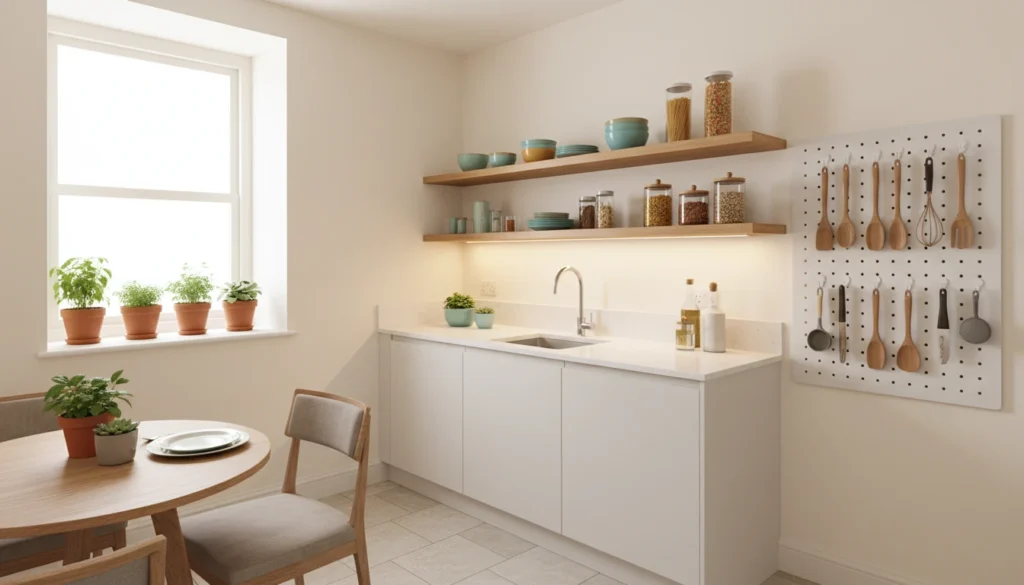
Pegboards in the kitchen, hooks by the front door, tall bookcases, a narrow shelf above a doorway—vertical storage quietly multiplies your usable space without adding a single thing to the floor.
Mirrors: Instant Space Without Moving a Wall
I used to think mirrors were mainly for checking if I had spinach in my teeth. Then I hung one opposite a window in my living room and suddenly it looked like I’d added an extra window—and half a room.
Mirrors are one of the most underrated small house makeover ideas out there. They bounce light, create depth, and make tight hallways and small rooms feel less boxed-in. In a retirement home where natural light and a sense of openness genuinely affect your mood and energy, this is worth paying attention to.
I now have:
- A tall mirror near the entry to reflect light from the front door
- A large round mirror above my living room console, catching the view from the window across the room
- A narrow mirror at the end of a short hallway to elongate the sightline
The key is being intentional about what the mirror reflects. A mirror facing a bright window or a nice view? Fantastic. A mirror facing your overstuffed laundry basket? Not doing you any favors.
I learned this the hard way. I once placed a mirror across from my “temporary” clutter corner. All it did was double the chaos. I moved it that same afternoon, slightly embarrassed that I’d thought that would work.
Lighting: The Mood Setter Your Home Deserves
Bad lighting can make even a well-designed small space feel like a basement storage closet. Good lighting can make 600 square feet feel warm, inviting, and surprisingly spacious. And for retirees, good lighting isn’t just about aesthetics—it genuinely matters for safety, reducing eye strain, and just feeling good in your own home.
For years I relied on one sad overhead fixture per room. Flip a switch, harsh light everywhere, instant headache. It wasn’t until I visited a friend’s tiny but impossibly cozy apartment that I realized what I was missing: layers of light.
She had a soft ceiling light, a reading lamp by the sofa, warm glow from under-cabinet strips in the kitchen, and a little desk lamp in the corner. Nothing fancy or expensive. But the room felt like it was giving you a hug the moment you walked in.
Now I aim for three types of lighting in each main room:
- Ambient — overall light: ceiling fixtures, larger lamps
- Task — focused light: desk lamps, reading lights, under-cabinet strips
- Accent — mood-makers: string lights, picture lights, candles
Dimmable bulbs have been a genuine game-changer. Bright for cleaning and working, soft for evenings and reading. Same small house, completely different vibe at 9 a.m. versus 9 p.m. If you haven’t switched to warm LED bulbs yet, that’s one of the easiest, most affordable upgrades you can make this week.
Open Shelving: Beautiful, But With Ground Rules
Open shelving shows up in almost every list of small house makeover ideas, and I get why. It’s airier than upper cabinets, keeps everyday items within easy reach, and makes a kitchen or living room feel more open and less boxy.
When I swapped a set of closed cabinets for open shelves in my kitchen, the room immediately felt lighter. But here’s the part Instagram doesn’t show you: open shelves only look good if what’s on them isn’t total chaos. And I say that with love, because my first attempt at open shelving looked like a very enthusiastic yard sale.
I had to build some new habits:
- Matching or coordinating dishes and containers so the shelves looked intentional
- Grouping items—mugs together, bowls stacked, jars lined up
- Leaving a little empty space so everything could breathe visually
Now it works. Daily dishes on the lower shelves. Nice-but-fragile things up high. Least photogenic items—looking at you, plastic food containers—behind closed doors elsewhere.
Open shelving can absolutely be a smart small house makeover idea. You just have to be honest with yourself about how tidy you’re actually willing to be on a Tuesday morning.
Smarter Doors: Pocket, Sliding, and Space-Saving Options
Once you notice how much space a swinging door needs, you genuinely cannot unsee it. In a small house, that door-swing zone is wasted real estate. And in a retirement home, it can also create real accessibility challenges that a sliding or pocket door would completely eliminate.
In my place, changing just one door made a surprisingly big difference. I turned the bathroom door into a pocket door that slides into the wall instead of swinging into the tiny bathroom. Suddenly I had room for a narrow cabinet that previously would’ve been smacked every time the door opened.
If cutting into walls sounds like too much, sliding barn doors or track doors are a great alternative. They stay flat against the wall, free up floor space, and can actually become a design feature rather than just a functional fix.
Just make sure the door fully covers the opening when closed and that there’s enough adjacent wall for it to slide. Once those boxes are checked, you’ve reclaimed several square feet without adding a single inch to your floorplan.
Built-Ins: Custom Solutions for Tricky Spaces
If there’s a secret level to small house makeover ideas, it’s built-in storage. That awkward nook under the stairs? Potential. The weird short wall between two windows? Potential. The empty space below a big window? Prime, untapped potential.
The first time I invested in a built-in was a simple window seat with storage underneath. Suddenly I had a cozy reading spot, hidden storage for board games and blankets, and a focal point that made the whole room feel intentional—all in a space that had previously just been a wall with a window doing nothing.
You don’t always need a custom carpenter. I’ve seen beautiful “built-in” looks created with IKEA cabinets plus a bit of trim and paint so everything looks seamless.
Some of my favorites for small retirement homes:
- Shelving or cabinets built around a doorway
- Shallow built-ins between wall studs for books or bathroom storage
- Banquette seating with storage in a dining nook—perfect for smaller gatherings with family
- A desk niche with shelves in an unused corner for hobbies, crafts, or correspondence
If you’ve got a weird spot you’re not sure what to do with, that’s usually a sign a built-in could shine there.
Color Flow: Connecting Rooms So Everything Feels Bigger
In a small house, you see more of your home at once. Standing in the living room, you might be able to see into the kitchen, the hallway, and maybe even the bedroom. That’s why color flow matters—and why it’s one of the most impactful small house makeover ideas that most people overlook entirely.
I learned this the hard way. At one point I had a yellow kitchen, a blue living room, and a gray hallway. Each room looked fine on its own. But moving between them felt like channel surfing—jarring and weirdly exhausting.
When I repainted with a more cohesive palette—soft neutrals with blue and green accents carried throughout—the whole house suddenly felt calmer and more spacious. Nothing changed in the floor plan. But the visual transitions were smoother, and the home felt like one intentional space rather than a collection of separate rooms that happened to share walls.
A simple rule designers love—and I’ve found genuinely helpful—is the 60-30-10 rule:
- 60% of the room is your main color (usually walls)
- 30% is a secondary color (furniture, large textiles)
- 10% is an accent color (pillows, art, small decor)
Repeat versions of those colors from room to room, and everything starts to feel connected instead of choppy.
Layout: Making the Same Room Feel Twice as Functional
You know those puzzles where moving one piece suddenly solves the whole thing? Furniture layout in a small house is exactly like that.
I once spent months feeling vaguely annoyed at my living room—too cramped, too awkward, not enough seating. One Saturday I dragged the sofa away from the wall (just a few inches), angled a chair instead of lining it up like it was in a waiting room, and shifted the rug. It took maybe an hour. The room felt completely different. I genuinely couldn’t believe I’d lived with the old layout for so long.
A few layout tips that consistently help in small homes:
- Float the furniture when you can instead of pushing everything against the walls
- Create clear walkways so you’re not weaving through a furniture obstacle course—especially important for safety and ease of movement in retirement
- Anchor the space with a rug that’s big enough for at least the front legs of major pieces
When in doubt, I do a “walk-through test.” I enter the room like a guest, walk to the main seating, pretend to grab a drink, head toward a window, and back out. If I bump into anything or feel like I’m navigating an obstacle course, I rearrange. Same room, same furniture, better life.
Textiles and Texture: Warmth Without the Clutter
One thing I love about small house makeover ideas is how often the smallest changes have the biggest emotional impact. Textiles—rugs, throws, pillows, curtains—are a perfect example.
They don’t take up hard space the way furniture does, but they add warmth, color, texture, and even sound-softening (genuinely helpful if your small house has a bit of an echo). In a retirement home where comfort and coziness are real priorities, getting your textiles right is worth the attention.
I used to be a pillow hoarder. No judgment if you’re there right now. Then I realized I was spending half my life moving pillows around just so I could sit down. Now I’m pickier. A few pillows that actually work with the space. A textured throw on the sofa. A soft rug underfoot. Lightweight curtains that let in light but add softness around windows. Small touches that make a compact room feel finished and intentional—not fussy and overcrowded.
Plants: Low Square Footage, High Impact
If there’s one thing I’ll always make room for, it’s plants. They don’t need much square footage, they soften the hard edges of furniture, and they make even the tiniest home feel more alive.
A study in the Journal of Physiological Anthropology found that interacting with indoor plants can reduce stress and improve mood. I didn’t need a study to tell me that—but it’s nice to know science is on board.
I like to mix:
- A taller floor plant in a corner that otherwise looks bare and forgotten
- A hanging plant or two near windows
- Small potted plants on shelves or a hobby desk
If you’re worried about keeping them alive, start with forgiving varieties—pothos, snake plants, ZZ plants. I’ve forgotten to water mine more times than I’d like to admit, and they’re still here. Loyal, low-maintenance, and genuinely good for the soul.
Letting Your Personality Show (Without Overcrowding)
One mistake I made early on was thinking a small house had to be minimal to “work.” I stripped back almost everything personal, and suddenly the space was tidy… but also kind of soulless. It didn’t feel like home anymore. It felt like a showroom that nobody actually lived in.
The sweet spot is somewhere in between: edited, but still you.
Now I keep a few shelves and corners for things that genuinely mean something:
- A framed photo from a favorite trip
- A couple of books I actually re-read
- A handmade mug from a local market
- A small piece of art I saved up for
- A memento from a milestone moment in retirement—a trip, a grandchild’s drawing, a souvenir from somewhere that mattered
The difference between clutter and character, for me, is intention. If I can point to something and say, “That’s here because it makes me happy,” it stays. If it’s just there because I never made a decision about it—it might be on borrowed time.
Key Takeaways
- Small house makeover ideas for seniors start with decluttering—it makes every other change more effective and the space feel immediately larger
- Paint, mirrors, vertical storage, and layered lighting are your best low-cost, high-impact allies
- Multi-functional furniture and built-ins turn awkward corners into your favorite spots in the house
- Furniture with visible legs, floating layouts, and properly sized rugs make rooms feel more open and easier to move through
- Cohesive color flow from room to room makes a small home feel calm and connected instead of choppy and chaotic
- Good lighting isn’t just aesthetic—it’s important for safety, comfort, and daily wellbeing in retirement
- Your home should still look like you—just the edited, intentional, less-stressed version
Final Thoughts: Small House, Big Retirement Life
If you’ve made it this far, you’ve basically walked through my entire brain on small house makeover ideas. Welcome. It’s a little crowded in here, but it’s organized—which, honestly, is the whole point.
Here’s what I’ve learned after rearranging furniture more times than I care to admit and testing ideas in a very real, very imperfect small home: you don’t need more space. You need better use of the space you have.
And in retirement, that truth hits a little differently. Because this is the season when your home becomes your headquarters—the place where you read, rest, create, host grandkids, pursue hobbies, and simply be. It deserves to feel good. It deserves to work for you, not against you.
A small house doesn’t have to be a “for now” situation or a consolation prize. With the right small house makeover ideas, it can feel intentional, welcoming, and surprisingly luxurious in its own quiet way.
There’s something genuinely wonderful about knowing every corner, every shelf, every weird little nook is working hard for you. No wasted rooms. No “we never use this space” guilt. Just a home that fits your actual life—the life you’ve built, the life you’re living right now, and the life you’re still very much looking forward to.
If your place feels a little off right now, don’t assume you need a bigger house. You might just need a weekend, a can of paint, a donation box, and a few smart tweaks.
The square footage might be small. But with the right mindset and a few creative changes, your life inside it absolutely doesn’t have to be. 🏡





One Comment
Comments are closed.