Living Room Decor Ideas for Retirees: How to Create a Space That Finally Works for You
Discover the best living room decor ideas for retirees — from curved furniture and warm colors to smart lighting and multi-functional spaces — and build a home that fits your life now.
Nobody warns you about the living room problem in retirement.
They warn you about the financial stuff — make sure your savings last, watch your withdrawal rate, don’t panic when the market does something dramatic. They warn you about the social stuff — stay connected, find your people, don’t let the days blur together. But nobody sits you down and says, “Hey, you’re about to spend a lot more time in your living room than you ever have in your life. You might want to think about that.”
And then retirement arrives, and suddenly you’re home. Really home. Not “home by 7pm, eat dinner, collapse” home — but home for morning coffee that actually gets finished while it’s still warm, afternoon reading sessions that stretch past three o’clock, video calls with the grandkids, hobby projects spread across the coffee table, and everything in between. Your living room is now doing more work than it’s ever done in its entire existence.
If it’s still running on a 2012 setup — boxy sofa, cool gray walls, one harsh overhead light, a rug that “kind of fits” because it was on sale — it might be time for a real conversation.
The good news is that the best living room decor ideas right now are practically made for this chapter of life. They’re warmer, softer, more personal, and more functional than anything that came before. And you don’t need a designer, a renovation budget, or a Pinterest addiction to pull them off. You just need to know what’s worth borrowing — and what you can safely ignore.
Key Takeaways:
- Curved furniture and soft lines make rooms feel more relaxed and welcoming — and reduce sharp corners that become a daily navigation hazard
- Warm, earthy colors replace cold grays and create spaces that feel secure, calm, and emotionally supportive
- Biophilic design — plants, natural materials, natural light — measurably reduces stress and improves cognitive function
- Multi-functional furniture is a smart investment for retirees who use their living rooms for everything from hobbies to hosting grandkids
- Sustainable and vintage choices save money, reduce waste, and create more personal, story-rich spaces
- Layered lighting is the single fastest way to transform how a room feels — and it supports eye health and sleep quality as we age
- The best living room decor ideas are the ones you actually use — not the ones that look good in photos
Why Your Living Room Deserves a Real Upgrade in Retirement
Here’s something I’ve noticed talking to a lot of retirees: the living room is almost always the last room to get any love. Kitchens get renovated. Bedrooms get new mattresses. Bathrooms get updated fixtures. But the living room? It just quietly accumulates — a sofa from one decade, a rug from another, a lamp that came with the house and nobody’s ever questioned because it technically works.
For most of your working years, that was fine. You weren’t really in there that much. The living room was more of a pass-through than a destination.
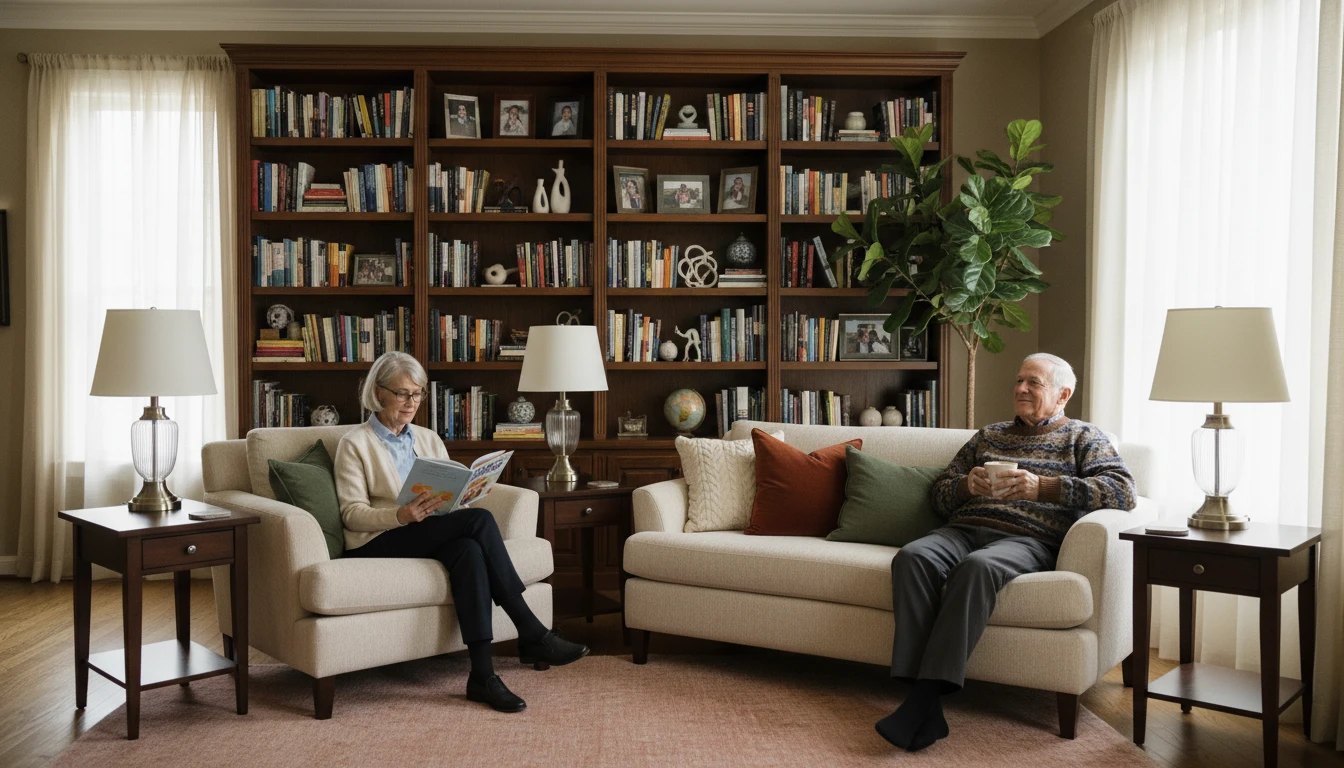
But retirement changes the math completely. You’re spending significantly more time at home — and specifically in your living room — than you ever did during your working years. That space is now pulling more weight than it ever has: morning routines, hobbies, hosting, resting, thinking, connecting. It deserves to be designed for that reality, not just inherited from it.
A 2023 study in the Journal of Environmental Psychology found that people who intentionally personalize and design their home spaces report significantly higher life satisfaction and lower stress — not because they hired expensive designers, but because the space finally felt like theirs. That’s the real case for updating your living room decor. Not trends for trends’ sake. Not keeping up with anyone. Just building a room that quietly supports the life you’re actually living now.
If you’re thinking about how your home fits into the bigger picture of retirement life, Retirement Lifestyle Planning: The Real, Honest Guide to Finances, Health, and Living Well covers the full picture — living space included — in a way that doesn’t make you feel like you need to overhaul everything at once.
Curves Are In: Goodbye, Boxy Furniture
For a solid decade, “modern” meant sharp. Crisp corners, rigid lines, furniture that looked like it was designed by someone who’d never actually sat on a sofa. Glass tables with edges that could file a lawsuit. Square arms on every chair. Everything very serious and geometric, like your living room was auditioning for an architecture magazine.
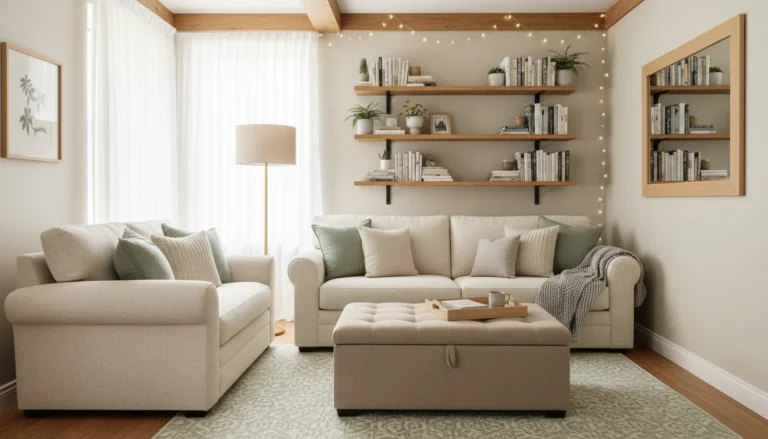
The latest living room decor ideas have gone soft — and honestly, it’s about time. Curved sectionals, rounded coffee tables, arched floor lamps, soft-edged shelving — curves are showing up everywhere, and the effect is immediate. Rooms feel calmer. More welcoming. Like they’re inviting you to sit down instead of standing at attention.
And for retirees specifically, this shift matters beyond aesthetics. Rounded edges mean fewer sharp corners to navigate around — a quiet but real safety consideration when you’re moving through the same space multiple times a day. A rounded coffee table won’t catch your hip on the way to the kitchen at 6am. A curved sectional with a gentle slope is easier to get in and out of than a rigid, boxy frame. Good design and practical design don’t have to be two different things.
Researchers at the University of Toronto also found that people instinctively associate curved forms with safety and comfort — our brains read a curve and quietly decide, “this is a friendly place.” For a living room that’s supposed to be your most restful space, that’s not a small thing. Especially in retirement, when “restful” isn’t a luxury — it’s the whole point.
Consider a Curved Sofa or Chair
If you’re already thinking about new seating, this is where one decision can shift the whole room. A curved sectional, a sofa with rounded arms, or even a single sculptural accent chair can soften every straight line around it.
When I finally swapped my old boxy charcoal sofa for a lighter, slightly curved one, I didn’t change anything else for a full month just to see what happened. People kept walking in and saying the room felt “cozier” — even though I’d literally only changed one piece of furniture. That’s the quiet power of a curve. It doesn’t announce itself. It just makes everything around it feel a little more human.
Brands like Article and West Elm have solid curved options starting around $1,200. And if you’re shopping secondhand, curved pieces from the 70s and 80s are having a serious moment right now — which means estate sales and vintage shops are full of them at a fraction of the price. For retirees on a fixed income, that’s not a footnote. That’s the whole strategy.
Swap in Rounded Accent Pieces
Not ready for a new sofa? Small curved pieces can still move your living room decor in the right direction without a major commitment:
- A round coffee table instead of a rectangle — no sharp corners, easier to move around
- Circular side tables that tuck in easily
- An arched floor lamp that visually softens a corner
- A big round mirror that bounces light and breaks up straight-lined walls
I grabbed a simple round ottoman for under $200, and it completely changed how people move through the room. Instead of dodging corners, they just flow around it. My shins are genuinely grateful. That’s not a small quality-of-life improvement when you’re moving through the same space every single day.
Use Curved Details in Decor
You can also bring curvature in through smaller, lower-commitment details:
- Bowls and trays on your coffee table
- Vases with rounded, organic silhouettes
- Artwork that uses soft, wavy lines
- Rugs with curved, almost hand-drawn patterns instead of strict grids
Curves don’t need to take over your living room decor. They just need to show up often enough that the room stops feeling like it’s bracing for something.
The Great Gray Exodus: Embracing Warm, Earthy Colors
There was a solid decade where gray was the answer to everything in home design. New build? Gray. Rental refresh? Gray. Don’t know what to do? Gray. If your living room currently looks like a permanent overcast Tuesday, you are very much not alone — and the good news is, the design world has officially moved on and it’s taking us with it.
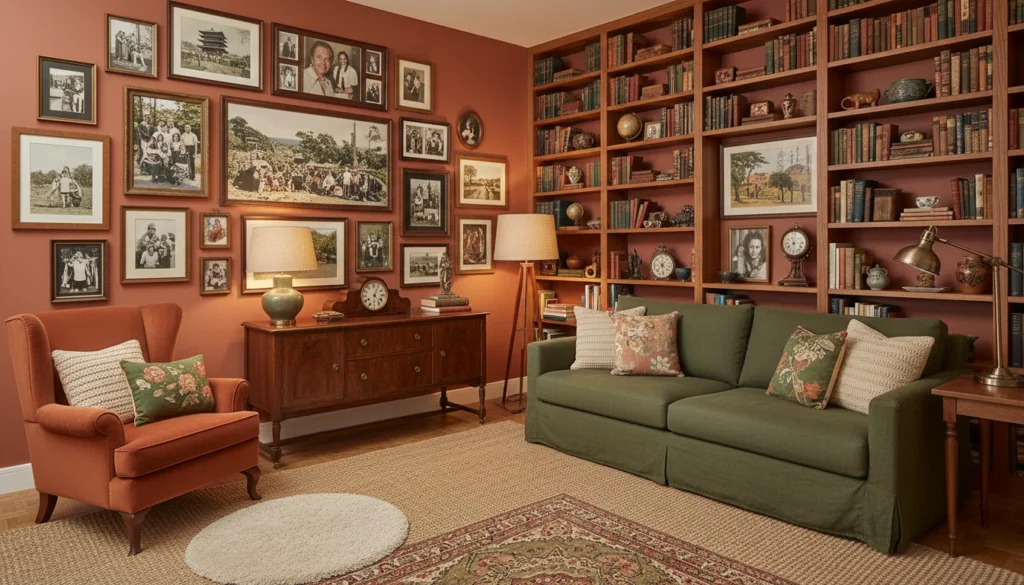
The current wave of living room decor ideas is replacing cool gray with warm, earthy tones: terracotta, clay, camel, caramel, olive, sage, ochre, and creamy off-whites that feel lived-in rather than sterile. And this isn’t just a “looks nice on Instagram” shift. Color psychology research from the University of British Columbia has shown that warm, natural tones can measurably reduce anxiety and make spaces feel more secure and welcoming.
For retirees, that matters more than it might sound. Retirement brings its own emotional weather — quieter days, more time alone with your thoughts, the occasional afternoon that stretches a little too long. The color of your walls is quietly affecting your mood every single day. If those walls are currently the color of a rainy afternoon, that’s worth changing. Warm tones don’t just look better — they feel better, especially during the slower, more reflective rhythms of retirement life.
Start With One Confident Color
When I repainted my own living room, I didn’t go full terracotta cave. I chose a soft, warm neutral with the faintest hint of clay — on the paint chip it looked terrifyingly orange; on the wall it just looked like “cozy, but awake.” That’s the sweet spot you’re aiming for.
Pick one anchor color you’re genuinely excited about. It could be:
- A terracotta accent wall behind the sofa
- A deep olive green media console
- A rust or cognac accent chair
- A warm, spiced rug that ties everything together
Once you choose your hero color, everything else becomes about supporting it — not competing with it. The room starts to feel like it has a point of view instead of just a collection of things.
Layer in Warm Neutrals
Instead of stark white and blue-based gray, think:
- Cream
- Sand
- Warm taupe
- Latte-ish beige
These create a soft, calm base that lets your bolder color move around the room without shouting. You can keep some gray in your living room decor — just make sure it’s mixed with warmer tones so it reads as current rather than cold.
Add Depth With Textures and Patterns
An earthy palette without texture can still fall flat — like someone turned the saturation down on your life. The trick is layering materials:
- Linen or cotton curtains that catch the light
- Velvet or chenille cushions for a little luxury
- Woven jute or wool rugs for grounding
- Clay, ceramic, and wood accents for warmth
Patterns help too, in small doses: subtle stripes, small-scale florals, quiet abstracts. Keep them within your color palette so your living room decor looks layered and intentional — not like three different rooms had a collision.
Maximalism, But Make It Curated
For a long time, minimalism got all the good press. White walls, one plant, three objects on a shelf, and a constant low-grade anxiety about owning too many things. If that never matched your actual life — or your actual decades of accumulated memories — you’re in very good company.
The latest living room decor ideas are giving maximalism a thoughtful comeback. Not “everything I own is on display” maximalism, but curated maximalism — spaces that are full, interesting, and personal without feeling like a storage unit with better lighting.
This is a natural fit for retirees, and I mean that genuinely. You’ve lived a full life. A really full one. You have things that mean something — travel souvenirs from trips you saved up for and planned for years, family photos spanning multiple generations, books you’ve actually read and underlined and argued with, art you collected because it moved you, not because it matched the couch. A curated maximalist approach lets all of that show up without apology. Your living room gets to tell your story — the whole story, not just the edited highlight reel. And in retirement, when you finally have time to sit in that room and actually look around, that story matters more than ever.
Use a Limited Color Palette
Maximalism works best when there’s a thread tying everything together. Pick two or three main colors and repeat them across the room — pillows, art, book spines, vases, rug, throws. You can own a lot of things and still have them look like they belong to the same chapter of the same story.
Mix Patterns With Intention
You can absolutely mix florals, stripes, geometrics, and abstract prints — as long as you play with scale:
- One large-scale pattern (often the rug)
- One medium-scale (maybe pillows or curtains)
- One small-scale (throws, trays, or art)
That balance keeps your eye moving comfortably instead of feeling like it’s trying to decode static. The room feels layered, not chaotic.
Respect Negative Space
Even a bold, maximalist-leaning living room decor needs a place to breathe. Leave bits of wall uncovered. Let one shelf be less full than the others. Keep a section of your coffee table mostly clear.
The goal isn’t to show everything you own — it’s to show the things that tell your story. There’s a real difference between those two things, and it’s the difference between a room that feels rich and one that just feels crowded.
Biophilic Design: Nature, But Make It Livable
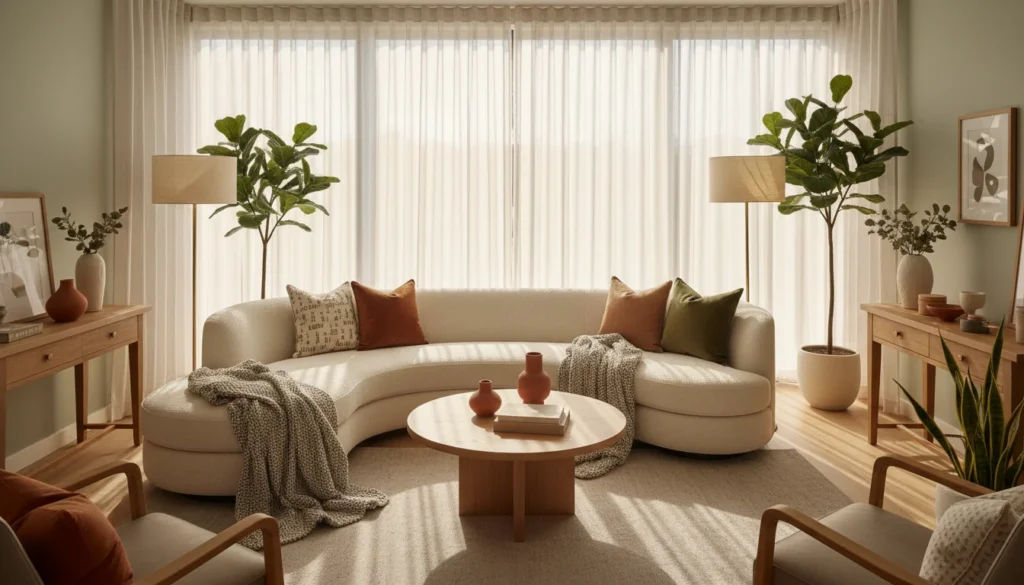
“Add some plants” is decent advice, but the newer wave of biophilic design goes deeper than sticking a fiddle leaf fig in the corner and hoping it survives the winter.
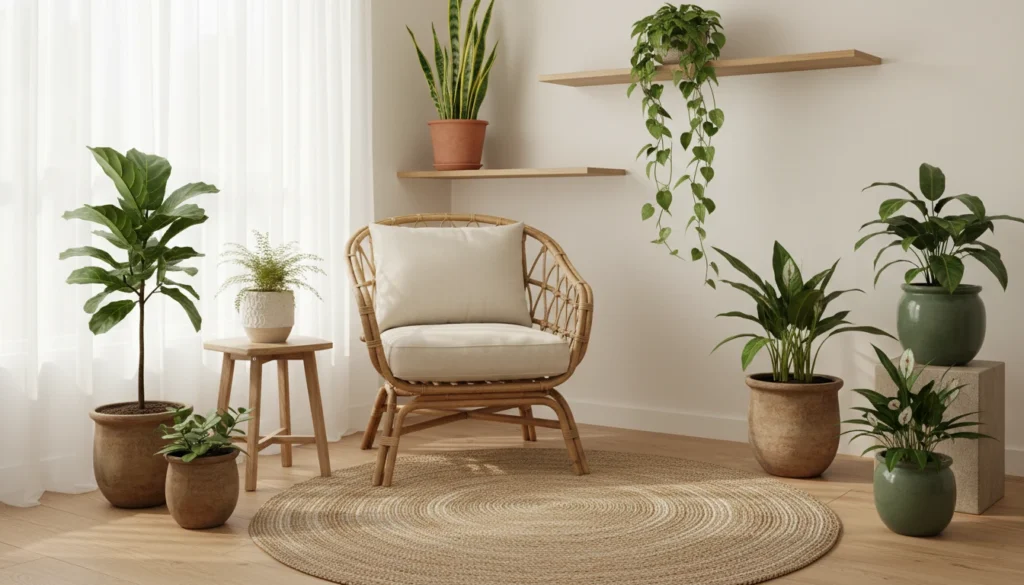
Biophilic design is about intentionally weaving nature into your home — through light, materials, views, and yes, plants. A 2024 study in Building and Environment found that living spaces with strong biophilic elements — greenery, natural textures, views outdoors — help lower cortisol levels and improve cognitive function. In other words, a well-designed, nature-inspired living room can literally help you think more clearly and stress a little less.
For retirees navigating health concerns, family dynamics, financial decisions, and the general uncertainty of this chapter, that’s not a small thing. It’s the kind of benefit that quietly shows up every single day — in how you feel when you sit down with your morning coffee, in how easily you settle into an afternoon book, in how calm the room feels when the news is anything but. And research increasingly shows that regular exposure to natural elements supports cognitive health as we age — which makes biophilic living room decor ideas less of a style choice and more of a genuinely smart investment in your wellbeing.
Bring in Real Plants (That Don’t Hate You)
If you’ve killed a houseplant or three, you are not alone. I once managed to kill a cactus. A cactus. Start with genuinely forgiving varieties:
- Snake plants
- ZZ plants
- Pothos
- Philodendron
These can handle less-than-ideal light and the occasional “oh no, I forgot to water you for two weeks” situation. Group a few together in different heights and pots to create a mini indoor garden moment without it feeling like a second job.
Use Natural Materials Everywhere You Can
You don’t have to rebuild your house in timber and stone. Just look for places where you can swap in natural materials:
- Wood coffee tables, frames, consoles, or stools
- Rattan, cane, or wicker chairs and baskets
- Stone or ceramic lamp bases, trays, and coasters
- Linen and cotton for pillows, throws, and curtains
When I replaced a metal-and-glass side table with a simple wood stump table, it instantly grounded that corner of the room. Same lamp, same chair — completely different feel. Natural materials have a warmth that manufactured surfaces just can’t replicate, no matter how good the finish is.
Let the Light In (For Real)
Natural light is a huge part of biophilic design, but it’s also the part we quietly sabotage with heavy curtains and furniture shoved against windows.
If you can, try:
- Swapping blackout panels for sheers or lighter linen
- Pulling large furniture a few inches away from windows
- Cleaning your windows more than once every presidential election
Even in a small or darker space, mirrors placed opposite windows can help bounce available light around and brighten your living room considerably. And for retirees, natural light isn’t just aesthetically nice — it supports your circadian rhythm, your mood, and your sleep quality. That’s a lot of work for a clean window.
Multi-Functional Spaces: Your Living Room, But Smarter
If your living room is pulling triple duty — hobby room, reading nook, grandkid zone, and movie theater — you’re not doing it wrong. You’re just living in retirement.
The latest living room decor ideas don’t pretend every room has a single, pure function anymore. They lean into flexibility. And for retirees who are home more than ever, designing around that reality instead of fighting it makes everything easier — and a lot less frustrating.
Because here’s the thing nobody tells you: retirement doesn’t mean you stop doing things. It means you finally have time to do all the things you kept putting off. The watercolors. The woodworking. The genealogy research. The novel you’ve been meaning to start for fifteen years. All of that needs somewhere to live — and it’s probably going to be your living room. So you might as well design it to handle all of that gracefully.
Invest in Transforming Furniture
Pieces that change with you are worth every inch of their footprint:
- A lift-top coffee table that becomes a desk or craft surface
- Ottomans with storage for blankets, games, or hobby supplies
- Nesting tables that spread out for guests and tuck away after
- A sleeper sofa or daybed for visiting grandchildren or family
My lift-top coffee table cost under $400 and quietly runs my workday. At the end of the afternoon, I drop the top, tuck the work stuff inside, and it goes back to being just a coffee table. That clean separation between “productive” and “relaxed” matters more than I expected — especially when both happen in the same room, sometimes within the same hour.
Create Zones With Rugs and Lighting
You can use rugs and lighting to draw a map of your living room without building any new walls:
- A low-pile rug under your reading or hobby area
- A softer, more plush rug for the TV or lounge zone
- A bright, focused task lamp where you work or craft
- Warmer, dimmable lighting for the rest of the room
Your brain will start to associate certain corners with certain activities — which makes it a lot easier to mentally shift gears between “productive” and “relaxed” even when you’re in the same room. It sounds almost too simple to work. It works.
Hide the Work When the Day’s Over
One of the simplest ways to protect the restful feel of your living room is to make your project stuff literally disappear at the end of the day:
- Baskets or bins that can swallow laptops, craft supplies, or notebooks
- A sideboard, cabinet, or armoire with doors that fully close
- A rolling cart you can wheel into a closet
There’s something weirdly satisfying about physically putting things away — even if it’s only five steps from the sofa. The room exhales. And so do you. That transition from “working” to “resting” matters more in retirement than most people expect, because the lines between the two can get blurry fast. Having a living room that supports both — and can switch between them cleanly — is one of the most underrated things you can do for your daily wellbeing.
Sustainable and Vintage Choices: Good for the Planet, Great for Style
Here’s the uncomfortable truth: constantly buying new decor every time a trend shifts is tough on your budget and on the planet. According to the U.S. Environmental Protection Agency, Americans send over 12 million tons of furniture and furnishings to landfills every year. Once you picture that, it’s hard to un-see it.
The latest living room decor ideas lean hard into vintage, secondhand, and sustainably made pieces. And for retirees on a fixed income, this approach has a very practical upside: secondhand and vintage pieces are almost always significantly cheaper than new — and often far more interesting, because they come with actual history instead of just a price tag. You’re not settling for less. You’re getting more — more character, more story, more value per dollar.
Shop Vintage and Secondhand First
Some of the best pieces in a living room weren’t bought new at all. They came from:
- Facebook Marketplace
- Local thrift and vintage shops
- Estate sales
- Community buy/sell groups
I once found a mid-century-style credenza for $150 because the owner was moving and didn’t want to drag it across the country. It’s now the quiet star of the room, and people constantly assume it’s some fancy designer piece. It is not. It cost less than a nice dinner out. And every time someone compliments it, I feel a small, private satisfaction that I will never get tired of.
Reupholster and Refresh Instead of Replacing
If a sofa, chair, or ottoman has a solid frame but questionable fabric, reupholstery can be magic. It’s not always cheap, but it’s often comparable to — or less than — buying a quality new piece, and you get something unique in the process.
You can also:
- Refinish or stain wood tables and consoles
- Swap dated hardware on cabinets and sideboards
- Paint older shelving units a fresh, modern color
Sometimes the difference between “old junk” and “vintage treasure” is literally one afternoon and a can of paint. I’ve seen it happen. It’s a little miraculous every time — and it’s the kind of project that retirement finally gives you the time to actually do properly, without rushing.
Support Sustainable Brands When You Buy New
When you do go new, look for brands that build sustainability into their DNA: FSC-certified wood, recycled textiles, modular designs that can be repaired or reconfigured instead of tossed.
The bonus? A sustainable-minded living room decor approach usually ends up looking more collected and personal — because you’re not just copying whatever big box store has on the first display table.
Lighting: The Secret Weapon of a Great Living Room
Lighting is one of those things you don’t notice until it’s bad. My first place had exactly one overhead light in the living room — bright, harsh, and about as flattering as a DMV photo. Once I swapped that fixture and added a couple of lamps, the entire space instantly looked more expensive. Same furniture, same rug, completely different mood.
For retirees, lighting also has a practical dimension that goes well beyond aesthetics. Our eyes change as we age — the lenses thicken, pupils become less responsive to light, and we genuinely need more illumination to see comfortably than we did at 40. If you’ve noticed that you need more light to read than you used to, you’re not imagining it. Good task lighting reduces eye strain during reading or hobbies, warmer ambient light in the evening supports better sleep, and well-lit spaces are simply safer to move around in — which matters more as we get older, even if we don’t always want to say it out loud. Lighting isn’t just a design choice in retirement. It’s a quality-of-life choice.
Start With Ambient Lighting
Ambient lighting is the base layer in your living room decor:
- Ceiling fixtures
- Recessed or track lighting
- Large pendants or chandeliers
If your current overhead light is a basic builder special, upgrading to a more sculptural pendant or flush mount can transform the room in a single afternoon. I swapped mine for a simple modern fixture and had multiple people ask if I’d redone “everything” in the space. I had not. I had changed one light. That’s how much lighting matters.
Add Task Lighting
Task lighting handles the jobs:
- Floor lamps by the sofa for reading
- Table lamps on side tables or consoles
- A small lamp or sconce near your hobby or work zone
These little pools of light make your living room feel layered and cozy while actually letting you see what you’re doing — which, after 60, is not a small consideration. A good reading lamp is one of the best investments you can make in your daily comfort. Don’t underestimate it.
Finish With Accent Lighting
Accent lighting is where the personality sneaks in:
- Picture lights above artwork
- LED strips inside bookshelves or behind media units
- Small spotlights aimed at textured walls or big plants
If you can, put your main lights on dimmers. I spent about $100 upgrading to dimmable switches, and now I can shift the whole room from “bright and focused” to “movie night” without moving anything but my thumb. It’s one of the best $100 I’ve spent on this house. And for retirees who are more sensitive to harsh light in the evenings — which affects melatonin production and sleep quality — dimmable lighting isn’t just cozy. It’s genuinely good for you.
Texture Layering: The Secret to a Room That Feels Finished
You can have all the right pieces — a nice sofa, a good rug, a pretty coffee table, art on the walls — and still have a living room that feels oddly flat. That’s almost always a texture problem.
The latest living room decor ideas lean heavily on texture because it’s what makes even simple rooms feel rich and intentional. It’s the difference between a room that looks like a catalog and a room that feels like a home. And in retirement, when you’re spending real time in that room every single day, “feels like a home” matters a lot more than “looks like a catalog.”
How to Layer Texture Without Overthinking It
Start by taking inventory:
- Is your sofa smooth or nubby?
- Is your rug flat-woven or plush?
- Are your tables glossy or matte?
If everything is smooth, shiny, and flat, your job is to add contrast. You might:
- Toss a chunky knit blanket over a sleek leather sofa
- Put a thick, soft rug under a slim, modern coffee table
- Add linen or bouclé pillows to a tight-weave couch
- Hang a woven wall hanging or textured canvas
When I did my most recent living room refresh, I added exactly three things: a heavy, nubby throw, two velvet pillows, and a woven basket for blankets. The room instantly looked more pulled together — like I’d thought about it, instead of just bought things and hoped for the best.
The goal is simple: give your eyes and hands different things to land on. That’s what makes a room feel finished rather than just furnished. And there’s something quietly satisfying about a room that feels good to touch — the softness of a good throw, the warmth of a wood surface, the weight of a ceramic bowl. In retirement, when you’re actually sitting still long enough to notice those things, they matter more than you’d expect.
Smart Tech That Doesn’t Ruin the Vibe
For a while, smart home tech felt like the enemy of cozy design. Cables everywhere, blinking routers, giant black speaker boxes — it was a lot. The newer wave of living room decor has figured out how to let tech do its thing without visually announcing itself every five seconds.
For retirees, smart home tech also has a genuinely practical upside that goes beyond convenience. Voice-controlled lighting means you don’t have to get up every time you want to dim the room — which matters more when joints are stiff or balance is a consideration. Smart thermostats learn your preferences and adjust automatically, so you’re not constantly fiddling with settings. Automated window treatments let you control light and privacy without wrestling with cords. And entertainment systems that respond to simple voice commands mean you’re not calling your grandkids for help every time you want to watch something. Good tech in retirement isn’t about being fancy. It’s about making daily life genuinely easier — quietly, in the background, without making a big deal of itself.
Integrating Tech Seamlessly
Some of the best low-visibility upgrades:
- Smart lighting with presets like “Morning,” “Reading,” and “Movie Night” — controllable by voice or a single tap, no tech degree required
- Frame-style TVs that display art when they’re off, so your wall isn’t dominated by a black rectangle
- Hidden or discreet speakers — in-ceiling, in-wall, or disguised as decor — so you get great sound without the tech takeover
- Furniture with built-in charging so cords can disappear into drawers and armrests instead of draping across the floor — a genuine trip hazard worth eliminating
I resisted getting a frame TV for ages, assuming it was more hype than help. Then I visited a friend who had one and realized I’d spent 20 minutes admiring the “art” before she casually turned on Netflix. Now mine blends into a gallery wall, and the whole living room feels calmer when the TV’s off. That calm matters more than I expected.
The rule of thumb: tech should support how you live in the room, not dictate how the room looks.
Making It Personal: Your Living Room, Your Rules
Here’s the part that gets skipped in a lot of glossy design advice: you do not have to adopt every trend. You don’t even have to like most of them.
The real win is using these living room decor ideas as a menu, not a checklist. You pick what works for your lifestyle, your taste, and your budget — you leave the rest behind without guilt. Because the goal was never to have a living room that looks like a design magazine. The goal is a living room that makes your actual life better.
I know someone whose heart is basically minimalist but who secretly loves loud gallery walls. Her compromise? One statement wall packed with art over the sofa, and everything else in the room kept calm and simple. It looks intentional because it matches who she actually is — not who a design magazine told her to be. That’s the version of “trend-following” that actually works.
Before you buy anything in the name of “updating” your living room, it helps to ask:
- Does this support how I really use this room?
- Will I still like this in two or three years?
- Does it play nicely with what I already own?
- Am I buying this because I love it — or because an algorithm convinced me I should?
When your answers line up, living room decor ideas stop feeling like pressure and start feeling like tools. That same principle — figuring out what actually fits your life now, not the life you used to have — applies to retirement broadly. Finding Purpose in Retirement: Practical Steps Toward a More Meaningful, Active Life explores that in a way that goes well beyond home decor, if you’re in that kind of reflective mood.
The Bottom Line on Living Room Decor Ideas for Retirees
At its core, the best living room decor ideas for retirees aren’t about creating a museum piece that nobody’s allowed to touch. They’re about making your living room pull its weight — emotionally, practically, and yes, aesthetically.
Curved furniture and softer lines make rooms feel more relaxed — and safer to move around in. Warm, earthy colors wrap everything in a sense of comfort that supports the quieter rhythms of retirement life. Biophilic design brings in nature’s calm and supports cognitive health. Curated maximalism lets your personality and your decades of lived experience actually show up. Smart lighting, texture layering, sustainable choices, and quiet tech integration all team up so your space feels intentional instead of accidental.
In retirement, your living room is no longer just a room you pass through. It’s where your days actually happen — the slow mornings, the long afternoons, the spontaneous visits, the hobbies that finally have time to breathe, the quiet evenings that you’ve honestly earned. It deserves to be designed for that reality, not just inherited from a version of your life that no longer fits.
Start small. One curved piece. One new color. One plant. One smarter light. You’ll be surprised how quickly the energy of your living room shifts — and once you get used to a space that actually supports you and reflects you, it’s pretty hard to go back to “couch against the wall and hope for the best.”
And if redesigning your living room is part of a bigger rethink of how you want to live in retirement — where you live, how you structure your days, what your home actually needs to do for you now — Retirement Lifestyle Planning: The Real, Honest Guide to Finances, Health, and Living Well is a good place to start that conversation.