

Exercise for Body Types After 60: Your Guide to Working Out Smarter, Not Harder
Discover how exercise for body types after 60 can transform your retirement fitness — personalize your workouts, protect your joints, and finally stop fighting your own genetics.
Key Takeaways:
- Your body type — ectomorph, mesomorph, or endomorph — shapes how you respond to exercise, especially after 60
- Most people are a blend of two types, and that’s completely normal
- Ectomorphs over 60 need heavy compound lifts, minimal cardio, and generous nutrition
- Mesomorphs thrive on variety — rotating strength, hypertrophy, and conditioning phases
- Endomorphs build their best results on a foundation of strength training, not endless cardio
- Individual factors like sleep, stress, hormones, and recovery time matter just as much as body type
- The best workout plan is the one you’ll actually stick with — consistency beats perfection every time
Retirement has a funny way of making you rethink everything — your schedule, your priorities, your relationship with the couch. But here’s one thing I didn’t expect to rethink when I hit my sixties: my entire approach to exercise.
For years, I treated fitness like a universal math equation. Do X workouts, eat Y protein, get Z results. Simple, right? Except it wasn’t. I watched one friend lose fat just by thinking about cardio, while another practically moved into the gym and barely saw a change. That’s when I started paying attention to something most people never really factor in — especially after retirement: the relationship between body types and exercise.
Once I understood how exercise for body types after 60 actually works, so many things finally clicked. Why some people gain muscle quickly while others struggle. Why your friend thrives on long walks and you burn out after twenty minutes but absolutely crush it in the weight room. It’s not that your body is broken. It’s that your body is different — and after 60, those differences become even more pronounced.
And if your body is different, your workouts should be too.
What Do We Mean by “Body Types”?

Back in the 1940s, psychologist William Sheldon developed a system called somatotypes — three general body types based on physical structure and how we tend to carry muscle and fat. His attempt to link body types to personality didn’t hold up (thankfully, or we’d all be in trouble), but the physical side of his work still shows up in modern sports science and retirement fitness planning.
The three classic body types are:
- Ectomorph — Naturally lean, often with longer limbs, struggles to gain weight or muscle
- Mesomorph — Naturally muscular or athletic-looking, gains muscle easily, responds quickly to training
- Endomorph — Softer, rounder build, gains weight easily, often has to work harder to lose body fat
Here’s what I wish someone had told me sooner: almost no one is a “pure” type. Most of us live somewhere in the overlap — an ecto-meso, an endo-meso, or some other fun hybrid that makes clothing sizes a daily adventure.
And after 60? Your body type tendencies can actually intensify. Ectomorphs may find it even harder to hold onto muscle. Endomorphs may notice fat redistributing in new and unwelcome places. Mesomorphs may discover that recovery takes longer than it used to. Understanding your type isn’t about boxing yourself in — it’s about giving yourself a smarter starting point.
According to AARP’s guide to essential exercises for aging well, adults over 50 need a combination of strength, cardio, balance, and flexibility work — but how you balance those elements should absolutely depend on your body type and individual response.
Ectomorphs After 60: The Lean Machines Who Need to Fight for Every Pound of Muscle
If you’re an ectomorph, you’ve probably heard some version of, “Wow, you’re so lucky, you can eat anything.” Which is great… until you actually want to hold onto muscle in your sixties and realize your metabolism is still running like a hummingbird on espresso — but now your hormones aren’t exactly cooperating.
Ectomorphs tend to have:
- Narrower shoulders and hips
- Long limbs
- A fast metabolism
- A hard time gaining both fat and muscle
I had a college roommate like this. Let’s call him Jake. Jake would crush an entire pizza at midnight, sleep four hours, and wake up with visible abs. But when he tried to bulk up for wrestling season, it was like trying to fill a bathtub with the drain open. Now that we’re both in our sixties, Jake’s biggest challenge isn’t staying lean — it’s staying strong. Sarcopenia (age-related muscle loss) hits ectomorphs particularly hard because they had less muscle to begin with.
According to CNN’s coverage of age-related physical decline, muscle loss typically starts around age 30 and accelerates significantly after 60. For ectomorphs, this makes strategic strength training non-negotiable.
Strength Training for Ectomorphs Over 60
When it comes to exercise for body types after 60, ectomorphs do best with training that focuses on quality over quantity. The goal is to send a loud, clear signal to your muscles to grow — without burning through every calorie you’ve eaten that day.
Think big, compound lifts:
- Squats
- Deadlifts
- Bench presses
- Rows
- Overhead presses
I usually recommend 3–4 sets of 6–10 reps for most exercises. Heavy enough to challenge you, but not so many reps that you’re basically doing cardio with dumbbells. And here’s the part many ectomorphs resist: you need more rest than you think. After 60, recovery windows are longer. Training the same muscle group hard more than twice a week is usually overkill — and the injury risk goes up considerably.
I went through a phase where I hit shoulders three times a week because I wanted “capped delts.” What I got instead was tendonitis and three weeks off pressing anything overhead. Lesson learned the painful way.
Cardio for Ectomorphs After 60
Do ectomorphs need cardio? Yes — your heart still exists, and the CDC recommends at least 150 minutes of moderate aerobic activity weekly for older adults. But if your goal is muscle preservation, cardio shouldn’t be your main hobby.
Short, purposeful sessions work best:
- 2–3 times per week
- About 20–30 minutes per session
- Brisk walking, cycling, or short HIIT sessions
I used to run five miles three times a week because I thought that’s what “fit” people did. When I finally admitted I cared more about staying strong than improving my 10K time, I cut my runs down, focused on lifting, and — shockingly — my muscles stopped ghosting me.
Eating Like It’s Your Part-Time Job
For ectomorphs over 60, nutrition is half the battle. You’re going to need a caloric surplus — usually 300–500 calories above maintenance — with plenty of protein (aim for 1.2–1.6 grams per kilogram of body weight) and enough carbohydrates to fuel training and recovery.
I’ve had phases where eating enough felt like a second job. Meal prep containers, protein shakes between morning walks, peanut butter on everything. Did it feel glamorous? Not remotely. Did it work with the right exercise strategy for my body type? Absolutely.
Mesomorphs After 60: The “Natural Athletes” Who Still Need to Work for It
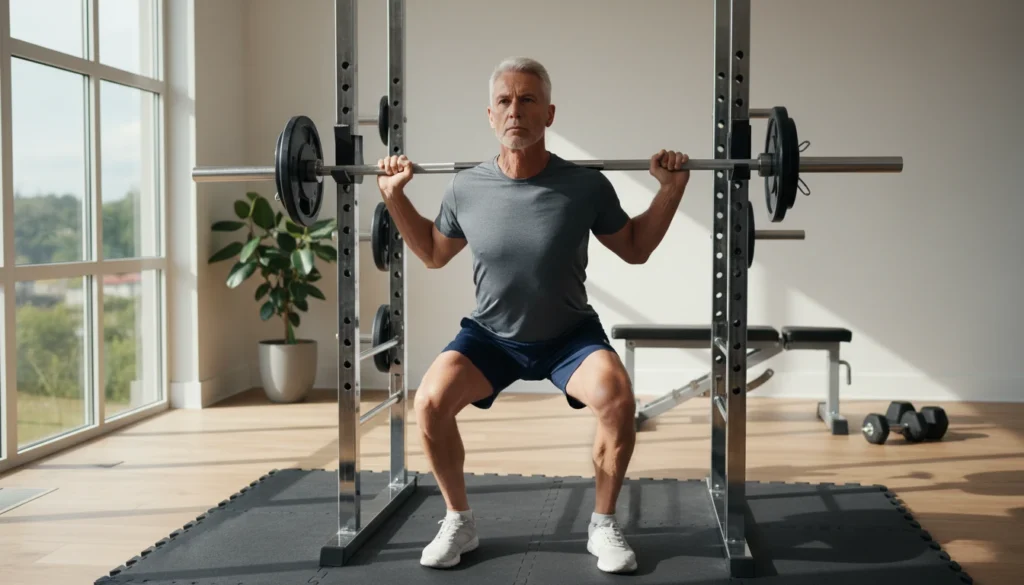
If ectomorphs are trying to gain and endomorphs are trying to lean out, mesomorphs are the people who walk into a gym and their body just… gets the memo. Even after 60, they tend to respond well to training — but they’re not immune to the realities of aging.
Mesomorphs often have:
- Naturally broader shoulders
- A relatively narrow waist
- Good muscle definition, even without intense training
- A strong response to both strength and cardio work
A study in the Journal of Sports Sciences observed that individuals with more mesomorphic traits tended to respond especially well to resistance training — more strength, more muscle, faster. My cousin Alex is that guy. He took a long break from training, decided to get back into it before his retirement party, and within half a year looked like he was about to shoot a fitness commercial. Meanwhile, I was over there counting almonds.
But here’s what Alex has had to learn in his sixties: recovery doesn’t happen overnight anymore. He used to bounce back from hard sessions in 24 hours. Now it’s closer to 48–72. That’s not failure — that’s biology asking for an update.
Training Variety for Mesomorphs Over 60
Here’s where exercise for body types after 60 gets interesting: mesomorphs actually need variety more than they need intensity. Their bodies adapt quickly, which is great until you plateau — and after 60, plateaus can feel permanent if you don’t shake things up.
Mesomorphs generally thrive on a mix of:
- Strength-focused phases (lower reps, heavier weights)
- Hypertrophy phases (moderate reps and volume)
- Athletic or conditioning phases (circuits, swimming, or sport-specific work)
Research from the European Journal of Applied Physiology has shown that people with mesomorphic builds respond well to both strength and endurance training. Rotating focus every 4–6 weeks — for example, four weeks of strength, then four weeks of hypertrophy — can keep results coming without burning you out or beating up your joints.
Cardio and Conditioning for Mesomorphs After 60
Mesomorphs can usually handle 2–4 cardio sessions per week without it sabotaging their gains. That might look like:
- A HIIT workout one day
- A steady-state walk, swim, or cycle another
- A sport, class, or weekend hike
Alex plays pickleball twice a week (a sport Mutual of Omaha notes is particularly joint-friendly for older adults), lifts four days, and still recovers like a champ. But if a mesomorph tried nothing but heavy lifting and ignored cardio altogether, they’d be leaving a lot of heart health and longevity benefits on the table.
Endomorphs After 60: Strong, Powerful, and Wildly Underrated

Let’s talk about the most misunderstood group in the body types conversation: endomorphs. And let’s be real — this is also the group that gets the most frustrating advice.
Endomorphs typically have:
- A softer, rounder appearance
- Wider hips or waist
- A tendency to gain fat more easily
- Surprisingly high strength potential
“Just eat less and move more” sounds simple until you’re doing everything “right” and the scale barely moves. I’ve seen this play out too many times. But here’s what I’ve also seen: when endomorphs align their exercise for body types after 60 properly — especially with the right kind of strength work — the transformation can be genuinely dramatic.
One of my friends, Maria, is a textbook endomorph. When she first joined our gym in her early sixties, she spent most of her time on the treadmill, terrified of the weight room. She was doing nearly an hour of cardio every day and eating as little as possible. She was exhausted, frustrated, and ready to quit.
Then a coach convinced her to flip the script.
Strength Training First, Cardio Second
For endomorphs over 60, strength training isn’t optional — it’s the foundation. A review in Obesity Reviews found that resistance training can significantly improve body composition in people with higher body fat, sometimes outperforming cardio alone in terms of fat loss and muscle gain. Muscle mass increases your resting metabolic rate, which means you burn more calories even when you’re doing absolutely nothing. (Yes, that includes binge-watching your favorite show.)
For most endomorphs, a solid setup looks like:
- 3–4 days per week of resistance training
- 4–5 sets of 10–15 reps on big compound movements
- Shorter rest periods (30–60 seconds) to keep your heart rate elevated
- Circuit training, supersets, and metabolic-style workouts
LifeCare Residences’ comprehensive retirement fitness guide echoes this approach, noting that strength training is vital for preserving muscle mass and bone density — both of which are especially important for endomorphs managing body composition after 60.
I’ve watched Maria go from being afraid of the barbell to deadlifting over 300 pounds. She didn’t get there by living on a treadmill. She got there by owning her strength and using it.
Smart Cardio for Endomorphs After 60
Unlike ectomorphs, endomorphs usually benefit from more consistent cardio — but not just endless, slow miles. A balanced approach could include:
- HIIT 2–3 times per week (20–30 minutes)
- Moderate steady-state cardio 2–3 times per week (30–45 minutes)
- Low-impact options like swimming or cycling to protect aging joints
Too much cardio, though, can backfire. If you’re drained all the time, your strength sessions will suffer — and strength is your secret weapon. The sweet spot is enough cardio to support heart health and help create a calorie deficit, without doing so much that your body feels like it’s under permanent attack.
Most of Us Are Hybrids — And That’s Actually Great News
Here’s the fun twist: most people are some mix of these body types. You might be:
- An ecto-mesomorph: generally lean, but able to build muscle with focused work
- An endo-mesomorph: gains both fat and muscle easily, often very strong
- Somewhere else in between, with traits from more than one group
Personally, I sit somewhere around ecto-meso. I stay relatively lean without trying too hard, but I don’t pack on muscle nearly as fast as my more mesomorphic friends. Once I accepted that, everything about my training got calmer. I stopped expecting three-month miracles and started aiming for steady progress over years.
I also train with a guy who’s this fascinating ecto-endo blend — lean arms and legs but carries most of his weight around his midsection. For him, dialing in exercise for body types after 60 meant focusing on heavy strength work to build up his limbs while using more cardio and conditioning to target overall fat loss. His program doesn’t look like mine, and it shouldn’t.
Common Mistakes People Make with Body Types and Exercise After 60
One of the biggest mistakes I see? Treating body type as a life sentence instead of a starting point.
- “I’m an endomorph, I’ll never have abs.”
- “I’m an ectomorph, I’ll never be strong.”
- “I’m a mesomorph, I don’t need to worry about what I eat.”
None of those are actually true.
A study in Medicine & Science in Sports & Exercise showed that people with all kinds of body compositions could dramatically improve muscle mass, strength, and fat levels with the right combination of training and nutrition. The playing field isn’t perfectly level — some people will always have an easier road — but everyone can move the needle.
Another mistake? Assuming everyone with the same label needs the exact same workout. I’ve trained with two people who both looked like classic endomorphs. One thrived on high training volume: lots of sets, lots of days in the gym. The other did better with fewer, more intense sessions and more recovery time. Same basic body type, totally different sweet spots.
Body types give you clues. They’re not a full instruction manual.
Your Body Doesn’t Read the Textbook
There’s one more factor that often gets left out of the exercise for body types after 60 conversation: real life.
Your results are shaped by things like:
- Sleep quality (or lack thereof)
- Stress levels
- Hormonal changes (especially significant after 60)
- Daily movement outside the gym
- Training history
- Medications and health conditions
A paper in the Journal of Applied Physiology found that individual responses to the same training program varied dramatically — some people were “high responders,” others were “low responders,” and that variation was bigger within groups than between them. Translation: who you are as an individual matters just as much as your body type.
This is why I love using body types not as fixed labels, but as a starting hypothesis. You look at your build, your tendencies, your history, and you say, “Okay, I probably lean ectomorph,” or “I’ve got a lot of endomorph traits.” Then you test. You adjust. You pay attention.
How Your Body — and Your Approach — Can Evolve in Retirement
Here’s something I didn’t expect in my own journey: your body can shift along this spectrum over the years — and retirement often accelerates that shift.
In my early twenties, I was a full-on ectomorph. After years of lifting, eating more, and treating my body better, I’ve crept closer to the mesomorph side. I gain muscle more easily now… but I also gain fat more easily than I used to. That means the way I think about exercise for body types after 60 has changed. I used to worry only about gaining. Now I pay more attention to balance — keeping the muscle I’ve worked for while not pretending I can bulldoze through entire pizzas forever.
You might notice the same thing. Maybe you’re an endomorph who’s built a lot of muscle over the years and now finds it easier to maintain leanness than before. Maybe you’re a lifelong mesomorph who hits your sixties and realizes recovery doesn’t happen overnight anymore.
The plan that worked at 35 doesn’t always work at 60 or 65. And that’s not failure — it’s just biology asking for an update.
Pulling It All Together: A Smarter Way to Train After 60
If you’ve read this far (first of all, high five), here’s the bottom line: understanding exercise for body types after 60 isn’t about boxing yourself in. It’s about giving yourself better starting conditions.
Ectomorphs over 60 usually do best with:
- Heavy, compound lifting (2–3x per week)
- Limited cardio (2–3 short sessions)
- Generous calories and protein
- Plenty of recovery time between sessions
Mesomorphs over 60 usually shine with:
- A mix of strength, hypertrophy, and conditioning
- Regular, moderate cardio (2–4 sessions)
- Periodized training blocks (rotating focus every 4–6 weeks)
- Enough food to fuel performance without drifting into autopilot eating
Endomorphs over 60 usually thrive with:
- Strength training as the non-negotiable base (3–4x per week)
- Smart, consistent cardio (4–5 sessions, mixed intensity)
- Higher overall daily activity
- A nutrition plan that creates a gentle calorie deficit without going extreme
But at the end of the day, the most important plan is the one you’ll actually stick with. If the “perfect” program for your body type makes you miserable, it’s not perfect for you.
Making Peace with Your Body Type in Retirement
I’ve come to genuinely like the hand I was dealt. Being more on the ectomorph side means I’ve had to work harder for muscle — but it’s also made me more patient. It forced me to pay attention, to learn how my body responds, to actually understand this whole body types and exercise thing on more than just an academic level.
My friend Maria, the strong endomorph, once said something that stuck with me: “I used to hate my body for not being lean like everyone else. Now I love it for being able to lift what most people can’t budge.” That’s what happens when you stop fighting your body and start working with it.
So here’s my honest encouragement: figure out where you roughly land on the body type spectrum. Use that to guide your first draft of a training plan. Then tweak based on your real-world results. Give it time. Be patient with yourself.
Your body type is your starting point, not your final score.
Final Thoughts: Your Body, Your Blueprint — Especially After 60
When you zoom out, the relationship between exercise for body types after 60 is really about personalization. It’s about trading one-size-fits-all workouts for something more honest. More realistic. More you.
You’re not broken if you don’t respond to the same program your friend swears by. You’re not doomed because you gain fat easily or struggle to add size. You just need a strategy that respects how your body is built — and one that respects the season of life you’re in.
Use body types as a guide. Let research shape your decisions. Pay attention to how you feel and how you recover. And give it enough time to actually work — because the most underrated training principle, regardless of body type, is consistency.
When you finally stop trying to turn your body into someone else’s and start training the one you actually have, fitness gets a lot less frustrating — and a lot more effective. And if you can laugh at yourself a little along the way? Even better.






3 Comments
Comments are closed.