
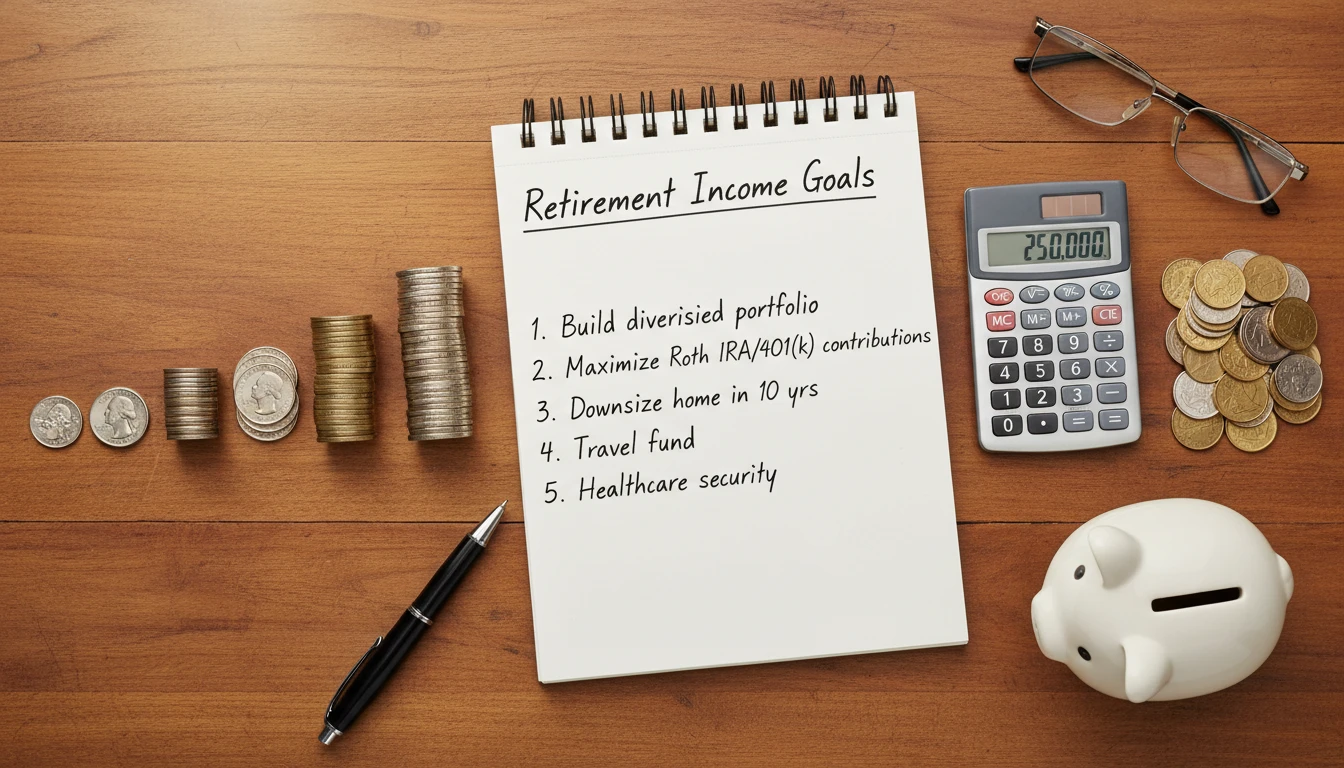
What Percentage of Income Should Go to Retirement? Expert Guidance on Savings Rates and Planning
Discover what percentage of income should go to retirement by age and income level — with expert savings rates, account tips, and planning steps.
Deciding what percentage of income should go to retirement is one of the most consequential financial choices you’ll ever make — and the honest answer shifts as your income, family needs, and life priorities evolve. This guide covers expert-recommended savings rates, age- and income-specific targets, the right account mix, and practical steps to help you allocate your income with real confidence.
What Percentage of Income Should Go to Retirement — and Why Most People Get It Wrong
Let’s start with something uncomfortable: do you actually know what percentage of your income is going toward retirement right now? Not a rough sense. Not “I think I contribute something to my 401(k).” The actual number — the precise percentage of your gross monthly income flowing into retirement accounts, automatically, every pay period.
If you had to pause to calculate it, you’re not alone. According to the Employee Benefit Research Institute’s 2023 Retirement Confidence Survey, only about one in three American workers have ever tried to calculate how much they actually need to save. The majority are operating on vague optimism — and the cost of that uncertainty compounds silently over decades.
The Center for Retirement Research at Boston College estimates that more than half of American households are at risk of being unable to maintain their standard of living in retirement. Not because they earned too little — because they didn’t save a sufficient percentage of what they earned while they were earning it. Undersaving by just 3% annually in your 30s doesn’t create a 3% problem later. It creates a dramatically larger one, because every dollar not saved also lost 30+ years of compound growth. The math is merciless — but it works just as powerfully in your favor when you get it right.
What Percentage of Income Should Go to Retirement? What the Research Says
The 10%–15% gross income benchmark is the most widely cited starting point among financial planners — and it didn’t emerge from thin air. It’s grounded in actuarial analysis, historical market return assumptions, and a specific definition of retirement adequacy. A retiree who needs to replace 70%–80% of pre-retirement income, retires at 65, and draws on Social Security for a meaningful portion needs approximately 10–12 times their final salary at retirement. Getting there over a 40-year career requires saving roughly 10%–15% of income annually.
Fidelity Investments formalizes this into age-based milestones:
| Age | Savings Target | What This Means Practically |
|---|---|---|
| 30 | 1× salary | ~$60,000 saved if earning $60,000/year |
| 40 | 3× salary | Mid-career check-in; adjust if behind |
| 50 | 6× salary | Catch-up contributions available |
| 60 | 8× salary | Begin detailed retirement income projections |
| 67 | 10× salary | Target for full retirement at FRA |
These are targets, not verdicts. Being behind at 40 doesn’t mean retirement income is compromised — it means your savings rate needs to increase now.
How Age Changes What Percentage of Income Should Go to Retirement
Age is the single most important modifier on any savings rate recommendation. A dollar saved at 25 and invested at 7% annually grows to approximately $14.97 by age 65. That same dollar saved at 45 grows to only $3.87. That nearly fourfold difference is the core argument for starting as early as possible, even when early-career income makes higher rates genuinely difficult.
- Ages 22–30 (Early Career): Target 10%–12%. Capture the full employer match. Automate contributions and resist lifestyle inflation from the start.
- Ages 31–40 (Mid-Career Build): Target 12%–15%. Raise your rate with every salary increase. Close any gap between your current balance and the 3× milestone.
- Ages 41–50 (Acceleration Phase): Target 15%–20%. Maximize tax-advantaged accounts. Catch-up contributions become available at 50 — plan for them now.
- Ages 51–60 (Intensification): Target 20%–25% if possible. Eliminate debt. Begin detailed Social Security timing analysis and retirement income projections.
- Ages 61–67 (Transition): Maximize what income allows. Shift from accumulation thinking to distribution planning and explore Roth conversion strategies before retirement begins.
The 50s deserve special emphasis. Most people earn significantly more at 50 than at 25, and fixed expenses — mortgage largely paid off, children no longer dependents — may be lower as a percentage of income. Using that window aggressively can close gaps accumulated over the previous two decades.
What Percentage of Income Should Go to Retirement Across Different Income Levels?

Income level creates wide variation in what’s appropriate — and the relationship isn’t simply “earn more, save more.”
| Annual Income | Typical Current Rate | Recommended Target | Key Challenge |
|---|---|---|---|
| Under $35,000 | 3%–6% | 8%–10% | Fixed costs dominate; employer match is priority one |
| $35,000–$60,000 | 6%–10% | 10%–12% | Balancing emergency fund and savings simultaneously |
| $60,000–$100,000 | 8%–12% | 12%–15% | Family expenses; student loan overlap |
| $100,000–$200,000 | 10%–15% | 15%–20% | Lifestyle inflation risk; widening retirement income gap |
| Over $200,000 | 12%–18% | 20%+ | Social Security replaces less; tax efficiency critical |
For higher earners, IRS contribution limits can actively constrain your savings rate. A household earning $300,000 that maxes out a 401(k) at $23,000 is saving just 7.7% through that vehicle. Additional strategies — taxable brokerage accounts, mega backdoor Roth conversions, executive compensation plans — become necessary to reach adequate retirement income at higher income levels.
Understanding the Income Replacement Target
What Percentage of Income Should Go to Retirement Using the 70%–80% Rule?
The 70%–80% income replacement guideline translates a vague goal into a specific, calculable target. Retirement eliminates several major expense categories: payroll taxes disappear, retirement contributions stop, and work-related expenses decline. What remains typically lands at 70%–80% of gross working income.
Your personal number adjusts from there. Add 5%–15% if you plan significant travel, carry a mortgage into retirement, or live in a high-cost area. Subtract 5%–10% if your home is paid off, you’re planning a simpler lifestyle, or you have substantial pension income covering fixed costs.
How Social Security and Pensions Reduce What Percentage of Income Should Go to Retirement
Here’s where planning commonly goes wrong: people calculate their retirement income replacement need and forget to subtract guaranteed sources. The correct approach identifies the personal savings gap — what your portfolio alone must fund after guaranteed retirement income is credited.
Example — $90,000 household income:
- Target: $90,000 × 80% = $72,000/year needed
- Social Security (projected): $24,000/year
- Pension: $12,000/year
- Personal savings gap: $36,000/year
- Required portfolio at 4% withdrawal: $900,000
The SSA reports Social Security replaces roughly 40% of pre-retirement earnings for an average-wage worker — a figure that meaningfully reduces the required portfolio. Failing to credit it leads to overstated savings requirements and unnecessary anxiety.
Choosing the Right Accounts to Support What Percentage of Income Should Go to Retirement

The amount you save matters enormously. So does where you save it. The tax treatment of different account types creates lifetime wealth differences that can rival differences in contribution amounts.
The Priority Ladder:
- Tier 1 — Capture the full employer 401(k) match. An immediate 50%–100% return. Nothing else takes priority over this.
- Tier 2 — Max the HSA (if enrolled in a qualifying high-deductible plan). Triple tax advantage: deductible contributions, tax-free growth, tax-free medical withdrawals. Given that healthcare is typically the largest variable expense in retirement, a dedicated HSA reserve is among the most targeted strategies available.
- Tier 3 — Max the Roth IRA (if income-eligible). After-tax contributions, tax-free growth, tax-free qualified withdrawals, and no RMDs — the most flexible account in retirement income planning.
- Tier 4 — Return to the 401(k) and push to the full limit: $23,000 under 50, or $30,500 with catch-up contributions.
- Tier 5 — Taxable brokerage account. No contribution limits, capital gains treatment, full liquidity.
- Tier 6 (high-income) — After-tax 401(k) / Mega Backdoor Roth. Allows higher Roth savings beyond Roth IRA income limits.
Maintaining both traditional (pre-tax) and Roth (after-tax) accounts creates powerful tax flexibility. Drawing from traditional accounts up to a bracket threshold, then supplementing with tax-free Roth retirement income, can reduce your lifetime tax burden by tens of thousands of dollars.
Practical Steps: Adjusting What Percentage of Income Should Go to Retirement Over Time
Tie contributions to percentages, not dollar amounts. A fixed 12% automatically rises as income grows. A fixed $500/month loses real value to inflation every single year.
Use automatic escalation. Most 401(k) platforms offer this feature. A 1% annual increase starting at 10% reaches 19% by year ten — and the portfolio difference is substantial.
Avoid the most expensive mistakes:
- Delaying the start. A 25-year-old who saves $5,000/year for just 10 years and stops ends up with ~$602,000 at 65 (at 7%). A 35-year-old saving $5,000/year for 30 straight years ends up with ~$472,000 — despite contributing three times as much. Start early.
- Lifestyle inflation without savings escalation. When income rises, raise your savings percentage first — before expanding spending. Every raise is a savings opportunity before it becomes a spending habit.
- Leaving the employer match uncaptured. This is declining an immediate 50%–100% return. There is no financial justification for it under any ordinary circumstances.
- The debt-vs.-savings false choice. Always capture the full employer match first. Then aggressively pay high-interest debt (18%+). For moderate-rate debt (5%–7%), split surplus between payoff and Roth IRA contributions rather than choosing one exclusively.
Frequently Asked Questions
How can I determine if I’m saving the right percentage of income for retirement?
Use Fidelity’s age-based milestones as a quick benchmark, then calculate your personal savings gap using your actual Social Security projection from ssa.gov/myaccount. A NAPFA-member fee-only planner can run Monte Carlo simulations that stress-test your plan against different return and inflation scenarios.
What are the most effective strategies for boosting what percentage of income should go to retirement?
In order of leverage: automate contributions, capture every dollar of employer matching, implement automatic annual escalation, and direct future income increases to savings before adapting your spending.
Should I prioritize paying off debt or saving for retirement?
Almost never one or the other — both, in the right proportion. Always capture the full employer match first, regardless of debt. Then use aggressive payoff for high-interest debt and a parallel approach for moderate-rate debt.
How often should I reassess my retirement savings plan?
At minimum annually, and after every significant life event — job change, raise, marriage, divorce, or birth of a child. Plans reviewed and adjusted consistently retire far better than those set once and forgotten.
Can I save effectively for retirement if I’m starting late?
Yes — with honest adjustments. Maximize catch-up contributions ($30,500/year in a 401(k) for those 50+), delay Social Security to 70 for up to 77% more monthly retirement income than claiming at 62, and consider working 2–3 additional years. A CFP® specializing in late-career planning can build a realistic strategy from your specific numbers.
How do healthcare expenses affect what percentage of income should go to retirement?
Significantly. Fidelity’s 2023 estimate puts average healthcare spending at $157,500 per person over retirement — and that excludes long-term care, which Genworth’s Cost of Care Survey puts at $4,500–$9,000/month. Maximize HSA contributions during working years, budget healthcare as a dedicated line item, and have an explicit long-term care plan.
The Bottom Line
Answering the question of what percentage of income should go to retirement isn’t a one-time decision — it’s an ongoing practice. The households that retire with genuine financial security and strong retirement income aren’t necessarily the highest earners. They’re the ones who decided early what percentage would go toward retirement, automated that commitment, and adjusted it consistently as their lives changed. Start with the employer match. Build toward 15%. Increase by 1% every year. Review annually. The best plan is the one you actually follow — aligned with the retirement income life you genuinely want to live.
About the Author
Josh Gibson is the founder of Vanika.com, a retirement-focused resource dedicated to helping individuals better understand retirement income, Social Security, pensions, taxation, and financial planning for retirement.
With over a decade of experience in digital publishing, SEO, and content strategy, Josh currently serves as the Search Engine Optimization Manager at IC-Agency, where he leads content and search optimization initiatives for various online brands.
Through Vanika, Josh combines his expertise in research-driven content creation with a strong interest in retirement education, helping readers access clear, trustworthy, and easy-to-understand information sourced from reputable organizations, government agencies, and financial resources.
Vanika’s editorial approach focuses on accuracy, transparency, practical guidance, and regularly updated content designed to support retirees and pre-retirees in making informed decisions.
For inquiries or collaborations:
Email: josh[at]vanika.com