Muscular Strength in Retirement: Your Friendly Guide to Getting Stronger and Feeling Better Every Day
Muscular strength in retirement matters more than you think. Here’s how to build real strength, protect your body, and feel capable for years to come.
I want to tell you about the moment I realized my body had been sending me memos I’d been ignoring for years.
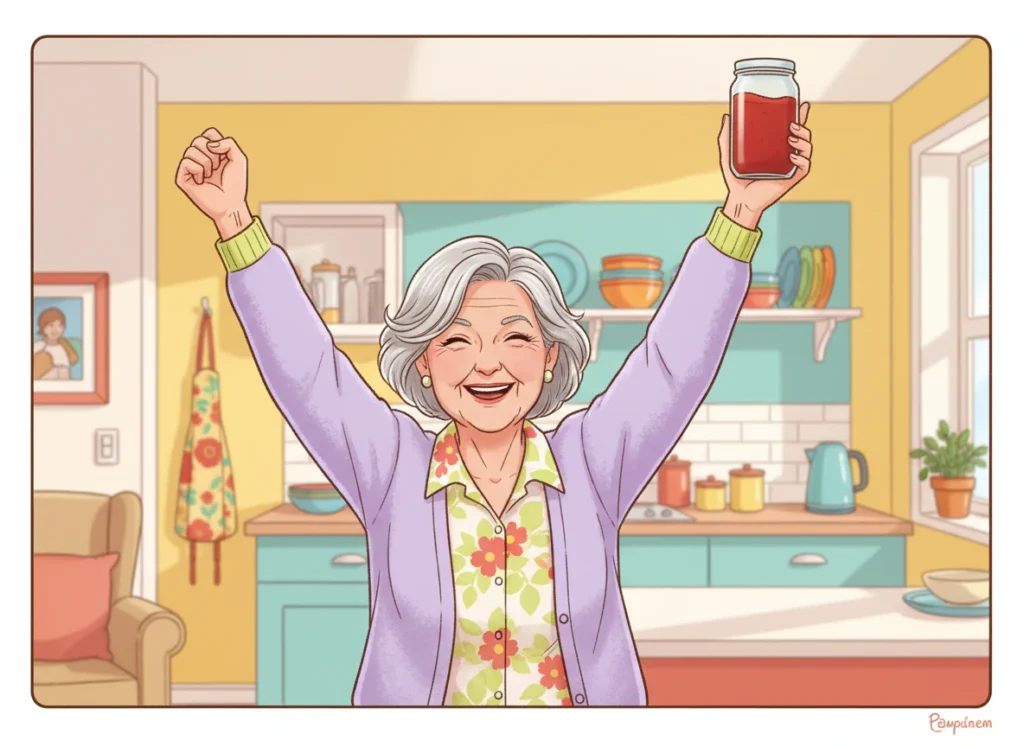
It wasn’t dramatic. There was no injury, no emergency, no single event that made everything click. It was a Wednesday. I was trying to open a jar of marinara sauce for pasta night, and the jar — sealed, I can only assume, by someone with a personal vendetta — would not budge.
I tried the rubber band trick. I tried hot water. I tried the spoon-tap method my grandmother swore by, which has never worked for me in my entire life but which I keep attempting out of some combination of nostalgia and desperation. I tried asking the jar nicely. I tried asking it less nicely. At one point I was braced against the counter, both hands on the lid, making a face I am deeply grateful no one was there to photograph.
The jar won.
I ate toast for dinner and sat with a feeling I didn’t quite have words for yet. Not embarrassment, exactly. More like a quiet reckoning. A sense that somewhere along the way, without my permission or even my awareness, my body had started to quietly opt out of things I used to do without thinking.
That’s the thing about losing muscular strength in retirement — or in the years leading up to it. It doesn’t announce itself. It doesn’t send a formal notice. It just shows up one day as a jar lid that defeats you, a flight of stairs that requires a pep talk, a chair that seems to have gotten lower somehow. (The chair has not gotten lower. I know this. I know this intellectually. And yet.)
And here’s what I want you to know, right from the start: that quiet opting-out is not inevitable. It is not your destiny. It is a starting point, and starting points, by definition, are places you can move from.
That’s what this is about. Not the gym. Not the barbell. Not becoming someone who owns multiple foam rollers and uses the word “gains” unironically at dinner parties. Just building a body that shows up for your life — the pasta nights, the grandkids, the overhead bins, the spontaneous adventures, the stairs — without making everything feel like a negotiation you’re not sure you’re going to win.
What Is Muscular Strength, and Why Does It Matter More After 60?

Let’s start with the basics before we start lifting things.
Muscular strength is your muscles’ ability to exert force during a single, maximal effort. In real-life language, that’s:
- How much you can lift before you’re done.
- How powerfully you can push, pull, or carry something heavy.
- How capable you feel when life unexpectedly hands you a heavy box — or a grandchild who has decided, mid-walk, that their legs have permanently stopped working and that is now entirely your problem.
When we talk about muscular strength in retirement, we’re really talking about training your body so it can handle heavier loads and tougher tasks with more ease and less internal negotiation. Less “can I do this?” and more “yes, obviously, let’s go.”
Here’s the part I wish someone had told me years earlier: we naturally lose muscle as we age. The medical term is sarcopenia, and it starts earlier than you’d think — somewhere around your 30s — and accelerates meaningfully after 60. By the time most people retire, they’ve already lost a significant amount of muscle mass without ever noticing, because it happens so gradually that your brain just quietly adjusts its expectations downward.
One year you’re carrying all the grocery bags in one trip. A few years later you’re making two trips and telling yourself it’s actually more efficient. A few years after that you’re sitting on the kitchen floor eating toast because a jar of marinara has bested you, and you’re not entirely sure when that became your life.
The good news — and I mean this, this is genuinely good news — is that this loss is not inevitable. It is not a sentence. It is a starting point.
Regular strength training slows that loss way down. And can even reverse it. Which is exactly why the U.S. Department of Health and Human Services recommends that all adults, including older adults, do muscle-strengthening activities at least twice a week.
Twice a week. That’s the whole ask. Not every day. Not two hours a session. Not a complete lifestyle overhaul. Twice a week, consistently, over time.
I think we can work with that.
The Everyday Wins Nobody Talks About
I’ve seen this play out in small, genuinely moving ways — and I mean that literally and figuratively, because sometimes the most moving thing is watching someone realize their body can do something it couldn’t do six weeks ago.
Someone starts strength training and suddenly picking up a sleeping grandchild from the floor is no longer a full-body event requiring a recovery period, a heating pad, and possibly a nap. Someone else realizes they climbed two flights of stairs and didn’t stop to catch their breath — and then stood at the top for a moment, quietly amazed, like they’d just summited something that mattered. Another person notices they got up from a low chair without using their hands for the first time in years, and they just sort of stare at their legs like, “Oh. Hello. You’re back. I missed you. We need to talk.”
That’s muscular strength in retirement quietly doing its job. No fanfare. No dramatic transformation montage. Just your body showing up for you in ways it hadn’t been for a while, and you noticing, and feeling something that’s hard to name but sits somewhere between relief and pride.
The bigger-picture benefits are just as real, and just as worth knowing about:
Stronger bones. When you train your muscles against resistance, you’re also sending a message to your bones: “We need you to be strong too.” That mechanical stress helps improve bone density. The National Osteoporosis Foundation and multiple clinical trials have highlighted resistance training as a key way to reduce the risk of osteoporosis and fractures — especially in older adults. Every squat is a quiet deposit into your long-term bone health savings account. It’s not glamorous. It doesn’t make for exciting dinner conversation. But it is one of the smartest, most loving things you can do for your future self.
A metabolism that works a little harder for you. Muscle is metabolically active tissue — the fancy way of saying it burns more calories at rest than fat does. A review in the Journal of Applied Physiology found that regular strength training increases lean muscle mass and can boost your resting metabolic rate. In real life, that means your body becomes slightly more efficient at using fuel, even when you’re just sitting in your favorite chair with a cup of tea and a book you’ve been meaning to finish since last spring. No, it doesn’t magically erase an entire pizza. But it does quietly upgrade your engine in the background, and I will take every quiet upgrade I can get.
Fewer aches, better joint support. Think of your muscles as shock absorbers for your joints. Strong quads and glutes help your knees. A strong back and core support your spine. When your muscles are weak, your joints end up doing more of the work — and they are not thrilled about it. They will let you know, loudly and specifically, usually at the worst possible moment, like when you’re trying to get out of a low car in a parking lot with people watching. As you build muscular strength in retirement, you’re also reducing the chance of sprains, strains, and those “I just moved slightly wrong and now my entire week is ruined” moments that feel increasingly personal as the years go on.
Staying independent. This is the one I think about most. The one that keeps me showing up even on the days I don’t feel like it. Muscular strength is what lets you get up from a chair without rocking back and forth for momentum. Climb stairs without stopping halfway. Carry laundry, groceries, or luggage without feeling wrecked afterward. Travel without needing to ask strangers for help with your bag. Live in your home, on your terms, for as long as you want to.
I want Future Me to still be carrying her own suitcase, getting off the floor without assistance, and walking into a room like she owns it. Working on muscular strength in retirement now is my way of voting for that future, one rep at a time. And I take that vote very, very seriously.
The Mental Health Benefits Nobody Warned Me About
Can we talk about this for a second? Because nobody warned me about this part, and it might genuinely be my favorite part of the whole thing — and I say that as someone who also really loves the part where you get stronger.
A 2017 meta-analysis in Sports Medicine found that resistance training was associated with reduced symptoms of anxiety and depression. And honestly, that tracks completely with what I’ve experienced and what I’ve watched other people experience, over and over again.
You see yourself get stronger from week to week. You feel more capable in your own body. You get that endorphin lift and a quiet, steady sense of “Hey. I can actually do hard things. Look at me, doing hard things, on purpose.”
I’ve walked into workouts feeling stressed, fried, vaguely annoyed at everything, and mildly convinced that the universe had arranged itself specifically to inconvenience me. And I’ve walked out feeling like someone turned the emotional volume down three notches. Not because the problems went away — they didn’t, they were still there, waiting patiently in the parking lot — but because something in my body had shifted, and suddenly the problems felt a little more manageable. A little less like emergencies and a little more like things I was capable of handling.
Building muscular strength in retirement doesn’t just make you physically stronger. It often makes you calmer, more grounded, more confident in your own skin, and more convinced that you are, in fact, someone who can handle what life hands her. And in a season of life that comes with its own set of transitions, uncertainties, and the occasional jar lid that defeats you on a Wednesday — that is not a small thing. That is a very, very big thing.
The Major Muscle Groups You Want on Your Team
If the goal is building muscular strength in retirement, you don’t want to hyper-focus on one area and ignore the rest. A balanced approach gives you a stronger, more capable body overall — and a much better shot at all those everyday wins we talked about.
Upper Body: The Push, Pull, and Carry Crew
Your chest, back, shoulders, biceps, and triceps handle everything from pushing open a heavy door to pulling luggage off a carousel to carrying bags through an airport while simultaneously navigating a map on your phone, trying to remember which gate you’re at, and maintaining the calm, confident expression of someone who definitely knows exactly where they’re going.
When upper body strength is there, all of that feels like normal life. When it’s not there, everything feels like a workout. I’ve lived both versions. I know which one I prefer. I know which one you’ll prefer too.
Core: Your Built-In Stabilizer
Your core is way more than visible abs — and I say that as someone who has made a full, complete, and genuinely peaceful peace with the fact that my abs are more of a theoretical concept at this point in my life. Your core includes your front abdominals, obliques, deep stabilizing muscles, and lower back. It’s the transfer station between your upper and lower body, and it’s involved in basically every movement you make, whether you’re aware of it or not.
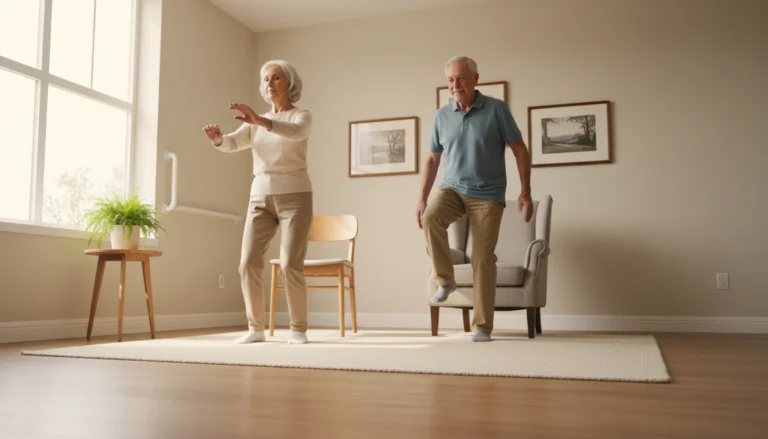
A strong core helps with balance, posture, spinal support, and any movement involving twisting, bending, or reaching. I’ve lost count of how many people say, “My back feels so much better,” once they start training their core consistently. It’s not flashy work. Nobody’s posting their dead bug reps on social media. But it is powerful, life-changing, quietly revolutionary work that your spine will thank you for every single day.
Lower Body: The Powerhouse
Your quads, hamstrings, glutes, and calves handle walking, climbing stairs, sitting down, standing up, and lifting things from the ground. These are some of your largest muscles — and they’re the ones most responsible for keeping you upright, mobile, and independent.
Strong legs and glutes are a massive piece of muscular strength in retirement in a very practical, “I live in a body that does stuff and I would very much like to keep doing stuff for a long time, thank you” kind of way. Also, strong glutes are just deeply satisfying. I’m not going to pretend otherwise, and I don’t think you should either.
How to Actually Build Muscular Strength in Retirement
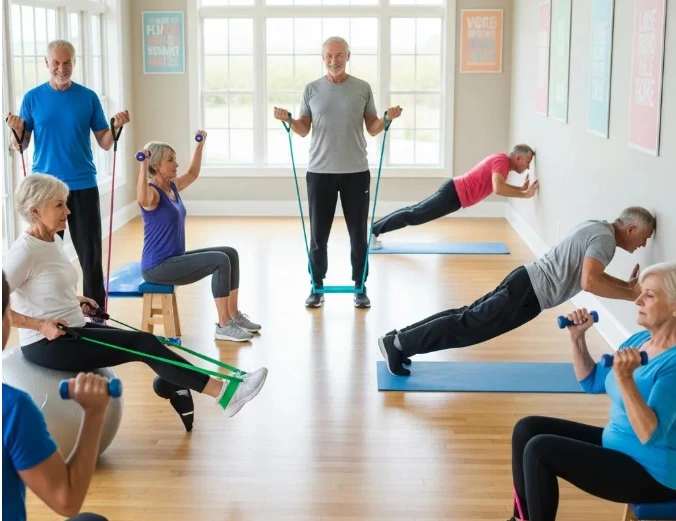
So, how do you do it? You use resistance training — any form of exercise where your muscles work against a force.
That resistance can come from:
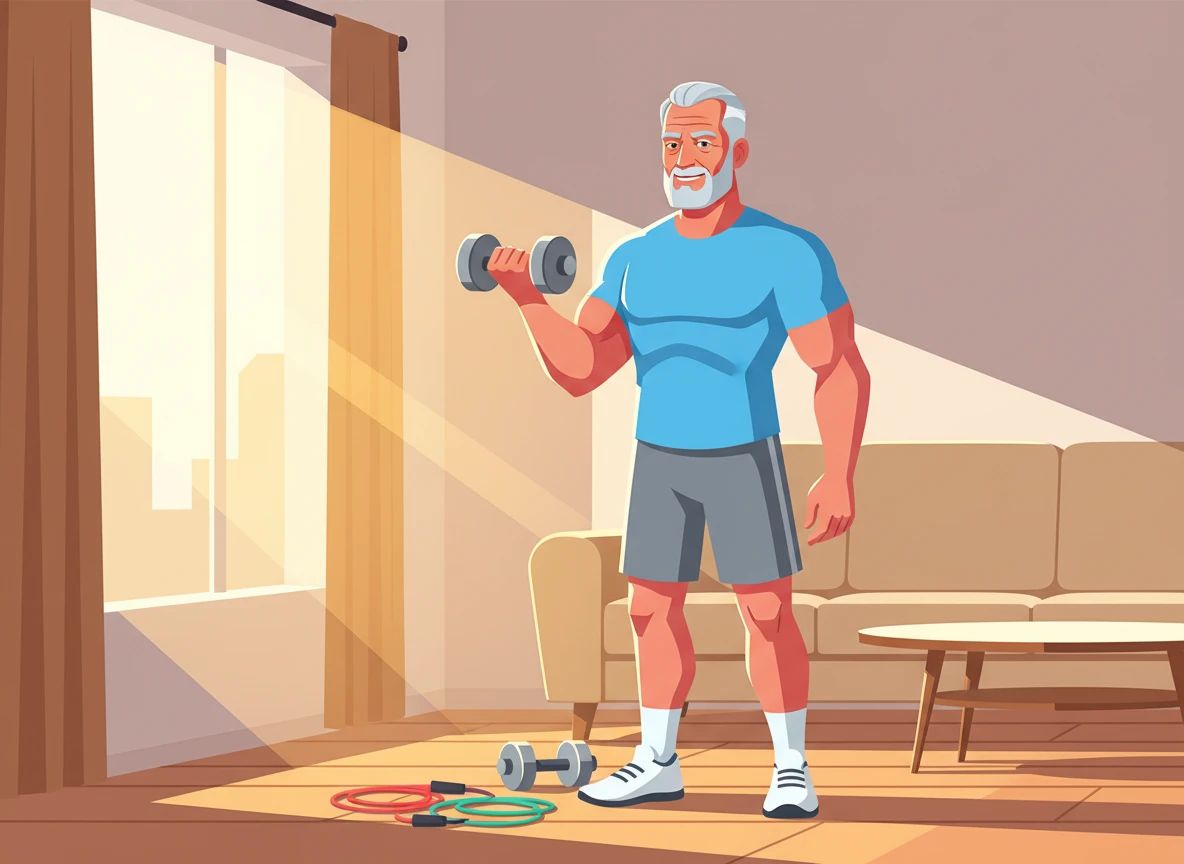
- Free weights (dumbbells, barbells, kettlebells)
- Resistance bands
- Weight machines at a gym
- Your own body weight (push-ups, squats, lunges, planks)
- Everyday objects (water jugs, a loaded backpack, a very uncooperative dog who has gone completely limp and decided the couch is his forever home)
The idea is beautifully, almost insultingly simple: you ask your muscles to do more than they’re used to, they adapt, and over time you get stronger. That gradual increase in challenge is called progressive overload, and it’s the backbone of building real muscular strength in retirement. It’s not complicated. It’s not mysterious. It’s just consistent, intentional effort over time.
You Don’t Need a Fancy Gym
One of the biggest myths about strength training is that you need a gym membership, special equipment, and the confidence of someone who knows what every machine does and has never once accidentally sat on the wrong thing and had to quietly pretend it was intentional while making eye contact with a stranger.
You really, truly, genuinely, completely don’t.
Some of the strongest progress I’ve seen came from people who started in their living room with nothing but their own body weight — push-ups, squats, lunges, glute bridges, planks. Then they added a resistance band. Then maybe a pair of dumbbells from a garage sale that cost them eight dollars. Then one day they looked up and realized they were genuinely, measurably stronger than they’d been in years, and they’d done the whole thing in their living room in mismatched socks with a cat judging them from the couch.
If you like the gym, perfect. If you’d rather train at home with a playlist that would horrify your children and a dog who occasionally wanders into your plank and makes everything harder, that works too. Your muscles don’t care where you are. They care what you ask them to do.
How Often Should You Train?
A realistic, sustainable, actually-doable starting point:
- 2–3 strength training sessions per week, hitting all major muscle groups.
That might look like two full-body sessions — say, Monday and Thursday — or three shorter sessions spread across the week. You don’t need daily workouts to see progress. You just need consistency and a willingness to gradually challenge yourself over time. Consistency beats intensity every single time. Every. Single. Time. I cannot say this enough.
A Simple Starting Roadmap

If you’re new to this — or coming back after a long break — it is very easy to get stuck in research mode and never actually start. I’ve been there: 37 tabs open, five different “beginner workout” PDFs downloaded, a new pair of workout shoes purchased as a gesture of good faith toward my future self, and zero actual workouts completed. The shoes were very comfortable. My muscles were not impressed.
Let’s not do that. Let’s actually start.
Step 1: Warm up. Spend 5–10 minutes on light movement before you ask your muscles to work hard. Brisk walking, arm circles, leg swings, easy air squats. This gets your joints moving, your blood flowing, and your body ready for what’s coming. Non-negotiable — and honestly kind of enjoyable once you stop resenting it and start thinking of it as a small act of kindness toward the body that carries you through your life.
Step 2: Choose compound movements. These are exercises that use multiple muscle groups at once — and they give you the most benefit for the time you put in. Think of them as your muscular strength in retirement workhorses. They do a lot. They ask for relatively little. They are the reliable friends of the exercise world.
Great starting options:
- Squats or sit-to-stands — for legs and glutes
- Push-ups (wall, knee, or full) — for chest, shoulders, and triceps
- Bent-over rows (bands or dumbbells) — for back and biceps
- Glute bridges — for glutes and hamstrings
- Planks — for core stability and the quiet, hard-won satisfaction of surviving them
Step 3: Pick a resistance that’s challenging, not cruel. The last 2–3 reps of your set should feel genuinely tough, but you should still be able to keep good form. If you can do 15 reps and feel like you could keep going indefinitely while also planning dinner and composing a mental grocery list, it’s time to increase the resistance. If you can’t get to 8 reps without everything falling apart, go lighter. There is no prize for suffering. There is only a prize for showing up consistently over time, and that prize is a body that works better.
Step 4: Make technique your best friend. Move with control, not momentum. Keep your core gently engaged. Don’t sacrifice form just to use heavier weight. I’ve done the ego-lifting thing — grabbed a weight that was clearly too heavy just to prove something to absolutely no one in a room by myself at 7am. My shoulders filed a formal complaint. They were completely right. Technique first, weight second. Always, always, always.
Step 5: Respect rest. Here’s the thing that genuinely surprised me when I first learned it, and that I think about often: you don’t actually get stronger during the workout. You get stronger after, when your body repairs and rebuilds. Give each muscle group about 48 hours before training it hard again. Use rest days for light movement — walking, stretching, gentle mobility work. Rest is part of the plan. It’s not a reward you have to earn. It’s not laziness dressed up in athletic wear. It’s biology. Honor it accordingly, and your body will reward you for it.
Fitting Strength Training Into Retirement Life
Here’s the beautiful thing about retirement: you have more flexibility than you did when you were working full-time and running on caffeine, willpower, and the vague hope that things would eventually calm down. But that doesn’t mean you want to spend your days in a gym. So let’s talk about making this fit your actual life — the one you’re actually living, not the one in the fitness magazine with the suspiciously perfect lighting.
Turn TV time into mini-workout time. If you’re going to watch a show anyway — and you are, and that is completely fine, I am not here to judge anyone’s viewing habits — do bodyweight squats during commercial breaks. Add a set of push-ups between episodes. Hold a plank during the opening credits of whatever you’re watching. Is it fancy? No. Does it count toward building muscular strength in retirement? Absolutely, unequivocally, without question yes.
Make your walks work harder. Add a weighted vest, carry light hand weights, or find a hilly route. Walking is wonderful. A few small tweaks can make it a meaningful part of your strength routine without it feeling like a workout at all. It just feels like a slightly more purposeful walk, which is a very dignified and satisfying thing to be doing with your afternoon.
Turn chores into strength opportunities. Lunge while you vacuum. Carry grocery bags evenly in both hands and walk with intentional posture. Take the stairs with a bit more purpose — maybe even two at a time if it’s safe for you. No need to announce you’re “biohacking your life.” Just quietly enjoy that you’re making strength part of your normal routine, and let your body quietly thank you for it in the form of feeling better, moving easier, and opening jars on the first try.
Join a class designed for your stage of life. Many community centers, YMCAs, and gyms offer strength classes specifically for older adults. Silver Sneakers, chair yoga with resistance, water aerobics with weights — these are real options that are also genuinely fun. And fun matters more than people admit. If you dread it, you won’t do it. If you enjoy it, you’ll keep showing up. And showing up, consistently, over time, is most of the battle. Most of the battle is just showing up.
Staying Safe: What to Know Before You Start
Building muscular strength in retirement is one of the best things you can do for your health — and doing it safely is what keeps you in the game long-term. Because the goal isn’t to have one great month of training and then spend the next three recovering from something avoidable. The goal is to still be doing this five years from now, feeling better than you do today, opening jars with casual confidence.
Check in with your healthcare provider if needed. If you have chronic conditions, joint issues, heart concerns, or you’re recovering from an injury, talk with your doctor or a physical therapist before leveling up your routine. You want a plan that respects your current reality, not one built for a completely different body in a completely different situation.
Start lighter than your ego wants to. Start with lighter weights or just bodyweight. Focus on nailing the movement patterns. Increase resistance gradually as you feel more confident and capable. You’ll still get stronger — and you’ll be far less likely to collect injuries like souvenirs from a trip you didn’t enjoy and absolutely cannot return.
Know the difference between discomfort and pain. Strength training will bring some muscle burn and effort. That’s normal. That’s the work. That’s actually what you’re going for. But sharp, stabbing, or joint-centered pain? That’s your body saying “Nope, not today, not like this, we are done here.” If something feels off — stop, check your form, reduce the weight, or choose a different movement. One set is never worth a long-term injury. Not one single set. Not ever.
Don’t skip rest because you’re feeling motivated. The more serious you get about building muscular strength in retirement, the easier it is to overdo it — especially in the beginning, when everything feels exciting and possible and you’re convinced you can make up for lost time in a single week. You cannot. Signs you might need more rest: you’re sore for days and never really recover, you feel unusually tired or irritable, or your performance is getting worse instead of better. Rest is where all your hard work turns into actual progress. It is not optional. It is, in fact, the whole point.
A Simple Weekly Blueprint to Get You Started
Here’s a beginner-friendly outline you can adapt. It’s a starting point, not a rulebook. Adjust it, swap things around, make it yours. The best plan is always the one you’ll actually follow.
Day 1 — Full-Body Strength (20–30 minutes)
- Warm-up: 5–10 minutes of light movement
- Squats or sit-to-stands: 2–3 sets of 8–12 reps
- Push-ups (wall, knee, or full): 2–3 sets of 8–12 reps
- Bent-over rows (bands or dumbbells): 2–3 sets of 8–12 reps
- Glute bridges: 2–3 sets of 10–15 reps
- Plank hold: 2–3 holds of 15–30 seconds
Day 2 — Light Movement / Active Recovery
- Walking, easy cycling, stretching, or gentle yoga
Day 3 — Full-Body Strength (20–30 minutes)
- Warm-up: 5–10 minutes
- Lunges or step-ups: 2–3 sets of 8–12 reps per leg
- Overhead press (bands or dumbbells): 2–3 sets of 8–12 reps
- Deadlifts (light dumbbells or kettlebell): 2–3 sets of 8–10 reps
- Bird-dog or dead bug core work: 2–3 sets per side
Day 4 — Optional Cardio or Movement
- Brisk walk, cycling, dancing — anything that gets you moving and feels genuinely, honestly good
Day 5 — Strength or Mixed Day
- Repeat Day 1 or Day 3, or mix your favorite movements from both
Keep the weekend lighter, or use it for activities you actually enjoy — hiking, playing with grandkids, leisurely walks, a round of golf, a dance class, whatever keeps you moving and reminds you that movement can be joyful and not just dutiful. It doesn’t have to be perfect. It just has to be consistent enough to keep moving forward, one week at a time.
The Science Behind It (Without the Textbook Vibes)
When you strength train, two major things happen:
- Your nervous system gets better at recruiting muscle fibers.
- Over time, your muscle fibers grow — a process called hypertrophy.
In the beginning, most of your progress actually comes from your nervous system learning how to fire more efficiently. That’s why beginners often see strength gains before they see big visual changes. Your body is getting smarter before it gets bigger. It’s learning. Classic research in the European Journal of Applied Physiology and many later studies show significant increases in muscle size and strength after structured resistance programs — even in adults well into their 70s and 80s.
Let that sink in for a moment. Well into their 70s and 80s. It is never too late to start. Never. I want that to really land, because I think a lot of people have quietly decided it’s too late for them, and it isn’t. It just isn’t.
The benefits spill into almost every area of health. Studies have linked regular strength training to:
- Reduced blood pressure and improved cardiovascular markers (research in the journal Hypertension supports this)
- Improved bone mass, especially in weight-bearing areas like the hips and spine
- Better cognitive function and reduced risk of cognitive decline
- Improved management of chronic conditions like arthritis, heart disease, and type 2 diabetes
- Reduced depressive symptoms, as highlighted in work published in JAMA Psychiatry
We’re not just talking about muscles here. We’re talking about your heart, your bones, your brain, and your quality of life. All of it. Connected. All of it improved by the same two or three sessions a week of showing up, doing the work, and then going home and eating something good and feeling quietly, genuinely proud of yourself.
Key Takeaways
- Muscular strength in retirement is one of the most powerful investments you can make in your long-term health and independence.
- We naturally lose muscle as we age, but regular strength training slows that loss — and can reverse it.
- You don’t need a gym, fancy equipment, or hours of free time. Two to three sessions a week, 20–30 minutes each, is enough to make real progress.
- Compound movements — squats, push-ups, rows, deadlifts, planks — give you the most benefit for the time you put in.
- Progressive overload (gradually increasing the challenge) is the key to continued improvement.
- Rest and recovery are not optional — they’re where the actual strength gains happen.
- The benefits go far beyond muscles: stronger bones, better metabolism, improved mood, sharper cognition, and greater independence.
- Start where you are. Start lighter than you think you need to. Start today.
Wrapping It Up: Your Strength Journey Starts Now
Improving muscular strength in retirement is one of those life upgrades that quietly impacts everything else. It’s not about becoming the strongest person in the room or living under a barbell. It’s about building a body that supports the life you actually want to live — for as long as possible, with as much joy and ease and spontaneity and pasta as possible.
When you commit to this in a steady, realistic way, you make everyday tasks easier and less draining. You protect your bones and joints for the long term. You support your metabolism, mood, and mental health. And you give future-you a body that feels capable instead of fragile. A body that says yes instead of “let me think about whether I can physically do that.”
You don’t need the perfect plan to start. You just need a starting point.
Maybe today that’s one set of squats in your living room. A few push-ups against the kitchen counter. A walk to warm up and a couple of beginner exercises to follow. Maybe it’s just reading this article all the way to the end and deciding — quietly, firmly, without fanfare — that you’re going to try.
Rep by rep, week by week, you’ll figure out how to build muscular strength in retirement in a way that fits your life — not the life of some hypothetical fitness model who has never once been defeated by a jar of marinara on a Wednesday night and had to eat toast for dinner and sit with the quiet humiliation of it.
And one day, when you carry all the groceries in one trip, climb the stairs without thinking about it, get up from the floor without help, or reach for that jar and feel it give way on the very first try — you’ll have a quiet moment of realization:
“This stuff actually worked.”
Your future self? They’re already cheering you on.
And for the record? They opened the jar. First try. Didn’t even make a face.