
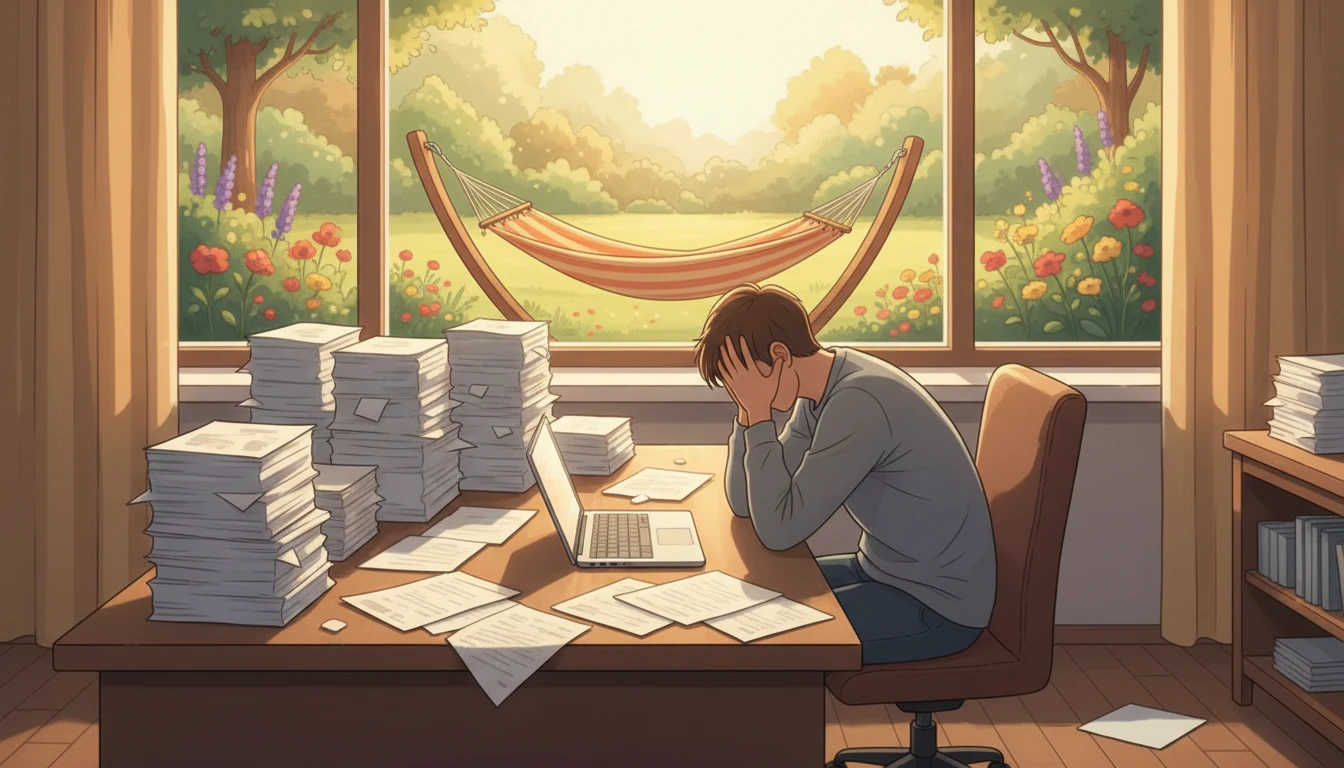
How to Manage Work Stress Before It Follows You Into Retirement
Feeling the weight of work stress? Discover practical, science-backed ways on how to manage work stress now — so you can protect your health, your peace, and the retirement you’ve earned.
Nobody warns you about this part.
You do everything right. You save. You plan. You build the spreadsheet with the retirement projections and the color-coded tabs. You imagine the version of your life where you’re not answering emails at 9 p.m. and you actually have time to read a book that isn’t about productivity.
And then somewhere in the middle of all that planning, you forget to ask: what is all this stress doing to me right now?
Because here’s the thing — learning how to manage work stress isn’t just about surviving your current job. It’s about making sure you actually arrive at retirement healthy enough to enjoy it. Not just technically retired. Actually there. Present. Capable of enjoying a Tuesday afternoon without your nervous system still running at full tilt like it forgot to clock out.
That’s what this is really about.
Key Takeaways
- Chronic work stress is linked to anxiety, depression, and cardiovascular issues — all of which can affect your retirement health and finances
- Catching stress early is far easier than recovering from full burnout
- Small, consistent habits — not dramatic overhauls — are what actually move the needle
- Boundaries, sleep, movement, and real human connection are your most underrated stress tools
- If stress has crossed into something deeper, professional support is not a last resort — it’s a smart move
- The habits you build now will shape the quality of life you carry into retirement
Why Work Stress Hits So Hard (And Why You’re Not Just “Too Sensitive”)
Let’s get something out of the way first.
If you’re struggling with work stress, it doesn’t mean you’re weak. It doesn’t mean you’re bad at your job, or that you need to toughen up, or that everyone else is somehow handling it better than you are. It means you’re a human being with a nervous system — and that nervous system has limits that no amount of hustle culture can override.
Work stress is what happens when the demands placed on you consistently outpace the resources you feel you have. Demands look like impossible deadlines, shifting priorities, unclear expectations, difficult managers, and the quiet exhaustion of trying to be a decent person at work and at home without turning into a hollow shell of yourself by Thursday.
Resources look like time, energy, support, autonomy, and some reasonable sense of control over your own day.
When that equation tips too far for too long, it becomes chronic stress. And if chronic stress goes unaddressed, it slides into burnout — that hollow, “I care but I physically cannot care anymore” feeling that’s a lot harder to come back from than most people expect.
The World Health Organization officially recognizes burnout as a work-related condition. Research published in The Lancet and reports from the National Institute for Occupational Safety and Health (NIOSH) consistently link long-term work stress to anxiety, depression, and cardiovascular problems. These aren’t abstract risks. They’re the kinds of health issues that show up in your fifties and sixties — right when you’re supposed to be stepping into the life you spent decades building.
Learning how to manage work stress isn’t optional maintenance. It’s how you protect the future you’re working toward.
Is Stress Getting Under Your Skin More Than You Think?

Sometimes stress announces itself loudly. You’re crying in the bathroom at 11 a.m. on a Wednesday. That’s obvious.
Other times, it’s sneaky. It shows up wearing a disguise, moves in quietly, and starts rearranging the furniture before you even realize it’s there.
Watch for these:
- Chronic tiredness. You wake up exhausted. You move through the day exhausted. You collapse at night — still exhausted. Sleep stops feeling like rest and starts feeling like just another thing you’re not doing well enough.
- Brain fog. You reread the same sentence four times and still don’t know what it says. You walk into a room and forget why. You lose words mid-sentence and stand there, blinking, while your brain buffering symbol spins.
- Short fuse. You’re snapping at people you love over things that wouldn’t have registered six months ago. The patience you used to have has just… quietly left the building.
- Random body complaints. Tension headaches. A jaw you’re clenching without realizing it. Shoulders that live somewhere near your ears. Stomach issues that come and go with no clear cause. Your body is filing a formal complaint and you keep dismissing it.
- Zero motivation. Work that used to feel meaningful now just feels like an endless list of chores with no finish line and no point.
- Sleep and appetite shifts. Too little sleep, too much, or just off. Stress cravings at 10 p.m. or no appetite at all. Neither feels like you.
I’ve had seasons where I told myself, “I’m just tired, it’s a busy stretch, it’ll pass.” And sometimes it did pass. But sometimes it didn’t — it just got quieter and more settled, like a houseguest who stopped asking if they could stay and just started leaving their stuff everywhere.
One of the most important parts of how to manage work stress is catching these signs before you hit the wall. Before you’re Googling “how much does it cost to move somewhere with no Wi-Fi and no Slack notifications.”
What’s Actually Happening in Your Body
When something at work feels threatening — an angry email, a surprise meeting request, a deadline that materialized out of thin air — your brain makes a snap decision: this might be danger.
So it hits the fight-or-flight switch. Your heart rate climbs. Your muscles tense. Your breathing gets shallow. Cortisol and adrenaline flood your system. If a tiger were actually chasing you, this would be exactly right. The problem is that at work, the “tiger” is your inbox — and it never, ever stops running.
So instead of a quick spike followed by calm, your system stays activated. All day. Every day. Over time, that chronic activation can suppress your immune system, impair memory and focus, raise blood pressure, and leave you in that exhausting “wired but tired” state that no amount of sleep seems to fix.
This is why how to manage work stress isn’t about “just relaxing.” It’s about teaching your nervous system that the alarm can come down from DEFCON 1 back to “mildly annoyed human who is going to be okay.”
Fix What You Can Control: Workload, Time, and Daily Habits
You can’t fix everything about your job. I know. But there’s usually more within your influence than it feels like when you’re overwhelmed and running on fumes and your to-do list has started to feel like a personal threat.
Tame the To-Do List Before It Eats You Alive
Here’s what actually helps — on the days I remember to do it, anyway:
Dump everything out of your head first. Projects, tiny tasks, half-formed worries, that thing you promised someone three weeks ago and have been quietly dreading — get it all down somewhere. Your brain is a terrible storage system and an even worse filing cabinet. It was not designed to hold forty-seven open tabs simultaneously.
Sort by importance, not just urgency. The urgent stuff always screams loudest. But ask yourself: what actually matters for my role this week? What will genuinely move things forward? Those are your real priorities. Everything else is noise wearing a deadline costume.
Pick a Daily Big 3. Each morning — or the night before if mornings are chaos — decide: if I only finish three things today, which ones make the day feel like a win? Those become your anchors. Everything else is bonus.
Break big tasks into tiny moves. “Write the report” is paralyzing. “Draft the intro paragraph” is doable. “Write three bullet points for the data section” is even better. Specificity is your friend when your brain is already overwhelmed and looking for any excuse to go check the fridge instead.
Say No Without Burning Bridges
One of the sneakiest causes of work stress is saying yes to everything like a people-pleasing robot who forgot they have a body and a life outside of this building.
Protecting your time isn’t difficult — it just takes practice and a willingness to be slightly uncomfortable for about thirty seconds. Which, honestly, is a fair trade.
Try:
- “I’m at full capacity right now. I can take this on next week — does that still work?”
- “I can do this, but it’ll mean delaying X. Which would you prefer I prioritize?”
- “I want to give this proper attention. My earliest realistic start is Thursday.”
You’re not being difficult. You’re being honest. And in most workplaces, that earns more respect than quietly drowning while nodding enthusiastically in every meeting.
I’ve had seasons where I said yes to everything to look capable — and ended up looking frazzled, missing deadlines, and needing help anyway. Saying no sooner would’ve been kinder to everyone, including me. Especially me.
Small Daily Habits That Actually Work

You don’t need to become a different person to manage work stress better. You just need habits that fit inside your actual life — not the aspirational version of your life where you wake up at 5 a.m. and meditate for forty-five minutes before making a smoothie from scratch.
Take Real Breaks — Not Just “Switch Tabs to Social Media” Breaks
Scrolling isn’t a break. It’s just a different kind of stimulation. Your brain never gets to exhale. You close Instagram and feel vaguely worse than before you opened it, slightly guilty, and somehow more tired. That’s not rest. That’s just stress wearing a different outfit.
Try working in focused bursts — 25 to 50 minutes on one task, then a genuine 5 to 10 minute pause. On those breaks: stand up, stretch your neck and shoulders, look at something far away, drink some water, take a slow walk to the other end of the building. Research from the Draugiem Group found that top performers tended to work in focused intervals with deliberate rest periods in between. The exact numbers matter less than the pattern: focus, pause, repeat.
Think of breaks as maintenance. You’re not being lazy. You’re preventing a mental system crash — the kind that turns a manageable afternoon into a complete write-off where you stare at the same document for forty minutes and produce nothing.
Use 60-Second Calm Buttons When You Feel Overwhelmed
You don’t need a meditation room with plants and ambient music and a diffuser running something called “Serenity Blend.” You just need something you can do at your desk without your coworkers thinking you’ve lost it.
Box breathing (4–4–4–4):
Inhale for 4 counts. Hold for 4. Exhale for 4. Hold for 4. Repeat four to six times. It sounds almost too simple to work. It works anyway.
The 5–4–3–2–1 reset:
Name 5 things you can see, 4 you can feel, 3 you can hear, 2 you can smell, 1 you can taste. It pulls your attention out of the spiral and back into the room you’re actually sitting in, which is usually a lot less catastrophic than the one in your head.
A 2014 review in JAMA Internal Medicine found that mindfulness-based practices can meaningfully reduce anxiety and improve mood. You don’t need the full program to get some benefit. These micro-practices still nudge your nervous system in the right direction — and they’re free, which I always appreciate.
Food, Movement, and Sleep: The Boring Stuff That Quietly Runs the Show

I used to roll my eyes when people said, “Maybe you’re just tired or hungry.” Then I had a full-blown “I hate everything and everyone and this entire situation” moment at 3 p.m. on a Tuesday, ate an actual meal, and felt like a completely different person twenty minutes later.
Sometimes the most sophisticated stress management strategy is just being a human who eats lunch.
Give Your Body Something Better Than Caffeine and Vibes
When you’re slammed, it’s incredibly easy to skip meals or survive on coffee and whatever’s in the break room that someone brought in for a birthday three days ago and is now slightly stale but still technically food.
But low blood sugar feels a lot like anxiety — shaky, unfocused, irritable, convinced that everything is a crisis. That just makes work stress feel ten times worse than it actually is.
Some simple things that help: don’t skip meals because you’re “too busy.” Set a reminder to eat lunch if you’re the “suddenly it’s 4 p.m. and I haven’t eaten” type. Aim for protein, fiber, and healthy fat at meals — not because you’re training for anything, just because it keeps your blood sugar stable and your brain functional. Try not to rely on sugar all afternoon. The crash is real and it is not kind.
A 2014 paper in Nutrients found that diets rich in whole foods — fruits, vegetables, whole grains, lean protein — are associated with better mood and stress regulation. You don’t need perfection. You just need a little intentionality, and maybe a snack drawer that isn’t entirely made of desperation and vending machine regret.
Move — Even If Gym Life Is Not Your Thing
Movement is one of the fastest ways to shift how you feel. Not because it’s magic, but because your body was built to move, and sitting still for eight hours while your nervous system runs at full tilt is genuinely not what it was designed for.
You don’t have to become a runner. You don’t need special equipment or a gym membership or a motivational playlist that makes you feel like you’re training for something cinematic. Walk for 10 minutes before or after work. Take calls while walking. Stretch every time you get up for coffee. Try a short YouTube yoga video at home on a Tuesday night when you’d otherwise just scroll until you fall asleep.
The American Psychological Association consistently highlights physical activity as one of the most effective tools for reducing stress and improving mood. The goal isn’t “fitness influencer.” It’s “slightly less tense human who can get through the day without their shoulders living somewhere near their ears.”
And here’s the retirement angle worth sitting with: the movement habits you build now are the ones that carry you into a healthier, more active retirement. Bodies that stay in motion tend to stay in motion. Bodies that don’t — well, that’s a harder conversation to have later, and I’d rather we not have to have it.
Treat Sleep Like an Actual Priority
You’ve heard this before. I know. But if you’re serious about how to manage work stress — and about protecting your long-term health — sleep is the one thing you genuinely cannot keep borrowing against.
Try going to bed and waking up around the same time most days, even on weekends. Create a simple pre-sleep ritual: dim the lights, step away from work talk, do some light reading or stretching. If you can, stop checking work messages after a certain hour. Nothing says “bad dreams” like a 10:47 p.m. Slack notification from someone who “just had a quick thought” that absolutely could have waited until morning.
Lack of sleep makes stress feel louder, sharper, and more permanent than it actually is. With enough sleep, the same situation that felt catastrophic on Thursday can feel like “annoying but manageable” on Friday. That’s not a small thing. That’s the difference between a hard week and a hard life.
Boundaries: The Part Nobody Actually Teaches You
If your workday slowly bleeds into your evenings, weekends, and the quiet corners of your brain where you used to keep other things — hobbies, relationships, actual thoughts that aren’t about work — boundaries are your most underused tool.
Create a Clear “Work Is On / Work Is Off” Moment
This matters especially if you work from home, where the commute that used to signal “day is done” no longer exists. Without that physical transition, work just keeps going. Indefinitely. Until you fall asleep and dream about your inbox, which is a thing that happens and is not okay.
Start your day with a ritual: coffee, a five-minute plan, your most important task before you open email. End your day with a quick review — what did I finish, what are my top three for tomorrow — then close the tabs, shut the laptop, and physically leave your workspace if you can. If you don’t have a separate office, even putting your laptop in a bag at the end of the day sends a signal to your brain: we’re done. You’re allowed to be a person now.
It’s a small thing. But small things, done consistently, add up to a life that actually feels like yours.
Let People Know When You’re Available
Part of how to manage work stress is managing expectations — yours and everyone else’s. Add your working hours to your email signature or Slack bio. Use status messages. Have a direct, calm conversation with your manager: “For my focus and wellbeing, I’m planning to be offline after 6 p.m. most days. If something urgent comes up, how would you like me to handle it?”
This doesn’t work perfectly in every job. I know that. But having some structure is better than silently suffering in 24/7 availability mode — which, by the way, is a fast track to the kind of burnout that can take months or years to fully recover from. And that’s time you don’t get back.
People Are the Buffer: You Don’t Have to Do This Alone
Here’s something we don’t talk about enough: how to manage work stress isn’t just about changing your habits. It’s also about who you have in your corner. And a lot of us, somewhere along the way, stopped investing in that part.
Find Your “I Get It” People
You don’t need a huge circle. You just need a few humans who actually get you — who you don’t have to perform “fine” for. Who you can be real with without worrying about how it lands.
That might be a coworker you can be honest with, not just “living the dream!” polite. A friend you can text “today was rough” without needing to explain everything from the beginning. A partner or family member who knows when to listen and when to just make you laugh at something completely unrelated.
Research published in Health Communication shows that sharing stress with supportive listeners can actually reduce your physiological stress response. Venting to someone who cares isn’t just emotional relief — it’s biological relief. Your body literally calms down.
Some of my favorite stress-management moments have been embarrassingly simple: a coworker saying, “Yeah, that deadline is wild — you’re not crazy for feeling overwhelmed.” A friend reminding me, “You are more than your job.” Someone sending a meme that makes me snort-laugh between meetings. It doesn’t fix everything. But it makes the load feel lighter, and lighter is enough sometimes.
Use the Support Your Workplace Offers
Many workplaces have Employee Assistance Programs (EAPs) for counseling, mental health benefits, or wellness workshops. If you have access to those, using them is a smart part of managing stress — not a sign you’re failing. It’s a sign you’re paying attention to something that matters.
NIOSH and other occupational health organizations consistently emphasize that workplace stress needs both individual tools and systemic support. It’s perfectly reasonable to ask for help on both fronts.
When Coping Isn’t Enough: Knowing When to Get Help
Sometimes stress stops being “work is rough right now” and starts being “I don’t feel like myself anymore.” And those are two very different things.
If you’re feeling down or anxious most days, experiencing physical symptoms that won’t resolve, losing interest in things you used to enjoy, struggling to get through basic daily tasks, or having thoughts that scare you — one of the bravest things you can do is talk to a mental health professional. Not because you’ve failed. Because you’re paying attention to something that matters.
A therapist or counselor can help you sort out what’s work stress versus something deeper, build a personalized plan, and navigate bigger decisions — like whether a role or career change is actually what you need, or whether what you need is something else entirely.
The National Center for Complementary and Integrative Health (NCCIH) highlights that combining approaches — therapy, mindfulness, movement, and in some cases complementary practices like yoga or acupuncture — can be highly effective for chronic stress. It’s not one thing. It’s a toolkit. And you get to decide what goes in it.
Asking for help isn’t you failing to cope. It’s you taking your health seriously enough to get backup. There’s a real difference.
The Retirement Connection You Can’t Afford to Ignore
Here’s where I want to zoom out for a second, because this is the part that doesn’t get said enough.
Everything we’ve talked about — the sleep, the movement, the boundaries, the support systems — these aren’t just about surviving your current job. They’re about arriving at retirement in one piece. With your health. With your relationships. With some version of yourself still intact and curious and ready for what comes next.
Chronic stress accelerates aging. It contributes to the kinds of health conditions — heart disease, cognitive decline, metabolic issues — that can dramatically affect your quality of life in retirement. And the financial side matters too: stress-related health problems are expensive, and burnout can derail careers and savings timelines in ways that take years to recover from.
I’ve watched people work incredibly hard their whole lives, sacrifice their health and their relationships and their peace of mind, and then arrive at retirement too depleted to enjoy it. That’s not a cautionary tale I want to tell about myself. And I’m guessing it’s not one you want either.
The habits you build now are the ones you carry forward. The person who learns how to manage work stress in their forties and fifties is the person who retires with their health, their relationships, and their sense of self still intact. That’s worth working toward. That’s actually worth something.
Your Simple Starting Plan
We’ve covered a lot. Here’s how to make it real — starting this week, not next month, not after things calm down (they won’t calm down on their own), this week.
Step 1: Name your top two or three stress triggers.
Is it unrealistic timelines? Constant interruptions? A particular person? Lack of clarity about what’s actually expected of you? Write them down. Seeing them clearly is the first step to addressing them — and sometimes just naming them takes away a little of their power.
Step 2: Choose three small actions for the next seven days.
For workload: Start each day with a Daily Big 3. Break every big task into smaller steps before you begin.
For your body: Take one 10-minute walk each workday. Try box breathing once mid-morning and once mid-afternoon.
For boundaries: Set a “no work messages after 7 p.m.” rule three nights this week. Do a five-minute shutdown routine at the end of each day.
Step 3: Check in and adjust — without beating yourself up.
At the end of the week: what made even a small difference? What felt unrealistic? What’s one tweak for next week?
Learning how to manage work stress is not a one-week project. It’s more like learning a new language — awkward at first, smoother over time, and genuinely useful for the rest of your life. You don’t have to be fluent by Friday.
One Last Thing
You’re not the only one who feels guilty for not doing “enough” while also being exhausted from doing too much. You’re not the only one who’s thought, “Is it just me?” at 11 p.m. while staring at the ceiling, replaying the day.
It’s not just you. It really, genuinely isn’t.
You’re allowed to take breaks even when everyone else is grinding. You’re allowed to say no to protect your health. You’re allowed to choose sleep over “just one more email.” You’re allowed to want a career and a life you actually enjoy — not one or the other, both.
Managing work stress isn’t about becoming someone who never feels stressed. It’s about building enough tools, support, and self-respect that stress doesn’t get to run your whole life — or quietly steal the retirement you’ve been working toward all these years.
So maybe today, you start small. Take the walk. Eat an actual lunch. Tell one person the truth when they ask how you’re doing. Close the laptop at a reasonable hour and trust that tomorrow-you will handle tomorrow.
You don’t have to fix everything at once. You just have to care enough about yourself to take the next kind step.
And if nobody’s told you this yet today: you’re doing a lot more than you give yourself credit for.






3 Comments
Comments are closed.