
Natural Ways to Calm Anxiety in Retirement (That Actually Work When Your Brain Won’t Quit)
Discover natural ways to calm anxiety in retirement — from breathing techniques and cold water resets to grounding tools and creative outlets — without pills, guilt, or pretending you’re fine.
For a long time, my version of “calming down” was locking myself in a bathroom, staring at my reflection, and counting to ten while my heart tried to claw its way out of my chest.
I’d grip the edge of the sink. Stare at my own face. Count. And then walk back out into whatever situation had sent me in there, still tense, still wound up, just slightly more aware of how ridiculous I looked doing it.
Shockingly… that didn’t fix much.
If you’re reading this at 2 AM because your brain refuses to hit the off switch — or you just snapped at someone you actually love because your stress levels went full volcano — I see you. I’ve been that person. More times than I’d like to admit, and definitely more times than I’ve told anyone.
You’re not dramatic. You’re not falling apart. You’re human. And if you’re in or near retirement, you’re also dealing with a very specific kind of anxiety that nobody really warned you about.
Because here’s the thing nobody tells you before you retire: the stress doesn’t stop. It just changes shape.
Instead of deadlines and performance reviews, you’ve got a different kind of noise. The Medicare paperwork that makes no sense. The adult kids who still need things. The weird guilt of having “free time” and somehow still feeling behind. The 3 AM thought spiral that goes: Am I doing retirement right? Is this all there is? Did I save enough?
And yet nobody sat us down and said, “Here’s how to calm your nervous system without spiraling or pretending you’re fine.” If you’re still figuring out what this emotional shift is supposed to feel like, Preparing for Retirement Emotionally: Navigating Your New Chapter with Confidence and Joy is worth reading before or alongside this one — it covers the identity side of this transition in a way that might make a lot of things click.
The good news? There are natural ways to calm anxiety in retirement that don’t involve dropping hundreds on supplements TikTok keeps pushing at you, forcing yourself to become the kind of person who meditates at sunrise on a yoga mat that costs more than your shoes, or white-knuckling your way through another “just relax” suggestion from someone who clearly has never had a racing heart at midnight.
Over the years — through trial, error, late-night anxiety, and more than a few “I need five minutes alone in my car” moments — I’ve learned this: calming down isn’t about becoming perfectly chill. It’s about having a handful of tools you can actually reach for when life starts shouting.
And the science backs this up. A study published in Frontiers in Psychology found that a structured stress management program for older adults significantly reduced anxiety symptoms and lowered cortisol levels — which is another way of saying: no, you’re not doomed to be “the anxious one” forever, not even in retirement.
So let’s walk through some natural ways to calm anxiety in retirement that don’t just sound good online, but actually work when you’re in the thick of it.
Why Retirement Anxiety Hits Differently
Before we get into the how, it helps to understand what’s actually happening under the hood — otherwise it just feels like your body is randomly betraying you for fun.
Your nervous system has two main modes:
- Sympathetic: fight-or-flight (emergency mode)
- Parasympathetic: rest-and-digest (peace mode)
When you’re stressed, your sympathetic system slams the big red button. Heart racing. Breathing goes shallow. Muscles tense. Your body thinks it’s saving you from a tiger when in reality… it’s just a Medicare Advantage explanation of benefits that makes zero sense.
I remember sitting at my kitchen table one afternoon, staring at a letter from my insurance company, and feeling my chest tighten like I was about to give a speech to a thousand people. It was a letter. About a copay. And yet there I was, heart doing its thing, hands slightly clammy.
Modern retirement life is basically a highlight reel of things your brain interprets as danger:
- That unread message from your financial advisor.
- A weird tone in your adult kid’s voice on the phone.
- The news. (Just… the news.)
- Your body doing something new and slightly alarming that it didn’t do last year.
Individually, they’re small. Stack enough of them, day after day, and your system starts living in permanent “bear attack” mode.
The American Psychological Association has documented for years that most adults experience very real physical symptoms of stress — headaches, jaw pain, fatigue, anxiety, sleep problems. And for retirees, those symptoms can be amplified by the loss of structure, identity shifts, and the very real financial uncertainties that come with living on a fixed income.
That’s why natural ways to calm anxiety in retirement matter so much. You’re not just “trying to relax.” You’re teaching your body how to flip back from panic mode to peace mode on purpose. You’re basically re-training an overcaffeinated security guard who pulls the fire alarm every time someone burns toast.
Breathing Techniques That Actually Work
Yes, everyone says “just breathe,” and yes, that can sound wildly unhelpful when you’re freaking out. But certain ways of breathing can flip your nervous system out of crisis mode faster than most people realize.
Think of these as stealth natural ways to calm anxiety in retirement — you can do them in a waiting room, on your couch, even in line at the pharmacy. Nobody will know. You’ll just look like a person who is very calmly existing, which is honestly a vibe.
Box Breathing: The Navy SEAL Method
Box breathing is famously used by Navy SEALs in actual life-or-death situations. Which makes it feel slightly overqualified for “my inbox is overwhelming,” but here we are.
Here’s how it goes:
- Inhale through your nose for 4 counts.
- Hold your breath for 4 counts.
- Exhale slowly for 4 counts.
- Hold again for 4 counts.
- Repeat for a few minutes.
The first time I tried this, I felt dramatic and a little silly. I was sitting in my car in a parking lot, doing box breathing like I was preparing for a covert mission, when really I was just dreading going into a family dinner where I knew someone was going to bring up politics.
Then, about 60 seconds in, I realized my heart wasn’t doing that loud thumping thing anymore. I wasn’t magically zen, but I also wasn’t in full internal meltdown. I walked into that dinner. I survived. Progress.
Research on slow, controlled breathing shows it activates the parasympathetic nervous system — your body’s “calm it down” branch — within minutes. It’s one of the simplest natural ways to calm anxiety in retirement when you feel your stress switching from “mildly annoying” to “uh-oh.”
The 4-7-8 Technique
This one comes from Dr. Andrew Weil, and if box breathing is like a reset button, the 4-7-8 method is more like gently pulling down the dimmer switch on your nervous system.
Here’s the pattern:
- Breathe in through your nose for 4 seconds.
- Hold your breath for 7 seconds.
- Exhale through your mouth for 8 seconds, like you’re slowly blowing out a candle.
The long exhale is what does the magic — it tells your vagus nerve, “Hey, we’re not being chased. You can stand down now.”
I use this before bed when my brain is giving a TED Talk I definitely didn’t invite. I’ve also used it before tough conversations and doctor’s appointments I was dreading. One time I did it in a hospital waiting room, sitting next to a man who was doing a crossword puzzle with the confidence of someone who had absolutely no worries in the world. I wanted to be him. Instead, I breathed. And it helped.
Is 4-7-8 breathing going to solve your entire retirement? No. But as far as quick, natural ways to calm anxiety in retirement go, it’s one of my ride-or-dies.
Movement: The Underrated Anxiety-Buster

Here’s a fun fact nobody mentioned in health class: sometimes the fastest way to quiet your mind is to move your body — gently, not in a punishing “I must get shredded” way.
Your body was built to move. When stress jacks up your system, movement gives that energy an exit instead of letting it spin in circles. Think of it like shaking a snow globe — eventually, things settle. But only if you actually shake it.
Walking It Off (Literally)
Walking might be the most underrated of all the natural ways to calm anxiety in retirement. And no, I don’t mean doom-scrolling while half-jogging on a treadmill.
I mean: shoes on, phone mostly away, go outside if you can, and just… walk.
- Notice the trees or the neighborhood.
- Feel your feet hitting the ground.
- Let your thoughts wander without trying to “productivity hack” the moment.
Stanford researchers found that walking boosts creative thinking by an average of 60 percent and helps decrease anxiety — and the effect even lingers after you sit back down. When you walk, you change your environment (which your brain loves), get into a rhythmic, repetitive motion (oddly soothing), and give your mind something mildly interesting to do besides replay that argument from three years ago.
I have a route I walk when things feel heavy. It’s not scenic. It’s just my neighborhood — same sidewalks, same houses, same dog that barks at me every single time like we’ve never met. But something about moving through familiar space, at my own pace, with no agenda, consistently makes things feel more manageable by the time I get home.
Some of my best “oh, it’s actually not that big a deal” moments have happened mid-walk. There’s something about physically moving forward that makes problems feel less like walls and more like speed bumps.
Also, it’s hard to fully panic and gracefully avoid a crack in the sidewalk at the same time. The brain has limits.
Shaking It Out
Okay, this one sounds ridiculous until you try it. Stand up and literally shake your body — arms, legs, shoulders, hands — like a wet dog or a cartoon character who just got a surprise.
Do it for 30 seconds to a minute. You’ll feel awkward. Then you’ll probably feel better.
Animals do this constantly. Watch a dog after something stressful — they shake like they’re trying to reset their whole system. Trauma expert Peter Levine talks a lot about this: shaking naturally helps discharge stored stress from the body.
I started doing this after tense phone calls. I’d hang up, stand up, shake everything out, and sit back down feeling at least two notches calmer. My cat thinks I’ve lost my mind. But I feel better, so we’re both just going to have to live with that.
Is it glamorous? Absolutely not. Is it one of the most underrated natural ways to calm anxiety in retirement? 100%.
The Power of Cold (Yes, Really)
Cold is not cozy. But it is wildly effective.
If you’ve ever splashed cold water on your face after a hard cry and felt slightly more human afterward, you’ve already used one of the simplest natural ways to calm anxiety in retirement. You just didn’t know it had a name.
The Cold Water Face Splash
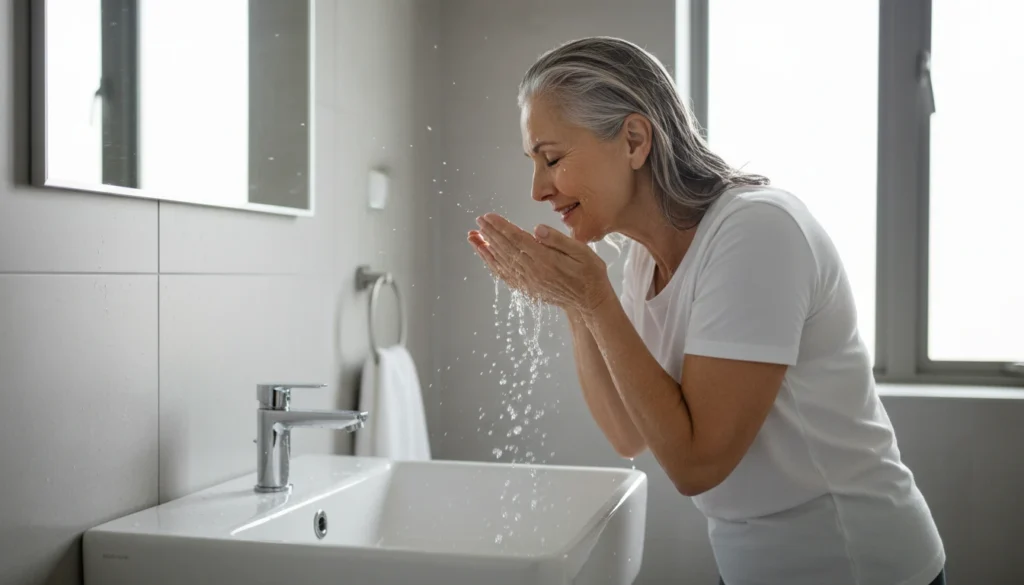
When you’re overwhelmed, head to the sink. Turn the tap cold — not “kinda cool,” actually cold. Splash your face several times or press a cold, wet washcloth over your cheeks and eyes.
This triggers something called the mammalian dive reflex. Your body thinks, “Oh, we’re going underwater? Better slow the heart rate and protect the important organs.” That reflex nudges you out of full-blown panic.
Research has shown that short bursts of cold exposure can reduce stress hormones and improve mood. You don’t have to be the person taking ice baths at 5 AM. Just a cold splash for 30 seconds can shift your state.
I keep a gel ice pack in my freezer specifically for this. I bought it for a knee thing, but honestly, it’s become my anxiety first aid kit. When anxiety shows up and starts unpacking its suitcase, I grab it, press it gently on my face or neck, and stay there for a minute. It’s not comfortable, but it pulls me out of my head and back into my body fast.
Of all the natural ways to calm anxiety in retirement, this one is very “emergency brake” — a little jarring, very effective.
Grounding Techniques: Getting Out of Your Head
Anxiety loves the future. It loves “what if” and “what then” and “but what about.” Grounding pulls you back into right now, where things are usually less catastrophic than your brain is insisting.
These natural ways to calm anxiety in retirement are quiet, subtle, and incredibly portable. No equipment required. No one around you will even notice.
The 5-4-3-2-1 Method
Here’s how it works when you’re spiraling:
- 5 things you can see
- 4 things you can feel or touch
- 3 things you can hear
- 2 things you can smell
- 1 thing you can taste
You start naming them, either silently or out loud:
“Okay… I see the lamp, the window, my phone, that plant that’s somehow still alive, and the mug on my desk. I feel my feet on the floor, the chair under me, my shirt on my shoulders, my hands on my lap…”
At first it feels almost too simple, but that’s the point. Instead of letting your brain sprint through worst-case scenarios, you give it a small, doable task. And brains, it turns out, are pretty obedient when you give them something specific to do.
I’ve used this in doctor’s waiting rooms, on bumpy flights, and sitting in a parked car trying to calm down before going inside somewhere. Nobody knows you’re doing it. On the outside, you look like a person existing in a room. On the inside, you’re using one of the most practical natural ways to calm anxiety in retirement.
The Texture Trick
Pick a “calm object” you can carry with you — a smooth stone, a fidget ring, a fabric bracelet, a stress ball. When anxiety hits, hold it and really notice it:
- Is it cool or warm?
- Smooth or rough?
- Heavy or light?
I have a small river stone I picked up on a trip years ago. It lives in my jacket pocket. I’ve held that thing in more waiting rooms, more tense conversations, more “I’m fine, totally fine” moments than I can count. Nobody knows it’s there. But I do. And somehow that’s enough.
Anxiety lives in future what-ifs. Texture lives in now. Your brain can’t fully occupy both at once. It’s tiny, simple, and weirdly effective — one of those quiet little natural ways to calm anxiety in retirement that you can keep in your pocket.
The Role of Sound and Music
Sound goes straight to your nervous system. That’s why certain songs instantly make you feel calm, nostalgic, or like you’re 35 again at a concert you still think about.
Used intentionally, sound can be one of the gentlest natural ways to calm anxiety in retirement — and one of the easiest to work into your day without changing much at all.
Binaural Beats and Frequency
Binaural beats sound fancy, but the experience is simple: you put on headphones, and each ear hears a slightly different tone. Your brain blends them into one pulsing rhythm that can nudge you toward relaxation.
A case study published in Frontiers in Human Neuroscience found that binaural beats objectively induced a state of relaxation in stressed participants, with measurable changes in brainwave activity — and because the beats were inaudible, the effects couldn’t be attributed to placebo. Translation: some people can literally listen their way into a calmer state.
You can find “binaural beats for relaxation” playlists on YouTube or Spotify. I use them when I’m reading or doing something low-key and feel my stress quietly spiking. It’s one of my lowest-effort natural ways to calm anxiety in retirement — I don’t have to stop what I’m doing, I just put on headphones and let the sound do its thing.
The Humming Technique
This might be the simplest tool in the entire list: hum.
Not a full concert. Just a low, steady “mmmmmmm” for 30–60 seconds.
The vibration from humming stimulates the vagus nerve, which sends “chill out” signals through your whole body. It’s like a massage for your nervous system from the inside.
I usually do this in the car or the shower, because otherwise I feel like a weirdo humming in the kitchen for no apparent reason. My neighbor once caught me humming in the driveway and gave me a very concerned look. Worth it. Every time I do it, I notice my shoulders drop and my breathing slow down a little. As far as natural ways to calm anxiety in retirement go, this one’s ridiculously easy and surprisingly legit.
Progressive Muscle Relaxation: The Tension Release
You ever suddenly realize your shoulders have been up near your ears for… who knows how long? And your jaw is clenched? And your hands are slightly fisted? And you’ve been holding all of that for what feels like hours without noticing?
Same.
Progressive muscle relaxation (PMR) is one of those natural ways to calm anxiety in retirement that also teaches you something: what tension actually feels like in your body, so you can catch it earlier next time.
Here’s the basic idea:
- Start at your toes. Tense the muscles for about five seconds.
- Then release and notice the difference.
- Move up: calves, thighs, glutes, stomach, chest, arms, hands, shoulders, neck, face.
It takes about ten minutes to go through everything slowly.
Research has consistently shown that PMR can reduce anxiety and improve sleep quality — it’s one of the most well-documented non-pharmaceutical tools in the mental health toolkit. It’s like a mini massage you give yourself without needing another person or a spa gift card.
I started doing this on nights when my body felt like a coiled spring and I knew I wasn’t going to fall asleep just by “trying to relax.” Half the time now, I don’t make it to my face — I’m out somewhere around shoulders or jaw. Which is either a sign it’s working, or a sign I was more tired than I thought. Probably both.
If sleep is where your anxiety loves to party, this might become one of your favorite natural ways to calm anxiety in retirement.
The Unexpected Power of Creativity
Here’s something I didn’t expect: creative activities aren’t just for “artsy people.” They’re secretly one of the most effective natural ways to calm anxiety in retirement — especially when your brain feels overloaded and you need somewhere to put all that noise.
And no, you do not have to be “good” at it. Zero people are grading you. There is no rubric. There is no audience.
Coloring, Doodling, and Art
Remember being a kid and zoning out with crayons or markers? That feeling of quietly focusing on shapes and colors while everything else sort of faded out? Turns out, that wasn’t just nostalgia. That was your nervous system getting a break.
Research published in the Art Therapy journal found that about 45 minutes of creative activity significantly lowered cortisol levels, even in people who didn’t see themselves as artistic.
When I feel stuck or overloaded, I’ll grab a pen and start doodling — lines, shapes, little boxes, nothing fancy. My notebook looks like the inside of a distracted person’s brain, which honestly… is accurate. It’s not about creating something beautiful. It’s about giving your hands something to do while your mind steps off the hamster wheel for a bit.
Writing It Out
Some days, the only way out of my head is through my pen.
Not typing, not drafting a perfect journal entry for future anthropologists — just messy, handwritten brain dumps. The kind where your handwriting gets worse as you go because you’re writing faster than you’re thinking.
Research from the University of Rochester Medical Center found that expressive writing about stressful experiences — just 15–20 minutes a day — can improve both mental and physical health over time. If you want to turn this into an actual habit, How to Start Journaling for Mental Health in Retirement Without Losing Your Mind walks you through exactly how to do that without making it feel like homework.
I usually set a timer for 5–10 minutes and write whatever’s in my head. No censoring. No fixing. Just: “I’m worried about X thing, and it feels like Y, and also I forgot to call back the doctor’s office and now I feel weird and—”
By the time the timer goes off, I don’t always feel amazing, but I almost always feel less tangled. And for me, “less tangled” is a win. Among the natural ways to calm anxiety in retirement, this one costs you a few minutes and some ink.
Nature: The Original Therapy
If we’re talking natural ways to calm anxiety in retirement, it would be rude not to invite actual nature to the party.
Humans weren’t built to spend all day under fluorescent lights, staring at rectangles and breathing recycled air. And your nervous system knows it, even if your schedule doesn’t always cooperate.
Forest Bathing (Shinrin-Yoku)
In Japan, there’s a practice called shinrin-yoku, or “forest bathing.” You’re not literally bathing. You’re just walking slowly through nature, being present with what’s around you — no step goals, no workout metrics, no pressure.
Research published in Environmental Health and Preventive Medicine found that people who spent time in forests had lower cortisol, blood pressure, and heart rate — classic signs that the body is moving into a calmer state.
I don’t have a magical mossy forest outside my door, but I do have a park with trees and a small trail. A few times a week, I’ll go there for 20 minutes, leave my phone in my pocket, and just walk. Notice the light. The leaves. The occasional squirrel who looks like it’s judging me. (They always look like they’re judging me.)
It’s become one of my non-negotiable natural ways to calm anxiety in retirement, especially when I feel like I’ve been living entirely in my head for too many days in a row.
Bringing Nature Indoors
If getting outside regularly isn’t realistic for you, you can still borrow some of nature’s calm.
Research from Japanese universities has shown that even having a plant at your desk — or just taking a few minutes to look at greenery — can reduce stress markers. Literally just glancing at a little potted plant for three minutes helped people feel calmer.
I have a couple of succulents and one plant that I’m 70% sure is unkillable. When I feel overwhelmed, I’ll water them, wipe a leaf, or just stare at how the light hits them. It sounds tiny, but it’s like a micro-break for my brain — a small, quiet reminder that not everything is urgent.
Sometimes, natural ways to calm anxiety in retirement are less “grand lifestyle change” and more “you know what, I’m going to water this plant instead of opening another tab.”
The Social Connection Factor
I wish this part weren’t true, as a recovering “deal with everything alone” person — but here it is: we really do need other people.
Not always for advice. Not always for solutions. Sometimes just for the feeling of “Hey, I’m not carrying this alone.” That feeling alone can take the edge off more than most people expect.
The Power of a Hug
A good hug is wildly underrated.
Physical touch releases oxytocin, a hormone that helps reduce stress and boosts feelings of safety. Research from Carnegie Mellon University suggests that people who get more frequent hugs are better buffered against the negative impacts of stress — and may even get sick less often under pressure.
A full 20-second hug (which is longer than it sounds — time it sometime) can literally help calm your nervous system. I timed one once. It felt like an eternity and also exactly right.
Obviously, you need to be hugging someone who’s comfortable with that. But when it’s possible, a real, solid hug is one of the simplest, most human natural ways to calm anxiety in retirement.
Talking It Out (The Right Way)
There’s venting — which can sometimes feel like shaking up a soda can and then handing it to someone else — and then there’s grounded, intentional talking.
When I’m spiraling, I’ll text a friend something like: “Do you have a few minutes? I don’t need solutions, I just need to say this out loud.”
That one sentence sets the tone. Then I talk. Sometimes I ramble. Sometimes I circle back to the same thing three times. But 9 times out of 10, by the end, the thing that felt absolutely enormous has shrunk down to a size my brain can handle.
You don’t need 20 friends for this. You need one or two safe people who get it. And if you’re navigating the social shifts that come with retirement — fewer built-in connections, more time alone — this matters even more. Retirement Lifestyle Planning: The Real, Honest Guide to Finances, Health, and Living Well has a lot to say about building that kind of community intentionally, and it’s worth a read.
Among all the natural ways to calm anxiety in retirement, honest connection might be the most vulnerable… and the most powerful.
Creating Your Personal Calm-Down Protocol
Here’s the thing: you don’t need every one of these tools. You’re not building an anxiety museum. You’re building a tiny, powerful toolkit that actually fits in your life — one that you’ll actually use when things get hard, not just when you’re feeling fine and optimistic.
I like to think of it as a “calm menu.” When I feel that familiar tightness in my chest or the rush of “oh no oh no oh no,” I mentally scroll through options:
- Can I step outside for a five-minute walk?
- Can I do box breathing for two minutes?
- Do I need to splash cold water on my face?
- Would it help to text a friend, or write everything out?
- Or do I just need to lie on the floor for a minute and stare at the ceiling like a Victorian heroine? (My personal specialty. Highly recommend.)
Not every tool will work every time. That’s okay. The point is that you have options — real, practical, natural ways to calm anxiety in retirement that you’ve already tried and know at least sometimes help. And if you want a broader look at how anxiety fits into the bigger picture of retirement stress, How Do You Cope with Anxiety: A Complete Guide to Managing Your Worries is a solid companion read.
Start small. Pick one or two from this list that sound doable and low-pressure. Try them this week. Notice what happens. Adjust. Add another one when you’re ready.
The Long Game: Building Resilience in Retirement
All of these natural ways to calm anxiety in retirement are powerful in the moment. But there’s also the long game — the stuff that makes your baseline less fragile so you don’t hit the red zone as often.
Things like:
- Moving your body regularly, even just walking.
- Sleeping as well as you reasonably can.
- Limiting caffeine if it makes you feel like a hummingbird on espresso.
- Staying connected to people who don’t drain you.
A review in JAMA Internal Medicine found that mindfulness meditation, practiced regularly, can reduce anxiety, depression, and even physical pain — not because one session fixes you, but because repeated small moments of presence literally change how your brain wires stress.
I’m not suggesting you transform your entire retirement overnight. That’s a straight shot to burnout. But maybe you go to bed 20–30 minutes earlier, add one short walk to your day, or do 4-7-8 breathing each night for a week. These don’t feel dramatic. That’s the point. For a deeper look at building these kinds of habits into a sustainable retirement routine, Managing Stress in Retirement: A Real-World Guide to Actually Feeling Better covers the long game in a way that’s practical and genuinely useful.
They’re quiet investments that make all your in-the-moment natural ways to calm anxiety in retirement work even better.
When Natural Isn’t Enough
One last, important thing: all the natural ways to calm anxiety in retirement in the world are not a substitute for professional support when you need it.
If your anxiety is running your life — if you’re having frequent panic attacks, can’t function the way you used to, or feel hopeless more days than not — please reach out to a doctor, therapist, or mental health professional.
There is zero shame in that. If anything, it’s one of the bravest things you can do.
I’ve sat on both sides of this. I’ve tried to “DIY” my mental health with podcasts and journaling only, and I’ve also had seasons where therapy and/or medication were absolutely necessary. Natural ways to calm anxiety in retirement still helped — but they were part of a bigger support system, not the only support.
You’re allowed to use every tool available: breathing, movement, ice packs, therapy, meds, friends, naps. Whatever keeps you here and helps you feel more like you is valid. All of it counts.
Your Next Steps
If you’ve made it this far, first of all: impressive. Second of all: let’s keep this simple.
Don’t try to implement everything you just read. That’s the fastest path from “I want to feel calmer” to “I’m stressed about my calm-down plan.” I’ve been there. It’s not a fun place.
Instead, pick one or two natural ways to calm anxiety in retirement from this article that genuinely clicked for you. Maybe it was box breathing, the 5-4-3-2-1 grounding method, a short no-phone walk, or the cold water face splash.
Try one of them today. Not “someday.” Not “when life slows down.” Today, in whatever tiny way you can manage.
Then pay attention to how you feel — during, right after, and 10 minutes later. No judgment, just curiosity. You’re running a small experiment on yourself, in a good way.
I’ve been practicing these techniques for years now, and I still have messy, anxious days. The difference is, those days don’t own me the way they used to. I know I have options. I know what helps even a little. And a little bit of calm, repeated often, adds up to something that actually changes your life.
You don’t have to become a person who never gets stressed. That person does not exist, and frankly, I’d find them exhausting. You just need some reliable, natural ways to calm anxiety in retirement for when your brain and body go into “everything is on fire” mode.
Start small. Be kind to yourself. And remember: the goal isn’t perfection, it’s progress — and a retirement where stress shows up, but doesn’t get the final say.
Key Takeaways
- Retirement anxiety is real and specific — it just wears different clothes than work stress did. If you’re still navigating the emotional side of this transition, Preparing for Retirement Emotionally: Navigating Your New Chapter with Confidence and Joy is a great place to start.
- Box breathing and the 4-7-8 technique can shift your nervous system out of panic mode within minutes.
- Walking, shaking, and gentle movement give stored stress an exit route. Stanford research confirms walking boosts creative thinking by 60% and reduces anxiety — even a short stroll counts.
- Cold water exposure triggers a natural calming reflex your body already knows how to use.
- Grounding techniques like 5-4-3-2-1 pull you out of future-focused spiraling and back into right now.
- Binaural beats in the theta frequency range have been shown to objectively induce relaxation, making sound one of the most accessible tools in your calm-down kit.
- Building a personal “calm menu” means you always have options, even on the hard days.
- Natural tools work best as part of a bigger support system — professional help is always on the table and never something to be ashamed of. For a fuller picture of how to build that system across finances, health, and daily life, Retirement Lifestyle Planning: The Real, Honest Guide to Finances, Health, and Living Well covers it well.




One Comment
Comments are closed.