
Nighttime Outdoor Activities for Seniors: 20+ Fun, Safe Ways to Reclaim Your Evenings in Retirement
Nighttime outdoor activities for seniors turn quiet evenings into something worth remembering — from stargazing and forest walks to glow games and campfire nights. Here’s how to do it right.
I’ve always believed that retirement gives you something most people completely underestimate: evenings. Real, unscheduled, nobody-needs-anything-from-you evenings. And for a long time, I watched those hours disappear into the same comfortable loop — dinner, a show, the phone, then somehow it’s midnight and I couldn’t tell you what I actually did.
Then I started stepping outside after dinner. Just for a few minutes at first. And something shifted.
The air was cooler. The street was quieter. The sky, which I’d been ignoring for years, turned out to have an entire show running every night for free. Nighttime outdoor activities for seniors aren’t some niche wellness trend — they’re one of the most accessible, genuinely enjoyable ways to make your evenings feel like they actually belong to you again.
This guide covers everything: the activities worth trying, the safety habits that make it all easy, the science that explains why being outside after dark feels so good, and a few ready-made evening plans you can use tonight. No expensive equipment required. No fitness level prerequisites. Just you, a comfortable pair of shoes, and the willingness to find out what you’ve been missing.
Why Nighttime Outdoor Activities for Seniors Are Worth Taking Seriously
Here’s the part most activity guides skip: the research on what evening time outdoors actually does for you.
A large-scale study published in the Journal of Affective Disorders, drawing on data from over 400,000 UK Biobank participants, found that time spent outdoors during the day and evening was significantly associated with better mood, improved sleep quality, and healthier circadian rhythm alignment — with effects consistent across both cross-sectional and longitudinal analyses. For retirees, whose circadian rhythms naturally shift with age and whose sleep quality often becomes more fragile, that connection between outdoor time and better nights is meaningful.
The social dimension matters just as much. A longitudinal study using Health and Retirement Study data — tracking over 19,000 older adults across multiple years — found that engagement in leisure activities, particularly social and club-based activities outdoors, was consistently associated with significantly lower rates of depression in older adults, independent of other health factors. Going outside in the evening, especially with others, isn’t just pleasant. It’s protective.
And then there’s the forest bathing angle. A systematic review and meta-analysis published in the International Journal of Biometeorology, covering 22 studies, found that forest bathing (shinrin-yoku) — spending mindful time in natural environments — significantly reduced salivary cortisol levels compared to urban settings, with the effect consistent across nearly all included studies. You don’t need a forest to access a version of this. A quiet park path, a tree-lined street, a backyard with the lights dimmed — the principle holds.
Retirement gives you the time to do this. The evenings are already there. You just have to walk into them.
Key Takeaways
- Nighttime outdoor activities for seniors support better sleep, lower stress, improved mood, and stronger social connection — all backed by research
- Safety is simple and non-negotiable: good lighting, reflective gear, a buddy or check-in plan, and awareness of your surroundings
- Evening activities range from high-energy (glow games, night walks with a group) to deeply calm (stargazing, forest bathing, outdoor journaling)
- The best starting point is your own backyard or a familiar neighborhood path — no special destination required
- A red-light headlamp preserves night vision and is worth more than any other piece of gear you could buy
- Social evening activities have an outsized effect on wellbeing in retirement — the combination of being outside and being with people is hard to beat
- Start with 20–30 minutes and build from there; consistency matters more than duration
Before You Go: The Retirement-Friendly Safety Checklist
None of this needs to be complicated. But a little preparation is what makes nighttime outdoor activities for seniors genuinely enjoyable rather than stressful — and it becomes habit faster than you’d think.
One LED flashlight per person, plus a spare for the group. A headlamp keeps your hands free for everything else — walking, pointing at constellations, fishing a phone out of your pocket. A red-light option (either a headlamp with a red mode, or a red-light flashlight) preserves your night vision so your eyes stay adjusted to the dark instead of resetting every time you check the path.
Reflective clothing or a vest matters more than people assume. Even quiet neighborhood streets have cars, and being visible from a distance is the simplest safety upgrade available.
Layers, bug spray, water. Mountain evenings drop fast. Coastal evenings can be deceptively cool. Even warm summer nights in the suburbs benefit from a light layer you can tie around your waist.
A check-in plan: someone at home knows where you’re going and when you’ll be back. If you’re walking solo, a fully charged phone is your safety net.
Check park hours before you go. Many parks lock gates after dark, and finding this out at 9 PM is avoidable with a one-minute search.
Skip thunderstorms, dense fog, high wind, and extreme cold. There’s always tomorrow, and the evening doesn’t have to be dramatic to be worthwhile.
Peaceful Nighttime Outdoor Activities for Seniors Who Want to Slow Down
Not every evening needs to be an event. Some of the best nighttime outdoor activities for seniors are the ones that ask almost nothing of you.
Stargazing: The Hobby That Costs Almost Nothing
Retirement is, genuinely, the ideal life stage for stargazing. You don’t have to be anywhere early the next morning. You can sit outside as long as you want. And the night sky, which most of us spent decades ignoring because we were too busy, is surprisingly generous once you give it your attention.
You don’t need a telescope to start. A reclining lawn chair or a blanket on the grass, a red-light headlamp, 20 minutes of eye adjustment, and a free app like Stellarium or SkySafari (kept in red mode so you don’t blow your night vision) is all it takes. Binoculars — a standard 7×50 pair is plenty — open up the Moon’s craters, Jupiter’s moons, and star clusters in ways that genuinely surprise people who’ve never looked.
Easy targets to start with: the Moon’s shadow line where craters pop in relief, Orion’s belt in winter, the Summer Triangle in warm months, the Pleiades cluster year-round. For meteor showers — the Perseids in August, the Geminids in December — bring a warm blanket and someone worth nudging when a bright streak flies by. Some of those shower nights leave you feeling like you witnessed something.
If light pollution is a problem where you live, the International Dark-Sky Association (darksky.org) maintains a directory of designated dark-sky parks and preserves worth planning a trip around.
Moonlit Walks: The Evening Version of Your Morning Stroll
A walk you’ve done a hundred times in daylight becomes a different experience in the dark. Shadows reorganize. Sounds you tuned out — crickets, frogs, wind in specific trees — become the foreground instead of the background. The familiar becomes a little mysterious in the best possible way.
Start with a route you know well: your neighborhood, a park you’ve visited in daylight, a path near your home. Bring your red-light headlamp, wear something reflective, and consider going with a friend or a partner. The conversation on a moonlit walk is different from daytime conversation — something about the setting tends to slow things down in a way that feels good.
For a more intentional version of this, Walking Groups for Seniors covers how to find or organize group walks that make evening outings more social, safer, and more likely to become a regular habit rather than a one-off.
Forest Bathing and Mindful Evening Walks
Forest bathing — the Japanese practice of shinrin-yoku, which essentially means spending slow, attentive time in a natural environment — is having a well-deserved moment in the research literature. And it translates beautifully to evening walks.
The practice isn’t about exercise. It’s about presence. Walk slowly. Stop every few minutes. Notice what you hear, what you smell, what the air feels like on your face. The darkness sharpens the non-visual senses in ways that can make a familiar park feel entirely new.
A simple protocol: walk two to three minutes at a slow pace, stop for one to two minutes and simply pay attention, repeat. End by naming three things you noticed that surprised you. It sounds almost too simple — and then you try it, and you understand why it keeps showing up in the research.
Night Journaling Outside
This one sounds small. It isn’t.
Bring a notebook and a red-light headlamp. Sit on a porch, a bench, a blanket in the backyard. Give yourself ten minutes with no agenda. The prompts I find most useful: What do I hear right now that I’d miss indoors? What did today feel like, in one honest sentence? What am I looking forward to?
Over months, those pages become something. A record of evenings that would have otherwise dissolved into screen time. A quiet habit that costs nothing and gives back more than it takes.
Active Nighttime Outdoor Activities for Seniors Who Want to Move
Not everyone wants to sit quietly and contemplate the cosmos. Some evenings call for something with a little more energy — and nighttime outdoor activities for seniors can absolutely deliver that.
Evening Group Walks and Night Hikes
Group walks in the evening are one of the most underrated activities in retirement. The combination of light movement, fresh air, and easy conversation hits a sweet spot that’s hard to replicate any other way. Many local parks and nature centers offer guided night hikes — these are particularly good for retirees who want to explore after dark with the safety of a naturalist leading the way and pointing out what to notice.
The social dimension here is worth emphasizing. A study published in PMC found that leisure activities improve mental health in older adults primarily through two pathways: expanding social support networks and reducing perceived stress — and that both effects are significantly stronger when activities involve social interaction. An evening walk with a friend or a group is doing more than you can see.
This is also why Social Health for Retirees belongs in the conversation here — it makes the case, backed by research, for why connection isn’t a bonus feature of retirement but a core health strategy.
Glow Games: Surprisingly Good Fun After 60
I want to make the case for glow games, which sound juvenile until you actually play them at night with a group of adults and realize how immediately, reliably fun they are. Darkness removes the usual self-consciousness. Nobody’s performing. You’re just playing.
Flashlight tag is the entry point: one person is “it” and tags others by shining their flashlight beam on them. Freeze tag with a flashlight is the escalation — tagged players freeze until a teammate releases them. It’s chaotic in the best way. Mark your boundaries with glow sticks and keep rounds to five or eight minutes so nobody overdoes it.
LED frisbee and glow football are the more relaxed versions: slower throws, more laughter, the surprisingly funny experience of trying to track a flying disc at night. Start on a flat, familiar surface, keep the play area small, and wear shoes with grip.
Backyard treasure hunts with glow sticks tucked around the yard are a genuine hit with any mix of ages. Set up clue cards or a simple map, hide a small prize or a basket of snacks at the end, and build in a “home base” where everyone regroups between clues. The fun comes from the atmosphere more than the prize.
Campfire Nights
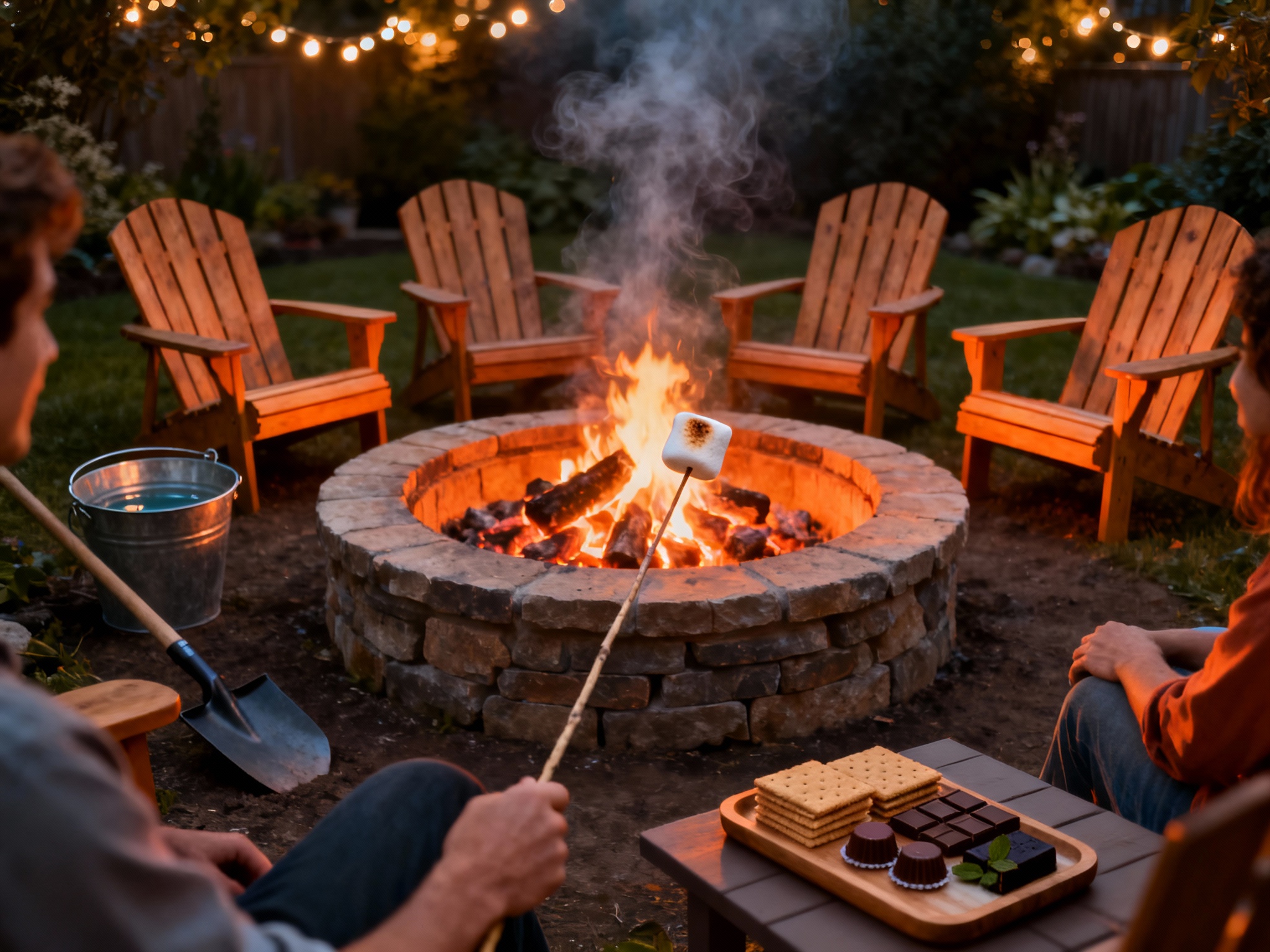
A campfire turns an ordinary evening into something people remember. Check fire restrictions before you build one — especially in dry seasons, these change quickly. Keep water and a shovel nearby. Position chairs so you’re not sitting in the smoke path.
Then just let it be simple. A few people, a fire, warm drinks, unhurried conversation. Stories, songs if someone has a guitar, a long comfortable silence while the fire does its thing. The campfire does the work; you don’t have to add much.
S’mores are not negotiable. Upgrade them if you want — a dark mint chocolate bar, a peanut butter cup instead of plain chocolate — but have them. Some traditions earn their place.
Wildlife Watching After Dark: Your Neighborhood’s Secret Life
This one takes the least effort and delivers some of the most surprising rewards.
The transition between dusk and full dark is loud if you know what to listen for. Great horned owls give their low, resonant calls from tree branches — a sound that stops being ambient noise the moment you’re actually paying attention to it. Eastern screech owls produce a soft trilling whinny that’s easy to miss and unforgettable once you’ve heard it. Bats are most visible just after sunset, working the edges of open spaces and water. Frogs and toads near any water source put on a sound performance that varies by season and species in ways that reward repeated evenings.
The best locations are edges: where woods meet fields, where lawns meet hedgerows, along fence lines near water. These are the wildlife corridors where activity concentrates. Many local nature centers offer guided night wildlife walks, which are particularly good for retirees who want expert company and narration for their first few outings.
Ready-Made Evening Plans for Seniors
Three practical plans you can use without any additional planning.
The Quiet Reset (45–60 minutes) Start with a slow 15-minute mindful walk — two minutes walking, one minute stopped and paying attention. Find a comfortable spot for 15 minutes of stargazing: locate the Moon, one constellation, or just lie back and watch for satellites moving slowly across the sky. Finish with 10 minutes of evening journaling. Bring a blanket, a red-light headlamp, and a warm drink.
The Social Evening (60–90 minutes) Meet one or two friends for a 30-minute evening walk on a familiar path. Follow it with 30–45 minutes around a campfire or on a porch with something warm to drink. No agenda required — just conversation, some stars overhead, and the kind of unhurried time that retirement makes possible in a way that working life rarely did.
The Active Family Night (60–90 minutes) Set glow-stick boundaries in a yard or park. Run two rounds of flashlight tag or glow frisbee (keep rounds short, rotate who’s “it”). Wind down with 15 minutes of casual stargazing or hot cocoa and one easy star story. This works for any age mix and builds the kind of shared memory that tends to outlast whatever was streaming that night.
What to Bring: A Simple Gear List
You don’t need much. That’s part of what makes nighttime outdoor activities for seniors so accessible.
A red-light headlamp is the single most useful item — it keeps your hands free, preserves night vision, and costs less than a dinner out. A regular LED flashlight as backup. Reflective clothing or a vest. Comfortable shoes with grip. Layers — a light jacket goes further than you’d expect. Water. Bug spray. A fully charged phone.
For stargazing: add a blanket or reclining chair, binoculars if you have them (7×50 is the sweet spot for beginners), and a star app in red mode.
For campfire nights: add seating arranged out of the smoke path, a bucket of water within reach, and ingredients for s’mores.
Rentals and purchases are available at outdoor shops in most areas, and many items — headlamps, reflective vests, binoculars — are inexpensive enough that the barrier to entry is genuinely low.
A Note on Accessibility
Many of the best nighttime outdoor activities for seniors work beautifully for people with varying mobility. Camp chairs make stargazing comfortable for anyone who can’t easily sit on the ground. Smooth, paved paths or familiar neighborhood routes work for walkers and those with mobility aids. Porches, patios, and balconies are legitimate venues for evening journaling, wildlife listening, and stargazing — you don’t need to be far from home for the sky to show up.
If sensory sensitivities are a factor, soft red lighting keeps the atmosphere calm without the jarring contrast of bright flashlights. Guided nature programs at local parks often have accessibility options worth asking about.
Conclusion: The Night Is Already There — Nighttime Outdoor Activities for Seniors Make It Yours
Here’s what I keep coming back to. Retirement gives you evenings in a way that working life never quite did. No commute home, no emails waiting, no alarm making decisions for you at 6 AM. The evening hours are genuinely available.
Nighttime outdoor activities for seniors are the answer to the question of what to do with them — not because screens are bad or couches are wrong, but because stepping outside after dark does something that staying in doesn’t. It resets your nervous system. It connects you with something larger. It gives you a memory instead of a blur.
The research is clear: outdoor time improves mood and sleep, leisure activities reduce depression, time in natural environments lowers stress hormones, and social connection in later life is one of the strongest predictors of healthy aging. A moonlit walk with a friend, a campfire with neighbors, a quiet half-hour with the stars — these are small things that compound into something significant.
Start with whatever requires the least effort: a blanket in the backyard, a walk around the block after dinner, ten minutes outside listening for owls. That’s enough to start. And more evenings than you’d expect, it turns into something worth staying for.
Grab the red light. Step outside. The night’s been waiting.



One Comment
Comments are closed.