The Real Guide to Toilet Safety Rail for Seniors (That Actually Makes the Bathroom Less Terrifying)
Everything you need to know about choosing the right toilet safety rail for seniors — from fall prevention stats to installation tips — so the bathroom feels safe again.
Nobody grows up thinking, “You know what I really want to spend a Saturday researching? Bathroom safety equipment.” And yet — here you are. Here we are. And honestly? I think that says something really good about you.
Whether you’re a caregiver trying to make life safer for an aging parent, a senior who’s had one too many close calls near the toilet, or just someone who’s finally decided to stop pretending the bathroom isn’t a little bit terrifying — welcome. You’re in the right place.
I got pulled into this topic a few years ago when my grandmother, sharp as a tack at 81, slipped getting up from the toilet and scared about ten years off my life. She was fine, thankfully. But watching her grab at thin air for something — anything — to hold onto made me realize how completely unprepared most bathrooms are for the realities of aging. We childproof homes for toddlers without a second thought. But somehow, we forget to do the same for the people who actually need it most.
That experience sent me down a rabbit hole of research, product comparisons, and more conversations about toilet hardware than I ever expected to have. And what I found was genuinely useful — so I’m sharing it here, minus the boring parts.
The short version? A good toilet safety rail for seniors is one of the simplest, most effective things you can do to prevent a bathroom fall. The long version is everything below.
Why the Bathroom Deserves More Respect (and More Grab Bars)
Let’s just say it plainly: the bathroom is the most dangerous room in the house. Not the garage with its power tools. Not the kitchen with its open flames. The bathroom — that small, wet, hard-surfaced room everyone visits multiple times a day without giving it a second thought.
The numbers back this up in a way that’s hard to ignore. The CDC consistently ranks falls as the leading cause of injury among adults 65 and older, and research suggests that roughly 80% of senior falls occur in the bathroom. Eighty percent. That’s not a rounding error — that’s a pattern.
Think about what the bathroom actually asks of you physically: you walk on wet tile, lower yourself onto a seat that’s often too low, and then push yourself back up using leg muscles and balance that — through absolutely no fault of anyone’s — tend to weaken with age. It’s a lot. And when there’s nothing to hold onto, that routine task becomes a genuine gamble.
I remember standing in my grandmother’s bathroom after her slip and just looking at it with fresh eyes. Smooth tile floor. No grab bars. A toilet that sat maybe 15 inches off the ground. It was basically a fall waiting to happen, dressed up as a normal bathroom. We fixed it. And I want to help you do the same.
So What Exactly Is a Toilet Safety Rail for Seniors?
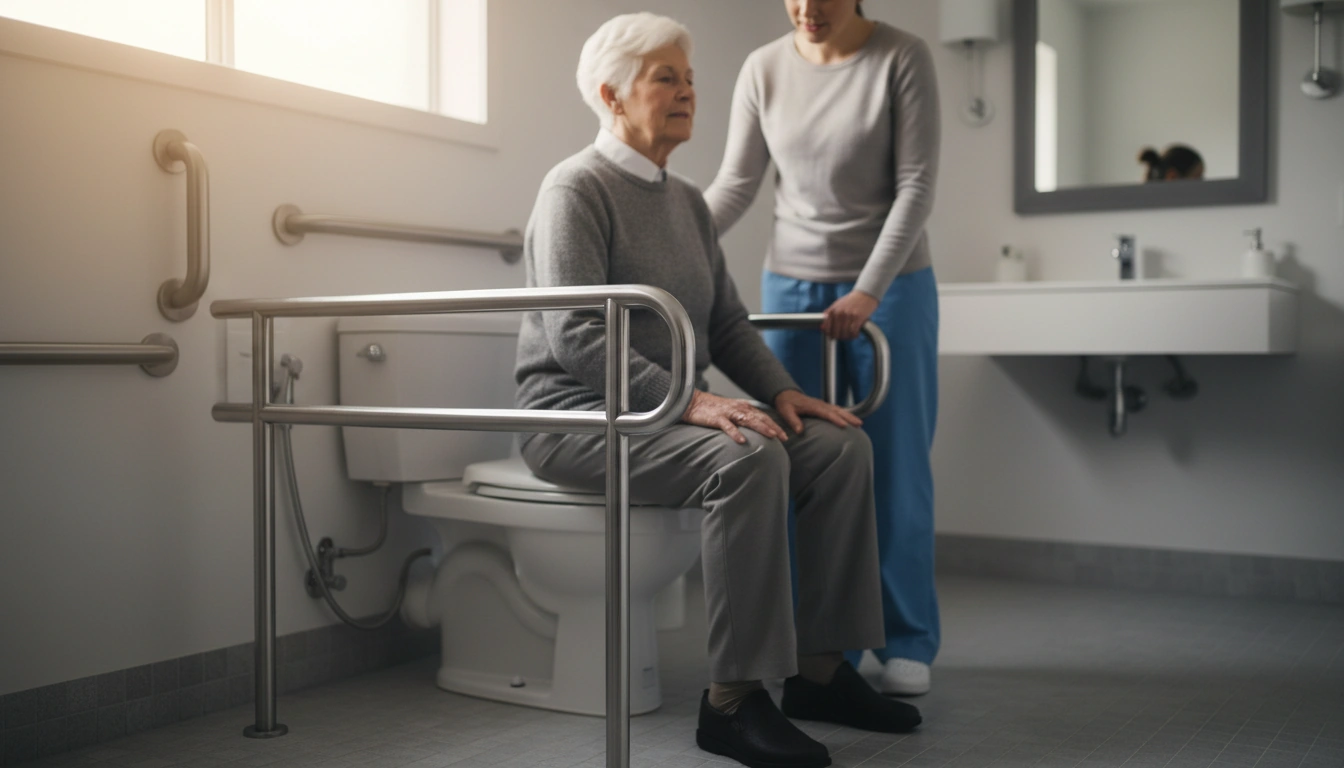
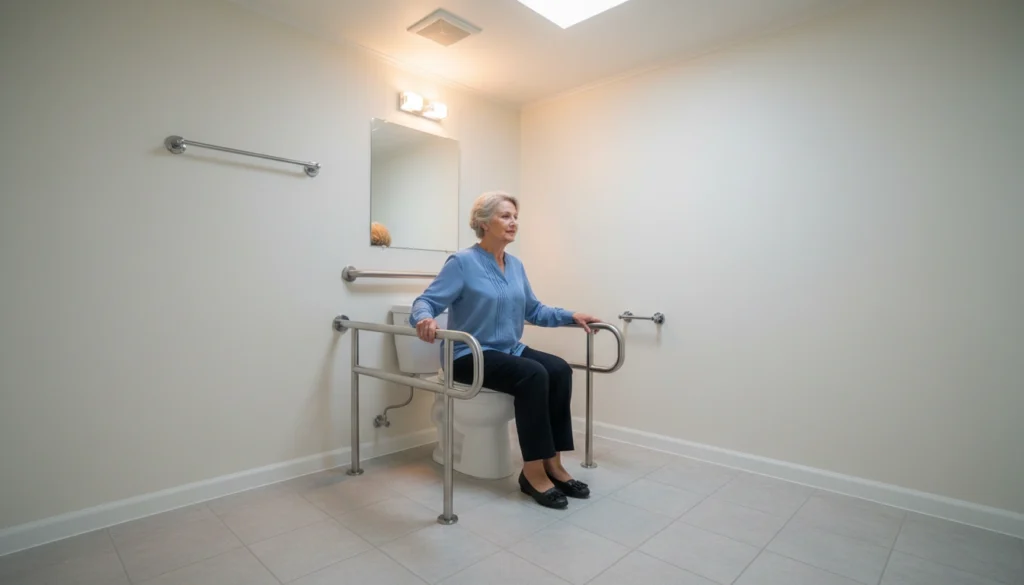
At its simplest, a toilet safety rail is a sturdy handhold that gives seniors something reliable to grip when sitting down, standing up, or repositioning on the toilet. It’s not complicated. It doesn’t need to be. The best safety solutions rarely are.
What does get a little nuanced is the variety of options available — because not every rail works for every person or every bathroom. Here’s how they break down:
Fixed (Permanently Mounted) Rails
These are bolted directly into the wall or floor, and they are not moving. That’s the whole point. Fixed rails offer the highest level of stability and are ideal for anyone who needs maximum, dependable support every single day. The trade-off is that installation requires drilling, and once they’re up, they’re up. But honestly? For most home setups, that permanence is a feature, not a bug.
Adjustable Rails
Adjustable rails can be set to different heights, which makes them surprisingly versatile. If multiple people share the bathroom, or if the user’s mobility needs are likely to change over time (which, let’s be real, they often do), adjustable models offer flexibility that fixed rails simply can’t match. They need occasional re-tightening, but that’s a five-minute job, not a project.
Portable Rails
Portable toilet safety rails are freestanding units that clamp onto the toilet — no drilling, no anchors, no tools required. They’re a lifesaver for renters, frequent travelers, or anyone who needs a temporary solution while figuring out a longer-term plan. The honest truth, though: they’re less stable than mounted options. They’re great for users with moderate balance challenges, but if someone needs serious support, a mounted rail is the safer call.
What to Actually Look For When You’re Shopping
This is where a lot of people go wrong. They find something on sale, it looks sturdy enough in the photos, and they click “add to cart” without checking the specs. I’ve done it with other products. Don’t do it with something a person is going to lean their full body weight on.
Material Matters More Than You Think
Stainless steel and aluminum are the materials you want. Both are durable, rust-resistant, and built to handle daily use without degrading. If something feels hollow or flimsy when you tap it — even through a screen, you can often tell from reviews — keep scrolling.
Weight Capacity Is Non-Negotiable
Most quality toilet safety rails for seniors are rated for at least 250 pounds. Always verify this before buying, and if the user’s weight is anywhere near that limit, go higher. A rail rated for 300 or 350 pounds gives you a real safety margin. There’s no prize for cutting it close here.
The Grip Surface Is Underrated
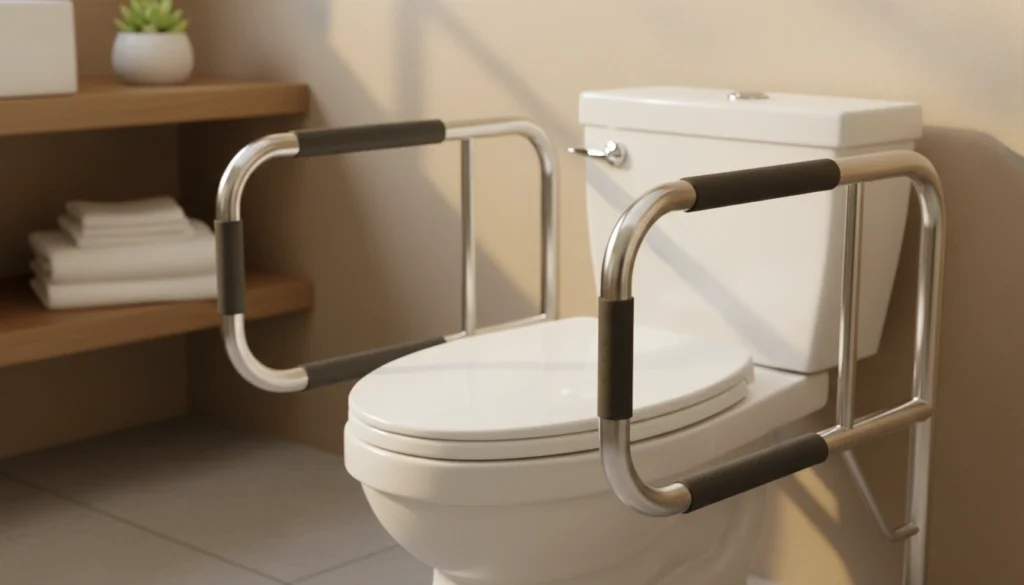
Wet hands are a bathroom reality. A smooth metal bar isn’t going to cut it when someone’s trying to steady themselves mid-stand. Look for rails with a textured or rubberized grip surface — it’s a small detail that makes a meaningful difference in actual use.
Safety Certifications
Certifications from recognized testing bodies mean the product has been evaluated against industry standards. They’re not the only thing to look for, but when you’re comparing two similar products at similar prices, a certification is a useful tiebreaker.
The Research That Made Me Take This Even More Seriously
I want to share something that genuinely stopped me in my tracks when I first read it.
A 2020 study by researcher M. Guay, focused on bathroom assistive technology, surveyed 28,406 noninstitutionalized Canadians between the ages of 50 and 104. The findings were sobering: disability rates climbed sharply with age, and by 90 years old, 21% of respondents reported needing help just to wash themselves. Not climb a mountain. Not run a 5K. Wash themselves.
The study’s conclusion was clear — adapting the bathroom with tools like grab bars, bath seats, and nonslip mats is one of the most practical, evidence-backed ways to preserve independence and reduce caregiver burden. Not a luxury. Not an overreaction. A practical, proven intervention.
That finding stuck with me because it reframes the whole conversation. A toilet safety rail for seniors isn’t a symbol of getting old. It’s a tool for staying in charge of your own life. And that’s a completely different thing.
How to Install a Toilet Safety Rail Without Losing Your Weekend
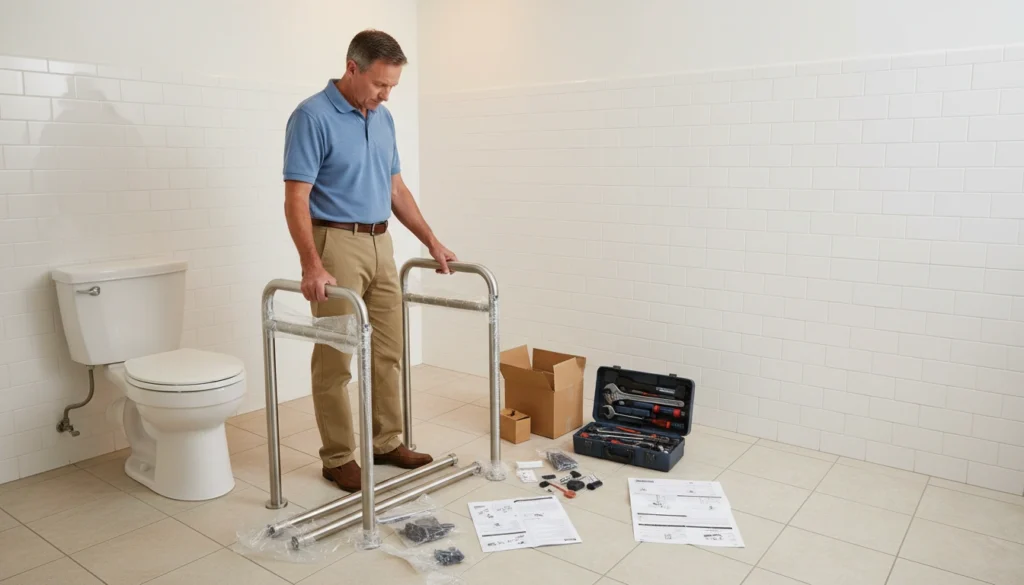
Good news: most toilet safety rails are designed for real people, not professional contractors. Many come with all the hardware you need and instructions that are actually legible. That said, a few tips can save you a lot of frustration — and one or two mistakes can turn a simple project into a headache.
Step 1: Pick the Right Spot
The rail should sit where it’s easiest to reach naturally — typically beside the toilet, at a height that lets the user push up or lower down without straining. Have the person actually stand next to the toilet and reach out naturally. Where their hand lands? That’s roughly where the rail should be.
Step 2: Gather Your Tools
You’ll need a drill, appropriate drill bits, a level, screws, and wall anchors if you’re not drilling into studs. Check the manufacturer’s hardware list — some kits include everything, others assume you have a fully stocked workshop. (Spoiler: most of us don’t.)
Step 3: Mark, Measure, and Double-Check
Use a pencil to mark your mounting points. Then check them again. A level is your best friend here — a crooked rail isn’t just aesthetically annoying, it affects how force is distributed when someone leans on it. Measure twice, drill once. Classic advice. Still true.
Step 4: Drill and Anchor Properly
Hitting a stud is ideal — it’s the strongest possible mount. If you can’t, use the correct wall anchors for your wall type. Drywall, tile, and concrete all require different approaches, and this is not the place to improvise. A rail that pulls out of the wall mid-use is genuinely dangerous.
Step 5: Test It Like You Mean It
Once it’s up, don’t just give it a polite little wiggle. Put your full body weight on it. Push from different angles. Lean on it the way someone would actually use it. If anything moves, address it before anyone else touches it. This is the step most people skip, and it’s arguably the most important one.
Fixed vs. Adjustable vs. Portable: The Honest Comparison
Still weighing your options? Here’s a no-fluff breakdown:
| Type | Best For | Stability | Flexibility | Installation |
|---|---|---|---|---|
| Fixed | Permanent homes, high support needs | Highest | None | Requires drilling |
| Adjustable | Shared bathrooms, changing needs | High | Good | Moderate effort |
| Portable | Renters, travelers, temporary use | Moderate | Excellent | None required |
One thing the table can’t capture: consider the user’s confidence level, not just their physical needs. Someone who’s already anxious about bathroom safety will feel the difference between a rock-solid fixed rail and a portable unit that shifts slightly underfoot. That psychological dimension is real, and it matters. Feeling safe and being safe aren’t always the same thing — but with the right rail, they can be.
Keeping It Safe Long-Term: Maintenance That Actually Gets Done
Here’s the part most people skip — right up until a screw works itself loose and someone gets a scare. Maintenance doesn’t have to be a whole thing. It just has to happen.
Once a month, give the rail a firm shake and check for any movement. Tighten any screws that have loosened — and they will loosen over time, especially with daily use. Inspect the mounting points for rust, corrosion, or any wall damage around the anchors. Clean the rail with mild soap and water; harsh chemical cleaners can degrade grip surfaces and corrode metal faster than you’d expect.
And if you ever notice cracking, bending, or significant rust — replace it. Don’t try to nurse a compromised safety device along. The whole point is reliable support, and a damaged rail can’t deliver that. Think of it like a smoke detector battery: the one time you ignore it is the one time it matters.
Real Questions, Real Answers
Are toilet safety rails hard to install?
For most people, no. Fixed and adjustable models require some drilling and basic tool use, but the process is manageable if you follow the instructions. Portable models need zero installation. If you’re not comfortable with a drill, a handyman or home health equipment supplier can typically install a fixed rail in under an hour — and it’s worth every penny.
Will a rail actually prevent falls?
Yes — when it’s the right rail, properly installed, and used consistently. The evidence is clear. But beyond the statistics, users consistently report feeling more confident after installation, and that matters too. Confidence changes how people move. Cautious, supported movement is safer movement.
Can I bring a portable rail when traveling?
Absolutely, and plenty of people do. Just make sure it’s compatible with the toilet you’ll be using — shapes and heights vary more than you’d think — and test it for stability before relying on it. For public restrooms, most accessible facilities already have fixed grab bars. Always give them a quick check before use, because “installed” and “well-maintained” aren’t always the same thing.
What if the user is close to the weight limit?
Go higher. If someone weighs 240 pounds and the rail is rated for 250, that’s not a comfortable margin — that’s a stress test waiting to happen. Look for models rated at 300 pounds or more, and prioritize products with recognized safety certifications. There’s no reason to test the limits of a safety device.
How to Choose the Right One: A Simple Decision Framework
If you’re still not sure where to land, here’s a quick gut-check guide:
- Permanent home, strong daily support needed? → Fixed rail, professionally installed if you have any doubts.
- Shared bathroom or needs that might change? → Adjustable rail with a solid weight rating.
- Renting, traveling, or just getting started? → Portable rail from a reputable brand.
- Significant balance or strength challenges? → Fixed or adjustable, and seriously consider consulting an occupational therapist. They’re incredibly good at this, and one home visit can be genuinely eye-opening.
Whatever you choose, don’t compromise on weight capacity and don’t skip the safety certification check. Those two things separate a rail that works from one that fails at the worst possible moment.
The Bottom Line (And Why This Actually Matters)
Here’s what I keep coming back to: the bathroom shouldn’t be a source of dread. It’s a room people visit multiple times every single day. For seniors navigating balance changes or reduced strength, that frequency means the risk compounds fast — and so does the quiet anxiety that comes with it.
A well-chosen, properly installed toilet safety rail for seniors doesn’t just reduce fall risk. It gives people back something that’s easy to take for granted: the ability to handle a basic daily task on their own terms, without fear, without help, without having to ask. That’s not a small thing. That’s dignity. That’s independence. That’s the difference between feeling capable and feeling like a burden — and no one should have to feel like a burden just because their bathroom isn’t set up right.
After my grandmother’s slip, we installed a fixed rail beside her toilet and a grab bar near the shower. She called me two weeks later — not to thank me, exactly, but to mention, almost casually, that she’d stopped dreading her morning routine. That was it. That was the whole review. And honestly, it was enough.
If you’re reading this because someone you love needs this kind of support, I hope it made the decision a little clearer and a lot less overwhelming. Start with the right type for the situation. Check the weight capacity. Install it properly. Check it monthly. That’s really all there is to it.
The bathroom doesn’t have to be the most dangerous room in the house — not when you’ve got the right tools in place and someone who cares enough to put them there.
Ready to find the right toilet safety rail for seniors? Look for options that combine durable materials, certified weight capacity, and the right fit for your bathroom — because the best rail is simply the one that’s right for the person using it.