

Stress Management for Seniors: Techniques That Actually Work (Without Losing Your Mind)
Practical stress management for seniors that addresses the real stressors of retirement — from health worries to identity shifts — so you can finally feel more at ease in this season of life.
My neighbor retired on a Friday.
By the following Wednesday, he was reorganizing his garage for the third time. Not because it needed it. Because he didn’t know what else to do with his hands — or his mind, or the six hours that used to belong to his commute and his meetings and the low hum of being needed somewhere.
“I thought I’d love this,” he told me, leaning against a rake he hadn’t used yet. “I do love it. I just also kind of hate it.”
That’s retirement stress in a nutshell. It doesn’t look like the stress you left behind — no deadlines, no performance reviews, no inbox that refills itself overnight. It’s quieter than that. More personal. And in a lot of ways, harder to name, which makes it harder to manage.
This article is about naming it. And then doing something about it.
Why Retirement Stress Hits Differently

There’s a reason the research on retirement keeps turning up the same surprising finding: the transition into retirement is one of the most psychologically disruptive life changes adults go through — not just logistically, but emotionally and existentially.
A study published in the Journal of Occupational Health Psychology put it plainly: retirement doesn’t just change what you do. It changes who you are. Your schedule, your social world, your sense of purpose, your daily identity — all of it shifts at once. And the human brain, which is wired for predictability and meaning, doesn’t always take that gracefully.
What makes retirement stress particularly tricky is that it often comes disguised as something else. The irritability that’s actually grief. The restlessness that’s actually a search for purpose. The 3 a.m. worry spiral that’s actually about identity, not money. You think you’re stressed about your savings account, and you are — but underneath that, you’re also asking a much bigger question: What is my life for now?
That question deserves a real answer. And it takes time to find one. In the meantime, the stress is real, and it needs to be managed — not pushed down, not cheerfully ignored, not solved with a cruise brochure.
The Stressors Nobody Puts on the Retirement Checklist
Most retirement planning focuses on finances and healthcare. Both matter enormously. But the stressors that actually catch people off guard tend to be the ones nobody warned them about.
The Money Worry That Never Fully Quiets
Here’s something financially comfortable retirees don’t always feel safe admitting: they’re still anxious about money. Not because they’re broke. Because the shift from accumulating to spending down is psychologically jarring in a way that no spreadsheet fully prepares you for.
For decades, a paycheck arrived and told you things were okay. Now you’re the one making withdrawals, watching the balance, doing the math in your head at the grocery store. The American Psychological Association’s Stress in America survey has found, year after year, that financial worry is one of the top stressors for older adults — and it’s rarely just about the numbers. It’s about control. Security. The fear of becoming a burden. The fear of outliving what you saved.
That kind of worry doesn’t respond to logic. You can know, intellectually, that you’re fine — and still feel the low hum of anxiety every time you swipe your card.
The Body That Has Opinions Now
Before retirement, most people managed health the way they managed everything else: efficiently, around the edges of a busy life. You went to the doctor when something was wrong. You pushed through when you were tired. You filed the concerning symptom away for later and forgot about it.
Retirement removes the distraction. Suddenly there’s time to notice things. Time to go to appointments. Time to sit with the results and actually think about what they mean.
A friend of mine — sharp, funny, someone who ran half-marathons into her late fifties — told me that the hardest moment of her first year of retirement wasn’t the diagnosis. It was the afternoon she tried to push through the fatigue the way she always had, and her body simply refused. “I kept waiting for the second wind,” she said. “It didn’t come. And I realized it wasn’t coming. That was the day I understood something had changed.”
Health stress in retirement isn’t just physical. It’s the renegotiation of your relationship with your own body — and that’s an emotional process, not just a medical one.
The Unstructured Day That Sounds Like Freedom
Everyone fantasizes about having nowhere to be. And then retirement arrives, and the first few weeks of nowhere-to-be are genuinely wonderful. And then, for a lot of people, they start to feel like quicksand.
The problem isn’t laziness. It’s that human beings are meaning-seeking creatures, and for most of your adult life, your job handed you meaning on a schedule. It told you what mattered, when to show up, and how to measure a good day. Retirement takes that away — which is liberating and also, quietly, destabilizing.
The restlessness that follows isn’t ingratitude. It’s your brain looking for a new organizing principle. And until you find one, the days can feel long in a way that has nothing to do with how many hours are in them.
The Social World That Was Smaller Than You Realized
This one blindsides people. You had colleagues, lunch plans, a built-in community of people who knew your name and your coffee order and the story about your kid’s graduation. And then you retired, and within six months, most of that was gone — not because anyone was unkind, but because proximity was doing most of the work all along.
The National Institute on Aging has linked social isolation in older adults to increased risk of cognitive decline, depression, and heart disease. Those are clinical findings. The lived experience is simpler and sadder: you look up one day and realize the world got quieter, and you’re not sure when it happened.
The Caregiving Nobody Planned For
A lot of retirees spend their first years not traveling or gardening or finally reading all those books — but caregiving. For a spouse whose health has shifted. For an aging parent. For grandchildren whose parents are stretched thin. For all of the above, simultaneously, with no days off.
Caregiving is love made physical. It’s also exhausting in a way that compounds over time, and it’s one of the most underacknowledged sources of stress in retirement. If this is your situation, I want to say something directly: you are allowed to be tired. You are allowed to need help. Loving someone and being depleted by caring for them are not contradictions.
What Actually Helps: Stress Management for Seniors That Fits Real Life

These aren’t hacks. They’re not a morning routine borrowed from a productivity influencer. They’re approaches that work specifically for the kind of stress retirement brings — tested by research, refined by real people, and honest about what they can and can’t do.
Build a Rhythm, Not a Schedule
The single most effective thing I’ve seen retirees do for their stress levels is create a loose daily rhythm — not a packed calendar, not a rigid routine, but a gentle structure that gives the day a shape.
The difference matters. A schedule is external. A rhythm is yours. It might mean coffee on the porch every morning before anything else. A walk on Tuesday and Thursday afternoons. A standing phone call with your daughter on Sunday evenings. A few anchoring points that make the week feel like it has a shape, without making it feel like work.
Research from the Journal of Aging Studies found that retirees with purposeful daily routines reported significantly lower anxiety and depression than those whose days were largely unstructured. The brain craves predictability — not rigidity, but the quiet reassurance that tomorrow will have a shape too.
The Three Things Rule
Here’s a small practice that sounds almost too simple and works almost embarrassingly well: every morning, write down three things you want to do or experience that day. Not a to-do list. Not goals. Just three things that would make the day feel lived rather than passed through.
They can be small. “Call my brother. Walk to the end of the street and back. Make that soup I’ve been thinking about.” That’s a full three. The point isn’t productivity — it’s intentionality. It’s ending the day with evidence that you were present in it.
I’ve heard from retirees who’ve done this for years and say it’s the one habit they’d never give up. Not because it makes them more efficient, but because it makes them feel like the author of their days rather than a passenger in them.
Face the Financial Anxiety Directly
Avoiding financial stress doesn’t make it smaller. It makes it larger, and vaguer, and more powerful — because anxiety thrives in the space between what you know and what you’re afraid to find out.
The most effective approach I’ve seen is structured, scheduled engagement: a monthly or quarterly sit-down with your actual numbers, not a frantic check when worry spikes. Know what’s coming in, what’s going out, and what the trajectory looks like. Adjust when needed. Then close the laptop and go live your life.
Working with a fee-only financial advisor — even annually — can be genuinely transformative for retirees dealing with money anxiety. Not because they have magic answers, but because having a knowledgeable person review your situation and say “you’re okay, here’s why” is worth more than any amount of self-reassurance.
If you’re working through the bigger picture — finances, health, lifestyle, all of it together — Retirement Lifestyle Planning: The Real, Honest Guide to Finances, Health, and Living Well approaches it in a way that’s honest about the emotional weight, not just the logistics.
The Physiological Sigh (It’s Faster Than It Sounds)
When stress spikes — a difficult phone call, a medical result, a financial surprise, a family conversation that went sideways — your body goes into alarm mode before your brain can catch up. You need a reset that works at the body level, not just the cognitive one.
Stanford neuroscientist Dr. Andrew Huberman has researched a technique called the physiological sigh, and the mechanism is straightforward: a double inhale through the nose (one long breath, then a short top-off), followed by a slow, full exhale through the mouth. Two or three rounds. About ten seconds total.
It activates the parasympathetic nervous system — the branch responsible for calming the body down — faster than almost any other voluntary action. It’s not meditation. It’s not a mindset shift. It’s a physiological lever you can pull anywhere, anytime, without anyone knowing you’re doing it.
I use it in waiting rooms. Before hard phone calls. In the car after an appointment I was dreading. It doesn’t fix anything. But it creates enough space between the trigger and the response that I can actually think — and that space is where good decisions live.
The Worry Window
Retirement has a way of producing a particular kind of ambient anxiety — not acute panic, but a low, persistent hum of “what ifs” that follows you through the day. What if the money runs out. What if the health gets worse. What if I’m wasting this time. What if I made the wrong call.
The worry window is a cognitive behavioral therapy technique that addresses this directly: you schedule a specific 10–15 minute block each day — same time, every day — as your designated worry time. When anxious thoughts arise outside that window, you write them down and consciously defer them. “I’ll think about this at 4 o’clock.” And then you actually do.
A study published in the Journal of Psychotherapy and Psychosomatics found that this approach significantly reduces overall anxiety levels. The reason it works is counterintuitive: you’re not suppressing the worry. You’re containing it. Giving it a room of its own so it stops wandering through the rest of the house.
When 4 o’clock arrives, you look at the list. Some items need action. Many don’t. A surprising number have already resolved themselves, or shrunk to a size that’s actually manageable. The catastrophe of 9 a.m. is often just a Tuesday errand by afternoon.
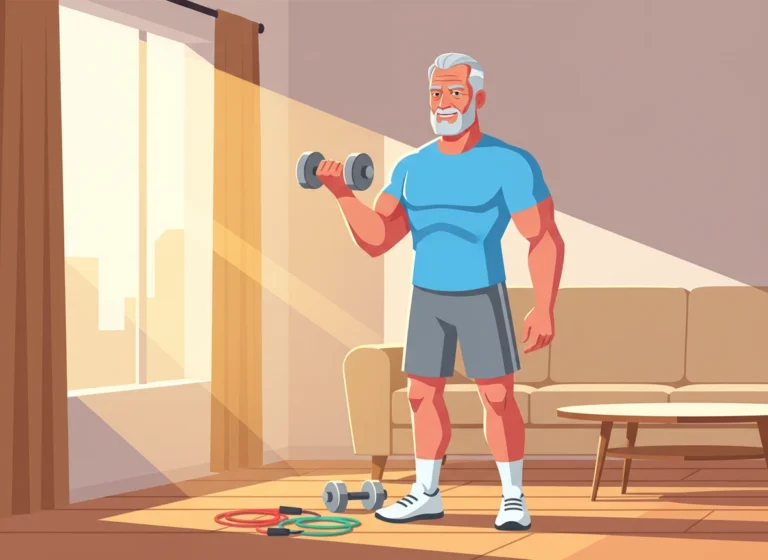
Movement as Medicine

The research on movement and stress in older adults is about as consistent as research gets: regular physical activity reduces anxiety, improves mood, supports cognitive function, and improves sleep quality. The Journal of Aging and Physical Activity has documented this across dozens of studies. It’s not a controversial finding. It’s one of the most replicated results in the field.
What’s less discussed is that the movement doesn’t have to be impressive. Researchers at the University of Limerick found that even brief “movement snacks” — one to two minutes of light activity — measurably lower stress markers. A ten-minute walk after breakfast. Stretching while the coffee brews. A slow loop around the block in the evening. Dancing in the kitchen to something embarrassing. All of it counts.
The goal isn’t fitness. It’s the felt sense of being in a body that still works, still moves, still responds — and the mood shift that follows, which is real and reliable and available to almost everyone.
Rebuild Your Social World Deliberately
If your social life contracted significantly when you retired — and for most people, it does — rebuilding it requires intention. It doesn’t happen on its own. The structures that used to create connection (the office, the commute, the shared project) are gone, and something has to replace them.
That something looks different for everyone. For some people it’s a class — pottery, language, cooking, anything that puts you in regular contact with people who share an interest. For others it’s volunteering, which research from the Corporation for National and Community Service consistently links to lower stress and higher life satisfaction in older adults. For others it’s simply being more deliberate about the friendships that already exist — the standing call, the monthly lunch, the commitment to showing up even when it’s easier not to.
The National Institute on Aging is unambiguous: meaningful social connection is one of the strongest protective factors against cognitive decline and depression in older adults. It’s not a nice-to-have. It’s a health intervention — and one of the few that also happens to be enjoyable.
When You Need More Than Techniques
I want to be honest about something: everything in this article assumes a baseline level of okay. A stress that’s manageable, even if it doesn’t feel that way right now. A life that’s hard in the ordinary ways that retirement can be hard.
But sometimes what’s happening is bigger than that.
If you’re a caregiver who hasn’t had a real break in months. If you’re carrying a grief that hasn’t lifted. If retirement has brought a depression — not sadness, but the flat, colorless, effortful kind that makes everything feel like wading through water. If the anxiety is constant and physical and interfering with your ability to function.
In those cases, the most important stress management technique is the one that’s hardest to use: asking for help. Directly. From a professional.
Talk to your doctor. Find a therapist who specializes in older adults — they exist, they’re good at this, and many now offer telehealth so geography isn’t a barrier. Look into caregiver support resources if that’s your situation. The National Institute of Mental Health is clear that untreated chronic stress in older adults carries serious health consequences. Getting support isn’t a last resort. It’s a first-line response.
One Small Shift, Starting Today
You don’t need a plan. You don’t need a system. You don’t need to implement everything in this article by next week.
You need one thing. One small, honest shift that fits where you actually are — not where you think you should be, not where the retirement brochure said you’d be by now.
Maybe it’s a ten-minute walk tomorrow morning. Maybe it’s finally making that financial appointment you’ve been avoiding. Maybe it’s texting a friend you’ve been meaning to call for three months. Maybe it’s just writing down three things you want to do today and seeing how it feels to actually do them.
Start there. See what happens. Adjust as you go.
Stress management for seniors isn’t about achieving a perfectly calm retirement. It’s about building a life that feels more like yours — more grounded, more spacious, more honest about what’s hard and more resourced to handle it.
That’s not a destination. It’s a practice. And you can start it today, with whatever you have, wherever you are.
Key Takeaways
- Retirement stress is distinct from work stress — it’s rooted in identity loss, unstructured time, financial uncertainty, and social contraction, not deadlines.
- A loose daily rhythm — not a rigid schedule — gives the brain the predictability it needs without recreating the pressure of a work calendar.
- The three things rule turns unstructured days into intentional ones, without adding pressure or complexity.
- Financial anxiety shrinks when you engage with it directly and regularly, rather than avoiding it until it spikes.
- The physiological sigh is a ten-second, research-backed tool for resetting the nervous system in real time.
- The worry window contains ambient anxiety without suppressing it — giving it a place to go so it stops running the whole day.
- Movement doesn’t have to be impressive to be effective — brief, gentle activity measurably reduces stress markers in older adults.
- Social connection is a health intervention, not a luxury — and rebuilding it after retirement requires deliberate effort.
- When stress is clinical in scale, professional support isn’t a last resort. It’s the right first move.





One Comment
Comments are closed.