
How to Build Muscle After 60: What Actually Works (And Why It’s Not Too Late)
Discover how to build muscle after 60 with practical exercises, smart nutrition tips, and science-backed strategies designed for seniors who want to stay strong and independent.
I’ll be honest with you — for a long time, I thought the whole “strength training after 60” thing was for someone else. Someone more disciplined. Someone who owned multiple sets of workout clothes and actually used them. Someone who woke up at 6 a.m. not because they had to, but because they wanted to go do hard things before the rest of the neighborhood had even found their slippers.
That was not me.
I was the person who told myself I’d “get back into it” every January, made it to the gym twice, and then quietly retired from the whole project by February. I had good intentions. I had a gym bag. I just also had a very comfortable couch and a deep personal relationship with doing nothing strenuous after dinner.
But then my body started sending memos I couldn’t ignore. My knees had opinions about stairs. Opening a jar of pasta sauce became a two-handed operation with sound effects. And one afternoon, after getting up off the floor after playing with my grandkids, I made a noise — a low, involuntary groan — that I can only describe as the sound of a man realizing he has been neglecting something important for a very long time.
That was it. That was my moment.
Not a dramatic diagnosis. Not a doctor shaking their head gravely. Just a quiet, slightly embarrassing realization that if I didn’t start doing something intentional about my strength, my body was going to keep making decisions for me — and I wasn’t going to like most of them.
So I started reading. Then I started moving. And what I found genuinely surprised me — not just the science, but how accessible the whole thing is once you stop treating it like a punishment and start treating it like something you’re doing for the person you want to be in ten years.
This is everything I wish someone had sat me down and told me earlier.
First, Let’s Talk About What’s Actually Happening to Your Body
Here’s something nobody puts on a birthday card: starting in your 30s, your body begins losing muscle mass at roughly 3–5% per decade. By your 60s, that process tends to accelerate. The clinical term is sarcopenia — age-related muscle loss — and it’s sneakier than it sounds, because it doesn’t announce itself. It just quietly shows up in small ways. The stairs feel steeper. The grocery bags feel heavier. You sit down a little more carefully than you used to.
And it’s not just about how you look. Sarcopenia chips away at your balance, your metabolism, your bone density, and your ability to do the everyday stuff that makes life feel normal and independent. Getting up from a chair without pushing off the armrests. Carrying groceries from the car in one trip like the capable adult you are. Walking up a flight of stairs without your thighs filing a formal complaint.
For a long time, I assumed this was just inevitable. Like gray hair or forgetting why you walked into a room — something you accept and work around. But that’s genuinely not what the research says.
A landmark review published in Current Opinion in Rheumatology by L.A. Clark in 2016 confirmed that progressive resistance exercise increases muscle strength, size, and functional capacity in older adults. Not “might help a little if you’re lucky.” Actually, measurably works. Decades of consistent evidence pointing in the same direction. Your muscles haven’t given up on you. They’re just waiting for you to give them a reason to show up.
That realization changed how I thought about all of this. It stopped feeling like damage control and started feeling like possibility.
The Exercises That Actually Move the Needle
Strength Training: The One Thing Worth Arguing About
If you take nothing else from this article, take this: lift something challenging at least twice a week. That’s the foundation of how to build muscle after 60. Everything else — the cardio, the stretching, the supplements — is supporting cast. Resistance training is the main character.
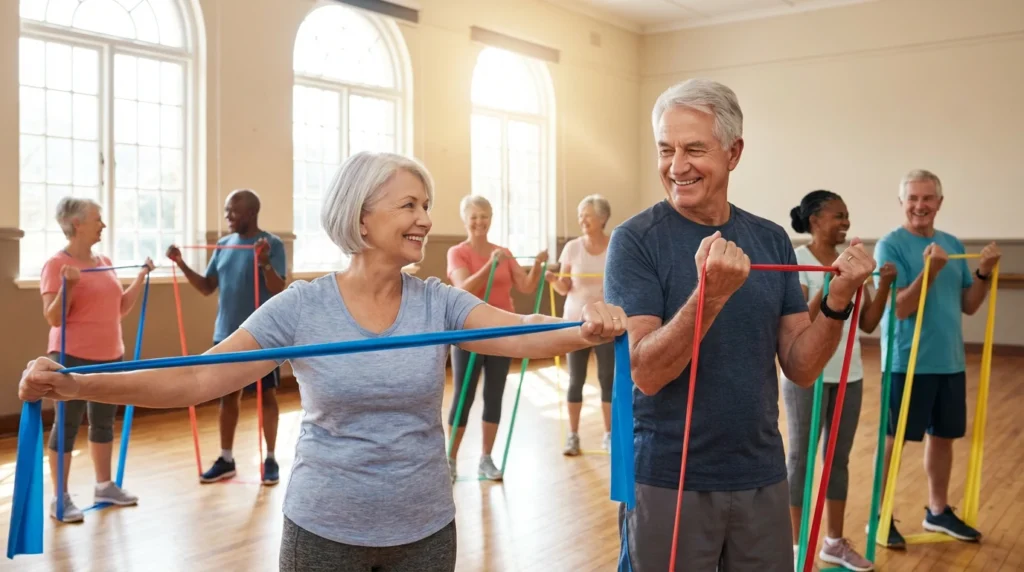
Now, “challenging” is relative, and I want to be clear about that. I’m not talking about loading up a barbell and going full gym-bro. I’m talking about resistance that makes your muscles actually work — light dumbbells, resistance bands, machines, or your own bodyweight. What matters isn’t the number on the weight. It’s the principle of progressive overload: gradually asking your muscles to do a little more over time, so they have a reason to adapt and grow.
When I first started, I was doing chair squats and wall push-ups. Genuinely, embarrassingly humbling. I remember thinking, this can’t possibly be doing anything. But here’s what I’ve come to believe after sticking with it: the starting line doesn’t matter. Showing up to it does. And then showing up again the week after that.
Focus on the muscle groups that keep you functional and upright — legs, back, core, chest, and arms. Good starting exercises include:
- Chair squats — your legs and glutes will quietly thank you every single time you stand up from a seat for the rest of your life
- Resistance band rows — great for the back, and they do slow, quiet miracles for posture
- Wall or incline push-ups — real upper body work, no equipment required
- Dumbbell curls — simple, satisfying, and more effective than people give them credit for
- Modified planks — core stability that protects your lower back from the general indignities of daily life
Two sets of 10–12 reps to start. Add a third set when it gets comfortable. Increase resistance when that gets comfortable. Repeat indefinitely. It’s not complicated. It’s just consistent — and consistency is the whole game.
Resistance Bands: The Thing I Dismissed Way Too Quickly
I owe resistance bands a public apology. For years I thought they were glorified rubber toys — the kind of thing you used in physical therapy after a minor injury and then shoved in a drawer next to the instruction manual for an appliance you no longer own.
I was completely, embarrassingly wrong.
For anyone figuring out how to build muscle after 60, resistance bands might genuinely be the most underrated tool available. They create constant tension throughout the movement — which is actually excellent for muscle activation — they’re kind to aging joints, and they’re versatile enough to work every major muscle group. You can use them at home, in a hotel room, in your backyard, or in your living room while watching a show you’ve already seen three times but somehow keep returning to.
My neighbor Margaret — 71 years old, sharper and more energetic than most people half her age — keeps a set of bands hanging on her bedroom door. Twenty minutes every morning before breakfast. She’s genuinely stronger now than she was five years ago. I’ve stopped being surprised by stories like hers, because I keep hearing them.
Bodyweight Training: Your Body Is Already a Gym

There’s something deeply satisfying about realizing you don’t need a membership, equipment, or a commute to build real strength. Squats, lunges, push-ups, step-ups — these movements build functional strength that translates directly into everyday life. And the progression is already built in. Once regular squats feel easy, try a single-leg variation. Once wall push-ups are no challenge, move to incline push-ups on a sturdy surface.
The goal here isn’t aesthetics, though that’s a perfectly welcome bonus. The goal is being able to live your life on your own terms — without hesitating at a flight of stairs, without that quiet internal negotiation before you attempt something physical, without needing to ask for help with things you used to do without thinking.
Cardio: Keep It Low-Impact, Keep It Something You’ll Actually Do
Strength training is the headline, but your heart deserves some attention too. The trick after 60 is choosing cardio that gets your heart rate up without grinding your joints into dust. Walking, swimming, water aerobics, and cycling are all excellent options. They’re sustainable, accessible, and they don’t require you to be a particular kind of person to enjoy them.
I want to put in a genuine word for Tai Chi, because it gets overlooked in these conversations. It looks almost too gentle to count — slow, deliberate, almost meditative. But it’s been shown in multiple studies to meaningfully improve balance and reduce fall risk in older adults. I tried a class once expecting to be mildly bored and left genuinely impressed. There’s more happening in those slow, intentional movements than meets the eye.
Aim for about 150 minutes of moderate cardio per week. That’s 30 minutes, five days a week. A brisk walk counts. A swim counts. An enthusiastic kitchen dance session while making dinner absolutely counts, and I will not hear a single argument about it.
Flexibility and Balance: The Boring Stuff That Actually Saves You
Falls are one of the leading causes of serious injury in adults over 65. What gets me about that statistic is how preventable so many of those falls are with consistent, unglamorous balance and flexibility work.
Simple things — standing on one leg near a wall, heel-to-toe walking, gentle yoga — build the kind of stability that keeps you upright when life gets unpredictable. An uneven sidewalk. A slippery floor. A dog that materializes directly in your path at the absolute worst possible moment. (You know the one.)
I’ve met people in their 70s doing yoga poses that would make a 35-year-old groan and quietly reconsider their life choices. Flexibility doesn’t have an expiration date. It just requires maintenance — like a car, or a friendship, or a sourdough starter you’re actually committed to keeping alive this time.
Stretch after every workout. Hold each stretch for 20–30 seconds. Don’t bounce. Your future self will be quietly, genuinely grateful — even if they never say so out loud.
Eating to Support Muscle: The Nutrition Side of Things
Protein: You’re Probably Not Eating Enough of It
This is where I have to be a little direct, because it’s where I see the biggest gap between what most seniors are actually eating and what their bodies genuinely need.
Here’s the counterintuitive part: as we age, our bodies become less efficient at using dietary protein for muscle synthesis. Which means older adults need more protein than younger people — not less. The ESPEN Expert Group, in a widely cited 2014 paper by N.E.P. Deutz and colleagues, recommends that older adults consume 1.0–1.2 grams of protein per kilogram of body weight daily to maintain muscle function — and potentially more if you’re actively training.
For a 70kg person, that’s 70–84 grams of protein a day. Spread across meals, not crammed into one big dinner. Your muscles can only use so much protein at once for synthesis, so how you distribute it throughout the day genuinely matters.
When I first tracked my own protein intake, I was genuinely shocked. I thought I was eating well. Turns out “eating well” and “eating enough protein” are two very different things, and I’d been cheerfully confusing them for years. Lots of vegetables. Not nearly enough eggs.
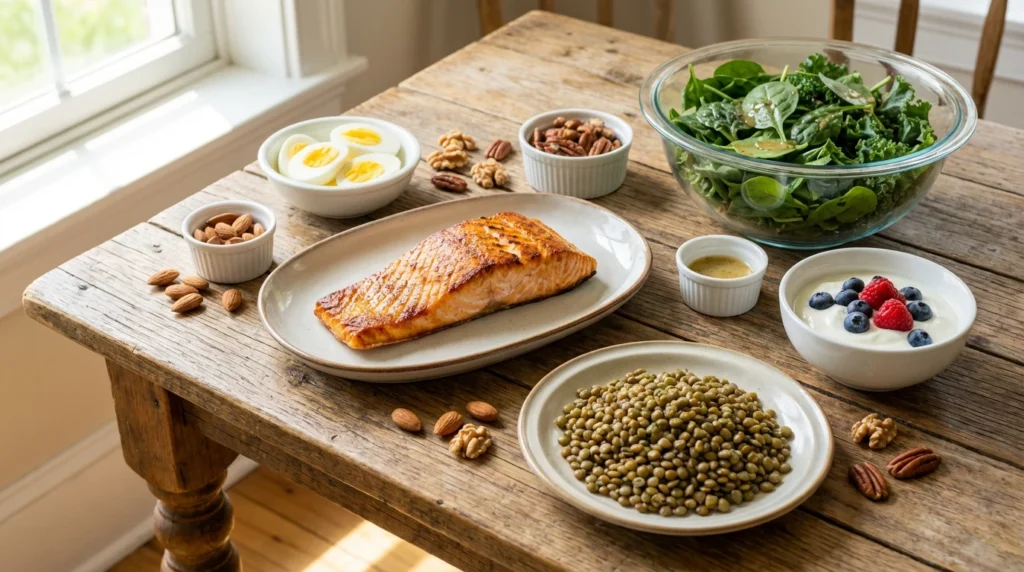
Good protein sources to build your meals around include eggs, Greek yogurt, cottage cheese, chicken, turkey, salmon, mackerel, lean beef, lentils, beans, tofu, and nuts. Salmon and mackerel are worth highlighting specifically — they bring omega-3 fatty acids along for the ride, which support both heart health and muscle recovery. If you’re struggling to hit your targets through food alone, a quality protein supplement is a perfectly reasonable solution. A morning smoothie with a scoop of protein powder isn’t cheating. It’s just practical.
Vitamin D and Calcium: Don’t Sleep on These Two
You can’t talk about how to build muscle after 60 without talking about bone health, because the two are more connected than most people realize. Weak bones and weak muscles tend to travel together — and both are heavily influenced by vitamin D and calcium.
Research by K.M. Sanders in 2014 found that prolonged vitamin D insufficiency in older adults is associated with loss of type 2 muscle fibers — the fast-twitch fibers responsible for power and quick reactions — which directly increases fall and fracture risk. That’s not a minor footnote buried in a journal somewhere. That’s a finding with real, daily-life consequences for real people.
Get your vitamin D levels checked if you haven’t recently. Deficiency is surprisingly common in older adults, especially in winter months or in less sunny climates. Pair a supplement with calcium-rich foods — dairy, leafy greens, fortified cereals — and you’re giving your bones and muscles a genuine, meaningful advantage.
Hydration: The Easiest Win Most People Are Quietly Ignoring
Here’s the sneaky thing about dehydration after 60: your sense of thirst becomes less reliable with age. You can be meaningfully dehydrated without feeling particularly thirsty. And dehydration affects muscle function, joint lubrication, energy levels, and recovery in ways that are very easy to chalk up to “just getting older” — when really, you just need more water.
Aim for 6–8 glasses a day, more on exercise days. Keep a water bottle somewhere visible as a low-effort, constant reminder. It sounds almost too simple to be worth mentioning. But staying well-hydrated genuinely moves the needle on how you feel and perform, and it costs absolutely nothing.
The Post-Workout Window: Don’t Waste It
After a strength training session, your muscles are primed and ready to absorb nutrients. Eating a protein-containing snack or meal within 30–60 minutes of finishing your workout helps kickstart the repair and growth process. Greek yogurt with fruit. Eggs on toast. A protein shake. A handful of nuts with some cheese. Nothing elaborate — just enough to give your muscles what they need to do their job.
I started keeping a container of Greek yogurt in the fridge specifically for after workouts. It took about four days to become a habit. Small change, real difference. That’s kind of the theme of all of this, honestly.
How to Train Without Wrecking Yourself
Start Easier Than You Think You Need To
The most common mistake I see when people start strength training later in life is doing too much too soon. The enthusiasm is genuinely admirable. But your connective tissue — tendons, ligaments, the stuff that holds everything together — needs time to adapt, and it doesn’t care how motivated you feel on day one. It operates on its own schedule.
Start lighter and easier than feels necessary. Build up gradually over weeks and months, not days. A rule I’ve come to live by: if you can’t complete a set with good form, the weight is too heavy. If you’re not feeling any challenge by the last few reps, it’s time to progress. Everything in between is exactly where you want to be — and that zone is wider than most people think.
Warm Up Like You Actually Mean It
A proper warm-up isn’t optional at any age, but after 60 it becomes genuinely non-negotiable. Spend 5–10 minutes doing light aerobic movement — a brisk walk, some gentle cycling — followed by dynamic stretches that take your joints through their range of motion. This gets blood flowing to your muscles and meaningfully reduces injury risk.
Skipping the warm-up to save ten minutes is like skipping the foundation to save money on a house. It never ends well. You always regret it. And the repair costs are always higher than the prevention would have been.
Good Pain vs. Bad Pain: Know the Difference
There’s the normal discomfort of working hard — the burn during a set, the muscle soreness 24–48 hours later that tells you something actually happened. That’s fine. That’s the process working exactly as it should.
Then there’s sharp, sudden joint pain that means stop immediately and figure out what’s going on. Don’t train through that. Modify exercises when needed. Get things checked out when something doesn’t feel right. Working around limitations isn’t weakness — it’s the kind of smart, sustainable approach that keeps you training for years instead of sidelining you for months. There’s a real difference between pushing through discomfort and ignoring a warning signal, and learning to tell them apart is one of the most valuable skills you can develop.
Rest Is Not Laziness — It’s the Whole Point
Muscles don’t grow during workouts. They grow during recovery. Rest days aren’t a reward for working hard — they’re a required, non-negotiable part of the program. Aim for at least one full rest day between strength sessions. Gentle movement on those days — a walk, some light stretching — is fine and actually beneficial. Just don’t confuse “active recovery” with “doing another hard workout because you feel guilty.”
And sleep. I genuinely cannot stress this enough. Growth hormone, which plays a direct role in muscle repair and rebuilding, is primarily released during deep sleep. Getting 7–9 hours of quality rest per night isn’t just good for your mood and your patience with other drivers — it’s literally part of your muscle-building strategy. I started treating sleep as seriously as my workouts about a year into this journey, and the difference in how I felt and recovered was one of the bigger surprises of the whole experience. Nobody tells you that going to bed on time is a fitness decision. But it is.
The Part Nobody Talks About Enough: Who You Do This With
Here’s something I’ve come to believe pretty strongly, and it took me longer than it should have to figure out: who you exercise with matters as much as what you do.
Group fitness classes, workout partners, community programs — they all dramatically improve how consistently people actually show up. When there’s a friend waiting for you at the pool, or a class you genuinely enjoy, you’re far more likely to go. Not because you’re suddenly more disciplined. Because you’re human, and humans show up for other humans in ways they don’t always show up for themselves.
Consistency — more than any specific exercise, any particular diet, any supplement or program — is what determines results when you’re learning how to build muscle after 60. And community is one of the most reliable ways to build consistency.
Beyond motivation, exercising with others does something for your emotional wellbeing that solo training simply can’t replicate. It reduces isolation. It lifts mood. It turns something that could feel like a chore into something you actually look forward to — and that shift matters more than people give it credit for.
I joined a small group strength class about a year ago, mostly out of curiosity and a mild sense of obligation to practice what I was writing about. I’ve made real friends there. We check on each other between sessions. We celebrate small wins — a new personal best, a flight of stairs that used to be hard and suddenly isn’t. We occasionally commiserate about our knees, which is its own particular kind of bonding. I wouldn’t trade any of it.
Key Takeaways
- Strength train at least twice a week — this is the non-negotiable foundation of building muscle after 60, full stop
- Aim for 1.0–1.2g of protein per kg of body weight daily, spread across meals — not saved for dinner
- Low-impact cardio like walking, swimming, and Tai Chi supports heart health without punishing your joints
- Balance and flexibility work reduces fall risk and keeps you moving freely and confidently
- Get your vitamin D and calcium levels checked — deficiency is common, quiet, and consequential
- Hydration and quality sleep are non-negotiable parts of recovery — treat them that way, not as afterthoughts
- Start slow, focus on form, and progress gradually — patience here is a genuine competitive advantage
- Exercise with other people whenever you can — it changes everything about consistency, enjoyment, and follow-through
So Here’s Where I Land on All of This
Building muscle after 60 isn’t about pretending the years haven’t happened. It’s not about chasing some younger version of yourself or proving something to anyone — not your doctor, not your kids, not the 40-year-old at the gym who looks at you like you wandered in by accident.
It’s about showing up for the life you actually want to be living. One where you’re strong enough to do the things that matter. Independent enough to do them on your own terms. Capable enough to say yes when something sounds fun instead of quietly calculating whether your body will cooperate.
The research is clear. The path is genuinely straightforward. And it’s so much more achievable than most people believe — especially once you stop waiting for the perfect moment and just start with whatever you have, wherever you are, at whatever level makes sense right now.
Some days it won’t feel great. Some days you’ll be tired and sore and the couch will make a very compelling, very comfortable argument. That’s real, and I’m not going to pretend otherwise. But on the other side of those days is a version of yourself that gets up off the floor without the undignified sound effects, carries the groceries in one trip, keeps up with the grandkids without needing a two-day recovery, and moves through the world with a quiet confidence that comes from knowing your body is capable.
That version of yourself is absolutely worth showing up for.
So — what’s the one small thing you’re willing to do this week?