
Healthy Eating in Retirement: How to Stick to a Diet Without Losing Your Mind or Your Love of Food
Healthy eating in retirement doesn’t have to mean giving up the foods you love. Here’s how to build a diet that actually sticks — no guilt, no gimmicks.
Let me tell you something I am not particularly proud of: I once started a diet on a Monday, abandoned it by Thursday, and then spent the entire weekend eating in a way that can only be described as “making up for lost time.” I told myself I would start fresh the following Monday. I did not start fresh the following Monday.
If any part of that sentence felt uncomfortably familiar, welcome. You are in exactly the right place.
Retirement was supposed to fix all of this. That was the deal I made with myself somewhere around year twelve of my career, standing in a break room eating a sad desk sandwich at 2 PM because I had missed actual lunch again. When I retire, I thought, I will finally have time to eat well. I will cook real meals. I will stop stress-eating crackers over a keyboard. I will become, in short, a person who has their life together in the food department.
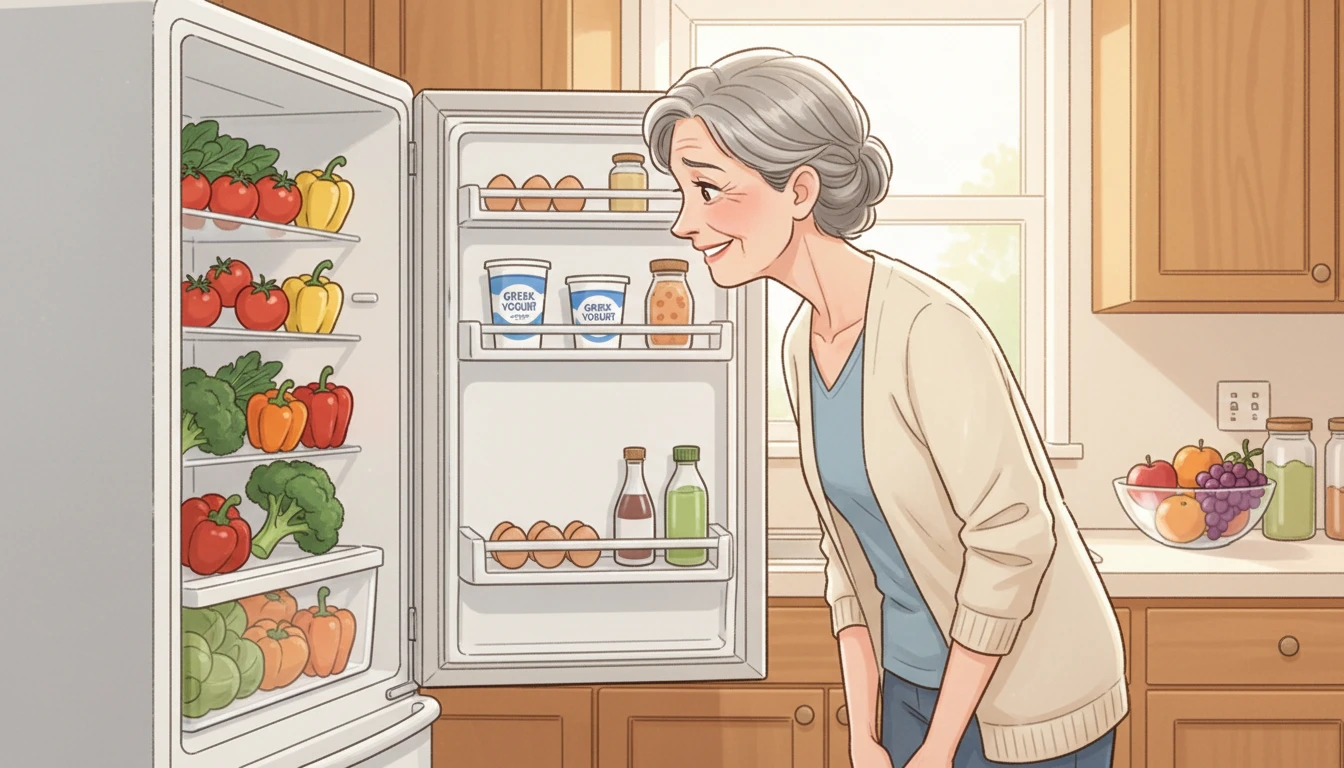
And then retirement arrived, and I discovered something nobody warns you about: having more time does not automatically make healthy eating easier. It just changes the obstacles. The vending machine is gone, yes. But now the kitchen is fifteen feet away at all times, the fridge has developed a magnetic pull I cannot fully explain, and without the structure of a workday to regulate anything, I found myself wandering in for “just a small snack” approximately four hundred times a day.
Here is what I have learned — slowly, imperfectly, and with a lot of cheese consumed along the way: healthy eating in retirement is not a willpower problem. It is a design problem. And once you understand that, everything starts to shift.
Key Takeaways
- Healthy eating in retirement requires a genuinely different approach than dieting in your 30s or 40s — your body’s needs have changed, and so has your entire daily structure.
- Willpower is a limited resource that drains throughout the day. Your environment and your habits matter far more than your motivation on any given morning.
- Flexible eating beats rigid restriction every single time, especially over the long haul.
- Protein, fiber, and hydration are the three pillars most retirees quietly underestimate — and all three are easier to fix than you think.
- Self-compassion is not soft. Research shows it is one of the strongest predictors of long-term healthy behavior, which means being kind to yourself is not optional — it is strategic.
- One rough day does not undo weeks of progress. The restart mindset is everything.
Healthy Eating in Retirement: Why Dieting Feels Different in Retirement (Because It Actually Is)
Here is something that does not make it into the retirement brochures, right next to the photos of smiling couples on golf courses: retirement changes your relationship with food in ways you genuinely did not see coming.
The structure that used to regulate your eating — office hours, lunch breaks, the granola bar you ate in the car because you were running late again and breakfast was a distant memory — is gone. Suddenly, the kitchen is always right there. The fridge is always within reach. And without a calendar full of meetings to distract you, food can quietly become the most interesting thing happening on a Tuesday afternoon. Not because you are weak. Not because you have no self-control. But because you are a human being navigating a major life transition, and your brain is looking for something familiar and comforting to hold onto.
I noticed this in myself about three months into retirement. I was not particularly hungry most of the time, but I kept wandering into the kitchen anyway — opening the fridge, staring into it like something new might have appeared since the last time I checked four minutes ago, closing it, walking away, and then somehow ending up back in front of it again like a very confused moth near a light. It was not hunger. It was habit. It was boredom wearing hunger’s coat and hoping I would not notice.
Your body has also changed in ways that genuinely matter for how you eat. According to the National Council on Aging, our nutritional needs shift significantly as we age — metabolism slows, muscle mass decreases, and the body actually needs more of certain nutrients like calcium, vitamin D, vitamin B12, and protein, even while needing fewer overall calories. So the diet that worked for you at 45 may not serve you nearly as well at 65 or 70. It is not that you have gotten worse at dieting. The game itself has changed, and nobody handed you the updated rulebook when you walked out of your last day of work.
And then there is the research that should honestly be printed on the front of every diet book ever published: approximately 95% of people who lose weight on a diet gain it back within one to five years, according to work by UCLA’s Traci Mann and colleagues published in American Psychologist. Read that again. Ninety-five percent. That is not a “you are lazy” statistic. That is a “these systems are fundamentally broken for most human beings” statistic. Most diets are designed like sprint races when what we actually need — especially in retirement — is a sustainable, enjoyable walking pace we can keep up for years without wanting to quit and lie down on the sidewalk.
The Real Reason Most Diets Fail After 60
The Willpower Myth
Willpower is like your phone battery. It starts the day reasonably charged, and it drains with every decision, every temptation, every moment of “should I or shouldn’t I” that your brain has to process. Roy Baumeister’s research on ego depletion at Florida State University showed that self-control behaves like a limited resource — and once it is depleted, it is gone until you rest and recharge.
In retirement, the triggers are different but just as relentless. You are home more. Food is more accessible. Boredom, loneliness, and the quiet loss of routine can all drive you toward the pantry in ways that have absolutely nothing to do with actual hunger. By the time evening rolls around, your decision-making tank is running on fumes — and that is precisely when the crackers start looking less like a snack and more like an emotional support system with a satisfying crunch.
I used to think I was just weak. Every Monday morning, I would wake up genuinely ready to transform my life with grilled chicken and virtuous salads and a new attitude. By Wednesday afternoon, I would be standing at the kitchen counter eating cheese directly off the block, staring into the middle distance, wondering where it all went wrong and why I apparently had the self-control of a golden retriever in a bacon factory. The lesson I eventually learned — the hard way, as most good lessons are — was to stop trying to be a superhero and start building a system that did not require heroics to maintain.
The Restriction Rebellion
Ever notice how the second you tell yourself you absolutely cannot have something, it becomes the only thing you can think about? That is psychological reactance — your brain staging a full-scale rebellion the moment it senses its freedom is being threatened.
Tell a toddler they absolutely cannot touch the red button. You know exactly what happens next. Your adult brain does the exact same thing with forbidden foods, just with slightly better vocabulary and a longer delay before the meltdown.
A study published in Appetite found that people who labeled certain foods as completely off-limits experienced stronger cravings and were significantly more likely to overeat those foods when they eventually did have them. So when you create a mental blacklist of things you are never allowed to touch again — no bread, no sugar, no joy — you are not building discipline. You are stockpiling frustration and quietly setting up a future binge that will feel both inevitable and deeply unfair.
Healthy eating in retirement is not about tightening the rules until nothing is allowed. It is about loosening them just enough that you stop wanting to break them every single weekend.
What Healthy Eating in Retirement Actually Looks Like
Start With a Plan You Do Not Hate
This sounds almost insultingly obvious, and yet here we are. You would be genuinely surprised how many people pick a diet based on what worked for their neighbor’s cousin or some enthusiastic stranger on the internet with very good lighting and a suspiciously tidy kitchen. If you hate fish, do not build your meals around salmon and sardines and then act shocked when you cannot sustain it. If you love bread more than most of your relatives, going full keto is probably not your forever plan. It might not even be your next-three-weeks plan.
The best approach for healthy eating in retirement is the one you can actually stick to for months and years — not just for a motivated six-week sprint before you quietly abandon it and pretend it never happened.
I spent six months on a plan that eliminated all my favorite foods because a very convincing article swore it was the only way and the science was settled and anyone who disagreed was simply not committed enough. I was miserable, irritable, and thinking about pasta like it was a long-lost friend I was not allowed to contact. I dreamed about bread. Actual dreams. When I finally switched to an approach that let me eat foods I genuinely enjoyed — just in more reasonable portions and with better balance — everything changed. I stopped obsessing. I stopped rebelling. I stopped dreaming about carbohydrates. And I stuck with it way longer than anything I had tried before, because it did not feel like punishment.
Make Your Environment Work for You
Here is a truth bomb that took me an embarrassingly long time to fully accept: you cannot out-willpower a bad environment. You just cannot. If your pantry looks like a convenience store and your fridge is basically condiments and optimism, you are not setting yourself up for a test of character. You are setting yourself up to fail, and then feel bad about failing, and then eat more things to feel better about feeling bad. It is a whole cycle.
Research from Cornell University’s Food and Brand Lab found that people who kept junk food visible on their kitchen counters weighed significantly more than those who did not — not because they were weaker or less disciplined, but because what is visible and accessible is simply what we reach for. We are all creatures of convenience, and there is genuinely no shame in that. It is just how brains work.
If you are serious about healthy eating in retirement, start by reshaping your environment so the healthy choice is the easy choice. Stock your kitchen with foods that align with your goals. Prep a few basics on Sunday — chopped vegetables, cooked protein, maybe a grain or two — so you are not making important food decisions from a place of hunger and exhaustion at 6 PM when your willpower has already clocked out for the day. Keep fruit, yogurt, nuts, or whatever better-choice snacks you actually enjoy front and center where you can see them.
Is this glamorous advice? Absolutely not. Does it work ridiculously well? Every single time, without exception.
Plan for Real Retired Life, Not Fantasy Retired Life
A lot of diet plans are clearly written for people who have unlimited time, zero stress, and a personal chef waiting quietly in the kitchen with fresh herbs and a calm demeanor. Even in retirement, life gets busy in its own particular way. Grandkids visit and turn your carefully organized week into a beautiful, chaotic adventure. Appointments pile up. Travel happens. Social events appear on the calendar with alarming frequency, and suddenly your “simple, healthy week” has three dinners out and a birthday party.
When I finally figured out how to make healthy eating in retirement actually work for me, it was because I stopped planning for the imaginary version of myself — the one who happily spends three hours cooking elaborate meals every single day and never has a tired afternoon or a week where everything goes sideways. I started planning for the version who sometimes just wants something quick, easy, and good, and who is not going to feel guilty about that.
So I found breakfasts that work for both relaxed mornings and rushed ones. I collected a handful of dinner recipes I can pull together in under 30 minutes without consulting a culinary degree or a YouTube tutorial. I figured out what to order at my favorite restaurants so I do not show up starving and accidentally end up with the nachos for four — for one — while telling myself it is fine because I will start over Monday.
Healthy eating in retirement is not about becoming a different person. It is about tailoring your approach to the person you actually are today, on a regular Tuesday, when life is happening all around you and nobody is giving you a gold star for effort.
The Nutrition Shifts That Matter Most After 60
Protein: Your Most Underrated Ally
If I could hand you one simple rule that genuinely moves the needle more than almost anything else, it would be this: prioritize protein at every single meal. Not because carbs are evil or fat is the enemy or any of the other dramatic nutritional narratives that cycle through the internet every few years. But because protein is incredibly satisfying, keeps you full for longer, and — this part is crucial in retirement — preserves the muscle mass you are quietly losing every year whether you realize it or not.
According to the National Council on Aging, between the ages of 40 and 80, adults can lose up to 50% of their muscle mass. Fifty percent. I want you to sit with that number for a moment, because it is not a small one. Dietary protein is one of the most powerful tools available for slowing that process down. A study in the American Journal of Clinical Nutrition found that increasing protein intake to about 30% of total calories led people to spontaneously eat roughly 441 fewer calories per day — without trying to restrict anything. They just naturally felt fuller and stopped eating sooner. The diet did the work for them.
Aim for 25 to 30 grams of protein at each main meal. Good sources include eggs, Greek yogurt, lean meats, fish, beans, lentils, and tofu. When I started building my meals around protein first and everything else second, I stopped thinking about food every 90 minutes like it was a part-time job I had not signed up for and could not figure out how to quit.
Fiber: The Quiet Workhorse Nobody Talks About
Fiber does not get nearly enough credit, and I am prepared to defend that statement at length if necessary. It keeps your digestive system running smoothly, helps regulate blood sugar, reduces the risk of heart disease, and keeps you feeling full between meals without requiring any particular effort on your part. It just quietly does its job while everyone else is arguing about intermittent fasting on the internet.
And yet, according to the NCOA, about 95% of adults do not get enough of it daily. Which means most of us are walking around chronically under-fibered and not even aware of it.
The recommended daily intake for adults over 51 is 30 grams for men and 21 grams for women. You can hit those numbers with foods like bananas, apples, black beans, quinoa, whole-grain bread, and leafy greens — none of which require a special grocery store or a second mortgage. The National Institute on Aging recommends filling half your plate with fruits and vegetables at every meal — a simple visual rule that makes fiber almost automatic without requiring you to track a single gram or download a single app.
Hydration: The One Everyone Forgets Until They Feel Terrible

Here is something that catches a lot of retirees genuinely off guard: as we age, our sense of thirst diminishes. You can be meaningfully dehydrated without feeling particularly thirsty. Your body just quietly stops sending the memo with the same urgency it used to. And dehydration does not just make you tired and foggy — it can actually mimic hunger, leading you to eat when what your body is really asking for is a glass of water and a moment of your attention.
The National Academy of Medicine recommends nine to thirteen cups of fluid daily for healthy older adults. If plain water bores you — and I completely understand if it does, because plain water is not exactly thrilling — try herbal teas, sparkling water, or water-rich foods like watermelon, cucumbers, and celery. Drinking a glass of water before each meal is one of the simplest habits that quietly supports healthy eating in retirement without requiring any willpower at all. It is almost unfairly easy, which is precisely why I love it and recommend it to everyone.
The Art of Flexible Eating in Retirement
The 80/20 Approach
The real secret to healthy eating in retirement is not iron-clad perfection. It is flexible structure — and those two words together are doing a tremendous amount of heavy lifting in that sentence.
I am a devoted fan of the 80/20 rule: aim to eat in line with your plan about 80% of the time, and give yourself genuine, guilt-free breathing room for the other 20%. That 20% is not failure. It is not weakness. It is not something to confess to anyone. It is built-in flexibility that keeps you sane, keeps you social, and keeps you in the game for the long haul instead of burning out spectacularly by week three.
Research in the Journal of the Academy of Nutrition and Dietetics found that people who practice flexible restraint — occasional planned treats within an overall healthy pattern — are more successful at long-term weight management than people with rigid, all-or-nothing rules. In other words, being a little more relaxed actually helps you stick to a diet instead of swinging between extremes like a very tired, very hungry pendulum.
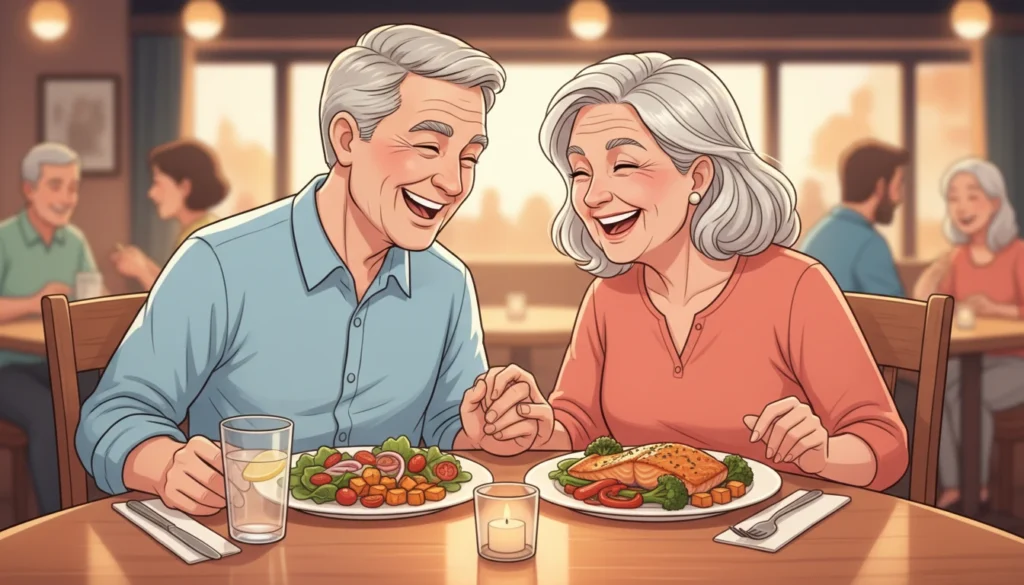
Birthday cake at the family gathering? Have a slice and enjoy every single bite without narrating your guilt to the table. Date night at your favorite restaurant? Order what you love and be present for the conversation instead of mentally auditing every ingredient on the plate. Life in retirement is meant to be lived, not audited.
Retiring the Cheat Meal Mindset
Can we please, finally, retire the phrase “cheat meal”? It sounds like you are sneaking around on your salad with a burger in a parking lot somewhere, and the whole arrangement is frankly exhausting for everyone involved.
Calling food “cheating” loads it with shame and guilt and a vague sense of moral failure, and that mindset is genuinely brutal for long-term success. I stopped doing cheat days years ago and started thinking in terms of “life meals” instead. Sometimes life includes your daughter’s birthday cake, your friend’s famous lasagna that she has been making for thirty years and that you would be a fool to turn down, or the best tacos you have ever had at a tiny restaurant you stumbled into on vacation. These are not moral failings. They are part of being a human being with a social life and people you love and experiences worth having and a mouth that deserves to enjoy things.
The goal is not to eat perfectly forever. The goal is to eat in a way that supports your health most of the time — and not emotionally implode when you do not.
Practical Strategies That Actually Work in Retirement
The Hunger Scale
Learning to tell the difference between “I am actually hungry” and “I am bored, restless, or avoiding something I do not particularly want to think about right now” is a quiet superpower — and it becomes especially important in retirement, when the structure of a workday no longer regulates your eating schedule for you and the kitchen is always, always right there.
I use a simple 1 to 10 hunger scale:
- 1 = Absolutely starving, would eat anything including things I do not even like
- 5 = Neutral, neither hungry nor full, just existing
- 10 = Stuffed and deeply regretting every decision that led to this moment
The sweet spot is eating when you are around a 3 or 4 — genuinely hungry, stomach making its opinions known — and stopping around a 6 or 7 — comfortably satisfied, not Thanksgiving full, not the kind of full where you need to lie down and reconsider your life. Before you eat, pause for three seconds and ask yourself honestly: am I actually hungry, or am I just tired, restless, or looking for something to do because the afternoon is long and quiet? There is no judgment either way. If you are hungry, you eat. If you are not, maybe you go for a walk, make tea, call a friend, or just sit with the feeling for a minute and see what it actually wants from you.
The Five-Minute Rule
Cravings can feel like genuine emergencies, but they are really more like waves — they build, they peak, and then they fade if you give them even a small amount of time and space. One simple tool that has saved me more times than I can count: when a craving hits, tell yourself you absolutely can have the thing, but in five minutes.
In that delay, drink a glass of water, walk around the house, step outside for some air, or scroll something that has nothing to do with food. Just give your brain a tiny buffer between the impulse and the action. Often, the craving dies down on its own or at least loses its sharp, urgent edge. And if, after five minutes, you still genuinely want the thing? Have it — intentionally. Sit down, choose a reasonable portion, and enjoy it without turning it into a self-blame festival that lasts the rest of the evening.
Sometimes a craving is just a craving. Sometimes it is your body hinting at something else entirely — boredom, loneliness, stress, the need for a break. Either way, a small pause turns a mindless impulse into a conscious decision, and that shift matters more than you might expect.
Meal Prep Without the Marathon
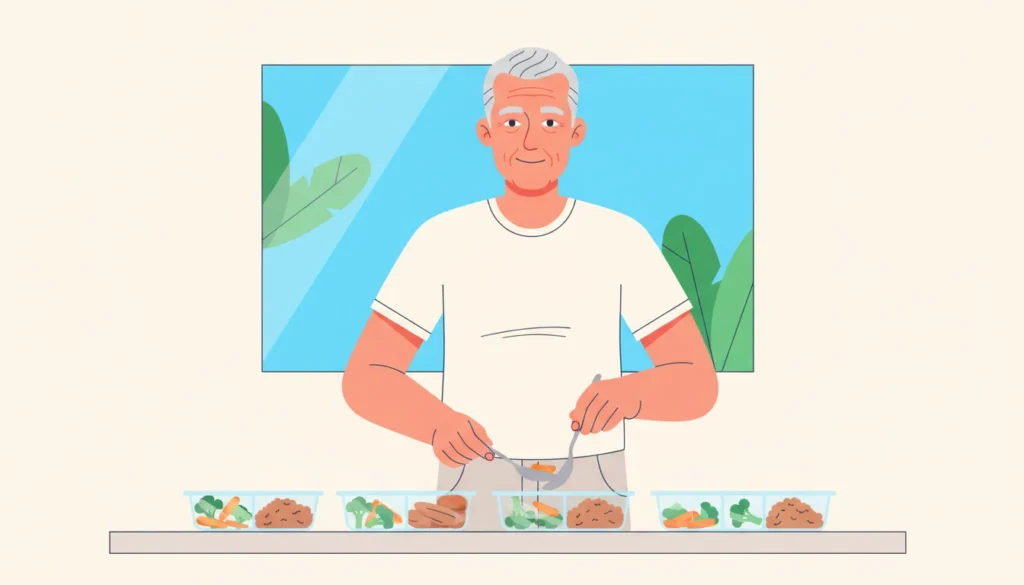
You do not need to spend your entire Sunday cooking elaborate meals in matching glass containers while listening to a wellness podcast and feeling very virtuous about your life choices. But having a few basics ready to go makes healthy eating in retirement dramatically easier on every other day of the week, and the investment of a couple of hours pays off in a way that is almost unfair.
Grill or bake a batch of chicken or fish. Wash and chop some vegetables. Cook a pot of grains. Portion out a few snacks. That is genuinely it. The goal is not perfection — it is making the healthy option the one that does not require a full internal negotiation at 6 PM when you are tired and hungry and the takeout menu is sitting right there on the counter, looking very reasonable and requiring absolutely no effort from you whatsoever.
Navigating the Social Side of Eating in Retirement
Food Pushers and Social Situations
There is always that one person who treats your healthy eating choices like a personal insult directed specifically at them and everything they stand for.
“Oh, you are watching what you eat now? Just have one cookie, it will not kill you. You used to eat everything. What happened to you?”
Translation: I am deeply uncomfortable with you making different choices in my vicinity, and I would like you to stop immediately so I can feel better about my own choices.
I have learned to keep a few go-to lines ready, delivered with a warm smile and absolutely zero apology: “I am good, thanks!” followed immediately by a subject change to something they care about. Most people back off when you are friendly but firm and clearly not interested in debating your food choices at a dinner party. And if they do not back off? That is genuinely about their stuff, not yours, and you are allowed to remember that.
For parties, dinners, and holidays, I like to plan my approach before I walk in the door. I might eat a small, balanced snack beforehand so I am not arriving ravenous and making decisions from a place of desperation and low blood sugar. I will decide in advance what I am going to enjoy and what I am going to skip. And then I focus on the actual point of being there — the people, the conversation, the laughter, the stories — rather than treating the buffet table like the main event of the evening.
Eating Out Without the Anxiety
Retirement often means more time for dining out, travel, and long leisurely meals with people you love — which is genuinely one of the great pleasures of this chapter of life, and I refuse to let healthy eating take that away from anyone.
A few simple strategies that have served me well: check the menu online before you go and decide what you will order while your willpower is still fully charged and you are not sitting at the table starving and surrounded by the smell of fresh bread. Ask for dressings and sauces on the side. Consider eating half and taking the rest home — restaurant portions are usually enough for two meals anyway, which is honestly a great deal when you think about it. And if you end up ordering something that was not exactly on plan? Enjoy it fully, move on completely, and do not let one restaurant meal become the opening act of a week-long spiral that ends with you declaring the whole month a wash.
The Emotional Side Nobody Talks About
Stress Eating in Retirement
Stress eating is real, it is incredibly common, and it is not a character flaw or a sign of weakness or evidence that you are fundamentally broken. When you are stressed, your body releases cortisol, which boosts appetite and makes high-sugar, high-fat foods sound like a completely reasonable and frankly excellent coping strategy. Your brain is not trying to sabotage you. It is trying to comfort you with the tools it has available, and food has been a source of comfort for human beings since the beginning of human beings.
The trick is expanding your comfort toolkit so food is not the only option in there. I made a literal list in my phone — hot shower, walk outside, stretching, a funny show I can count on to make me laugh, five minutes of journaling, texting a specific friend who always knows what to say. When stress hits, I scan the list and pick something, anything, that does not involve raiding the pantry. Sometimes it works beautifully. Sometimes I end up in the pantry anyway. Both outcomes are part of being human.
Does this mean you will never eat your feelings again? Absolutely not. Some days, the ice cream wins, and honestly, sometimes that is okay. But the goal in healthy eating in retirement is progress, not perfection. One stressful night with snacks does not undo weeks of steady, quiet effort. The key is not letting “I had a rough day” turn into “well, I ruined everything, might as well start over in three months when I feel more motivated.”
Self-Compassion Is Not Optional — It Is Strategic
Research from Kristin Neff at the University of Texas at Austin has shown that self-compassion — treating yourself with the same basic kindness and understanding you would offer a good friend — is strongly linked to better long-term health behaviors. In plain English: shaming yourself does not work. It just makes you feel terrible, which usually leads to more emotional eating, more avoidance, and a longer, harder road back to where you want to be.
If your best friend called you and said, “I completely blew my diet and ate an entire pizza and then some cookies and I feel awful about myself,” you would not say, “Wow, you are hopeless. Why do you even bother trying? You have no discipline.” You would probably say something like, “Okay, rough night. It happens. Tomorrow is a new day. Want to go for a walk in the morning and get coffee after?”
You deserve that exact same tone from yourself. Every single time. Without exception. Not because you have earned it, but because it is the approach that actually works.
Building Habits That Last Through Retirement
The Two-Day Rule
Here is a rule that has quietly saved my healthy eating habits more times than I can count, and I share it with everyone who will listen: never skip two days in a row.
Ate way off-plan at lunch? It is done, it is over, it is in the past where it belongs. Make dinner more aligned with your goals and move on without drama. One day off is a blip in the data — barely worth noting. Two days back-to-back starts to become a pattern. Three days and you are suddenly “starting over on Monday” again, which is a place none of us want to be because Monday is a long way away and a lot can happen between now and then.
This rule quietly dismantles the “I’ll start again Monday” mindset and replaces it with something far more useful and far more kind: I will start again at the very next opportunity. It does not demand perfection. It just asks for gentle, stubborn consistency — which, it turns out, is the only kind that actually works over the long haul.
Identity-Based Change
James Clear explores this beautifully in Atomic Habits, and it is one of those ideas that sounds simple until you actually try it and realize how much it changes: instead of obsessing over outcomes like “I want to lose 20 pounds,” focus on identity — “I am the kind of person who takes care of my body.”
When you shift your identity, your choices naturally start to follow. Instead of “I am trying to stick to a diet,” it becomes “I am someone who eats in a way that supports my energy and my health and the life I want to be living.” That tiny wording shift changes everything. You are not punishing yourself with rules — you are voting for the future version of yourself every single time you make a food choice, good or imperfect.
This is especially powerful in retirement, when so much of your identity is already in transition anyway. Who are you now that you are not defined by your job title? What kind of person do you want to be in this chapter? Healthy eating in retirement can become part of that answer — not a temporary project you are white-knuckling through, but a genuine expression of how you want to live and feel and show up for the people and experiences you love.
Celebrating Non-Scale Victories
If you only measure progress by the number on the scale, you will miss at least half the story — and honestly, probably the better half. The scale measures one thing. Your life is made of many things.
Pay attention to the quieter wins that do not get nearly enough credit:
- You are not crashing at 3 PM anymore and reaching for something sugary just to make it to dinner
- Your clothes fit better and more comfortably and you stopped avoiding certain items in your closet
- You are sleeping more deeply and waking up less groggy and more ready for the day
- Your mood feels more stable and you are not snapping at people for reasons you cannot quite explain
- You have more energy for the things and people you love
- You are not thinking about food every 90 minutes like it is a second job you never applied for
I keep a running list of these non-scale victories in my notes app. When motivation dips — and it will dip, because that is just how motivation works, it is not a straight line upward, it is more of a very squiggly line that generally trends in the right direction — I scroll through and remember that this is not just about weight. It is about building a retirement that feels genuinely good from the inside out, on a regular Tuesday, when nobody is watching and you are just living your life.
Your Next Steps
If you have made it this far, you are clearly serious about making healthy eating in retirement something that actually sticks — not just for a season, not just until the next holiday derails you, but for the long, good chapter ahead of you.
So here is what I would love you to do next.
First, stop thinking of it as a diet. Diets are temporary by design. What you are building is a way of eating you can actually live with for years — something that fits your real life, includes foods you genuinely enjoy, and does not require you to develop a second career as a professional meal prepper or a person who brings their own food to every social event in a small container.
Second, start small and stay small for longer than feels necessary. Do not try to fix everything at once. Pick one or two changes this week — maybe it is “protein at every meal” and “drink a glass of water before I eat anything.” Master those until they feel automatic, then layer on more. Small changes that stick are worth infinitely more than dramatic overhauls that collapse by day five and leave you feeling worse than when you started.
Third, build support around yourself. Tell at least one person what you are working on and how they can help. Maybe that is a walking buddy, a partner who agrees not to pressure you about food choices, or a community of people navigating the same season of life. Speaking of which, if you are thinking about how nutrition fits into the bigger picture of your retirement — the finances, the housing, the daily rhythms, the whole thing — this guide to retirement lifestyle planning on Vanika covers it all in a way that might surprise you with how connected everything actually is.
Fourth, be patient with yourself in a way that feels almost uncomfortable at first. You did not end up here overnight, and you are not going to rewrite decades of habits in a single motivated weekend. This is a long game. Give yourself time, grace, and the same kindness you would offer someone you genuinely love who was trying to do something hard.
And finally, remember this: every single choice is a chance to vote for the retirement you want. You do not have to be perfect. You just have to keep choosing, again and again, in your own wonderfully messy, imperfect, thoroughly human way.
Healthy eating in retirement is not about punishment, willpower marathons, or never touching bread again. It is about understanding yourself — really understanding yourself — designing habits that actually fit your life, and being just stubborn enough to keep going when it gets hard and the crackers are right there and nobody would even know.
You are more capable than you think. And on the days you do not feel that way — and those days will come, I promise you they will come — you do not have to fix the whole week. You just have to make it to the next meal, the next decision, the next tiny vote for the person you are still becoming.
Now if you will excuse me, I have some meal prep to do. And yes, it absolutely includes foods I actually like — because that is the only way any of this works, and I learned that the hard way so you do not have to.




One Comment
Comments are closed.