

Bodyweight Exercises for Retirees: A Real-World Guide to Getting Strong, Lean, and Independent at Home
Discover the best bodyweight exercises for retirees — practical routines, safe progressions, and science-backed tips to build strength, energy, and confidence at home.
I’ve always believed the best gym you’ll ever own is the one you’re already living in.
No membership fees. No parking. No machine that requires a computer science degree to operate. Just you, a little floor space, and a plan that actually works — which is a pretty liberating realization when you’re in or approaching retirement and starting to think seriously about staying strong for the long haul. Bodyweight exercises for retirees aren’t a consolation prize. They’re one of the most intelligent, joint-friendly, and genuinely effective approaches to fitness available — and the research backs that up. When I finally ditched the on-again-off-again gym routine in favor of a consistent home-based practice, the changes were hard to miss: fewer aches, better sleep, and the quiet satisfaction of carrying all the groceries from the car in one trip out of sheer principle.
This is the guide I wish someone had handed me. It’s warm, practical, and built around the reality of retirement life — not the aspirational version, the actual one.
Why Bodyweight Exercises for Retirees Matter Even More in Retirement
Here’s something most people don’t talk about at the dinner table: starting in your 30s, your body gradually loses muscle mass — roughly 3–5% per decade. By the time retirement rolls around, that process tends to pick up speed. The clinical name for it is sarcopenia, and it’s sneakier than it sounds. It doesn’t announce itself loudly. It just quietly shows up in small, inconvenient ways. The stairs feel a little steeper. Jars require more effort. You sit down with slightly more intention than you used to.
And the consequences go beyond appearance. Sarcopenia chips away at balance, bone density, metabolism, and the ability to do the everyday tasks that make independent living feel effortless. Getting up from a chair without pushing off the armrests. Carrying groceries from the car without redistributing them three times. Walking to the end of the block and back without negotiating with your knees.
The good news — and it genuinely is good news — is that this decline is not inevitable once you start moving with purpose. A landmark review published in the Journal of Aging and Physical Activity confirmed that progressive resistance exercise meaningfully increases muscle strength, functional capacity, and quality of life in older adults. Not “might help a little.” Actually, measurably reverses things. Your muscles aren’t done with you. They’re just waiting for a reason to show up.
Bodyweight exercises for retirees are particularly well-suited to this challenge because they build functional strength — the kind that translates directly into daily life. Less pain when you bend down. Less hesitation at a flight of stairs. More confidence doing the things you love, whether that’s gardening, traveling, playing with grandchildren, or hiking trails that would have felt ambitious five years ago.
Key Takeaways
- Bodyweight exercises for retirees build functional strength that protects independence, balance, and joint health — without equipment
- Compound, multi-joint movements recruit more muscle, burn more energy, and deliver better results per minute than isolation exercises
- Progressive overload — gradually adding reps, sets, or difficulty — is the engine of long-term improvement
- A proper warm-up and cool-down are not optional; they’re what keeps the whole system running without injury
- Protein intake, hydration, and sleep matter as much as the workouts themselves
- Three to four sessions per week, done consistently, beats daily half-hearted effort every single time
- Modifications exist for every exercise — using them is smart, not weak
- Tracking functional markers (push-ups, plank time, sit-to-stand reps) tells you far more than a scale ever will
What Bodyweight Exercises for Retirees Actually Do (And Why They Work)
Bodyweight training for retirees is built on three principles that work together beautifully once you understand them.
The first is compound movement. Exercises like squats, push-ups, lunges, and hip hinges recruit multiple muscle groups simultaneously, which means more energy demand, better coordination, and more bang for your training time. Research published in the Journal of Strength and Conditioning Research by Calatayud and colleagues found that when load is matched and muscle activation is comparable, push-up progressions produce similar strength gains to bench pressing. Your living room is a legitimate training environment — full stop.
The second is time-under-tension. Slowing down the lowering phase of a squat or push-up — say, three seconds down — trains strength, stability, and joint control all at once. Your connective tissue adapts, your form gets cleaner, and over time you build a body that holds up well.
The third is progressive overload, which sounds technical but really just means you give your body a slightly bigger challenge every week or two. More reps. An extra set. A tempo change. A slightly harder variation. Small, steady bumps. That’s it. That’s the whole game.
And for anyone who wonders whether this is “enough” — Longland and colleagues’ randomized trial, published in the American Journal of Clinical Nutrition, found that higher-protein diets combined with resistance training supported meaningful fat loss while preserving or increasing lean muscle mass. The combination of consistent movement and adequate nutrition is genuinely powerful. You don’t need a barbell to access it.
If you’ve been building up to strength work and want to understand the muscle-building side in more detail, How to Build Muscle After 60: What Actually Works (And Why It’s Not Too Late) covers the physiology and progression with the depth it deserves.
The Five-Minute Warm-Up That Saves Everything
I used to skip warm-ups. I told myself my muscles would figure it out once I got moving. Then my back had a very firm, very extended conversation with me about that decision — one that lasted several weeks and cost me far more training time than five minutes of prevention ever would have.
The warm-up below targets the exact areas that tend to stiffen up in retirement: hips, thoracic spine, shoulders, ankles. It takes five minutes. It’s worth every second.
Start with cat-cow (six to eight reps), moving slowly and letting your spine actually breathe through the motion. Follow with the world’s greatest stretch — two reps per side, taking your time — which opens the hips, stretches the hip flexors, and mobilizes the thoracic spine all in one movement. Add scapular push-ups (eight to ten reps, keeping arms straight and just moving the shoulder blades), glute bridges (ten reps with a two-to-three second squeeze at the top), and ankle rocks (ten per side, gentle circles).
That’s it. You’ll feel warmer, more coordinated, and quietly smug about the decision to take care of your joints. That last part matters more than people admit.
Beginner Bodyweight Exercises for Retirees: Where to Start Without Drama
No punishment. No heroics. Just clean, repeatable reps that build confidence before they build anything else.
The chair sit-to-stand is the single most functional exercise in this entire guide. Every time you stand up from a seated position for the rest of your life, you use the muscles this trains — quads, glutes, core. Start with two to three sets of eight to twelve reps, using a sturdy chair or a box to control depth. Cue yourself to push through your heels and stand tall at the top, squeezing your glutes.
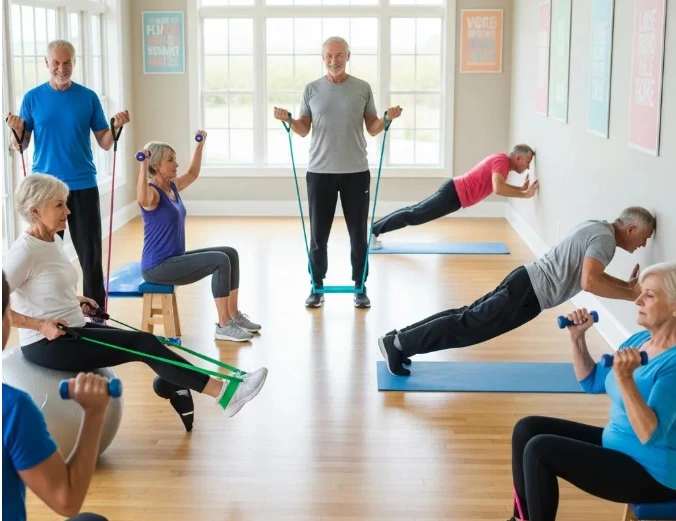
For upper body, incline push-ups are where most people should start — and there’s absolutely no shame in that. Wall push-ups, counter push-ups, table push-ups — all of these are real training that builds real strength. I started on a wall. Then moved to the counter. Then the floor. Each step felt like a genuine win, because it was. Two to three sets of six to ten reps.
Glute bridges deserve more respect than they get. Lie on your back, feet flat, drive through your heels, and squeeze your glutes hard at the top for two to three seconds. Two to three sets of ten to twelve reps. Your lower back will quietly thank you.
For core, the forearm plank — knees down if needed — teaches your spine to stay stable under load, which is exactly what it needs to do every time you bend, carry, twist, or stand up from the floor. Hold for fifteen to thirty seconds, two to three sets. Stop before your form collapses. A short, excellent plank beats a long, miserable one every time.
Add dead bugs (five to eight reps per side, slow and controlled) and two to four minutes of marching in place or step-ups, and you have a complete beginner session in under thirty minutes.
One honest tip: if your low back arches during a plank, shorten the hold and reset. If your knees drift inward during squats, push them out and slow down. Form is the whole point at this stage. You can always add intensity; you can’t undo an injury.
Intermediate Bodyweight Exercises for Retirees: Adding Range and Challenge
Once the basics feel genuinely steady — not just doable, but clean and controlled — it’s time to add a little complexity.
The reverse lunge is one of my favorites for retirees because it trains single-leg strength without the balance challenge of a forward lunge. Step back, lower your back knee toward the floor, push through the front heel to return. Three sets of eight to twelve per side. Your hips, quads, and glutes all show up for this one.
Standard floor push-ups replace incline variations when you’re ready. Hip hinges with a light backpack teach the Romanian deadlift pattern — the movement that protects your lower back every time you pick something up from the floor, which happens to be quite frequently in real life. Side planks (fifteen to thirty seconds per side, two to three sets) train lateral stability that pays dividends in balance and fall prevention.
For conditioning, mountain climbers — thirty seconds on, thirty seconds off, three rounds — raise your heart rate, work your core dynamically, and keep the whole session honest without grinding your joints.
Progress intelligently: shave ten to fifteen seconds off rest periods as the work gets easier. Add a three-second lowering phase to squats and push-ups. Lower your chair for sit-to-stands. Move from two feet to a staggered stance on hinges. One variable at a time, every one to two weeks.
An 8-Week Progression Plan Built for Real Life
Good plans account for Tuesdays that go sideways. Here’s one that does.
Weeks one and two: two sets of eight to ten reps (or twenty to thirty second holds), RPE six to seven, rest sixty to seventy-five seconds between sets. The goal here isn’t intensity — it’s building the habit and teaching your body the patterns.
Weeks three and four: move to three sets of ten to twelve reps, RPE seven to eight, rest forty-five to sixty seconds. Things should feel challenging by the last few reps but never ugly.
Week five: keep the sets and reps, but add a three-one-one tempo to squats, push-ups, and hip hinges. Three seconds down, one second pause, one second up. This single change does more than adding weight ever could at this stage.
Week six: progress one variation. If you’ve been doing incline push-ups, move to the floor. If you’ve been using a tall chair for sit-to-stands, find a lower surface.
Week seven: deload. Cut volume by roughly thirty percent, keep intensity, emphasize mobility and sleep. This is not optional and is not a sign of weakness. It’s how your body consolidates the work you’ve done.
Week eight: retest your benchmarks. Maximum clean push-ups. Strict sixty-to-ninety second plank. Sit-to-stand reps in thirty seconds. A brisk one-mile walk. Compare to week one. The numbers will have moved, and seeing that matters.
Weekly Schedule: How to Fit This Into Retirement Life
Three to four days per week. Focused sessions beat daily half-hearted movement every single time.
Day one is a full-body strength session: squat, push, row or band pull-apart, plank, bridge. Follow it with six to eight minutes of Zone 2 cardio — a brisk walk, step-ups, anything that keeps you at a talkable pace.
Day two focuses on lower body and core: split squat or reverse lunge, hip hinge, calf raises, side plank, dead bug. Optional six rounds of thirty seconds on, thirty seconds off low-impact conditioning to finish.
Day three shifts to upper body and conditioning: push-up variation, pike push-up or overhead press with a band, towel rows or band pull-aparts, plank. Eight to ten minutes of shadow boxing or brisk marching to close.
Day four, if you use it, is pure recovery: fifteen to twenty-five minutes of hip, thoracic spine, shoulder, and ankle mobility, followed by an easy walk with nasal breathing. This isn’t nothing — it’s how you show up feeling good on day one the following week.
The American College of Sports Medicine recommends blending moderate cardio with resistance work for both health and body composition, and this schedule does exactly that without requiring you to block out your entire morning.
Equipment That Actually Helps (And What You Probably Already Own)
The star of bodyweight exercises for retirees is your body. A few supporting players make the whole thing smoother.
An exercise mat is worth every penny — your knees and elbows will file a formal complaint without one. A sturdy chair or step unlocks countless progressions. Resistance bands are the most underrated tool in this entire space: they create constant tension through the movement, they’re gentle on aging joints, they work every major muscle group, and they cost almost nothing. A backpack filled with books becomes an instant hinge and squat load. Optional dumbbells in the five-to-twenty-five pound range add variety when you want it.
Apartment-friendly alternatives I’ve actually used: folded towels as floor sliders, water bottles as light weights, and step-ups on the bottom stair as quiet cardio that doesn’t rattle the ceiling below.
Modifications for Real Bodies in Real Retirement
This is where bodyweight exercises for retirees genuinely shine, because nothing about this approach requires you to pretend you’re twenty-five.
Grumpy knees? Box squats, split-stance sit-to-stands, short-stride reverse lunges, and wall sits are all legitimate and effective. Tight hips or lower back? Elevated glute bridges, hip flexor stretches with a deliberate glute squeeze, and cat-cow will address the pattern without loading the problem. Wrist sensitivity? Push-ups on fists or handles take the wrist out of the equation. Forearm planks replace standard ones entirely. Limited range of motion in any direction? Partial-range movements with support build the pattern safely while the body adapts.
The pain policy I follow and recommend: sharp or pinching joint pain means stop and modify. Muscular burn and mild shaking with good form means you’re doing exactly what you should be. Modifying isn’t quitting — it’s playing the long game, which is the only game worth playing in retirement.
If you’re managing a chronic condition, recovering from an injury, or returning to exercise after a long break, a conversation with your doctor or a physiotherapist before starting is time extremely well spent.
Cool-Down and Mobility: The Part That Pays Off Tomorrow
I used to think cool-downs were optional. Then I started waking up noticeably less stiff. That was the end of my skepticism.
A five-minute cool-down: hamstring stretch (short lever, thirty to forty-five seconds per side), hip flexor stretch with glute squeeze (thirty to forty-five seconds per side), pec doorway stretch (thirty to forty-five seconds), thoracic spine open books (six to eight per side), and one full minute of slow nasal breathing lying on your back.
Those last ten breaths do something specific: they signal your nervous system to downshift out of exertion mode, which affects how your body recovers for the next several hours. Small thing, meaningful return.
Tracking Progress Without Letting a Scale Ruin Your Day
The scale is data, not destiny. I’d honestly rather track the things that change how retirement actually feels.
Progress photos every two to three weeks — same lighting, same pose, same clothes — tell you far more than a number. Functional benchmarks matter most: maximum clean push-ups, a sixty-to-ninety second strict plank, sit-to-stand reps in thirty seconds, a brisk one-mile walk time. Track average sleep hours, energy on a one-to-five scale, daily steps, and — this one is unflinchingly honest — how your jeans fit.
One counterintuitive thing worth knowing: you might weigh the same or a little more while losing inches, especially if you dial in your protein and sleep. This is body recomposition, and it’s exactly what the Longland research found — higher protein combined with resistance training supports fat loss while preserving and building lean mass. Not magic. Just consistent bodyweight exercises for retirees, plus a little patience.
Common Mistakes Worth Skipping Entirely
Racing through reps. Five crisp, controlled push-ups do more than twenty sloppy ones. There’s no award for speed here.
Skipping the warm-up. A five-minute investment is the difference between a productive session and a week of dealing with something that didn’t need to happen.
Doing the same workout indefinitely. Familiarity is comfortable, but your body stops adapting when nothing changes. Adjust one variable every one to two weeks and the progress continues.
Overtraining. Rest days are when the actual improvement happens. Soreness is not a personality.
All-or-nothing thinking. Missed a session? That’s fine. Do two sets tomorrow and keep going. Bodyweight exercises for retirees reward consistency, not perfection. My old mantra was “I’ll make up for it tomorrow.” Tomorrow had other plans. Now I do small, steady, repeatable — and the wins accumulate quietly in the background.
A Mini Circuit You Can Start Right Now
Ten chair sit-to-stands. Six to eight incline push-ups. Ten glute bridges with a two-to-three second squeeze at the top. Twenty seconds of forearm plank, knees down if needed. Rest sixty seconds. Repeat two to three rounds.
Twelve to fifteen minutes. No equipment required. No commute. Just you, your living room, and the beginning of something that compounds quietly over months and years into a version of retirement that moves easily, feels good, and says yes to things without hesitation.
Wrapping Up: Why Bodyweight Exercises Belong in Your Retirement
Bodyweight exercises for retirees are not a workaround. They’re not the “budget version” of real fitness. They are real fitness — efficient, adaptable, scientifically supported, and surprisingly enjoyable once you find your rhythm.
They build the kind of strength that retirement actually needs: functional, sustainable, joint-friendly, and transferable to everything from hiking a new trail to keeping up with grandchildren to walking through an airport with a carry-on and zero drama. They protect your independence, support your metabolism, improve your balance, and change how you feel in your own body on an ordinary Tuesday afternoon.
Start where you are. Progress one small thing each week. Retest in eight weeks and notice how your benchmarks have shifted, how your energy lands differently, how your back has stopped narrating your day.
The version of you who carries all the groceries in one trip, stands up from the floor without sound effects, and moves through retirement with quiet confidence — that version is closer than you think. Your living room is open. And your body, with a little consistent encouragement, is absolutely ready.





3 Comments
Comments are closed.