Morning Exercise for Seniors: Simple Routines to Boost Health, Mobility, and Confidence
Morning exercise for seniors can boost mobility, balance, mood, and confidence with simple, safe routines you can start tomorrow—no gym required.
Picture this: it’s morning, the coffee is brewing, and your body is doing that classic “creaky door” impression when you stand up. Been there. That’s exactly why morning exercise for seniors is such a smart habit—it’s less about chasing some perfect fitness ideal and more about making the rest of the day feel easier.
I’ve watched friends’ parents (and a few very determined neighbors) go from “I feel stiff all the time” to “I can get up from a chair without planning it like a NASA launch.” The difference usually isn’t a dramatic makeover. It’s a consistent, gentle routine they can actually stick with.
This guide is built for real life: low-impact cardio, simple strength, easy stretching, practical balance drills, plus a sprinkle of mindfulness. If mobility, steadiness, or memory feels like a concern, a steady morning exercise for seniors routine can help you feel more grounded—physically and mentally. And yes, you can start tomorrow morning.
What Are the Benefits of Morning Exercise for Seniors?
A good morning exercise for seniors routine is like tuning up a car you actually want to keep driving. The benefits show up in the places that matter most: how steady you feel walking, how confident you are climbing stairs, how easily you get moving, and how clear your head feels.
Here’s what tends to improve when morning movement becomes a habit:
- Heart health and endurance (so daily tasks feel less tiring)
- Strength and joint support (which can mean less wobble and more stability)
- Flexibility and comfort (hello, easier reaching and bending)
- Balance and coordination (a big deal for fall prevention)
- Mood and mental sharpness (because brains like blood flow, too)
And there’s a bonus nobody advertises enough: when you start your day with a small win, your confidence quietly grows. Not “I’m going to run a marathon” confidence. More like “I’ve got this” confidence—the kind that helps you keep your independence.
How Does Morning Exercise Improve Senior Health and Cognitive Function?
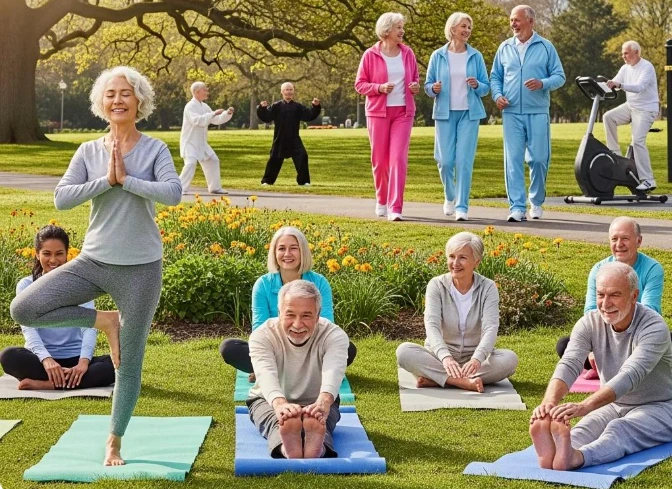
A consistent morning exercise for seniors plan supports the body in obvious ways—better circulation, stronger muscles, more mobile joints—but it can also support the brain in ways that feel almost unfair (in a good way).
The physical side: heart, muscles, joints
Low-impact movement in the morning raises your heart rate a bit, warms your muscles, and helps joints move through their range of motion. That matters because stiffness often gets worse when we move less… and we move less because we feel stiff. Morning movement breaks that loop.
The brain side: memory, attention, and “mental fog”
Regular physical activity is linked to improved cognitive function in older adults, including memory and attention. One reason is that aerobic activity can increase levels of brain-derived neurotrophic factor (BDNF)—a protein that supports brain cells and brain plasticity. You don’t need to memorize that acronym (I had to double-check it the first time I read it). The takeaway is simple: moving your body can help support your brain.
If you’ve ever felt clearer after a walk, that’s not just “fresh air vibes.” That’s biology doing something helpful.
In What Ways Does Morning Activity Reduce Fall Risk and Enhance Mobility?
If there’s one practical reason to prioritize morning exercise for seniors, it’s fall prevention. Falls aren’t just scary—they can be life-altering. The good news is that fall risk is not a fixed fate. Strength, balance, coordination, and gait can improve.
Research has long highlighted how balance and gait changes contribute to limited mobility and fall risk. A review discussed in Exercise, Mobility and Aging (2000) emphasized that impaired balance and gait changes are among top risk factors for mobility limitations and falls—and that exercise is central to protecting independence.
Translation into normal-person language: the right exercises can help you feel steadier doing everyday things, like stepping off a curb, turning quickly, or getting up from a chair.
A well-rounded morning exercise for seniors routine targets:
- Leg strength (so your body has the power to stabilize)
- Hip and core control (for steadier walking)
- Ankle and foot strength (often overlooked, often crucial)
- Balance reactions (the “catch yourself” reflex)
You don’t need to do complicated drills. Simple, consistent practice works.
Exercise for Seniors: Mobility, Balance & Independence
Decades of research show that exercise supports physical and mental health in older adults. But here’s the part I want to underline: the goal isn’t just “fitness.” The goal is independence.
A good morning exercise for seniors plan supports the abilities that matter in daily life:
- standing up from a chair
- walking confidently
- carrying groceries
- reaching overhead
- stepping into a tub safely
Mobility and balance aren’t “nice-to-haves.” They’re the foundation of doing what you love without constantly negotiating with your body.
Which Low Impact Workouts Are Best for Seniors’ Morning Routines?
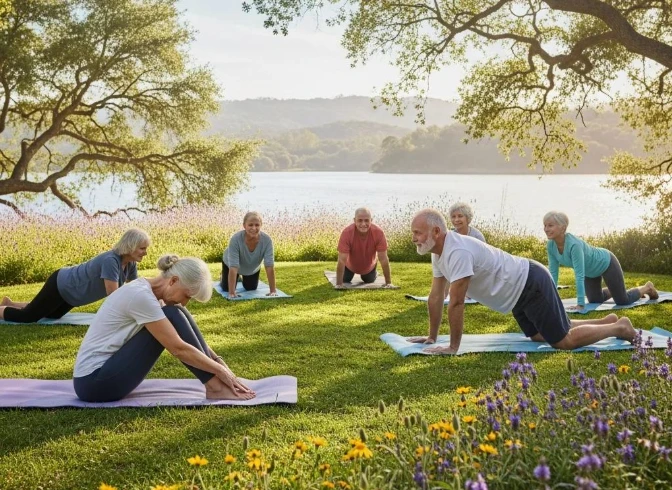
Low-impact workouts are the sweet spot for many older adults because they protect the joints while improving cardiovascular health, strength, flexibility, and balance. They also tend to feel… doable. (And “doable” is underrated in fitness marketing.)
A helpful example comes from a 2022 study by C. Rismayanthi, The effect of low impact aerobic exercise on increasing physical fitness for the elderly. In that program, adults aged 60–70 completed 16 low-impact aerobic sessions. Participants improved cardiovascular endurance, upper- and lower-body strength, flexibility, and balance across standard tests.
That’s the magic of low-impact: it can be gentle and still effective.
Common low-impact options that fit nicely into morning exercise for seniors include:
- brisk walking (outdoors or treadmill)
- stationary cycling
- gentle aerobics
- swimming or water aerobics (especially joint-friendly)
- simple dance steps in the living room (yes, it counts)
If you’re choosing between options, pick the one you’ll do consistently. The “best” exercise is the one you’ll still be doing six weeks from now.
What Are Safe and Effective Cardio Exercises for Seniors in the Morning?
Cardio is the “engine work” in a morning exercise for seniors routine. It improves stamina, heart health, and circulation—so everything from walking to cleaning to playing with grandkids feels easier.
Safe morning cardio ideas
- Brisk walking: Start with 10–20 minutes and build toward 30 if it feels good.
- Easy cycling: Stationary bikes are great for reducing joint impact.
- Gentle swimming or water walking: Excellent if arthritis or joint pain is a factor.
- Low-impact aerobics: Simple step patterns, arm swings, and light marching.
How hard should cardio feel?
A simple guide is the “talk test.” During moderate cardio, you should be able to talk in full sentences, but you probably don’t want to sing a musical number. If you can’t talk, slow down. If it feels too easy, speed up slightly.
And if you’re new to cardio—or restarting after time off—start shorter. Ten minutes still counts. Ten minutes done regularly is powerful.
How Can Seniors Incorporate Strength Training into Morning Workouts?
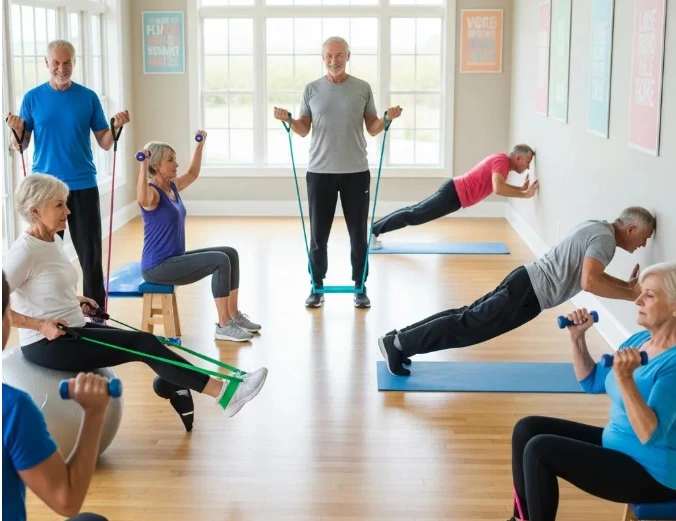
Strength training is the quiet hero of morning exercise for seniors. It helps maintain muscle, supports joints, improves posture, and makes daily tasks safer. Think of it as “life insurance you can feel.”
You don’t need heavy weights. You can use:
- resistance bands
- light dumbbells
- bodyweight
- a sturdy chair
Simple strength moves that work (and don’t feel scary)
Try adding 1–2 sets of 8–12 reps of a few moves, two mornings a week:
- Chair stands: Sit down and stand up slowly without using your hands if possible.
- Wall push-ups: Hands on the wall, body straight, bend elbows and press back.
- Seated leg lifts: Lift one leg at a time, hold briefly, lower with control.
- Resistance-band rows: Pull elbows back, squeeze shoulder blades gently.
If you’re thinking, “Is this really enough?”—yes. When done consistently and with good form, these build functional strength.
How to Perform Stretching Exercises for Older Adults in the Morning?
Morning stretching is like turning the lights on in your body. It reduces stiffness, improves range of motion, and makes movement feel smoother. In a morning exercise for seniors routine, stretching is not a warm-up you rush through—it’s part of what makes the whole thing feel good.
A simple approach:
- Move a little first (march in place for 1–2 minutes).
- Stretch gently.
- Breathe slowly and steadily.
Stretching should feel like mild tension, not pain. If it hurts sharply, that’s your body waving a small red flag.
Which Morning Stretches Improve Flexibility and Reduce Stiffness?
These are common tight spots for many older adults, and they’re perfect targets for morning exercise for seniors:
Neck and upper back
- Gentle neck turns: Look left, then right. Slow and easy.
- Shoulder rolls: Roll shoulders up, back, and down.
Chest and shoulders
- Chest opener: Hands behind back (or hold a towel), gently lift and open chest.
Hips and hamstrings
- Seated hamstring stretch: Sit tall, extend one leg, hinge forward slightly.
- Hip flexor stretch (supported): Step one foot forward, gently shift weight.
Ankles
- Ankle circles: Lift one foot and circle the ankle both directions.
Ankles are the unsung heroes of balance. Give them some love.
What Are Tips for Safe Stretching to Prevent Injury in Seniors?
Safe stretching is a cornerstone of morning exercise for seniors—especially if you have arthritis, osteopenia/osteoporosis concerns, or past injuries.
- Go slow. Your tissues warm up gradually.
- No bouncing. Bouncing is an injury invitation.
- Hold 15–30 seconds. That’s plenty.
- Breathe. Exhale as you ease deeper.
- Avoid sharp pain. Stretching is not a “push through it” sport.
If you’re unsure about a stretch, a physical therapist can offer excellent modifications. (PTs are basically movement detectives. They’re really good at this.)
What Balance Exercises Help Seniors Stay Stable During Morning Workouts?
Balance work is not just for athletes doing fancy drills. It’s for anyone who wants to feel steadier walking through a parking lot or turning quickly in the kitchen. That’s why balance belongs in morning exercise for seniors.
The best part? You can get meaningful benefits with just a few minutes a day.
Which Balance Drills Reduce Fall Risk for Elderly Individuals?
These drills are simple, effective, and easy to scale up or down.
Single-leg stands (supported)
Stand behind a sturdy chair, hands lightly resting on the back. Lift one foot slightly and hold 10–15 seconds. Switch sides.
If you’re wobbling: congratulations, you’re training the right system.
Heel-to-toe walk
Walk in a straight line placing the heel of one foot directly in front of the toes of the other. Use a wall for support if needed.
Tai chi-style weight shifts
Shift weight slowly from one foot to the other. Keep knees soft. Move like you’re calmly avoiding stepping on a sleeping cat.
Balance improves when you practice it regularly, even in small doses.
How Can Seniors Safely Practice Balance Exercises at Home?
Safety first—always. Here’s how to make morning exercise for seniors balance work safer at home:
- Use a sturdy chair or countertop.
- Clear rugs, cords, and clutter.
- Wear supportive shoes or go barefoot only if your floor is safe and stable.
- Start with easier versions and build gradually.
If dizziness is a concern or you’ve fallen recently, talk to a healthcare provider before increasing the challenge.
How Can Morning Yoga and Mindfulness Benefit Senior Fitness Routines?
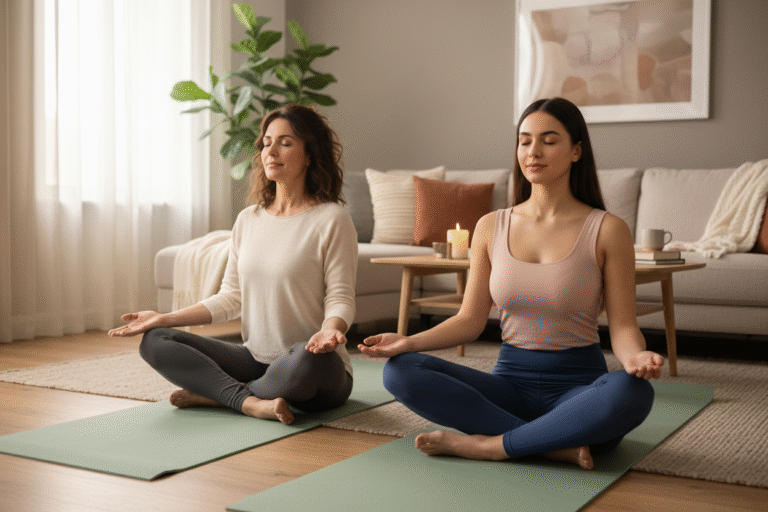
Yoga and mindfulness are a powerful pairing for morning exercise for seniors because they support flexibility, breathing, posture, and stress management—without beating up your joints.
I also love yoga for the sneaky way it improves body awareness. When you notice how you’re moving, you tend to move safer. And when you move safer, you move more. That’s a great chain reaction.
What Are Gentle Morning Yoga Poses Suitable for Seniors?
These poses are common, approachable, and easy to modify:
Cat-cow
This gently mobilizes the spine and can reduce back stiffness. You can do it on hands and knees or seated in a chair.
Seated forward bend
Sit on a chair, hinge forward gently, and let your arms relax. Great for lower back and hamstrings.
Child’s pose (or supported version)
If kneeling is comfortable, child’s pose can be deeply relaxing. If not, you can mimic the shape by leaning forward onto a table with a pillow.
If you ever feel pinching, sharp pain, or numbness, back off and modify.
How Does Mindfulness Enhance the Effectiveness of Morning Exercise?
Mindfulness sounds fancy, but it can be as simple as breathing on purpose for two minutes. In morning exercise for seniors, it helps in three practical ways:
- Better focus: You pay attention to form.
- Lower tension: Breath signals safety to the nervous system.
- More enjoyment: You’re present instead of rushing.
A simple breathing pattern:
Inhale for 4, hold for 2, exhale for 6. Repeat 5–10 times.
If you’re thinking, “I don’t meditate,” great—you don’t have to. Just breathe like you mean it.
What Safety Considerations Should Seniors Keep in Mind for Morning Exercise?
Safety is part of the plan—not an afterthought. A smart morning exercise for seniors routine is adaptable.
A few core principles:
- Start easy and progress slowly.
- Warm up before stretching deeply.
- Use support for balance work.
- Stop if you feel chest pain, severe shortness of breath, or dizziness.
- Check with your doctor if you have new symptoms or major medical conditions.
How to Adapt Morning Workouts for Arthritis and Other Medical Conditions?
If you have arthritis, diabetes, heart disease, osteoporosis, or another condition, you can still do morning exercise for seniors—you just want the right version.
Helpful adaptations:
- Choose low-impact cardio (walking, cycling, water exercise).
- Use a chair for stability.
- Shorten sessions but do them more often.
- Avoid painful ranges of motion.
- Consider water aerobics for joint comfort.
A healthcare provider or physical therapist can help tailor the routine. That’s not a sign of weakness—it’s a sign you’re being strategic.
What Are Recommended Durations and Frequencies for Safe Senior Exercise?
Many public health guidelines recommend about 150 minutes of moderate aerobic activity per week, plus strength training two or more days per week. But the best routine is the one you’ll actually do.
Here are practical ways to break it down for morning exercise for seniors:
- 30 minutes of cardio, 5 days/week
- or 10 minutes of cardio, 5–6 days/week + a longer walk on weekends
- strength training 2 days/week (15–25 minutes)
- stretching and balance most days (5–10 minutes)
Small chunks add up—and they’re often easier on the body than “all at once” workouts.
Frequently Asked Questions
Which morning exercises suit seniors with limited mobility?
Chair exercises, gentle stretching, and water aerobics are excellent for limited mobility. Chair routines reduce fall risk while still building strength and range of motion. Water-based classes use buoyancy to reduce joint stress.
If mobility is significantly limited or you’re recovering from an injury, talk with a healthcare provider for safe modifications. A personalized plan can make morning exercise for seniors feel safer and more effective.
How can seniors keep a morning exercise routine going?
Consistency is the whole game.
- Set small, realistic goals (10 minutes is a real workout).
- Track your progress in a simple calendar.
- Add social support—walk with a friend or join a class.
- Rotate your routine so it stays interesting.
I’ve noticed most people don’t quit because the routine “doesn’t work.” They quit because it’s too complicated. Keep it simple.
Which breathing techniques help during exercise?
Diaphragmatic breathing (breathing into the belly) can improve calm and oxygen flow. A simple pattern:
Inhale for 4, hold for 2, exhale for 6.
Use steady breathing during strength moves and balance work. It can make morning exercise for seniors feel smoother and less tense.
Why is hydration important for morning exercise?
Hydration supports energy, joint comfort, temperature regulation, and recovery. Older adults may not feel thirst as strongly, so it helps to drink water intentionally.
A practical goal: about 8 ounces of water before you start, then sip during and after—especially if it’s warm.
How can seniors move safely from one exercise to another?
Take your time and avoid sudden position changes (like popping up quickly from the floor). Pause for a short cooldown when switching exercise types.
Keep a chair or wall nearby when moving from standing to seated work. These little safety habits make morning exercise for seniors more comfortable and sustainable.
What are some common misconceptions about senior exercise?
- Myth: “I’m too old to exercise.”
Reality: Tailored movement is one of the best ways to protect health and independence. - Myth: “Exercise has to be intense to matter.”
Reality: Gentle, consistent movement delivers real benefits. - Myth: “Strength training is dangerous.”
Reality: Done safely, strength work supports joints, posture, and daily function.
Conclusion: A Simple Morning Routine Can Change Your Whole Day
If you take nothing else from this guide, take this: morning exercise for seniors doesn’t need to be extreme to be effective. A little cardio to wake the heart, a little strength to support your joints, daily stretching to reduce stiffness, balance work to stay steady, and a few mindful breaths to calm the system—it’s a full package.
Start small. Keep it consistent. Treat it like brushing your teeth: not optional, not dramatic, just part of caring for yourself.
And if you ever catch yourself thinking, “Is this really doing anything?”—that’s usually the moment it’s working. The changes are subtle at first: less stiffness, steadier steps, better posture, a little more confidence. Then one day you realize you carried groceries without effort or got up from a chair without bracing like you’re about to deadlift a refrigerator.
That’s the quiet power of morning exercise for seniors. It gives you more “yes” in your day—yes to walking farther, yes to feeling steadier, yes to doing what you love with a little more ease.