

How to Start Journaling for Mental Health Without Losing Your Mind
Learn how to start journaling for mental health in a simple, low-pressure way that helps you feel calmer, clearer, and a little less like your brain is hosting a group chat with no moderator.
Why Journaling is Like Therapy You Can Do in Your Pajamas
I used to think journaling was for two kinds of people: teenagers with dramatic feelings and adults with suspiciously tidy handwriting. I did not see myself in either group.
Then life got noisy. Not movie-level dramatic, just the regular kind of hard that sneaks up on you. Too many thoughts. Too many tabs open in my head. That low-grade mental static where nothing is technically falling apart, but everything feels slightly off. I’d replay conversations in the shower, overthink emails that took seven seconds to read, and lie in bed feeling tired in my body but somehow not tired in my mind. If you know, you know.
Someone suggested journaling, and I had the exact reaction you’d expect: a polite smile on the outside, a deep internal eye roll on the inside. It sounded cheesy. A little too neat. Like one of those wellness tips people give when they’re out of useful things to say.
Still, one night I grabbed a random notebook — not a cute one, not a meaningful one, just a notebook that happened to be there — and started writing. What came out was not elegant. It wasn’t insightful. It was mostly a list of things that were bothering me, plus one mildly dramatic paragraph about being overwhelmed by laundry and life in equal measure. But when I finished, I felt lighter. Not fixed. Just… less crowded.
That’s what journaling can do.
If you’ve been wondering how to start journaling for mental health, the good news is you don’t need to be “good” at it. You don’t need a poetic soul, a soft-lit morning routine, or a leather-bound notebook that costs more than lunch. You just need a way to get some of what’s inside your head out of it.
And there’s real evidence behind that. Psychologist James Pennebaker’s research on expressive writing found that people who wrote openly about emotional experiences often saw improvements in stress, mood, and even physical health markers over time. That doesn’t mean journaling is magic, and it doesn’t replace therapy when therapy is needed. But it does mean this simple habit can genuinely support your mental health in a meaningful way.
What I like about it most is how ordinary it is. No one has to know you’re doing it. There’s no right time. No gold star for best entry of the week. It’s just you, a page, and whatever truth you can manage that day. Some days that truth is deep. Some days it’s, “I’m annoyed and I honestly can’t tell if I need rest, a snack, or a personality transplant.” Both are valid.
The Perfect (Imperfect) Journal: Choosing Your Weapon of Self-Reflection
Before you write anything, you’ll probably hit the first surprisingly emotional question: what am I supposed to journal in?
And for such a small decision, it can become weirdly loaded. Suddenly you’re comparing notebooks like you’re selecting a life partner. One is too plain. One is too pretty. One feels too serious. One has paper so thin your feelings might bleed through to next Tuesday.
I say this with love because I’ve done it. I once bought a beautiful journal, decided it was too nice to “mess up,” and then left it untouched for months like some kind of shrine to my procrastination.
So let me save you some time: the best journal is the one you’ll actually use.
That’s it. That’s the rule.
When people ask how to start journaling for mental health, they often assume the process begins with finding the perfect tools. It doesn’t. It begins with removing excuses. If a cheap spiral notebook makes you more likely to write than a gorgeous hardbound journal that intimidates you, the spiral notebook wins by a landslide.
Paper vs. Digital: The Great Debate

There’s no universally correct answer here, which is both helpful and annoying.
Paper journaling feels more personal to a lot of people. There’s something about handwriting that slows your thoughts down just enough to make them easier to hear. You can’t rush across the page the same way you can type. That pause can be useful, especially if your mind tends to sprint. Research in Frontiers in Psychology has also suggested that handwriting engages the brain differently than typing, particularly in ways related to memory and processing.
But digital journaling has obvious perks too. It’s convenient, searchable, portable, and private. If your phone is always with you and your pen is always mysteriously gone — where do they go, by the way, is there a pen afterlife? — then digital may be the most realistic option. And realistic is underrated.
I’ve used both. Sometimes I want the scratch of pen on paper because it feels grounding. Other times I want to dump my thoughts into a note app at 11:47 p.m. without turning on a light or pretending I’m the kind of person who knows where a notebook is at all times. Both count. The point is not to impress yourself. The point is to write.
What About Bullet Journals?
Bullet journals are great if you genuinely enjoy structure. If making trackers and layouts helps you feel calm, go for it. There’s something satisfying about seeing your moods, habits, and thoughts mapped out in one place.
But if the thought of drawing clean lines and decorating monthly spreads makes you feel tired before you’ve even started, that’s your answer. Skip it. A mental health journaling practice should support you, not become another thing you feel behind on.
Learning how to start journaling for mental health gets much easier when you stop trying to make it look impressive and start making it feel possible.
Breaking the Blank Page Curse: Easy Prompts to Stop Staring and Start Writing
The blank page is rude. It just sits there, all innocent, while your brain suddenly forgets every thought it’s ever had.
This happens to almost everyone. You finally carve out time to journal, open the notebook, hold the pen dramatically for a second, and then… nothing. Not a single meaningful sentence. Just elevator music in your head.
That doesn’t mean you’re doing it wrong. It means you need a starting point.
One of the easiest ways to figure out how to start journaling for mental health is to stop asking yourself to write something profound right away. You do not need to produce wisdom on demand. You just need to begin somewhere slightly more specific than “thoughts?”
Mental Health Journal Prompts for Beginners
When I don’t know what to write, prompts save me from turning journaling into a staring contest. A few that actually help:
- What’s one thing I’ve been feeling today that I haven’t admitted out loud?
- What’s taking up more mental space than it deserves right now?
- If I could be kinder to myself today, what would that look like?
- What made today harder than it needed to be?
- What gave me even five percent relief?
That last question matters more than it seems. Sometimes “better” is too ambitious. Relief is more honest. A short walk. A text from a friend. Sitting in the car for two extra minutes before going inside. Tiny things still count.
There’s research to back up this kind of reflection, too. In a 2003 study published in the Journal of Personality and Social Psychology, Robert Emmons and Michael McCullough found that people who regularly wrote about gratitude reported greater well-being and optimism over time. Not because gratitude erases pain, but because it helps widen the frame. It reminds you that a hard day can still contain one decent moment.
And that matters. A lot.
You also don’t need to write forever. Some of the most honest journal entries I’ve ever written were short. One paragraph. Half a page. Once, just a sentence: “I’m more tired than I’m admitting.” That sentence told the truth better than three polished paragraphs could have.
Daily Reflection Questions to Build the Habit
If you want a simple rhythm, use the same questions at the end of the day. That takes the pressure off coming up with something new every time. Try:
What felt heavy today?
What felt good, even briefly?
What do I need tomorrow?
I like these because they’re small enough to answer honestly. Not every day deserves a full emotional excavation. Sometimes you just need a quick check-in, like knocking gently on your own door and seeing what’s going on in there.
Over time, this is one of the most helpful parts of learning how to start journaling for mental health. You begin to notice your own patterns. You catch the things that drain you. You recognize what steadies you. You become less mysterious to yourself, which is actually a gift.
No Rules Attached: How to Make Journaling Fun and Not a Chore
A lot of journaling advice sounds like it was written by someone sitting in a spotless room near a window with perfect natural light. Bless them. But that version of journaling can feel a little disconnected from real life.
Real life is more like: you’re tired, your phone battery is at 12 percent, there are dishes in the sink, and your brain is doing that thing where it keeps circling the same three worries like a raccoon in a parking lot.
That’s still a perfectly good time to journal.
If you want to know how to start journaling for mental health in a way that actually lasts, here’s the trick: make it less sacred and more usable. Less performance, more relief.
Try Free Writing (And Don’t Edit Yourself)
Free writing is one of the best ways to get out of your own way. Set a timer for five or ten minutes and write without stopping. Don’t edit. Don’t clean it up. Don’t pause every few words to decide whether this sounds insightful enough to deserve ink.
It probably won’t. That’s fine.
Some of the clearest thoughts show up only after you write past the polished ones. I’ve had days where I started with “I don’t even know why I’m annoyed” and ended up three paragraphs later realizing I was overwhelmed, overstimulated, and maybe a little lonely. Useful information. Not glamorous, but useful.
That’s something I wish more people knew about how to start journaling for mental health: clarity often arrives looking messy first.
Doodle, Collage, and Color Your Way Through It
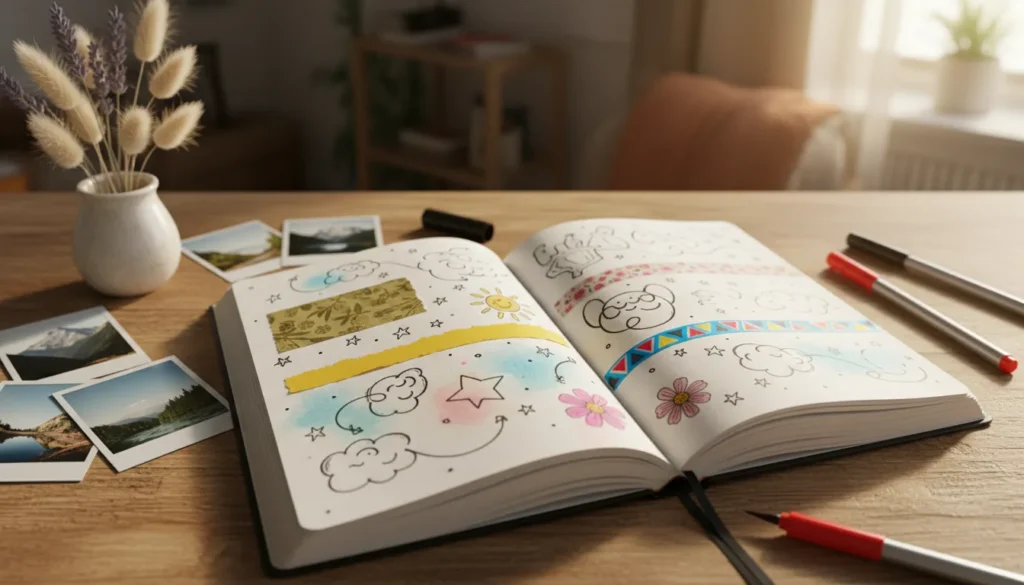
Not every feeling wants to become a sentence. Sometimes it wants to become a scribble, a color, a page full of disconnected fragments.
If words feel heavy, let the page be visual. Draw shapes. Use color. Paste in scraps from the day. Make a mess. There’s a reason creative expression shows up in therapeutic settings so often — it gives your inner world somewhere to go when language is too neat for what you’re carrying.
And honestly, a messy page can feel strangely comforting. It says, “Yep, this is where I was today.” No need to tidy it up for the imaginary judges.
Add Humor — Seriously
I think this is the part people underestimate most. Journaling can be funny. Not fake-happy funny. Real funny. The kind that shows up when you finally admit that your stress response has become a little dramatic and your inner critic sounds like a middle manager who skipped lunch.
Write the ridiculous version of what happened. Write a fake memo from your anxiety. Write a roast of the week you just survived. Sometimes humor is what helps you tell the truth without making the whole thing feel unbearably heavy.
And if you smirk while writing it? Even better. That tiny bit of lightness counts too.
Keeping It Real: Tips to Stay Consistent Without Becoming a Diary Dictator
This is where a lot of journaling habits quietly fall apart. Not because people don’t care. Because they accidentally turn journaling into one more standard they’re failing to meet.
They miss a day, then feel guilty. They miss three days, then feel dramatic about the guilt. Then the notebook starts radiating disappointment from a nearby surface.
I know this cycle well. It’s deeply human. It’s also unnecessary.
If you’re trying to learn how to start journaling for mental health, consistency matters — but not in a perfectionist way. More in a “keep coming back when you can” way.
Ditch the “Every Day or Failure” Mentality
You do not need to journal every day to get benefits from it. Truly. A few times a week can be enough. Once a week can still be meaningful if you keep returning to it.
Research on habit formation, including work by Phillippa Lally at University College London, has shown that habits are built through repetition, not flawless execution. Missing one day doesn’t ruin anything. It just means you missed a day. That’s all.
I think this matters because so many people start journaling hoping it will make them feel better, then immediately use it to create a new reason to feel bad. Which is… not ideal.
Anchor It to Something You Already Do
One thing that helps is attaching journaling to a routine you already have. After coffee. Before bed. Right after work. During lunch in your parked car before you go back inside and answer more emails that somehow all sound urgent for no reason.
This works because you’re not trying to create a whole new identity. You’re just placing a small habit next to one that already exists. That’s a lot easier on the nervous system — and on your calendar.
For me, nighttime works best. Not because it’s aesthetically pleasing, but because it’s when the day finally stops interrupting itself long enough for me to hear what I’m actually thinking.
Keep the Bar Low on Purpose

I love a high standard in the right context. Journaling is not that context.
Make it easy. Make it tiny. Make it so manageable that your tiredest self could still do it. One sentence counts. A short list counts. Writing the same feeling three times in slightly different words definitely counts. You showed up. That matters.
A lot of how to start journaling for mental health comes down to lowering the threshold so far that resistance has a hard time arguing with you.
Reread Old Entries (But Only When You’re Ready)
Going back and reading old entries can be surprisingly emotional. You see old worries, old versions of yourself, old days you thought might break you but didn’t.
And sometimes that’s incredibly healing.
I’ve reread journal pages from hard seasons and felt this strange mix of tenderness and disbelief. Tenderness for the version of me who was trying so hard. Disbelief that I forgot how far I’d come. Journaling can do that. It gives you proof that your inner life has been moving, even when growth felt invisible at the time.
The Grand Finale: Turning Your Scribbles into Sanity and Smiles
At the end of the day, learning how to start journaling for mental health is less about becoming a journaling person and more about becoming a little more honest with yourself.
That’s really it.
You’re creating a place where your thoughts don’t have to stay trapped in circulation. A place where you can say, “This is hard,” or “This is what I need,” or “I’m not okay today, but I am at least aware of it.” That awareness is not small. It’s the beginning of care.
Journaling won’t solve everything. It won’t magically organize your feelings into neat folders or turn every bad day into a breakthrough. Some entries will feel profound. Some will feel boring. Some will make you laugh later. Some will make you want to hug your past self a little.
But taken together, those pages become something steady. A record. A release valve. A conversation with yourself that gets a little more honest over time.
So if you’ve been waiting for the perfect moment to figure out how to start journaling for mental health, consider this your sign to stop waiting. Start with what you have. Start with one page. Start badly, if needed. Honestly, badly is underrated.
Because the goal isn’t to write beautifully. The goal is to feel a little less alone inside your own head.
Key Takeaways
- Start with the easiest format you’ll actually use.
- Use prompts when the blank page feels intimidating.
- Let journaling be messy, short, funny, or imperfect.
- Build the habit around real life, not an idealized routine.
- Focus on honesty over performance.
You don’t need a new personality to begin. Just a little space, a little willingness, and maybe ten quiet minutes.
Preferably in pajamas.