

How to Get Power of Attorney for Elderly Parent with Dementia: A Real-World, Step-by-Step Guide
Learn how to get power of attorney for elderly parent with dementia—capacity, durable vs medical POA, steps to sign, and what to do if it’s too late.
If you’re trying to figure out how to get power of attorney for elderly parent with dementia, you’re probably doing it the way most of us do hard things: a little worried, a little tired, and with 17 browser tabs open—half of them arguing with each other.
I’ve been around enough caregiving families to know this part can feel like a weird mix of legal paperwork and emotional whiplash. One minute you’re discussing “durable powers,” and the next you’re realizing your parent may not be able to manage their own checkbook much longer. It’s a lot.
This guide is designed to make how to get power of attorney for elderly parent with dementia feel less like a maze and more like a checklist you can actually follow. We’ll cover what a POA is, how dementia affects legal capacity, which POA types matter most, exactly how to get the documents signed and accepted, and what to do when the POA window has already closed.
And yes—there will be a touch of humor. Not because this is funny (it isn’t), but because sometimes a small smile is the only thing that keeps you from yelling into the void while you wait on hold with a bank.
How to Get Power of Attorney for Elderly Parent with Dementia: What Power of Attorney Actually Means
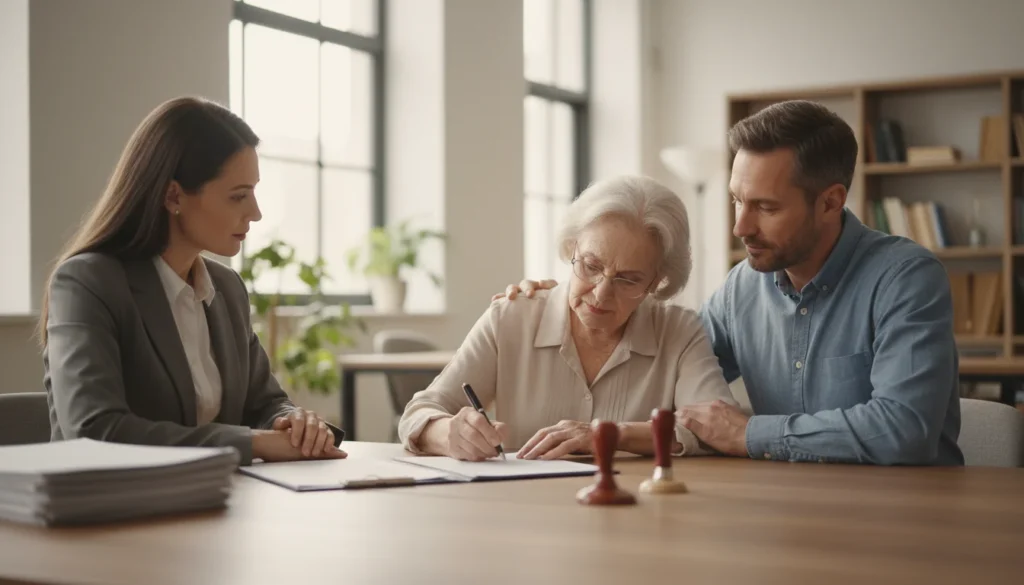
A Power of Attorney (POA) is a legal document that gives one person (the agent, also called the “attorney-in-fact”) the authority to act for another person (the principal—your parent). In real life, that authority can cover things like paying bills, dealing with insurance, managing bank accounts, signing contracts, and coordinating care.
When you’re researching how to get power of attorney for elderly parent with dementia, the central issue isn’t paperwork—it’s capacity.
Dementia affects memory, reasoning, and judgment over time. That’s why the “when” matters as much as the “how.” Your parent must have legal capacity at the moment they sign the POA. Dementia doesn’t always remove capacity all at once; it can fluctuate, and it can be stronger in the morning than late afternoon (hello, sundowning). So you’re not necessarily racing a stopwatch… but you are on a timeline.
This capacity nuance shows up in research too. For example, R.R. Darby’s 2017 work Dementia, decision making, and capacity explains how impaired decision-making can affect legal decisions and why the consequences can be significant for people living with dementia. That’s a polite academic way of saying: “If you wait too long, your options shrink.”
The Capacity Window: Why Timing Is Everything When You’re Figuring Out How to Get Power of Attorney for Elderly Parent with Dementia
If you remember only one thing from this guide on how to get power of attorney for elderly parent with dementia, make it this: POA is usually only possible while your parent can still understand what they’re signing.
Families often delay because they’re hoping things will “stay stable.” Totally understandable. But dementia tends to move like a sneaky little thief—quiet for a while, then suddenly you’re missing the car keys, the medication schedule, and your parent’s ability to explain what day it is.
Here’s the upside: an adult is generally presumed to have capacity unless evidence shows otherwise. That principle is discussed in R. Ellajosyula’s 2016 article Capacity issues and decision-making in dementia, which notes that capacity assessment is contextual and that factors like clinical findings matter.
So, yes—someone can have a dementia diagnosis and still be able to sign a valid POA. That’s why so many people looking up how to get power of attorney for elderly parent with dementia are not “too late”… yet.
The Types of POA That Actually Matter for Dementia Care
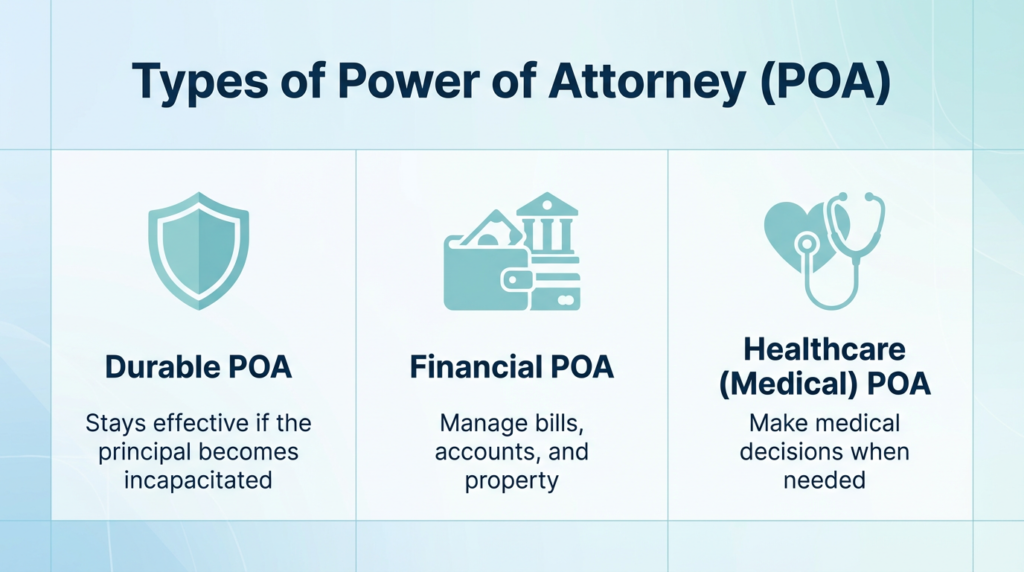
Not all POAs are built for dementia planning. If you’re learning how to get power of attorney for elderly parent with dementia, these are the POA types you’ll hear about most—and the ones that tend to matter.
Durable Power of Attorney: The Non-Negotiable for Dementia
A Durable Power of Attorney stays effective even if your parent becomes incapacitated. That’s the whole point for progressive conditions.
If you don’t choose “durable,” you might end up with a POA that ends the moment your parent can’t make decisions—like buying a fire extinguisher that turns into a decorative vase when the smoke starts.
Durable POA is typically used for financial and legal matters (more on those next). And when people ask me how to get power of attorney for elderly parent with dementia, this is the phrase I want them to remember: durable.
Financial Power of Attorney: Keeping Life From Falling Apart in Slow Motion
A Financial Power of Attorney gives the agent authority to handle money matters. That can include:
- Paying bills and managing bank accounts
- Handling Social Security, pensions, and insurance
- Filing taxes and dealing with the IRS
- Managing investments
- Buying, selling, or maintaining property (if the document includes that authority)
If you’re researching how to get power of attorney for elderly parent with dementia because bills are going unpaid or accounts are getting messy, financial POA is usually the first “urgent” document.
One practical reality: banks and financial institutions can be picky. Even with a perfectly valid POA, you may be asked to complete the bank’s internal forms or provide a certified copy. Sometimes they’ll “review” the document like it’s auditioning for a role in a legal drama.
Translation: build in time for follow-ups.
Healthcare Proxy / Medical POA: Speaking When Your Parent Can’t
A Healthcare Proxy (sometimes called a Medical POA or Healthcare Power of Attorney) authorizes the agent to make medical decisions if your parent can’t.
This isn’t only about end-of-life decisions (though it can include those). It’s also about:
- Approving treatment plans
- Choosing facilities (hospital vs rehab vs memory care)
- Managing medication changes
- Accessing medical information and coordinating with providers
When you’re figuring out how to get power of attorney for elderly parent with dementia, don’t skip the medical side. A financial POA won’t automatically let you make healthcare decisions.
Durable POA Details That Make or Break It
A durable POA can be simple or incredibly specific—depending on what your family needs.
“Immediate” vs “Springing” POA
When you’re researching how to get power of attorney for elderly parent with dementia, you’ll run into two common designs:
- Immediate POA: effective as soon as it’s signed.
- Springing POA: becomes effective only after a triggering event (usually a doctor’s determination of incapacity).
Springing POAs sound nice in theory—“we’ll only use it if we need it.” But in practice, they can slow things down. If a bank or facility demands specific proof of incapacity, you can end up stuck gathering letters while bills pile up.
If you want less friction later, many families choose immediate durable POA and rely on trust, transparency, and safeguards.
Specific Powers and Restrictions
A well-drafted durable POA can include:
- Whether the agent can make gifts
- Whether the agent can change beneficiaries
- Whether the agent can create or fund a trust
- Whether the agent can handle real estate transactions
- Requirements for recordkeeping (highly recommended)
This is where an elder law attorney can be a game-changer in how to get power of attorney for elderly parent with dementia without headaches later.
How to Get Power of Attorney for Elderly Parent with Dementia: Step by Step
Let’s get practical. Here’s the core process for how to get power of attorney for elderly parent with dementia, with enough detail to actually use.
Step 1: Start the Conversation (Without Making It Weird)
If you open with “So… when you lose your mind…” you will not have a productive chat. (Ask me how I know. Actually, don’t.)
Instead, try a framing like:
- “I want to make sure the person you choose is the one helping if things get harder.”
- “This is about keeping you protected and keeping decisions in the family.”
Give your parent as much control as possible. The best POA is the one that reflects their values, not just your stress level.
Step 2: Confirm Capacity—And Document It
For how to get power of attorney for elderly parent with dementia, capacity is the make-or-break issue.
If your parent’s capacity could be questioned, ask their physician (or a specialist) for a brief statement that your parent understood:
- what a POA is,
- what powers they were granting,
- who they were choosing as agent.
That documentation can reduce the risk of future disputes—especially if siblings (or other relatives) are likely to challenge the POA later.
Step 3: Pick the Right Agent (And a Backup)
The “right” agent is someone who is:
- trustworthy,
- organized,
- calm under pressure,
- willing to communicate clearly,
- capable of handling conflict without turning it into a family mini-series.
You can name separate agents for healthcare and finances. That can be smart—different skill sets, different responsibilities.
If you’re deep in the weeds of how to get power of attorney for elderly parent with dementia, also name a successor agent. Life happens. People move. People get sick. People decide they’re “too busy” once the paperwork turns into real work.
Step 4: Work With an Elder Law Attorney (Strongly Recommended)
Could you use a template? Maybe. Should you? That depends on risk.
If there’s any chance of:
- family disagreement,
- significant assets,
- complicated property,
- long-term care planning,
- Medicaid planning,
…then hiring an elder law attorney usually pays for itself in stress saved.
They’ll tailor documents to state law, ensure proper signing rules are followed, and help you avoid vague language that institutions love to reject.
And yes, this is still part of how to get power of attorney for elderly parent with dementia—because a POA that no bank will accept is basically a fancy piece of paper.
Step 5: Sign It Correctly (Witnesses, Notary, All the Details)
Each state has different requirements. Common ones include notarization and witnesses.
A simple but important tip: witnesses should usually be disinterested (not people who stand to inherit). Don’t use your sibling who’s already arguing about “what Mom would’ve wanted.” Choose neutral witnesses if possible.
Step 6: Make the POA Usable in Real Life (Distribution + Storage)
If you’re serious about how to get power of attorney for elderly parent with dementia, don’t stop at signing.
Give copies to the places that will need it:
- financial institutions
- medical providers and clinics
- hospitals your parent commonly uses
- care facilities (if applicable)
Store the original somewhere safe, and tell at least one trusted person where it is. A POA hidden in a “very safe place” that no one can find is a classic family tradition, right up there with “saving good boxes.”
What If Your Parent Can’t Sign? Alternatives When You’re Past the POA Stage
Sometimes, despite your best efforts, the answer to how to get power of attorney for elderly parent with dementia is: you can’t—because your parent no longer has capacity.
If that’s where you are, take a breath. You’re not alone, and there are still legal options.
Guardianship: When the Court Has to Step In
Guardianship (or a similar court process, depending on your state) may be necessary when:
- your parent can’t safely make decisions,
- there’s no valid POA,
- and critical decisions must be made (financial, medical, placement, etc.).
This typically requires a court petition, medical evidence, and a hearing. The court appoints someone to act, and there’s ongoing oversight.
It’s more expensive and more restrictive than POA, which is why families trying to understand how to get power of attorney for elderly parent with dementia are encouraged to act early.
Conservatorship: Often Focused on Finances
Conservatorship is usually the court-ordered route for managing finances (some places separate guardianship of the person vs conservatorship of the estate).
Unlike POA—voluntarily created by your parent—conservatorship is imposed by a judge and typically requires ongoing reporting.
In short: it’s a workable alternative, but not the first choice if POA is still possible.
Managing a POA After It’s Signed (Because It’s Not a One-and-Done Situation)
Once you’ve handled how to get power of attorney for elderly parent with dementia, the next question becomes: “How do we use this responsibly?”
Being an agent is a fiduciary role. That means you have a legal duty to act in your parent’s best interest and follow their known preferences.
Good Agent Habits (That Save You Later)
Keep clean records. Save receipts. Track major decisions. If you ever have to explain your actions to a bank, a court, Medicaid, or a skeptical cousin who suddenly cares deeply about spreadsheets, you’ll be glad you did.
Changing or Revoking a POA
If your parent still has capacity, they can change or revoke a POA. The typical steps include:
- Review the current POA.
- Create and sign a written revocation (or execute a new POA that revokes the old one).
- Notify banks, providers, and any institution that relied on the old POA.
If your parent no longer has capacity, changes generally can’t be made by the principal—at that point, you may need legal advice or court involvement.
Working With an Elder Law Attorney (Ongoing Support That’s Actually Worth It)
When people ask how to get power of attorney for elderly parent with dementia, they often think hiring an attorney is just about drafting the document.
But elder law attorneys can also help with:
- long-term care planning
- Medicaid strategy (where permitted and appropriate)
- dealing with POA disputes
- guardianship or conservatorship petitions
- coordinating documentation of capacity
If you’re looking for a good fit, ask:
- “How often do you handle dementia-related capacity issues?”
- “Do you draft both healthcare and financial documents?”
- “What’s your typical timeline and fee structure?”
Clear communication up front saves a lot of stress later.
Frequently Asked Questions
What should I consider when choosing an attorney-in-fact?
Choose someone who will respect your parent’s wishes, handle details consistently, and communicate clearly. Trust matters more than convenience. If you’re balancing siblings, sometimes the best decision is to split duties: one agent for health, another for finances.
If you’re still deciding how to get power of attorney for elderly parent with dementia, remember: the “best” agent is the person your parent trusts and the law will recognize.
Can a power of attorney be contested?
Yes. POAs can be challenged on grounds like incapacity at signing, undue influence, or fraud.
To reduce risk while you’re working on how to get power of attorney for elderly parent with dementia, document capacity, use proper witnesses, and consider attorney drafting—especially when family conflict is likely.
What happens if my parent didn’t establish POA?
If there is no POA and your parent can’t sign one now, guardianship or conservatorship may be required. It’s more time-consuming and costly, but it provides legal authority when voluntary planning isn’t available.
How can I ensure my parent’s wishes are honored?
Have explicit conversations while your parent can still express preferences. Put specific instructions in documents where appropriate, and pair the healthcare proxy with an advance directive.
The AgeQualiDe study by Rodriguez et al. (2017), Advance directives and power of attorney for health care in the oldest-old, highlights how these documents can preserve autonomy when decisional capacity declines. In plain language: planning early helps your parent stay in the driver’s seat longer.
What are the costs?
Costs vary by state and complexity. A basic set of documents may be relatively affordable; attorney-drafted plans can run higher—especially if they include broader estate or long-term care planning.
If you’re focused on how to get power of attorney for elderly parent with dementia, ask for fees up front and don’t forget possible costs for notarization or recording (where required).
Can I have multiple POAs?
Yes—separate healthcare and financial documents are common, and you can name different agents. It can be a great way to match responsibilities with strengths, as long as the documents don’t conflict.
The Bottom Line on How to Get Power of Attorney for Elderly Parent with Dementia
If you made it this far, you’re already doing the hardest part: showing up and taking action.
Here’s what I’d tell a friend over coffee who asked me how to get power of attorney for elderly parent with dementia:
Start earlier than you think you need to. Document capacity if there’s any doubt. Use durable POA language. Don’t skip the healthcare proxy. And if your family has even a hint of conflict, get an elder law attorney involved sooner rather than later.
Because the goal isn’t just to “get paperwork done.” The goal is to protect your parent’s wishes, reduce chaos, and make sure decisions are made with dignity and clarity—even when dementia makes everything feel fuzzy.
This article is for informational purposes only and does not constitute legal advice. Consult a licensed elder law attorney in your state for guidance specific to your situation.