

How to Change Your Diet for Good After 60: A Realistic Guide for a Healthy Diet for Retirees
A healthy diet for retirees doesn’t mean giving up everything you love. Here’s how to eat better after 60 with small, realistic shifts that actually stick.
Let me guess: you’ve been here before.
Maybe it was the all-salad week that turned into an all-salad three days before you quietly declared a personal ceasefire. Or the “no carbs ever again, starting Monday” phase that lasted until Wednesday when someone brought bread to dinner and you remembered that bread is wonderful. Or you downloaded that meal-prep app that now lives on page three of your phone, quietly collecting digital dust next to a budget app you opened once and a language-learning app that still believes, with touching optimism, that you’re becoming fluent in Italian.
I’ve done versions of all of that. More than once. And I’m genuinely not embarrassed about it anymore — because I’ve come to understand that the problem was almost never me. And it probably wasn’t you either.
Most advice on eating better after 60 is written like we’re all the same person — a 35-year-old with a gym membership, a meal-prep Sunday, and the kind of relentless energy that makes you want to alphabetize your spice rack on a Saturday morning. That might work for someone. It doesn’t work for retirees who have different bodies, different schedules, different budgets, and a very legitimate, decades-long emotional relationship with the foods they love.
Real humans — especially real retirees — eat for all kinds of reasons. Hunger, yes. But also comfort, tradition, habit, boredom, “it’s just sitting there on the counter,” and “it’s Friday and I survived the week and I have earned this.” So if you’re going to build a healthy diet for retirees that actually lasts, it has to fit that reality — not some fantasy version of your life where you cheerfully snack on raw celery and never once miss the foods you grew up with.
What I want to do here is walk you through a version of eating better that actually stands a chance in the real world of retirement. One that fits into chaotic Tuesdays, fixed budgets, smaller households, and the very real physical changes that come with being over 60. No punishment. No perfection required. Just a way of eating that works — and keeps working.
Key Takeaways:
- A healthy diet for retirees works best when built around addition, not restriction
- Your body’s nutritional needs genuinely shift after 60 — protein, calcium, vitamin D, and hydration all matter more than they used to
- Small, consistent habits beat dramatic overhauls every single time
- Your environment, your sleep, and your emotional relationship with food shape what you eat far more than willpower ever will
- Flexibility is not failure — a realistic plan that survives real life is always better than a perfect plan that lasts two weeks and leaves you feeling worse about yourself
Why Most Diet Changes Fail After 60 (And Why That’s Not a Moral Issue)

Before we get into how to actually build a healthy diet for retirees, it’s worth spending a minute on why so many attempts feel like déjà vu with new packaging — same story, different January.
There’s a paper in the American Journal of Clinical Nutrition that gets cited a lot in this space: roughly 80% of people who lose weight end up regaining it within a year. Eighty percent. That’s not because 80% of people are lazy or secretly don’t care about their health. It’s because most approaches are designed for short-term drama — the big reveal, the before-and-after — not for the long, ordinary, Tuesday-afternoon reality of actually living differently.
The script is painfully familiar: you pick a hardcore plan, clean out your pantry like you’re being filmed for a wellness documentary, track every bite, and find yourself Googling the calorie count of grapes at 10 p.m. like that’s a normal thing to do. And then life happens. You’re tired. You’re stressed. You’re cooking for one or two instead of a full household, and suddenly the “no sugar, no bread, no anything remotely enjoyable” rules feel like they were written by someone who has never actually met a retired person — or a person at all.
I remember one particular “new start” Monday. I filled an entire trash bag with anything processed, convinced this was the heroic moment my future self would thank me for. I felt genuinely virtuous. Righteous, even. By Thursday night, I was standing in the kitchen eating dry pasta straight from the box because I was too tired to cook and too stubborn to order takeout. That wasn’t discipline. That was just me losing a very quiet, very undignified argument with reality.
And here’s what your body is doing behind the scenes while all of this is happening: when you slash calories or outlaw entire food groups, your metabolism — which has already slowed with age — slows further. Hunger hormones ramp up. Your brain starts fixating on exactly what you’ve forbidden, with an intensity that feels almost personal. It’s like telling yourself, “Don’t think about donuts.” You know exactly how that ends.
So no, the fact that strict diets haven’t stuck doesn’t mean you’re broken or undisciplined or somehow failing at something other people find easy. It usually means the plan was never designed to become a way of living — especially not for life after retirement, which has its own rhythms, its own challenges, and its own very good reasons to eat the thing.
What Your Body Actually Needs After 60

Here’s something most general diet advice skips entirely, which is a little baffling: your nutritional needs genuinely change as you get older. A healthy diet for retirees isn’t just a “lighter” version of what you ate at 40. It’s a different set of priorities — and knowing what they actually are makes everything else make a lot more sense.
A few of the big ones worth understanding:
Protein becomes more important, not less. After 60, your body becomes less efficient at using protein to maintain muscle mass — a process researchers call anabolic resistance. The American Journal of Clinical Nutrition recommends that older adults aim for around 1.0–1.2 grams of protein per kilogram of body weight per day, which is higher than standard adult guidelines. This matters because muscle loss accelerates after 60 and is directly linked to falls, reduced mobility, and loss of independence. Not exactly a small thing to leave off the list.
Calcium and vitamin D are non-negotiable. Bone density decreases with age, and the risk of osteoporosis rises — especially for women after menopause. The National Institutes of Health recommends 1,200 mg of calcium daily for women over 50 and men over 70, along with adequate vitamin D to help absorb it. Dairy, leafy greens, fortified foods, and safe sun exposure all help here. Yes, the sun counts. Go outside occasionally.
Fiber matters more than ever. Digestion slows with age, and constipation becomes more common — something nobody puts on their retirement vision board but everyone eventually deals with. Fiber from fruits, vegetables, whole grains, and legumes keeps things moving, and also supports heart health and blood sugar stability, both of which become more important after 60.
Hydration needs more active attention. Older adults have a reduced sense of thirst, which means you can become dehydrated without feeling particularly thirsty. Chronic mild dehydration in seniors is linked to confusion, fatigue, urinary tract infections, and kidney issues. Things that are easy to chalk up to “just getting older” when the real fix might be a glass of water.
Calories may need to decrease slightly. Because metabolism slows and physical activity often decreases after retirement, many retirees need fewer total calories than they did in their 40s and 50s. The challenge is getting all the nutrients you need in a slightly smaller caloric window — which means the quality of what you eat matters more than it ever has before.
Understanding these shifts is the real foundation of building a healthy diet for retirees that actually serves your body — not just your waistline, not just a number on a scale, but your actual daily energy, strength, and quality of life.
Start With Addition, Not Restriction
Here’s a mindset shift that sounds almost too simple to be worth saying, but genuinely changes things: focus on what you can add before you obsess over what to cut.
Most “I’m going to eat better now” plans are built entirely around restriction. No sugar. No fries. No snacks after dinner. No eating after 7 p.m. No joy, apparently. You can white-knuckle that for a while — some people manage weeks — but it’s exhausting. And for retirees who’ve spent decades enjoying certain foods, it can feel like punishment for simply getting older. Which is not exactly a motivating frame.
Researchers at Cornell’s Food and Brand Lab have found that people stick with nutrition changes better when they focus on adding healthy foods rather than just eliminating “bad” ones. If your plate is naturally filling up with fruits, vegetables, fiber, and protein, there’s less room — physically and mentally — for everything else. You don’t have to become the food police. You just have to crowd things out a little, quietly, without making it a whole thing.
When I first leaned into this, I tried one tiny rule: add one plant to every meal. Not a full salad. Not a perfectly balanced rainbow bowl with seeds I can’t pronounce and a dressing that costs eleven dollars. Just one plant.
Pizza? A quick side salad or some heated frozen vegetables alongside it. Pasta? A handful of spinach or broccoli stirred into the sauce at the end. Sandwich? An apple or some carrot sticks on the side. That was it. I didn’t ban anything. I didn’t throw anything away. But a month later, my meals looked noticeably different without feeling like I was “on a diet.” I still ate pizza. I just also ate some color with it.
If you want a place to start that doesn’t involve suffering, try that: for the next two weeks, add one fruit or vegetable to lunch and dinner. Don’t change anything else. Don’t track anything. Just see what happens.
Protein First: The Retirement Diet Priority Nobody Talks About Enough
Given what we know about muscle loss after 60, protein deserves its own section in any honest guide to a healthy diet for retirees. And yet it’s the thing most retirees are quietly under-eating without realizing it — not because they’re making bad choices, but because nobody told them it mattered this much.
In a study published in the American Journal of Clinical Nutrition, people who increased their protein intake to around 30% of daily calories ended up eating roughly 400 fewer calories per day — without trying to restrict anything. They weren’t hungry. They were just full. And for older adults specifically, adequate protein is one of the most important tools for maintaining strength, mobility, and independence as the years go on. It’s not glamorous. It’s just true.
The problem is that many retirees — especially those cooking for one or two — tend to drift toward carb-heavy, protein-light meals because they’re easier and cheaper and require less thought at the end of a long day. Toast for breakfast. Soup and crackers for lunch. A small portion of whatever’s easiest for dinner. It’s not laziness. It’s just what happens when you’re not actively thinking about it and nobody’s reminded you that your protein needs actually went up, not down.
Simple shifts that genuinely help:
- Breakfast: Add eggs, Greek yogurt, or cottage cheese alongside your usual toast or cereal
- Lunch: Make sure there’s a protein source — canned fish, beans, leftover chicken, a boiled egg
- Snacks: Pair fruit with nuts or cheese instead of eating fruit alone
- Dinner: Build the meal around the protein first, then add vegetables and a small amount of starch
One question that quietly changed how I built meals: “Where’s the protein here?” Ask it before you finalize a plate, and your meals will shift in a steadier direction without any dramatic overhaul. It sounds almost too simple. It works anyway.
Hydration: The Most Underrated Part of a Healthy Diet for Retirees
Let’s talk about something deeply uncool: water.
No influencer is going viral for saying, “Hey, maybe you’re just thirsty.” Nobody’s building a brand around adequate hydration. But if we’re being honest about a healthy diet for retirees, hydration matters enormously — and it’s one of the areas where older adults are most quietly, consistently at risk.
As I mentioned earlier, the thirst mechanism becomes less reliable with age. Research in Physiology & Behavior has shown that older adults often don’t feel thirsty even when they’re already mildly dehydrated. And mild dehydration in seniors doesn’t just mean a dry mouth — it can show up as fatigue, brain fog, headaches, constipation, and increased fall risk. Things that are very easy to chalk up to “just getting older” when the real fix might be embarrassingly simple.
I was genuinely skeptical of this until I tried a small experiment on myself: whenever I felt randomly snacky or foggy in the afternoon, I’d drink a full glass of water and wait five minutes before doing anything else. A surprising number of times, the urge or the fog just faded. My brain wanted fluids, not food. Mildly annoying to admit, but there it is.
A decent starting rule for retirees: aim for around six to eight glasses of water per day, more if you’re active or live somewhere warm. Herbal teas, broth, and water-rich foods like cucumbers, watermelon, and soups all count toward your daily intake. You don’t have to chug plain water all day if you hate it — just keep something going.
Yes, you’ll visit the bathroom more often at first. Your body adjusts. And no, your morning coffee does not fully count — caffeine has a mild diuretic effect, so it’s worth following each cup with a glass of water. I know. I didn’t love hearing that either.
Staying hydrated makes cravings less intense, digestion more predictable, and your energy more stable throughout the day. For retirees especially, it’s one of the simplest and most impactful parts of eating well — and the one most people are still quietly underestimating.
Eating Well on a Retirement Budget
One thing most diet guides completely ignore, as if it’s impolite to mention: money. And for retirees on fixed incomes, the cost of eating well is a very real, very practical consideration that deserves a straight answer.
The good news is that a healthy diet for retirees doesn’t require expensive superfoods, specialty grocery stores, or a weekly bill that rivals a car payment. Some of the most nutritious foods available are also among the most affordable — and they’ve been affordable for decades, long before anyone put the word “superfood” on a label and tripled the price.
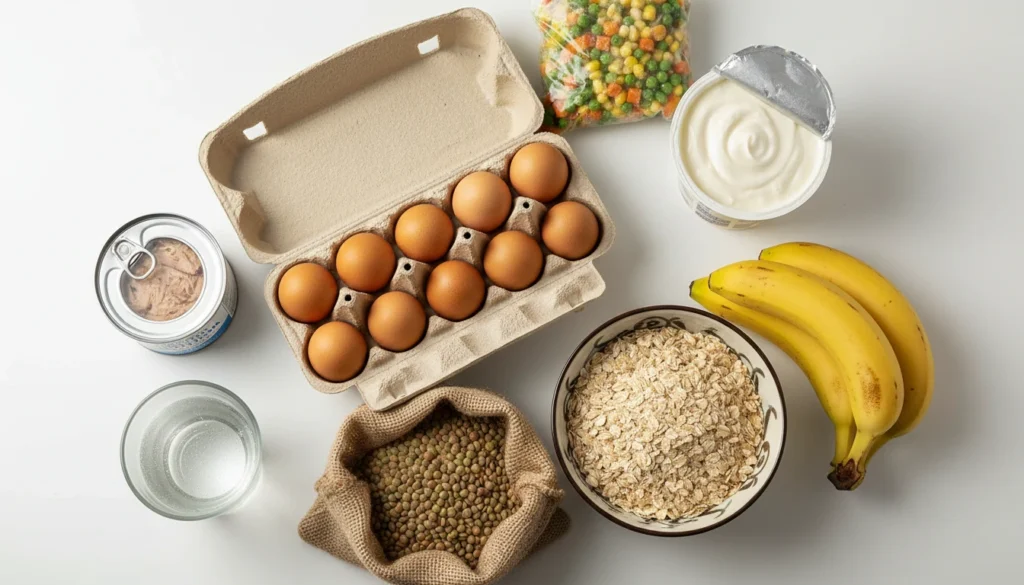
- Eggs — one of the cheapest, most complete protein sources you can buy, full stop
- Canned fish (tuna, salmon, sardines) — high in protein and omega-3s, budget-friendly, and shelf-stable for months
- Dried or canned beans and lentils — excellent protein and fiber at genuinely low cost
- Frozen vegetables — just as nutritious as fresh, often cheaper, and no watching things go bad in the crisper drawer
- Oats — a fiber-rich, filling breakfast that costs very little per serving and takes five minutes
- Bananas, apples, and seasonal fruit — affordable and genuinely nutrient-dense, despite being boring to talk about
- Greek yogurt — protein-rich and versatile, especially when bought in larger containers instead of the individual cups
A few practical strategies: shop with a loose weekly plan so you’re not buying things that quietly go bad in the back of the fridge while you forget they exist. Buy proteins in bulk when they’re on sale and freeze portions. Use frozen vegetables freely — the idea that fresh is always better is a myth that costs retirees money they don’t need to spend.
If you’re thinking about how your grocery budget fits into your overall retirement finances, Vanika’s complete guide to building a retirement investment plan is worth reading alongside this one — because eating well and spending wisely are two sides of the same coin in retirement, and they’re more connected than most people think.
Cooking for One or Two: The Retirement Kitchen Reality
Here’s a challenge that almost no general diet guide addresses, because most diet guides are not written by people cooking for one or two: most recipes are written for four to six people. And many retirees are cooking for one or two.
That gap matters more than it sounds. When you’re cooking for a full household, variety is easier and waste is less of an issue. When you’re cooking for yourself, making a full pot of soup or a whole roasted chicken can feel like a commitment — and leftovers get old fast. Really fast. By day three, you’re staring at the container with a look that can only be described as tired.
A few things that genuinely help:
Embrace the component approach. Instead of cooking full recipes, cook components: a batch of roasted vegetables, some cooked grains, a protein. Mix and match throughout the week into different meals. It’s far less repetitive than eating the same dish four nights in a row and staring at it with quiet resentment by night three.
Invest in a good set of small containers. Portioning and freezing single servings of soups, stews, and casseroles means you always have a real meal available without cooking from scratch every night. Future you will be genuinely grateful.
Scale recipes down. Most recipes can be halved or quartered without much trouble. A quick search for “half-batch” versions of your favorites often turns up helpful guides, and most cooking math is simpler than it looks.
Keep a rotation of no-cook or minimal-cook meals. A good Greek yogurt parfait, a can of quality tuna over salad greens, scrambled eggs with vegetables — these aren’t lazy meals. They’re smart, nutritious, and genuinely fast. There’s no shame in a five-minute dinner that’s actually good for you. None at all.
The goal is to make cooking for one or two feel like a reasonable, even enjoyable, part of retirement — not a daily reminder that the kitchen used to be noisier and fuller and somehow easier.
The 80/20 Rule: Perfection Is Not the Point
If the only way your eating plan “works” is if you never slip up, it doesn’t actually work. That’s not a plan — that’s a countdown to the moment it falls apart.
There’s research in the Journal of the Academy of Nutrition and Dietetics showing that people who aim to eat well most of the time — but don’t spiral when they don’t — tend to do better long-term than people who demand perfection from themselves and then fall apart the moment they’re not perfect. Which is most people. Which is, honestly, all of us at some point.
That’s the 80/20 rule in action: roughly 80% of the time, you’re eating meals that nourish you — plenty of plants, enough protein, reasonable portions. The other 20%? That’s life. Birthdays. Holiday dinners. Your grandchild’s birthday cake that you are absolutely going to eat a piece of. The restaurant you’ve loved for 30 years that doesn’t exactly serve spa cuisine and you’re not about to stop going because of a diet.
When I applied this to how I eat, it took so much pressure off that I almost didn’t know what to do with myself. I stopped calling things “cheat meals” like I was breaking some moral code that required confession. I just looked at the week as a whole. If most meals were solid, I wasn’t going to lose my mind over the slice of cake or the burger or the second glass of wine on a Saturday night.
Weirdly, once those foods weren’t forbidden, I wanted them a bit less. Or at least I could stop at enough instead of inhaling them like I’d never see chocolate again because tomorrow the rules restart and I have to be good.
For retirees especially, food is tied to culture, family, memory, and joy. A healthy diet for retirees should make room for all of that — not treat it like a problem to be eliminated or a weakness to be managed.
Sleep, Stress, and the Hidden Forces Shaping What You Eat
This might sound unrelated at first, but if you’re trying to build a healthy diet for retirees while running on poor sleep or high stress, you’re fighting an unfair battle — and then wondering why it feels so much harder than it should.
Sleep and food are more tightly linked than most people realize. When you’re short on sleep, your body increases ghrelin (the “I’m hungry” hormone) and decreases leptin (the “I’m full” hormone). Your brain also becomes more reactive to high-calorie foods — not because you have no willpower, but because your biology is actively working against you in ways that have nothing to do with character. In a University of Chicago study, sleep-deprived people lost less fat and more muscle than well-rested people eating the exact same number of calories. Same food, worse outcome — just because of fewer hours of sleep. That’s not fair, but it’s real.
For retirees, sleep quality often changes with age: lighter sleep, more frequent waking, earlier mornings that arrive whether you’re ready for them or not. If sleep is a challenge, it’s worth addressing directly — not just pushing through and wondering why your eating feels harder to manage than it used to.
Stress matters too. Cortisol — the stress hormone — increases appetite and specifically drives cravings for high-fat, high-sugar foods. Retirees navigating health changes, loss, shifting family dynamics, or financial uncertainty are not immune to stress eating. Recognizing it is the first step to responding differently. And if financial stress is part of the picture, Vanika’s guide on what the COLA for Social Security means for retirees is worth a read — because financial peace of mind and physical health are more connected than most people realize, and one genuinely affects the other.
Emotional Eating: Food Is Comforting, But It’s Not a Therapist
We can’t talk honestly about changing how we eat without touching emotional eating — especially for retirees, for whom food is often deeply tied to memory, tradition, and comfort in ways that go back decades.
Food is tangled up with almost everything: celebration, family, culture, reward, nostalgia. Of course you want certain foods when you’re stressed or lonely or grieving. Of course a bowl of something warm and familiar feels more comforting than a salad when your day falls apart or the house feels too quiet. That’s not weakness. That’s being human. That’s having a history with food, which all of us do.
A study in Appetite found that people who developed alternative coping strategies — journaling, walking, calling a friend, or even just naming what they were feeling out loud — instead of going straight to food had better odds of maintaining nutrition changes over time. Not because they stopped eating emotionally forever, but because they had other tools in the drawer when they needed them.
For me, this has never been about never eating when I’m emotional. That bar is way too high and I have never once cleared it, not even close. Instead, I try to slip in one small question before I grab something: “What am I actually feeling right now?”
Sometimes the answer is, “I’m just hungry.” Great, let’s eat. Other times it’s, “I’m bored,” or “I’m lonely,” or “I’m tired and I want today to be over and I don’t want to think about it anymore.” On good days, I’ll do one non-food thing first: send a quick text to a friend, take a short walk around the block, sit quietly for a few minutes with a cup of tea. If I still want the snack afterward, I have it — not as a secret weapon against my feelings, just as food.
That tiny pause is a surprisingly big piece of building a healthy diet for retirees. Not because you’ll stop emotional eating entirely, but because you’ll stop doing it entirely on autopilot, without even noticing it happened.
Design Your Environment So the Healthy Choice Isn’t a Struggle
Here’s an uncomfortable truth that took me longer than I’d like to admit to fully accept: if your kitchen is set up for your old habits, you’ll default to them no matter how motivated you feel on Monday morning. Motivation fades. Your pantry doesn’t.
Researchers from the University of Southern California have suggested that almost half our daily actions are habits triggered by our environment — not conscious decisions we’re making in real time. Translation: you eat what’s in front of you. You reach for what’s easiest. Every time, without thinking about it, because that’s how habits work.
When I finally admitted I needed to build an environment that matched how I wanted to eat, I didn’t go buy fancy equipment or overhaul my entire kitchen in a burst of weekend energy. I just rearranged a few things:
- Fruit bowl on the counter instead of bread
- Cut vegetables at eye level in the fridge, not shoved in a drawer to go forgotten and eventually sad and slightly slimy
- Nuts, seeds, and better snacks in the easiest-to-reach pantry spot
- The more indulgent stuff still around — just higher up, behind something else, requiring slightly more effort and a moment of actual decision-making
You can call this lazy hacking or you can call it knowing yourself well enough to stop fighting the same battle every day. Either way, it works. If you want to build a healthy diet for retirees that actually sticks, stop expecting sheer willpower to outperform a pantry full of landmines. Set things up so the easiest move is also a decent choice.
Plan Just Enough (But Don’t Turn It Into a Job)
Meal planning can sound like something only hyper-organized people with label makers, color-coded calendars, and an inexplicable amount of free time can pull off. But planning doesn’t have to mean batch-cooking 21 identical meals and eating them until you resent your own fridge and everything in it and the whole concept of food.
Researchers writing in the International Journal of Behavioral Nutrition and Physical Activity found that people who planned their meals tended to have better diet quality and lower odds of obesity — not because they were perfect, but because they weren’t constantly making food decisions in crisis mode at 7 p.m. when they’re tired and hungry and the easiest option always wins.
What works for me is a very low-pressure version of planning: I keep a mental list of 10–12 default meals I can make without much thought. On the weekend, I pick four or five, buy what I need, and that’s my loose map for the week. If Tuesday’s plan doesn’t sound good on Tuesday, I swap nights or grab one of the other easy options. No guilt. No starting over. No treating a changed plan like a personal failure.
It’s just enough structure so I’m not standing in front of the fridge at 7 p.m. thinking, “I have absolutely no idea what to do with my life right now” and defaulting to whatever’s easiest and least nutritious.
For retirees especially, a little gentle forethought beats heroic last-minute willpower every single time. Every time.
Medications, Supplements, and Talking to Your Doctor
One thing that’s genuinely different about building a healthy diet for retirees — and that most general diet guides gloss over entirely: many of you are managing medications, and some foods interact with them in ways that actually matter and are worth knowing about.
Grapefruit, for example, interacts with a surprisingly wide range of common medications — including certain statins, blood pressure drugs, and anxiety medications. Vitamin K-rich foods like leafy greens can affect blood thinners like warfarin. High-fiber diets can change how quickly some medications are absorbed. None of these are reasons to panic or avoid healthy foods — they’re reasons to have a real, honest conversation with your doctor or pharmacist before making significant dietary changes. That conversation is worth having.
A registered dietitian who specializes in older adults can also be an invaluable resource, especially if you’re managing multiple health conditions. This is one of those areas where personalized guidance genuinely beats general advice — including this article.
Similarly, supplements are worth discussing with your healthcare provider before you start stacking them. Many retirees benefit from vitamin D, B12 (which becomes harder to absorb with age), and calcium — but more isn’t always better, and some supplements interact with medications or each other in ways that aren’t obvious from the label. Getting personalized guidance is worth it. And if you’re thinking about who to trust for that kind of guidance, Vanika’s guide to choosing the right financial advisor has a parallel lesson that applies here too: the right professional makes a real difference, whether you’re managing your money or your health. The principle is the same.
How to Build a Healthy Diet for Retirees That Actually Lasts
So what does it all add up to?
Building a healthy diet for retirees isn’t about finding the “perfect diet” or the one plan that finally fixes everything. It’s about creating a way of eating that gives your body what it genuinely needs after 60, fits your real life — your budget, your household size, your schedule, your social life, your history with food — leaves room for the foods and traditions that bring you joy, and doesn’t require perfection to keep working day after day.
You focus on adding before subtracting. You prioritize protein. You drink more water than you think you need. You rearrange your kitchen so the good choices are the easy ones. You make a loose plan. You sleep. You give yourself permission to eat the birthday cake without treating it as a moral failure that requires a Monday reset and a fresh wave of guilt.
That’s how a healthy diet for retirees actually works — not with a cleanse, not with a 30-day punishment challenge, not with a trash bag full of everything you love, but with small choices that quietly become habits over weeks and months until you look up one day and realize things are just different now. And you didn’t even suffer that much to get there.
If you want a starting point that’s simple and honest, pick one of these to try this week:
- Add one fruit or vegetable to lunch and dinner
- Make sure every breakfast includes a protein source
- Drink a glass of water before you snack
- Rearrange one shelf in your fridge or pantry
- Go to bed 30 minutes earlier
Not all of them. Just one. The one that feels most doable right now, today, with the life you actually have.
If it helps, keep it and add another small change later. If it doesn’t, adjust and try something else. You’re not failing — you’re experimenting. And that’s the real secret of a healthy diet for retirees: you stop trying to be perfect, and you start being persistent instead. Quietly, consistently, without making it a whole dramatic thing.
Your future self — the one who feels stronger, thinks more clearly, moves more easily, and still genuinely enjoys every meal — will be very glad you did.




One Comment
Comments are closed.