

How to Pack for Travel Abroad for Retirees: Your Essential International Packing List and Smart Tips
Learn how to pack for travel abroad for retirees with practical tips on luggage, clothing, documents, medications, and smart international packing strategies.
The first time I packed for an international trip after retirement, I packed like I was moving abroad permanently, opening a small department store, or preparing for several unrelated climates at once.
I brought four pairs of jeans to a hot, humid destination where I wore exactly none of them. I packed a blazer “just in case,” which is a phrase that has caused more unnecessary baggage than almost anything else in modern travel. I packed too many shoes, a full-size shampoo bottle that was immediately confiscated, and enough extras to suggest I had absolutely no faith in local stores, laundry, or common sense.
By the time I got to the airport, I was tired. By the time I reached the hotel, I was irritated. And by the second day of the trip, I realized I had packed for a fantasy version of travel, not the real thing.
That experience taught me something important: learning how to pack for travel abroad for retirees is not really about stuffing more into a suitcase. It’s about making better decisions before you ever zip the bag.
And honestly, retirement changes the whole packing equation.
You’re not trying to squeeze a two-week international trip into one rushed vacation window anymore. You may be staying longer, moving slower, managing medications more carefully, and paying a lot more attention to comfort than you did in your 30s, which is only sensible. At this stage, “travel light” isn’t just a clever idea. It’s a kindness to your back, your shoulders, your energy, and your mood.
This guide is built around that reality. Not the fantasy version where every outfit is perfect and every item gets used, but the real one. The one where airports are large, cobblestones are rude, luggage fees are annoying, and the smartest travelers are usually the ones carrying less than you expected.
Key Takeaways
- Learning how to pack for travel abroad for retirees starts with a written list and a willingness to cut it down.
- Travel documents and medications need the most careful planning because those mistakes are the hardest to fix abroad.
- Clothing should work as a simple mix-and-match system, not a collection of “maybe” outfits.
- Carry-on travel can save time, money, and stress if your trip length and needs allow it.
- Packing cubes, travel-size toiletries, and a universal adapter make international travel much easier.
- The biggest packing trap is the “just in case” category.
- Comfort, simplicity, and flexibility matter more than packing for every possible scenario.
Why Packing for International Travel Feels Different in Retirement
Domestic travel is forgiving. If you forget toothpaste, you buy toothpaste. If you forget a sweater, you improvise. If you forget your favorite face cream, life, somehow, goes on.
International travel is less generous.
Suddenly you’re dealing with passport rules, customs restrictions, airline baggage limits that seem to vary by mood, unfamiliar pharmacy brands, and destinations where replacing what you forgot may be inconvenient, expensive, or weirdly difficult. I once spent far too long in a small town abroad trying to buy a very ordinary toiletry item, only to come home with something floral, aggressive, and spiritually not for me.
That’s the kind of mistake that sticks with a person.
For retirees, there’s often another layer too. You may be traveling with prescriptions, supplements, mobility aids, backup reading glasses, compression socks, or paperwork related to insurance and health needs. None of this is dramatic. It’s just real. And it means packing has to be thoughtful in a way it maybe wasn’t when you were younger and willing to wing things more recklessly.
Knowing how to pack for travel abroad for retirees means respecting that reality without overreacting to it. You do not need to pack for every disaster. But you do need to pack for the things that actually matter.
That difference is everything.
Start With a Real Packing List
I know. This sounds very obvious. Maybe even boring.
But a written packing list is one of the smartest things you can do before an international trip, especially if you’re the kind of person who suddenly remembers three important items while brushing your teeth the night before departure.
Writing things down reduces mental clutter. It gets the spinning thoughts out of your head and into a usable system. Instead of mentally rehearsing passport, charger, medications, glasses, adapter, paperwork, walking shoes, cardigan, you can relax a little because the list is now doing part of the work.
And before you pack a single thing, make that list.
Then cut it back.
Not brutally. Just honestly.
Because most of us, if left unsupervised with an open suitcase, start packing for imaginary scenarios. A gala we are not attending. A weather event that is unlikely. A version of ourselves who changes outfits three times a day and somehow needs multiple pairs of sandals to reflect different emotional states.

It helps to organize your list into five practical categories:
Travel Documents
This includes your passport, visas if needed, flight details, hotel confirmations, travel insurance information, emergency contacts, and copies of important records.
Clothing
This should be weather-appropriate, culturally appropriate, and easy to combine into multiple outfits.
Toiletries
Think practical, compact, and airport-friendly.
Electronics and Accessories
Chargers, phone, adapter, headphones, e-reader, power bank, and any small travel tools you genuinely use.
Health and Safety Items
Medications, copies of prescriptions, first aid basics, glasses, insurance cards, and anything you rely on day to day.
That structure alone can save you from a lot of useless packing.
Travel Documents: The Things You Really Cannot Forget
If you forget a shirt, you can buy a shirt.
If you forget your passport, you are not going anywhere.
This is the category that deserves your full attention because document mistakes are the ones most likely to derail a trip before it even begins. Your passport should usually be valid for at least six months beyond your travel dates, because many countries require that. This is one of those rules people assume will somehow bend for them. It will not.
Check it early. Not the week before. Early.
I still remember seeing someone get turned away at the airport because their passport validity fell short. It was awful. You could practically feel the vacation collapsing in real time.
Along with your passport, carry printed and digital copies of key travel information. That includes your itinerary, hotel addresses, insurance details, visas, and emergency contacts. I like having a slim document folder in my carry-on and digital backups stored online. It may feel overly cautious until the moment it doesn’t.
And for retirees, this folder should also include a current medication list, doctor contact information, and health insurance details. If something goes wrong abroad, even something minor, having that information ready can save time, confusion, and stress.
It’s not glamorous, but neither is standing in a foreign clinic trying to remember the exact dosage of something important.
Clothing: Pack a System, Not a Fantasy
This is where most overpacking happens.
Not because we’re foolish. Because we’re hopeful.
We imagine dinners we may not go to. Days that will somehow require four outfit options. Weather that is both colder and warmer than forecasted. We pack for every version of the trip except the one we’re actually taking.
I used to do this constantly.
I packed “options,” which sounds sensible until you realize “options” is often just a polite word for “too much stuff.” What I actually wore on most trips was a small rotation of favorite pieces that were comfortable, easy, and familiar.
That’s when I finally understood that clothing for international travel should work like a system.
Pick two or three neutral colors. Build around those. Make sure tops and bottoms can mix easily. Choose fabrics that travel well and layers that can adapt. The goal is not variety for its own sake. The goal is enough flexibility without dragging your entire closet across an ocean.
Choose Comfortable, Repeatable Clothes
Good travel clothing earns its place.
It should be comfortable on long days, easy to wash, easy to re-wear, and appropriate for more than one setting. A lightweight shirt that works for walking during the day and dinner in the evening is useful. A pair of trousers that can be dressed up slightly or worn casually is useful. A cardigan that works on the plane, in cool evenings, and in over-air-conditioned museums is useful.
That sequined top for the hypothetical elegant event you almost certainly will not attend? Probably not pulling its weight.
Retirement travel gets easier when you stop packing for possibility and start packing for reality.
Respect Local Dress Expectations
This matters more than some travelers realize.
Many international destinations, especially religious or historic sites, expect modest dress. That doesn’t mean you need an entirely separate wardrobe. It just means packing one or two pieces that keep you covered when needed: a lightweight long-sleeved shirt, a scarf or wrap, breathable trousers or a longer skirt.
These items do not take up much room, and they can save you from being turned away from places you very much wanted to see.
A good lightweight scarf, in my opinion, is one of the hardest-working items in a travel bag. It covers shoulders, adds warmth on cold planes, acts as a wrap, and occasionally makes you feel slightly more put together than you actually are.
That’s enough to make it worth packing.
Dress for the Climate You’re Actually Visiting
I say this with love and experience: do not pack for the climate you wish you were visiting.
If it’s hot, pack light breathable fabrics. If it’s cold, think in layers. If it’s rainy, bring one good protective layer instead of three mediocre ones. The weather does not care that you really wanted to wear those heavy jeans.
Trust the forecast more than your habits.
How to Pack Light Without Feeling Unprepared

Packing light sounds lovely in theory and mildly impossible in practice until you learn a few techniques that actually make a difference.
Roll Most Clothes
Rolling casual clothing saves space and helps keep things compact. It works especially well for t-shirts, casual trousers, knitwear, and softer fabrics. Structured items may still do better folded, but for most everyday pieces, rolling is simple and effective.
It also gives you that deeply satisfying feeling that perhaps you have become one of those organized travelers who knows what they’re doing.
Even if only temporarily.
Wear the Bulky Items on Travel Day
If you’re bringing walking shoes, a jacket, or a heavier sweater, wear them on the plane. This saves room and weight in your suitcase, which matters more than ever on international routes with strict baggage allowances.
You may feel slightly over-dressed for the airport. That is fine.
Your suitcase will be lighter, and you will not be paying extra because your boots insisted on traveling in luxury.
Let Laundry Solve Part of the Problem
This is one of the biggest mindset shifts in retirement travel: you do not need to pack for every day if you are willing to do laundry.
I know laundry on vacation does not sound glamorous. But neither does hauling a giant suitcase up stairs in a train station. A quick sink wash, a laundromat stop, or an apartment rental with a washer can completely change how much you need to pack.
Once you accept that laundry exists in other countries too, packing gets much easier.
Packing Cubes: Annoyingly Helpful
I resisted packing cubes for far too long because they sounded like one of those travel trends people get weirdly smug about.
Unfortunately, the smug people were right.
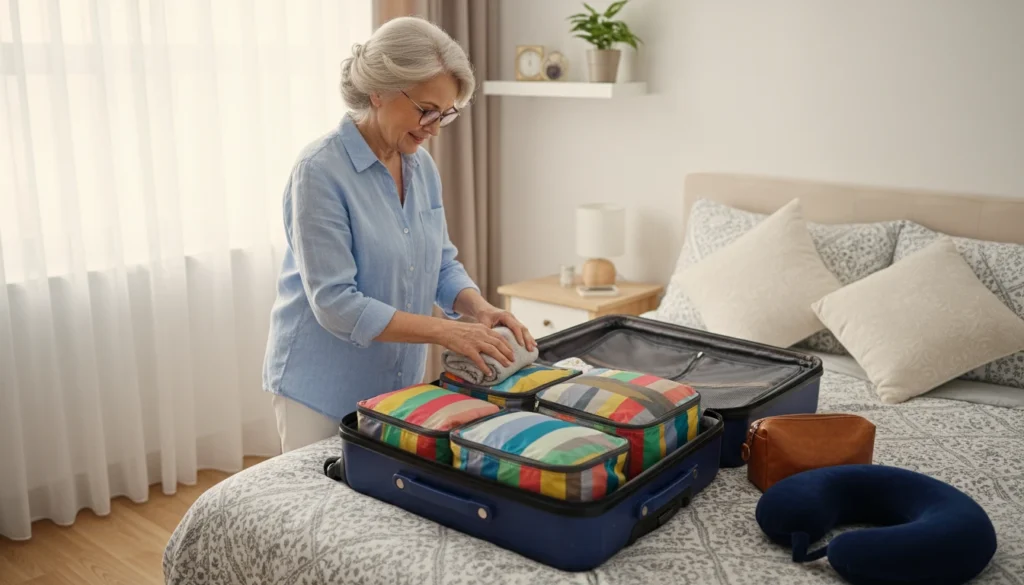
Packing cubes are genuinely useful. They keep your clothing grouped together, make unpacking easier, and stop your suitcase from turning into a soft-sided excavation site after day three. I usually separate tops, bottoms, undergarments, and sleepwear. That way I’m not digging through everything just to find socks.
And on longer multi-stop trips, they’re even better. They help create order in the middle of motion, which is a small but meaningful blessing when you’re tired and living out of a bag.
Choosing the Right Luggage for International Travel
The best luggage is not necessarily the fanciest. It’s the one that causes you the fewest problems.
That means it should roll easily, feel manageable for your body, fit airline rules, and be light enough that it doesn’t become your enemy halfway through the trip.
Carry-On Only if You Can Manage It
If your trip length and medical needs allow it, carry-on travel is wonderful.
You skip checked bag fees. You skip baggage claim. You skip the anxious little moment where everyone around you has their suitcase and you’re trying not to take it personally. You also lower the risk of your bag taking its own unexpected holiday somewhere else.
That said, carry-on only is not a moral achievement. If you need a checked bag, check a bag. The point is not winning some minimalist contest. The point is traveling in a way that feels manageable.
Still, if you can pack light enough, carry-on is often worth it.
Check Airline Size Rules Before You Fly
This is especially important internationally. Not all airlines use the same carry-on standards, and some are much stricter than others. Budget carriers can be ruthless about dimensions and weight.
Measure your bag. Check the airline website. Then check it again if you have connecting flights on different carriers.
It’s much nicer to learn this at home than at the gate while reshuffling belongings in public with the expression of someone who has made several preventable errors.
Think About Your Body, Not Just the Bag
As we get older, luggage comfort matters more. Handle height matters. Wheel quality matters. Weight matters. How easy it is to lift into an overhead compartment matters.
You are not choosing luggage for its personality. You are choosing it for how it behaves under pressure.
A suitcase that looks sleek but fights you through every airport is not stylish. It is a burden with wheels.
Toiletries and the Airport Liquids Rule

Airport security has no interest in your favorite oversized shampoo bottle.
If you’re bringing liquids in a carry-on, follow the size restrictions. Use small refillable containers and keep them together in a clear bag if required. It’s cheaper, simpler, and less wasteful than constantly buying miniature versions of everything.
Solid toiletries can also be surprisingly helpful. Shampoo bars, soap bars, and similar products cut down on liquids, save space, and make carry-on travel easier. I was skeptical at first, mostly because I enjoy distrusting new systems on principle, but some of these products really are excellent now.
If you find a few that work for you, they can simplify things a lot.
And for longer trips, keep your toiletry kit consistent. A dedicated travel toothbrush case, small containers, nail clippers, comb, and the essentials you always use. Once you’ve built a good toiletry setup, future packing becomes much easier because you’re not reinventing the process every time.
Medications and Health Essentials: The Part Retirees Should Plan Carefully
This is one area where extra caution is absolutely worth it.
Bring more prescription medication than you think you’ll need, ideally enough for the trip plus extra in case of delays. Keep medications in your carry-on, not in checked luggage. If your bag is delayed, your medicine should not be in another country without you.
Carry copies of prescriptions and a written list of medication names and dosages. This matters for customs, for emergencies, and for any situation where you need to explain what you take.
It’s also wise to check whether any medication is restricted in the country you’re visiting. Most trips will be straightforward, but some countries have stricter import rules than people realize.
Beyond prescriptions, pack the health items you actually rely on at home. Pain relievers, bandages, motion sickness tablets, antidiarrheal medicine, antihistamines, compression socks if you use them, extra eyeglasses, hearing aid batteries, whatever fits your real life.
You do not need a full medical cabinet.
But you do need to avoid being caught without the basics that matter to you.
Electronics That Make Travel Easier
You do not need to travel with half your house powered by adapters, but a few items make a big difference.
A universal travel adapter is one of the best small purchases you can make. It solves a problem once and keeps solving it trip after trip. A power bank is useful for long travel days. A dedicated travel charger can save you from the classic “forgot it plugged into the wall at home” mistake that somehow continues to happen to fully grown adults everywhere.
And if you check a bag, a simple tracking device can offer peace of mind. It’s not magic, but it can be reassuring to know where your suitcase seems to be, especially if the airline is being unhelpfully vague.
Packing for Short Trips vs. Longer International Travel
Not every trip needs the same strategy.
For Trips Under a Week
For shorter international trips, a carry-on is usually enough if you pack carefully. A few mix-and-match outfits, one extra layer, one pair of versatile shoes plus the pair you wear, and a compact toiletry kit can go a long way.
Short trips are where restraint really pays off.
You are unlikely to need a large wardrobe for five or six days. You just need enough to feel comfortable and presentable.
For Longer Trips
Longer trips require a different mindset. Instead of packing more clothing, you usually need a better system. Quick-dry items, easy layers, and a plan for laundry matter much more than sheer quantity.
This is especially true for retirees who may finally have the time to travel for multiple weeks at a stretch. That is one of retirement’s great pleasures, and it becomes much easier when your luggage doesn’t feel like a punishment.
For Multi-Destination Trips
If you’re moving between climates or different types of destinations, packing gets trickier. The answer is still not “bring everything.” It’s “pack layers and versatile pieces.”
One lightweight jacket is better than multiple bulky outerwear options. One pair of comfortable walking shoes is better than several “just in case” pairs. A scarf, cardigan, and breathable long-sleeved shirt can handle far more variation than people expect.
Common Packing Mistakes Retirees Make
I say all of this with affection because I’ve made nearly every mistake myself.
Packing Too Many Clothes
This is the big one. Most people wear the same favorite items on repeat and ignore a surprising amount of what they brought. If you’re hesitating over an item because it “might” be useful, that’s often your answer.
Packing Too Many Shoes
Shoes are heavy, awkward, and take up more room than they deserve. Most trips do not require more than two or three pairs total, including the ones you wear in transit.
Anything beyond that should have to present a very convincing argument.
Forgetting Chargers or Adapters
It’s always something small and annoying, isn’t it? Phone charger, watch charger, adapter, e-reader cable. These are easy to forget and irritating to replace on the road.
A permanent travel tech pouch helps a lot.
Bringing “Just in Case” Items
This is where packing goes off the rails. If an item is inexpensive, widely available, and unlikely to be needed, leave it at home. Most destinations have stores. You are not venturing into a supply-free wilderness every time you go abroad.
Ignoring Customs Rules
Different countries have different restrictions on food, medications, plant materials, and other goods. Spend a few minutes checking official entry guidance before you travel. It’s one of the least exciting parts of trip prep, but also one of the more useful ones.
Sustainable Packing Choices That Also Make Life Easier
The nice thing about sustainable packing is that it often overlaps with sensible packing.
Refillable toiletry bottles reduce waste and save money. Reusable shopping bags take up almost no room and come in handy constantly. Solid toiletries cut plastic and simplify airport security. Durable clothing that works for multiple outfits means packing less and replacing things less often.
None of this requires perfection. It just means making a few choices that are lighter on both your luggage and the planet.
That’s a pretty good combination.
The Bottom Line on How to Pack for Travel Abroad for Retirees
After enough trips, you start to realize that good packing is not about being brilliantly organized or naturally minimalist or one of those mysterious people who can live indefinitely out of a single elegant bag.
It’s about having a system.
It’s about knowing what matters, what doesn’t, and which items are quietly causing you more trouble than they’re worth. It’s about protecting your energy for the actual trip instead of wasting it wrestling with too much luggage, missing paperwork, or preventable mistakes.
Learning how to pack for travel abroad for retirees means packing for your real needs, not your imaginary ones. It means choosing comfort over clutter, preparation over panic, and versatility over excess. It means giving special attention to documents, medications, and practical clothing, then trusting that you do not need to carry your whole life with you in order to travel well.
And perhaps most importantly, it means finally making peace with the fact that the “just in case” blazer has never once earned its ticket.
Leave it home.
Your future self, moving through the airport a little more easily, lifting a lighter bag, finding what you need without digging, and arriving less frazzled, will be grateful. Possibly even a little smug.
Honestly, that’s fair. You earned it.





3 Comments
Comments are closed.