Home Decorating Ideas for Retirees: How to Create a Stylish, Comfortable Space That Actually Feels Like You
Home decorating ideas for retirees don’t have to mean “safe and beige” — this guide covers color, furniture, lighting, texture, storage, and how to make your space feel current, cozy, and completely yours.
The first time I seriously googled contemporary home decorating ideas, I was convinced it meant turning my living room into one of those all-white, glass-everything spaces where you’re afraid to sit down in case you wrinkle the sofa. You know the photos. They look incredible on Pinterest. They look slightly terrifying when you imagine dropping a slice of pizza in them.
Several questionable paint choices later, I’ve learned something important: good home decorating isn’t about living in a museum. It’s about creating spaces that feel current and comfortable at the same time. Clean, calm, and still full of you. Not the 2004 version of you. Not “aspirational Pinterest board” you. Actual, Tuesday-night-in-sweatpants you.
For retirees especially, this matters more than most decorating guides acknowledge. You’re home more. You’re living in your space more fully than you ever did during the working years — and that means your home needs to do more. It needs to be beautiful and functional. Calm and personal. Easy to maintain and genuinely enjoyable to be in. That’s a higher bar than most decorating advice is written for, and it’s exactly the bar we’re aiming for here.
This guide walks through home decorating ideas for retirees that work in real homes, with real people doing real-life things — like leaving shoes by the door and occasionally eating on the sofa. No judgment. We’ll cover color, furniture, lighting, texture, storage, tech, and how to make your place look pulled together without feeling like you fired your personality in the process.
Key Takeaways:
- Home decorating ideas for retirees work best when they balance style with genuine comfort and livability
- A calm, cohesive color palette is the foundation everything else builds on
- Layered lighting is the single most underrated upgrade in any home
- Texture and natural materials keep contemporary spaces from feeling cold or sterile
- Smart storage is what makes a polished look actually sustainable in real life
- You don’t have to do it all at once — one room, one change at a time is a perfectly valid strategy
What Contemporary Home Decorating Really Means (And Why It’s Not Just “Modern”)
Here’s where a lot of people get tripped up: contemporary and modern are not the same thing. I once told a designer friend I wanted a “modern contemporary” look and she blinked at me like I’d just asked for a “decaf triple espresso.” Technically possible. Spiritually confused.
Modern design refers to a specific historical style — think mid-century: Eames chairs, tapered legs, low teak credenzas, someone holding a drink in the corner looking very intentional about it. Contemporary design, on the other hand, is what’s happening right now. It’s flexible. It borrows from different eras and edits ruthlessly. It’s less a rulebook and more a sensibility.
So instead of strict rules, contemporary home decorating ideas are really about a few big themes:
- Clean lines and uncluttered spaces
- A mostly neutral base with carefully chosen color
- A mix of natural and industrial materials
- Comfort and function built into almost everything
What I love about this approach — especially for retirees — is that it leaves room for real life. You can have grandkids, pets, hobbies, and a collection of things you genuinely love, and still have a space that feels polished instead of chaotic. Research published in the Journal of Interior Design found that people are happiest in spaces that combine simplicity with personalization rather than strict minimalism. Translation: you don’t have to live in a white box with one chair and an existential crisis to have a beautiful home. You just need to choose what earns a spot.
The Foundation: Color Palettes That Feel Calm, Not Boring
Color is usually where people start — and where a lot of decorating dreams go sideways. The good news: you don’t have to paint everything white. The better news: you also don’t need a wild color palette to avoid looking “boring.”
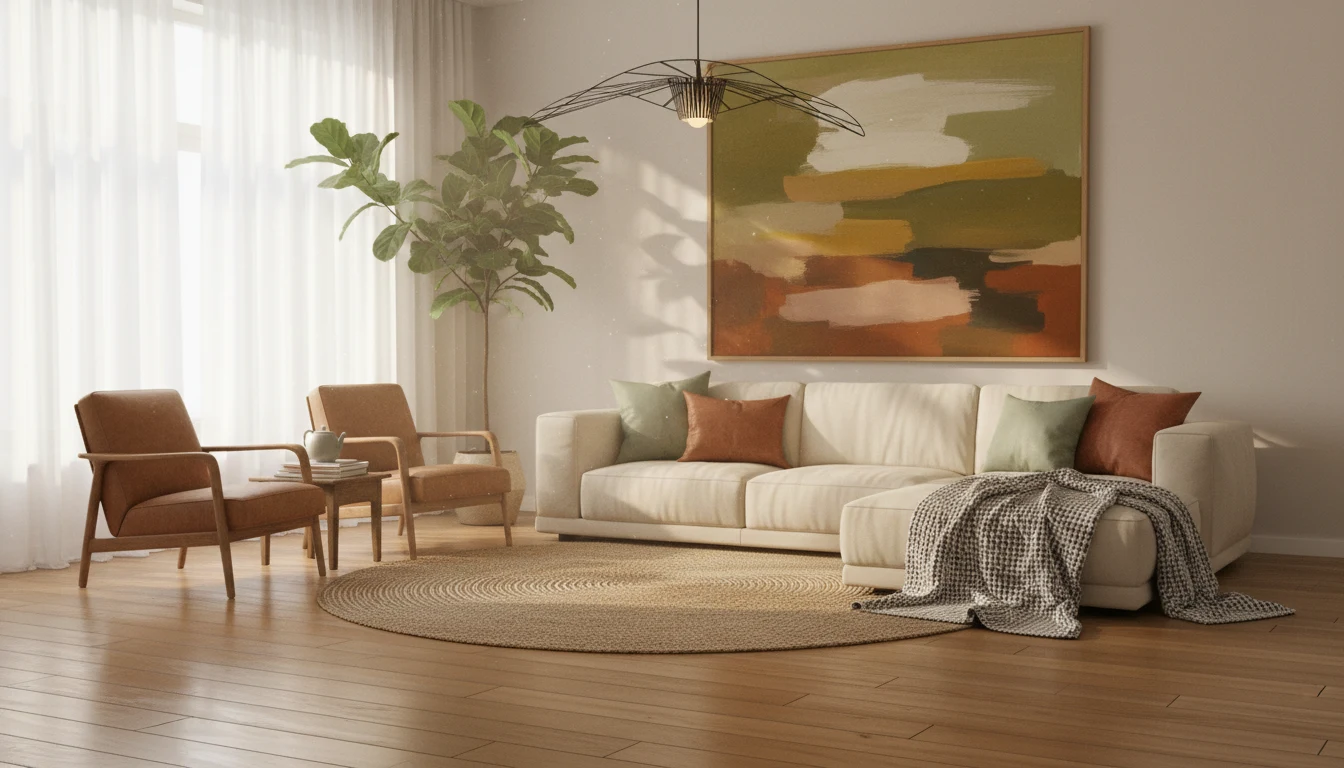
Contemporary home decorating ideas for retirees typically lean on interesting neutrals as a base, then layer in color where it counts. Think less “landlord beige,” more “soft stone on an overcast day.” There’s a whole world between those two things, and it’s a very livable world.
Some go-to base colors that work beautifully:
- Warm whites and off-whites with a hint of cream or gray
- Soft grays and greiges — that gray-beige hybrid that sounds fake but absolutely isn’t
- Mushroom, taupe, or stone tones
- Gentle earth tones like clay, sand, or sage
I once painted my living room what I thought was a very chic cool gray. Under the store lights, it looked perfect. Under my actual lights? Lilac. My “minimalist loft” instantly became “Barney’s bachelor pad.” Now I always test paint colors on multiple walls and check them morning, afternoon, and evening before committing. Game-changer. Genuinely.
A simple formula that works in most spaces:
- Let 70% of the room be soft neutrals — walls, big furniture
- Use 20% mid-tones — wood pieces, textiles
- Save 10% for deeper accents — pillows, art, one statement wall
If you’re craving more drama, contemporary decorating doesn’t say “no” — it just says “be intentional.” A charcoal accent wall behind the sofa, a deep green built-in, a navy kitchen island. One strong move is almost always more powerful than ten competing ones. Pick your moment and commit to it.
Furniture: Clean Lines, Real Comfort
Let’s talk furniture — the part where a lot of people accidentally slide into “futuristic office lobby” instead of “home I want to curl up in.”
The best home decorating ideas for retirees when it comes to furniture are surprisingly livable. You’re aiming for pieces that are clean-lined but not cold, low to medium in profile, scaled correctly for the room, and functional — with storage where it makes sense.
I still remember the day I swapped out my big, overstuffed sofa for a sleeker, low-profile sectional. I didn’t change anything else, but my living room suddenly felt twice as big and ten times more intentional. Same number of seats. Completely different energy. Sometimes one swap is all it takes.
A few helpful guidelines:
- Look for simple silhouettes: straight or gently curved arms, minimal ornamentation
- Mix materials: wood legs, fabric upholstery, maybe a metal base or detail
- Actually sit on things before you buy them — radical, I know, but worth saying
Environmental psychology research has shown that spaces with only hard surfaces and minimal upholstery can raise stress levels. Your body and brain want somewhere soft to land. So yes, that inviting armchair or deep sofa is doing important emotional work. If you can’t imagine napping on it or watching a whole season of your favorite show there, it’s probably not the right piece for a real home.
Accessibility Without Sacrificing Style
For retirees, there’s an additional layer worth thinking about: furniture that’s beautiful and easy to use. Chairs and sofas at a height that’s comfortable to get in and out of. Tables with enough clearance. Beds at a practical height. These aren’t compromises — they’re smart design choices that happen to also make your home more livable for guests of any age.
The best home decorating ideas for retirees don’t treat accessibility as an afterthought. They build it in from the start, invisibly. Nobody walks into a well-designed room and thinks “oh, that chair height was clearly chosen for ergonomic reasons.” They just think “I want to sit in that chair.” That’s the goal.
Lighting: The Underrated Upgrade That Changes Everything
If I could go back and give younger-me one decorating tip, it would be this: don’t treat lighting like an afterthought. You can have great furniture and perfect paint, but if the room is lit like a hospital corridor, it’s still going to feel off. Every single time.
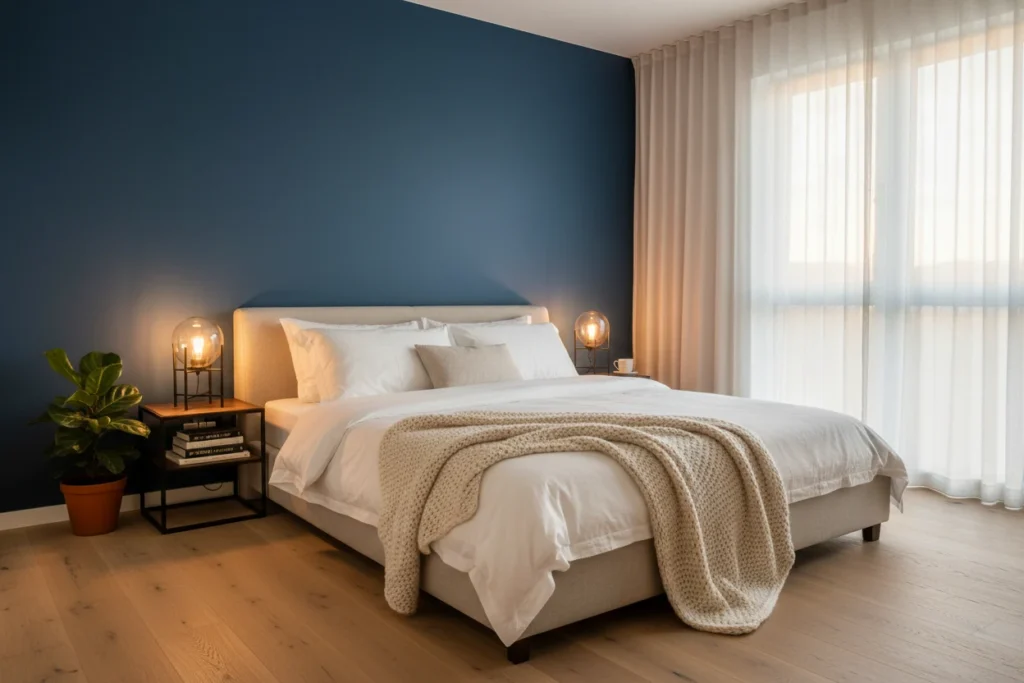
Contemporary home decorating ideas rely heavily on layered lighting — not one lonely ceiling fixture trying to light an entire life.
Think in three layers:
- Ambient lighting: your overall glow — ceiling fixtures, recessed lights
- Task lighting: dedicated light for activities — reading lamps, desk lamps, under-cabinet lighting
- Accent lighting: lighting that highlights art, shelves, plants, or architectural details
One simple update that makes an immediate difference: replace any builder-basic flush mount with a more sculptural fixture — something clean-lined in matte black, brass, or white. Instantly, you’ve got a design moment instead of a sad ceiling light that came with the house and nobody ever questioned.
And then there are dimmers. Put dimmers on as many lights as is reasonable. Bright for cleaning and working, softer for evenings and guests. Watching a movie under full overhead LEDs is a great way to feel like you’re being interrogated. Ask me how I know.
For retirees specifically, good lighting also has a practical dimension: brighter task lighting in kitchens, bathrooms, and reading areas reduces eye strain and makes everyday tasks easier. Style and function, working together. That’s always the goal.
Texture and Materials: How to Keep Minimal from Feeling Cold
Here’s the not-so-secret ingredient in every home decorating idea that actually works: texture. If you love the idea of contemporary interiors but don’t want your place to feel cold or “too perfect,” this is your Playground.
Because the shapes and lines in contemporary design are simple, you need texture and materials to create depth and warmth. Some of the best tools:
- Natural wood — floors, furniture, beams, side tables
- Stone and concrete — fireplace surrounds, countertops, accent tables
- Metals — matte black, brass, brushed nickel
- Textiles — linen, wool, cotton, velvet, bouclé
- Glass — table tops, doors, light fixtures
I added a ridiculously chunky knit throw to my very pared-back bedroom once, and it was wild how much warmer and more finished the room felt. Nothing else changed. Just one highly textured piece doing a lot of quiet, heavy lifting.
Design educators have noted that spaces with varied tactile surfaces — soft, rough, smooth, nubby — are consistently rated as more inviting. Your eyes crave that variety too. It’s like giving your brain a visual exhale after a long day.
If a room feels flat, don’t immediately reach for more color or more stuff. Try adding texture instead: a nubby rug, a woven basket, linen curtains, a wood side table with visible grain, a velvet pillow on a simple sofa. You’ll be surprised how much it changes the feel of a room without changing anything structural.
The Art of Negative Space: Letting Your Room Breathe
Negative space — also called white space — is just a fancy way of saying “the empty parts.” It’s the intentional breathing room around furniture, art, and objects. And it’s a big part of why contemporary rooms feel calm instead of cluttered.
When I first started editing my decor, my home looked a little naked. I kept wanting to fill every corner, every wall, every surface. But after a couple of weeks, I realized the emptier areas were actually what made the rest feel elevated. They gave my eyes somewhere to rest — and honestly, they gave me somewhere to rest too.
In practice, negative space looks like:
- Leaving a bit of room between furniture and walls where you can
- Allowing blank stretches of wall, especially near a large piece of art
- Not covering every horizontal surface with decor — your coffee table doesn’t need twelve objects
A surprisingly helpful trick: when you think you’re “almost there,” remove one more item. Nine times out of ten, the room looks better. It’s a little unnerving the first time you try it. But it works. Every time.
You’re not aiming for emptiness. You’re aiming for balance. The right home decorating ideas don’t just tell you what to add — they help you decide what not to put back.
Bringing Nature Inside: Biophilic Design for Retirees
If contemporary design leans too hard into sleek and shiny, it can start to feel like a nice office. That’s where nature comes in and saves the day.
Biophilic design — which sounds very technical for “bringing nature indoors” — has become a huge part of contemporary interiors, and not just because plants look great in photos. A study published in the Journal of Physiological Anthropology found that interacting with indoor plants lowered stress and helped people feel more at ease in their environment. For retirees spending more time at home, that’s not a small thing. That’s a daily quality-of-life upgrade hiding in a pot on your windowsill.
You don’t need to turn your living room into a jungle to get the benefits:
- Add one or two large statement plants in key spots — corners, next to a window
- Use smaller plants on shelves, nightstands, and kitchen counters
- Bring in natural materials like jute rugs, rattan chairs, wood bowls
- Maximize natural light with sheer curtains or no treatments where privacy allows
I used to be “that person” who killed succulents — supposedly the lowest-maintenance plants on earth. Now I’ve found a few resilient varieties that forgive my occasionally chaotic watering schedule, and they’ve completely changed the feel of my space. Even one good plant can soften sharp lines and make a contemporary room feel more alive. Worth the risk. Probably.
Technology That Disappears into the Design
We live in a world of cords, screens, and chargers. Good home decorating ideas don’t pretend that’s not true — they just try to keep the visual chaos under control.
A few ways to integrate tech without turning your living room into a gadget showroom:
- Choose media units with closed storage to hide consoles and cords
- Use cord channels or paintable covers for mounted TVs
- Pick smart speakers and hubs in neutral colors that blend in
- Install smart switches or bulbs so you get modern function with familiar-looking fixtures
One of my favorite small upgrades was swapping a handful of regular switches for smart dimmers that look exactly like the others. Now I can adjust lights from my phone or with my voice, but visually, the room still reads as calm and contemporary. Nobody walks in and thinks “tech house.” They just think “nice lighting.”
For retirees, smart home technology has an added layer of value: voice-controlled lighting, thermostats, and security systems make daily life easier and safer without requiring any visible clutter. The goal is a home that works like the future but still looks like a home, not a spaceship.
Smart Storage: Hiding the Real-Life Mess
Here’s the unglamorous truth: home decorating ideas fall apart fast without enough storage. All the clean lines in the world can’t compete with piles of mail, chargers, and “I’ll put this away later” items that somehow multiply overnight.
This is where hidden storage becomes your quiet hero:
- Closed media consoles instead of open TV stands
- Coffee tables, benches, or ottomans with storage inside
- Floor-to-ceiling cabinetry whenever you can manage it
- Lidded baskets for blankets, everyday clutter, or hobby supplies
- Built-in shelving with a mix of open display and closed cabinetry
A quick trick I use: do a five-minute “clutter walk” through the main living area. Anything that doesn’t have a logical home in under five seconds is a sign you’ve got a storage gap, not a self-control problem. That reframe alone is worth something — and it’s a lot kinder than blaming yourself for the pile of magazines on the coffee table.
The most successful home decorating ideas for retirees balance the polished look you want with the storage real life demands. The goal isn’t to have less life — it’s to hide the chaos enough that you can actually enjoy your home.
Art and Accessories: Personality Without the Chaos
If you’ve ever walked into a contemporary home that felt weirdly generic — like a nice hotel suite no one lives in — it was probably missing this piece: personality.
Art and accessories are how you keep home decorating ideas from sliding into “soulless showroom” territory. The trick is editing rather than eliminating. You’re not trying to remove yourself from the room. You’re trying to curate yourself into it.
Some guidelines that work well:
- Go larger with art rather than covering a wall in tiny frames
- Group accessories in odd numbers — 3 or 5 — instead of scattering objects everywhere
- Choose a simple color story for visible decor so it feels cohesive
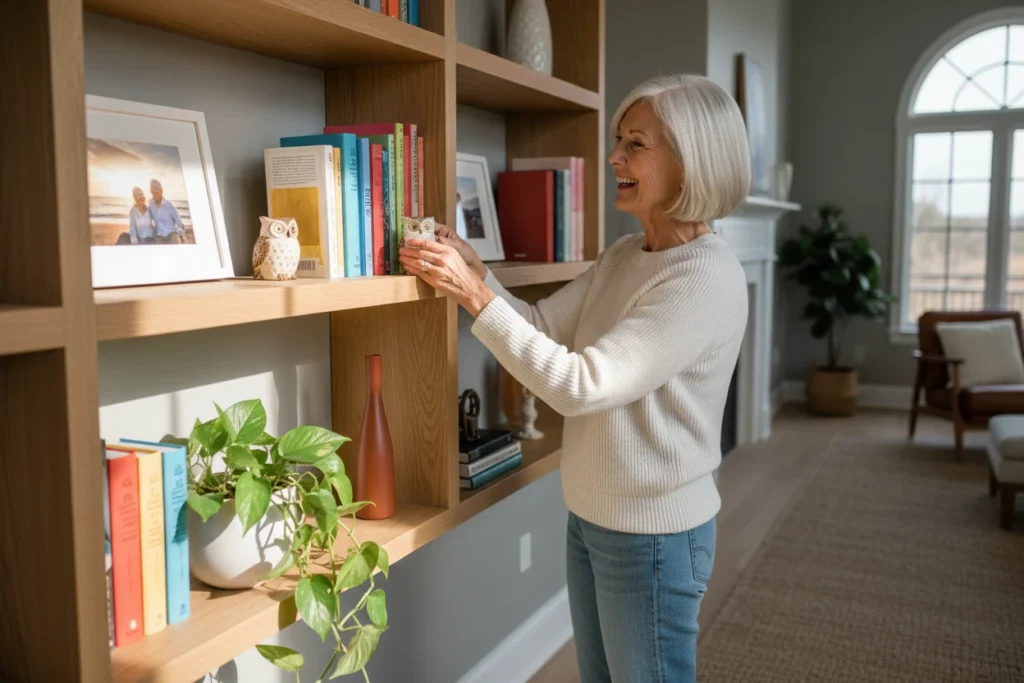
- Mix in pieces with real meaning: travel finds, family photos, an object that makes you smile every time you walk past it
In my own living room, I used to have a full gallery wall of random prints. It was fun but visually loud. Now I have one oversized piece I really love, plus a few smaller things on shelves, and the whole room feels calmer and more grown-up — without losing “me” in the process.
You want your decor to spark little “oh, that’s so you” moments. Not “oh, this entire aisle from HomeGoods” vibes. There’s a difference, and you can feel it the moment you walk in.
Flooring: Literally Grounding Your Space
Flooring isn’t as exciting to shop for as pillows or lamps, but it quietly sets the tone for everything else — and it has a huge impact on how contemporary your home feels.
Some reliable options that work beautifully:
- Wide-plank hardwood in light to medium tones — oak is a classic for good reason
- Engineered wood or luxury vinyl plank for durability and budget-friendliness
- Large-format tile with minimal grout lines for a sleek, seamless look
I swapped old beige carpet for wide-plank engineered oak in my place, and it immediately made everything feel brighter and more intentional. Same furniture, same layout — totally different atmosphere. It’s one of those changes that makes you wonder why you waited so long.
For retirees, flooring also has a practical dimension worth considering: slip-resistant finishes, low-pile rugs with non-slip backing, and smooth transitions between rooms all contribute to a safer home without compromising the look. Layer in area rugs that echo your color palette and add texture. Contemporary home decorating ideas rarely rely on wall-to-wall pattern — instead, they let the main floor stay simple and use rugs as flexible design tools you can swap as your style evolves.
Mixing Styles: Contemporary Doesn’t Mean Rigid
Here’s a fun twist: some of the best home decorating ideas come from mixing styles. Contemporary is adaptable. It plays well with others — which, honestly, is a quality worth celebrating in both design and people.
A few combos that work really well:
- Contemporary + Scandinavian: light wood, cozy textiles, soft neutrals
- Contemporary + Industrial: exposed brick, metal accents, concrete elements
- Contemporary + Boho: a clean base with layered textiles, plants, and collected pieces
- Contemporary + Traditional: streamlined architecture with a few classic furniture shapes
My own place is probably 70% contemporary, 20% Scandinavian, 10% “things I dragged home from vintage shops because they made me weirdly happy.” The contemporary backbone — color palette, clean lines, consistent lighting — keeps it from looking chaotic, while the mixed elements keep it from feeling like a furniture catalog.
When you mix styles, keep asking: does this still feel cohesive? If something you love is throwing the room off, try moving it to a different space where it can be the star instead of shouting over everything else.
Budget-Friendly Home Decorating Ideas for Retirees
There’s a myth that contemporary interiors require designer everything and a second mortgage. Not true. In some ways, these home decorating ideas are actually easier on the budget because they value fewer, better-chosen pieces over a ton of filler.
Some budget-friendly strategies that genuinely work:
- Paint: still the cheapest, highest-impact change you can make
- Decluttering: completely free and instantly more contemporary
- Thrifting and Facebook Marketplace for solid-wood pieces and accent chairs
- Mixing high and low: invest in your sofa and mattress, save on side tables and decor
- Swapping hardware: changing cabinet pulls and doorknobs to a modern finish costs almost nothing and looks like a renovation
I once helped a friend update her very “early 2000s” living room without buying new furniture. We painted the walls, changed out the yellowed light fixtures, added a large neutral rug, and edited her accessories. The whole room jumped a decade forward for less than the cost of a new TV. She cried a little. I’m not ashamed to say I was proud.
Focus your budget on the things you touch and see daily — sofas, dining chairs, bedding, main lighting — and let everything else quietly support the look.
Sustainable Choices That Fit Naturally Into Contemporary Style
One of the nice things about contemporary home decorating is how well it pairs with sustainability. When you’re already trying to buy less but better, and you’re drawn to natural materials, you’re accidentally doing the planet a favor.
Sustainable moves that fit perfectly with these home decorating ideas:
- Choosing solid or engineered wood instead of disposable particleboard when possible
- Buying vintage or secondhand furniture and having it refinished or reupholstered
- Using low-VOC paints for better indoor air quality
- Opting for wool, cotton, or jute rugs over synthetic fibers
- Installing LED bulbs in all those layered lights
One of my favorite pieces at home is a vintage wooden sideboard I found at a local shop. It has more character than anything I could’ve ordered new, and it’s been sturdy longer than I’ve been alive. That’s sustainability with serious style — and a story worth telling when someone asks about it at a dinner party.
Common Home Decorating Mistakes (I’ve Made Most of These)
Since we’re friends now, let’s talk about the landmines.
A few mistakes I see all the time — and have personally committed, some more than once:
- Going so minimal the room feels empty instead of intentional
- Choosing furniture that looks great but is miserable to sit on
- Relying on just one overhead light in each room
- Ignoring storage and hoping clutter will magically organize itself
- Mixing too many metal finishes and wood tones without a plan
- Copying a Pinterest room that doesn’t fit your actual lifestyle
The fix is rarely “start over.” It’s usually a series of small course corrections — add a lamp here, swap a rug there, donate a few extra accent pieces, bring in one plant, hang the curtains higher. Contemporary style is forgiving as long as you’re willing to tweak. And tweaking, honestly, is half the fun.
Bringing It All Together: Home Decorating Ideas That Feel Like You
At the end of the day, the best home decorating ideas for retirees are the ones that make your home feel more like you — just with better lighting and less visual noise.
If you remember nothing else, remember this:
- Start with a calm, cohesive base — color palette, flooring, main furniture
- Layer in texture so the space feels warm, not cold
- Use lighting like a dimmer-controlled superpower
- Give yourself storage so you can actually maintain the look
- Add personality with art, accessories, and a few rule-breaking choices
You don’t have to do it all at once. Pick one room, then pick one or two changes from this list. Paint a wall. Replace a light. Add a rug that actually fits the space. Buy one plant you promise to keep alive — and then actually keep it alive. That last part matters more than you’d think.
The most beautiful homes I’ve seen aren’t perfect. They evolve. They have a few quirks and “we’re still figuring that corner out” moments. But they feel calm, current, and deeply lived-in. And for retirees who are finally home enough to really enjoy their space, that’s not just a decorating goal — that’s a quality-of-life goal.
For more on building a retirement lifestyle that feels intentional in every room — not just the ones you decorate — this guide on retirement lifestyle planning is a natural next read.
That’s the goal: a home that looks like it belongs in the present — and feels like it belongs to you.