

Best Places for African Americans to Retire Abroad: Safe, Affordable, and Fulfilling Destinations
Discover the best places for African Americans to retire abroad — from Portugal’s sun-drenched coastlines to Costa Rica’s lush valleys — with honest visa info, real costs, and community insights from people who’ve actually done it.
Okay, real talk for a second.
You’ve spent decades showing up. Clocking in early, staying late, raising kids, taking care of parents, being the dependable one — for your family, your community, your workplace. And now retirement is either here or it’s close enough that you can smell it. So the question isn’t just when you retire. It’s how you retire. And more importantly — where.
Because here’s something a lot of people don’t say out loud: the traditional American retirement dream? It’s gotten expensive. Like, really expensive. And for a lot of African American retirees who’ve spent their careers navigating a system that wasn’t always designed with them in mind, the idea of packing up and starting fresh somewhere new — somewhere warmer, cheaper, slower, and genuinely welcoming — isn’t just appealing. It feels like justice.
I’ve been deep in this research for a while now. I’ve talked to retirees who made the leap. I’ve read the forums, crunched the numbers, and yes, I’ve done my fair share of daydreaming too. And what I found is this: the best places for African Americans to retire abroad aren’t some well-kept secret for the wealthy or the adventurous. They’re real, accessible, and waiting for people who are ready to stop settling for “fine” and start building something genuinely great.
So grab your coffee. Let’s talk about it.
Why So Many African Americans Are Saying “See You Later” to the U.S.

Let’s start with the numbers, because they tell a story that’s hard to ignore.
According to a 2023 Federal Reserve report, the median retirement savings for Americans aged 55–64 is around $185,000. That sounds okay until you do the math and realize that money might need to last 25 to 30 years. Suddenly it’s not so comfortable. And for African Americans specifically, the racial wealth gap — documented extensively by the Brookings Institution — means that many Black retirees are working with less cushion than their white counterparts, not because of personal choices, but because of decades of systemic barriers to homeownership, banking, and wealth accumulation. That’s not a personal failure. That’s history. But it does mean that every retirement dollar needs to work harder.
Moving abroad can be one of the smartest ways to make that happen. Countries like Portugal, Costa Rica, and Mexico can offer a quality of life that rivals — and in some ways surpasses — what you’d get in most American cities, at 40 to 60 percent of the cost. The same Social Security check that barely covers rent in a mid-sized U.S. city can fund a genuinely comfortable, full life in Lisbon or the Costa Rican highlands.
But honestly? The financial case, as compelling as it is, isn’t even the whole story.
I keep coming back to something the late Toni Morrison said about the experience of being in spaces where your Blackness isn’t the first thing people respond to. That idea — of just being a person, not a symbol or a statistic or someone who has to work twice as hard to be seen as half as worthy — resonates deeply with so many African American retirees who’ve moved abroad. I’ve read their essays, their blog posts, their forum comments. The word that comes up over and over again isn’t “cheap” or “warm” or even “beautiful.” It’s free.
That’s worth paying attention to.
Key Takeaways: What You Need to Know Before You Start Planning
- The best places for African Americans to retire abroad combine real safety, genuine affordability, quality healthcare, and cultural openness — not just one or two of those things
- Portugal, Costa Rica, Mexico, and Malaysia consistently rise to the top for good reason
- Most retirement visas require proof of age (typically 50–55+), steady monthly income, and valid health insurance coverage
- U.S. Medicare does not cover you outside the United States — full stop — so international health insurance isn’t optional, it’s essential
- U.S. citizens must still file federal tax returns on worldwide income even when living abroad, but credits and exclusions can significantly reduce what you actually owe
- Expat hubs like San Miguel de Allende in Mexico and Portugal’s Algarve region have active, diverse social scenes that make building a real community surprisingly doable
- Visiting your top destinations for at least two to four weeks before committing is one of the best investments you’ll ever make — in time and money
The Best Places for African Americans to Retire Abroad, Broken Down Honestly

Portugal: The One That Keeps Surprising People
I want to tell you about a woman I’ll call Denise. She spent 30 years as a school administrator in Baltimore — the kind of job that’s equal parts meaningful and exhausting. She retired at 63 and moved to Lisbon on what she described as “a hunch and a prayer.” Six months later, she called her sister back home and said something that stopped me cold when I read it: “I walk down the street here and nobody’s watching me. I’m just a woman going to get her bread.”
That’s Portugal in a nutshell. It’s not flashy about its welcome. It doesn’t make a big production of being inclusive. It just… is. And for a lot of African American retirees, that quiet normalcy is more valuable than any tax incentive.
Beyond the emotional resonance, Portugal makes practical sense in almost every way. Lisbon is one of Europe’s most walkable, livable cities — gorgeous architecture, world-class food, a café culture that will absolutely ruin you for office break rooms, and a creative energy that draws artists, writers, and retirees from all over the world. The Algarve region in the south is where many retirees eventually land, drawn by dramatic Atlantic coastlines, reliable sunshine, and an international community that makes it genuinely easy to build a social life from scratch. I’ve heard from retirees who arrived knowing nobody and had a full calendar within three months. The community there is that welcoming.
What you’ll spend: A couple can live comfortably in Portugal for roughly $2,500–$3,500 per month. Lisbon and Porto run higher; smaller towns and the interior are significantly more affordable. Either way, you’re getting considerably more for your money than you would in most Western cities.
Healthcare: Portugal’s National Health Service — the SNS — is available to legal residents and is genuinely solid. Not perfect, but solid. Most expats supplement it with private insurance, which runs about $100–$200 per month for comprehensive coverage. To put that in perspective: that’s less than a lot of Americans pay for a gym membership they stopped using in February.
The visa: Portugal’s D7 Passive Income Visa was practically built for retirees. You need to show proof of regular income — pension, Social Security, investment returns — of roughly €760 per month per person. It’s one of the most straightforward retirement visa pathways in Europe, and the process, while not instant, is manageable with a little patience and the right immigration attorney.
Safety: Portugal consistently ranks in the top 10 on the Global Peace Index — one of the most credible measures of national safety in the world. Violent crime is genuinely rare. The atmosphere is relaxed and unhurried in a way that doesn’t feel forced.
Diversity: Lisbon has a growing African diaspora community — Cape Verdean, Angolan, Mozambican — that gives the city a cultural texture many African American retirees find both familiar and fascinating. You’re not going to feel like the only Black person in the room. And if you’ve spent your whole life being the only one in the room, you know exactly why that matters.
Costa Rica: Pura Vida Isn’t Just Something They Say
“Pura vida.” Pure life. Costa Ricans use it as a greeting, a farewell, a response to “how are you doing,” and an all-purpose expression of contentment. The first time I heard someone say it in response to a delayed bus — just a shrug and a smile and pura vida — I laughed. By the end of the week, I completely understood it. By the end of the month, I was saying it myself.
Costa Rica has been attracting American retirees for decades, and it remains one of the best places for African Americans to retire abroad for a reason that’s both simple and profound: it actually delivers on what it promises. The country is stable, democratic, and has maintained no standing army since 1948 — a fact that still surprises people and says a lot about where national priorities lie. It’s also one of the most biodiverse places on Earth, which means your morning walk might include a sloth sighting. I’m not being poetic. That genuinely happens.
I spoke with a retired nurse from Houston — I’ll call her Gloria — who chose Costa Rica after visiting five different countries over two years. “I kept waiting to find the catch,” she told me. “The thing that would make me say, okay, this isn’t for me. I never found it.” She’s been in the Central Valley for four years now and has more friends than she’s had at any point in her adult life. “People here actually have time for each other,” she said. “That’s the pura vida thing. It’s not a slogan. It’s how they actually live.”
What you’ll spend: A comfortable retirement lifestyle in Costa Rica runs about $2,000–$3,000 per month for a couple. The Central Valley tends to be more affordable. Beach towns like Tamarindo and Manuel Antonio are pricier — but even those are dramatically cheaper than comparable coastal living in the U.S.
Healthcare: This is where Costa Rica genuinely earns its reputation. The country’s public healthcare system — the Caja — is available to legal residents and is consistently rated among the best in Latin America. The Johns Hopkins Bloomberg School of Public Health has cited Costa Rica as a model for healthcare efficiency in the developing world. That’s not a small endorsement. Private hospitals in San José are modern, well-staffed, and affordable by any standard you care to apply.
The visa: The Pensionado visa requires proof of at least $1,000 per month in pension income — one of the most accessible retirement visa thresholds anywhere in the world. It also comes with real, tangible perks: discounts on entertainment, healthcare services, and public transportation. The government is genuinely trying to attract retirees, and the visa structure reflects that.
The community: The Association of Residents of Costa Rica (ARCR) has been supporting expat retirees for decades. They host events, provide legal guidance, and maintain a network of regional chapters throughout the country. If you’re nervous about making the transition alone, Costa Rica is probably your lowest-risk option for landing somewhere with a ready-made support system.
Mexico: Closer Than You Think, Better Than You’ve Been Told
Mexico gets a bad reputation in certain media circles that simply doesn’t match the lived reality of the hundreds of thousands of Americans who call it home and love it. The country is enormous — geographically, culturally, culinarily — and painting it with a single brush is like saying “the U.S. is dangerous” because of crime statistics in a handful of cities. Technically defensible. Wildly misleading.
For African American retirees who want to stretch their dollars and stay close enough to fly home for a grandchild’s birthday without spending a fortune on airfare, Mexico is genuinely hard to beat. It’s a short, cheap flight from most U.S. cities. The food is extraordinary — and I will go to the mat on that — and the cost of living is among the lowest of any popular retirement destination.
San Miguel de Allende deserves special mention. It’s a UNESCO World Heritage city in the central highlands — cobblestone streets, colonial architecture, a thriving arts scene, and an expat community that is one of the most vibrant and genuinely diverse I’ve ever come across. The number of African American retirees who’ve made San Miguel home has grown noticeably in recent years, and the community there has a warmth and inclusivity that you feel within about 48 hours of arriving. One retiree I spoke with — a former teacher from Atlanta — described it as “the first place I’ve ever lived where I felt like I could just exhale.” She’s been there seven years and has no plans to leave.
What you’ll spend: A couple can live very well in Mexico for $1,500–$2,500 per month. Even in popular expat towns, you’re spending dramatically less than you would in most U.S. cities.
Healthcare: Private hospitals in major cities and expat hubs are modern, well-equipped, and staffed by English-speaking doctors who often trained in the U.S. or Europe. Many American retirees pay out of pocket for private care and still spend a fraction of what they’d pay stateside. Dental work in Mexico, in particular, is famously affordable — people routinely get high-quality work done for 20 percent of U.S. prices and come back with better results than they expected.
The visa: Mexico’s Temporary Resident Visa requires proof of income of roughly $1,620 per month or a qualifying lump sum in savings. It’s accessible for most retirees with Social Security and pension income, and it comes with a clear, well-established path to permanent residency.
Malaysia: The One Most People Sleep On
Okay, I’ll admit it — Malaysia wasn’t on my radar when I started this research. It should have been. Kuala Lumpur is a genuinely world-class city with modern infrastructure, an extraordinary food scene drawing from three distinct culinary traditions (Malay, Chinese, and Indian), and a cost of living that makes most Western retirees do a slow, disbelieving double-take.
What you’ll spend: A couple can live comfortably in Kuala Lumpur for $1,500–$2,200 per month, including rent in a nice apartment in a good neighborhood. That’s not roughing it. That’s a genuinely comfortable, full life in a cosmopolitan city.
Healthcare: Malaysia’s private healthcare system is internationally accredited and excellent. Medical tourism is a major industry there, which means hospitals are well-equipped, English-speaking staff are widely available, and the standard of care is high. It consistently appears on lists of the best countries for medical care abroad, and the reputation is earned.
The visa: Malaysia My Second Home (MM2H) is the country’s long-stay program for retirees. Requirements have been updated in recent years with higher financial thresholds, so check the latest official guidelines before starting the application process.
Diversity: Malaysia’s multicultural makeup — a genuine, lived blend of Malay, Chinese, Indian, and other communities — means that people of African descent generally report feeling less conspicuous than in more homogeneous countries. English is widely spoken. It’s not the first place most people think of, but for retirees who are open to Southeast Asia and want something genuinely different, it’s worth serious consideration.
The Practical Stuff Nobody Puts in the Brochure
Healthcare: Handle This Before You Book Anything
I’ll say it again because it bears repeating: U.S. Medicare does not cover you outside the United States. Not in Portugal. Not in Costa Rica. Not anywhere. Before you make any permanent decisions, you need a healthcare plan that actually works where you’re going. Most retirees abroad use a combination of international health insurance — Cigna Global, Allianz Care, and Aetna International all offer solid plans — and local coverage once they establish residency. Budget $150–$400 per month depending on your age and coverage needs. It’s a real cost, but it’s manageable — and it’s a lot less terrifying than being uninsured in a foreign country and hoping nothing goes wrong.
Taxes: Uncle Sam Has a Long Memory
Here’s the part of the expat dream that doesn’t make it into the Instagram posts: U.S. citizens are required to file federal tax returns on worldwide income, no matter where they live. You can move to a terrace overlooking the Atlantic and Uncle Sam will still be in your inbox come April. That said, tools like the Foreign Earned Income Exclusion (FEIE) and Foreign Tax Credits can significantly reduce your actual tax liability. Work with a tax advisor who specializes in expat taxation — this is genuinely not the time for TurboTax and a prayer. Organizations like American Citizens Abroad (ACA) and expat-focused tax firms are worth every penny of their fees.
Language: A Little Goes a Long Way
You don’t need to be fluent. But learning even basic conversational Spanish or Portuguese will change your daily experience in ways that are hard to overstate. It changes how locals see you. It changes how you feel about yourself in your new home. It’s the difference between being a tourist and being a resident. Apps like Duolingo are a fine starting point, but a local language class or a conversation partner will get you further faster. Most expat communities offer language exchange programs — and they’re one of the best ways to meet people who aren’t just other Americans.
Safety: Be Specific, Not General
Safety looks different in every destination, and it changes neighborhood by neighborhood. Before committing to any location, spend real time on expat forums like Expats.com, InterNations, and country-specific Facebook groups. Talk to people who actually live there — not people who visited once and have opinions. Visit for at least two to four weeks before making any permanent decisions. Once you arrive, register with the U.S. Embassy. It’s free, takes ten minutes, and gives you access to emergency alerts and assistance if you ever need it.
Building Your Social Life: The Thing That Actually Makes or Breaks It
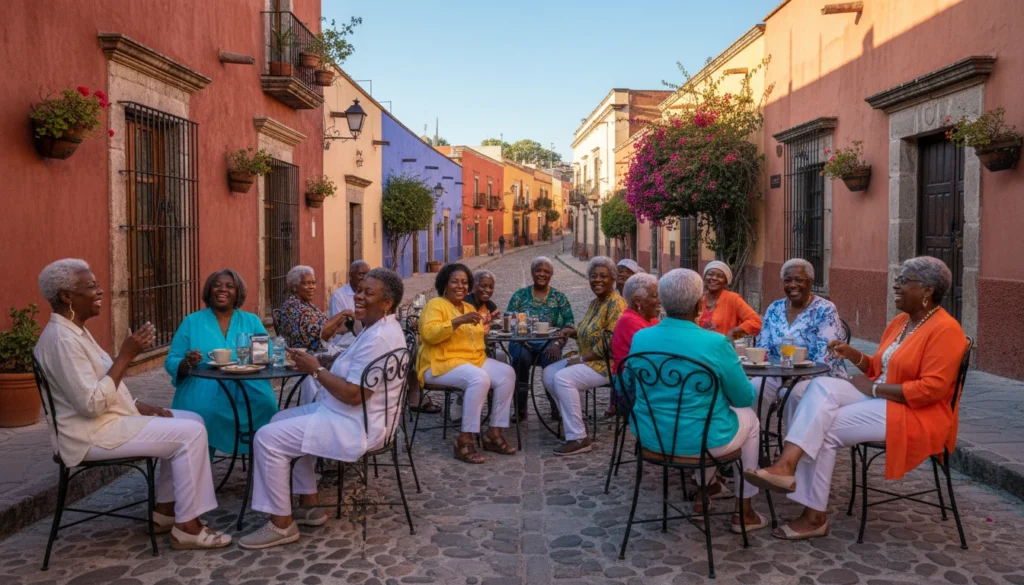
Here’s something I wish more retirement guides were honest about: the loneliness that can sneak up on you if you’re not intentional about building community abroad. The visa paperwork is manageable. The healthcare logistics are solvable. But showing up in a new country without a social network is genuinely hard, and it catches a lot of people off guard — even people who are naturally outgoing.
The good news is that the expat communities in the best retirement destinations are remarkably welcoming to newcomers, especially people who show up with curiosity and openness. In San Miguel de Allende, there are weekly meetups, art walks, cooking classes, and volunteer programs that can fill your calendar within weeks of arriving. In Portugal’s Algarve, hiking groups, cultural associations, and social clubs draw retirees from across Europe and North America. Costa Rica’s ARCR has regional chapters throughout the country and hosts regular events specifically designed to help newcomers connect.
For African American retirees specifically, online communities like “Black Expats” on Facebook and platforms like Expat Exchange have grown significantly in recent years. These spaces connect people who share both the expat experience and a cultural identity — and they’re invaluable, not just for practical advice, but for the simple, human reassurance that you’re not doing this alone. Because you’re not. There are thousands of people who’ve already made this move and are living proof that it works beautifully.
So How Do You Actually Choose?
Choosing among the best places for African Americans to retire abroad comes down to being honest with yourself about what you actually need — not what sounds good in theory, but what will genuinely make you happy day to day. Here are the questions worth sitting with:
- Budget: How much do you have to work with monthly? Mexico and Malaysia offer the lowest costs; Portugal and Costa Rica offer slightly higher costs with stronger infrastructure and more established expat support systems.
- Healthcare needs: Do you have ongoing medical needs that require specialist care? Costa Rica and Portugal have the most robust healthcare systems on this list.
- Climate: Do you want mild, four-season weather (Portugal), tropical warmth year-round (Costa Rica, Malaysia), or regional variety (Mexico)?
- Community: Do you want a large, established expat community where you’ll never be short of social options (Mexico, Costa Rica), or a more immersive local experience (Portugal, Malaysia)?
- Proximity to family: If staying close to the U.S. matters — and for a lot of people, it really, genuinely does — Mexico and Costa Rica win on flight time and cost, no contest.
There’s no universally right answer. There’s only the right answer for you. And the best way to find it is to visit, talk to people who’ve already made the move, and trust your gut more than you trust any article — including this one.
Conclusion: The Best Chapter Might Be the One You Write Somewhere Else
Here’s what I keep coming back to after all of this research, all these conversations, all these late nights reading expat forums and cost-of-living calculators and personal essays from people who took the leap: retiring abroad isn’t a backup plan. It’s not what you do when things didn’t work out. For a growing number of African American retirees, it’s the main event — the thing they worked toward, planned for, and ultimately chose with their eyes wide open.
The best places for African Americans to retire abroad — Portugal, Costa Rica, Mexico, Malaysia — aren’t consolation prizes. They’re real, vibrant, life-expanding options for people who decided they wanted more from their retirement years than the default script offers. More freedom. More color. More connection. More mornings with nowhere to be and no one watching.
You’ve worked hard for this. You’ve earned it. And if the life you’ve been quietly imagining happens to be on a cobblestone street in Lisbon, or a hillside in Costa Rica, or a sun-drenched plaza in San Miguel de Allende — well, that sounds less like a dream and more like a plan.
Do your research. Visit before you commit. Build your community with intention. And please, don’t let anyone convince you that the best years are behind you.
Because from everything I’ve seen? They’re just getting started.
Thinking about making the move? Drop your questions in the comments — or find your people in expat communities online. The folks who’ve already done it are almost always the most generous with their time and advice. And they’ll probably tell you the same thing: they just wish they’d done it sooner.






2 Comments
Comments are closed.