

Which Is Better: A Federal Retiree Plan or Medicare Part B? A Real-World Comparison for Retirees
Trying to figure out which is better: a federal retiree plan or Medicare Part B? Here’s a clear, honest breakdown to help you decide without the headache.
There’s a specific kind of overwhelm that hits federal retirees when they finally sit down to figure out their health coverage. It’s not like regular confusion. It’s the kind where you’ve read the same paragraph four times, you’re pretty sure you understood it the first time, and somehow you understand it less now than when you started.
I watched my uncle go through it. Thirty-two years with the postal service, a man who sorted mail through blizzards and never once complained — completely undone by a stack of insurance brochures on a Tuesday afternoon. He had three folders open, a highlighter in each hand, and the look of someone who had just realized that retirement might actually require a law degree.
“Just tell me which one is better,” he said. “The federal plan or Medicare Part B. Someone has to know.”
I didn’t have a great answer for him that day. But I went and found one. And then I kept digging, because it turns out this question — which is better, a federal retiree plan or Medicare Part B — is one of the most important financial decisions a federal retiree makes, and most people are making it with incomplete information, outdated advice, or a Google search that led them to a government PDF written in 2011.
So here’s the version I wish my uncle had. Written like a person. For people.
These Two Plans Are Not the Same Thing — and That’s the Whole Point
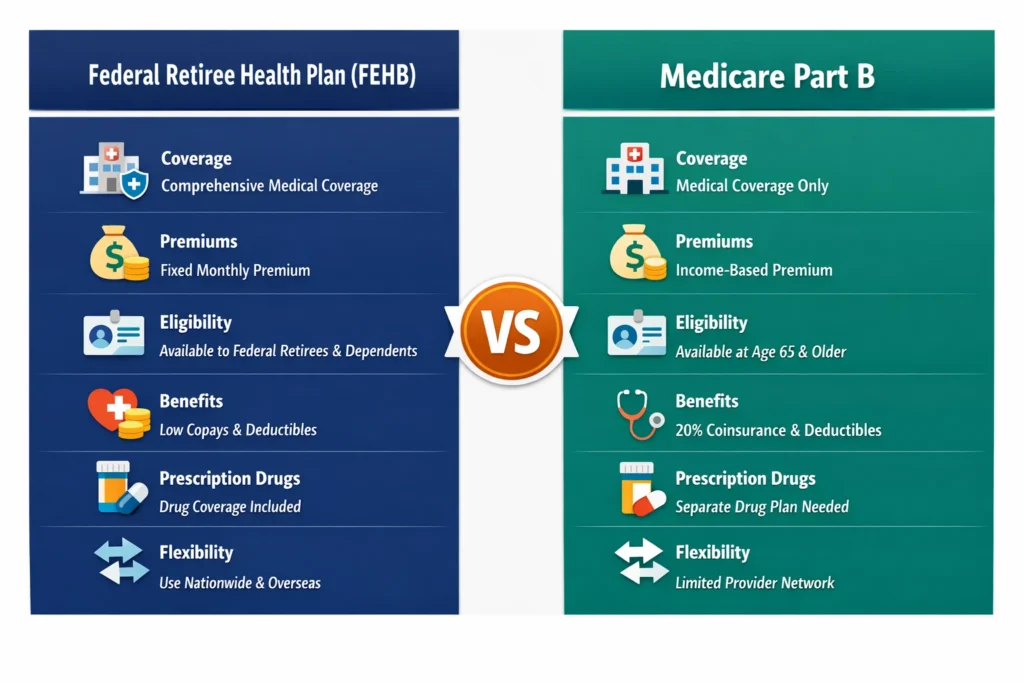
The first thing worth understanding is that you’re not really comparing two identical products. It’s more like comparing a full-service hotel to a really excellent airline. Both get you somewhere. Both have real value. But they’re built for different purposes, and the “better” one depends entirely on where you’re trying to go.
Federal Retiree Health Benefits — offered through the Federal Employees Health Benefits (FEHB) Program — are employer-sponsored plans for retired federal employees. The Office of Personnel Management runs the whole operation, and these plans are genuinely comprehensive. Medical coverage, yes — but also often dental and vision, which Medicare quietly leaves out and hopes you won’t notice until you’re staring at a $1,400 dental bill wondering what happened.
Medicare Part B is the outpatient side of Medicare — the federal program most Americans become eligible for at 65. It covers doctor visits, preventive screenings, outpatient hospital services, and durable medical equipment. It’s solid, it’s widely accepted, and it gives you access to an enormous network of providers across the country. What it doesn’t cover — routine dental, vision, hearing aids — are exactly the things that tend to get more expensive and more necessary as you get older.
So right away, you’re not comparing apples to apples. You’re comparing a comprehensive employer plan to a focused government outpatient program. Both have genuine value. The question is which one — or which combination — actually fits your life.
Key Takeaways (For the Skimmers — You Know Who You Are)
- Federal Retiree Plans typically cover medical, dental, and vision — often with capped out-of-pocket costs that give you real financial predictability
- Medicare Part B focuses on outpatient care and preventive services, with broad nationwide provider access
- Part B carries a standard monthly premium of $174.70 in 2024, a $240 deductible, and 20% coinsurance — with no annual spending cap
- Federal retiree plans vary, but most offer more predictable costs and lower financial exposure overall
- You can — and many retirees do — carry both, with Medicare paying first and FEHB covering the rest
- Missing enrollment windows for either plan can mean penalties or permanent gaps in coverage
- The right answer depends on your health, your budget, and what you actually value day-to-day
Which Is Better: A Federal Retiree Plan or Medicare Part B?
What Medicare Part B Covers — and What It Quietly Skips

Medicare Part B is the outpatient workhorse of the Medicare system, and it genuinely does its job well. Here’s what you’re getting:
- Doctor visits — primary care and specialists
- Outpatient hospital services — procedures that don’t require an overnight stay
- Preventive services — annual wellness visits, cancer screenings, flu shots, and more
- Durable medical equipment — wheelchairs, walkers, CPAP machines, oxygen equipment
- Some home health care — under specific qualifying conditions
- Mental health services — outpatient therapy and counseling
That’s a solid list. But here’s what Part B quietly leaves off: routine dental care, vision exams, hearing aids, and most prescription drugs. If you wear glasses, need a crown, or take a handful of daily medications — and honestly, by retirement age, most of us are somewhere on that list — Part B alone is going to leave some real, expensive gaps.
I had a conversation once with a retired federal employee named Carol who had gone with Medicare Part B only, thinking she’d save money on premiums. She did — until she needed two crowns and a new pair of progressive lenses in the same year. “I saved about $80 a month on premiums,” she told me, “and then spent $3,000 in six months on things Medicare didn’t touch.” That’s the kind of math that sneaks up on you.
Who Can Get Medicare Part B?
Most people become eligible at 65. If you’re already collecting Social Security, you’re typically enrolled automatically. If not, you’ll need to sign up during your Initial Enrollment Period — a seven-month window that opens three months before your 65th birthday.
Here’s where people get genuinely burned: if you delay enrolling in Part B without having qualifying coverage elsewhere, you could face a late enrollment penalty — a permanent 10% premium increase for every 12-month period you were eligible but didn’t sign up. And when I say permanent, I mean it follows you for the rest of your time on Part B. It doesn’t age out. It doesn’t forgive and forget. It just quietly inflates your premium every single month, forever, like a financial grudge that never lets go.
Don’t let that be you.
Federal Retiree Health Benefits — What They Are and Whether You Qualify

Federal Retiree Health Benefits through the FEHB Program are, in my honest opinion, one of the most underappreciated perks of a federal career. Most people spend their working years vaguely aware that they have “good benefits” without fully understanding just how good — and then they retire and finally start paying attention.
To qualify, you generally need to:
- Have retired under a federal retirement system like CSRS or FERS
- Have been enrolled in FEHB for the five years immediately before retirement — or since your first opportunity to enroll
- Be receiving an annuity from OPM
If those boxes are checked, you have access to a wide menu of plan options — HMOs, PPOs, high-deductible plans, consumer-driven options — all through OPM’s annual Open Season. And here’s the part that often surprises people: the government continues to pay a portion of your premium even after you retire. That’s not a small thing. When you see what private retiree coverage costs on the open market, that government contribution starts to feel like a gift you didn’t fully appreciate until now.
What Do These Plans Actually Cover?
Most FEHB plans include:
- Hospital and inpatient care
- Outpatient services and specialist visits
- Preventive care
- Prescription drug coverage
- Dental and vision — either built into the plan or available through the Federal Employees Dental and Vision Insurance Program (FEDVIP)
That dental and vision piece is worth pausing on, because it’s genuinely significant. Medicare doesn’t cover routine dental or vision — full stop. But many federal retiree plans do. I’ve talked to retirees who saved thousands in a single year just from the dental coverage their FEHB plan provided. One woman had two crowns and a root canal in the same calendar year — and her out-of-pocket was a fraction of what it would have been without FEHB. That’s not a hypothetical. That’s a real person’s real year, and her coverage made it survivable.
The Money Part — Because That’s Really What This Is About
Nobody loves the cost breakdown section. I get it. But this is genuinely where the decision gets made, so let’s walk through it together and I promise to keep it as painless as possible.
What Medicare Part B Will Cost You
- Monthly premium (2024): $174.70 — though higher-income retirees pay more through IRMAA adjustments
- Annual deductible (2024): $240
- Coinsurance: 20% of Medicare-approved costs after the deductible — with no out-of-pocket maximum
That last point is the one that deserves a second read. Medicare Part B has no cap on what you could spend in a year. None. If you have a serious illness, need surgery, or end up with a complicated diagnosis that requires multiple specialists, those 20% coinsurance charges can pile up fast. A $100,000 medical event — which is not as rare as we’d like to think — could leave you with $20,000 in out-of-pocket costs. That’s a real number. That’s a car. That’s a year of mortgage payments. That’s the kind of bill that changes retirement plans.
What Federal Retiree Plans Will Cost You
This varies depending on which FEHB plan you choose, but the general picture looks like this:
- Premiums are competitive, and the government still chips in even after you retire
- Deductibles vary by plan type — some are quite low
- Out-of-pocket maximums are typically defined and capped
A study published in Health Plan Choices of Retirees Under Managed Competition (Buchmueller, 2000) found that price and cost-sharing structures significantly influence how retirees choose health plans. Which makes complete sense — when you’re living on a fixed income, knowing your worst-case annual spending is capped at a specific number isn’t just a nice feature. It’s the difference between sleeping well at night and lying awake doing math in your head at 2 a.m.
Can You Have Both? Yes — and Here’s Why It Might Be Your Best Move
This is the part that genuinely surprises most people, so I want to say it clearly: you don’t have to choose. Many federal retirees carry both FEHB coverage and Medicare Part B at the same time, and when the two plans coordinate properly, the financial protection can be remarkable.
Here’s how it works:
- Medicare pays first as the primary payer for covered services
- Your FEHB plan pays second, picking up some or all of what’s left
Some FEHB plans waive their deductibles and cost-sharing entirely when Medicare is the primary payer. I’ve heard retirees describe their dual-coverage setup as “basically free healthcare” — which is a slight exaggeration, but honestly, only a slight one. The coordination between these two plans, when it works well, is one of the most powerful financial tools available to federal retirees. It’s the kind of thing that makes you wish someone had explained it to you ten years earlier.
The trade-off is real, though: you’re paying two sets of premiums. Whether that math works in your favor depends on how much care you actually use. For healthy retirees who rarely see a doctor, carrying both might feel like paying for a gym membership you never use. For retirees managing chronic conditions or expecting significant medical needs, the dual coverage can be a genuine lifesaver — financially and otherwise.
A 1968 analysis in Medicare and Federal Employees Health Benefits Programs: Their Coordination noted that retired federal employees don’t all share the same situation regarding Medicare eligibility — which helps explain why the coordination rules can feel so convoluted even today. Some things, apparently, are immune to simplification. But understanding the basics puts you miles ahead of most people walking into this decision.
Which Is Better for Your Actual Life? Let’s Get Specific
Here’s where I stop talking in generalities and start talking about real situations — because the right answer looks different depending on who you are.
You’re Managing Chronic Conditions or Complex Health Needs
Federal retiree coverage — especially paired with Medicare Part B — is almost certainly your best move. The combination of comprehensive benefits, capped out-of-pocket costs, and prescription drug coverage provides the kind of protection that matters most when you’re managing ongoing health issues. The financial predictability alone is worth a lot when you’re already dealing with enough.
You’re Healthy and Watching Every Dollar
You might genuinely question whether carrying both plans is worth the dual premiums. Some retirees in excellent health keep their FEHB plan and delay or skip Part B enrollment if they have qualifying coverage — though this requires careful planning to avoid future penalties. It’s a calculated risk that can pay off, but please, run the actual numbers before you decide. Guessing is expensive.
You Want the Freedom to See Any Doctor, Anywhere
Medicare Part B gives you access to any provider who accepts Medicare — and that’s a massive, nationwide network. If you travel frequently, split time between states, or simply want the freedom to see any specialist without referrals or network restrictions, Part B’s broad access is a real, meaningful advantage. I know retirees who spend winters in Arizona and summers in Maine, and for them, the nationwide network isn’t a nice-to-have — it’s the whole point.
Dental and Vision Are Non-Negotiable for You
Federal retiree plans win this one, and it’s not particularly close. Medicare doesn’t cover routine dental or vision — period. And those costs in retirement can be substantial. We’re talking hundreds to thousands of dollars a year depending on your needs. If keeping your teeth and eyes in good shape is a priority — and it should be, because both get more expensive to fix the longer you wait — FEHB coverage paired with FEDVIP is the smarter, more complete choice. Full stop.
Enrollment Deadlines: The Part Nobody Thinks About Until It’s Too Late
I want to be direct here because I’ve seen people get genuinely hurt by this: enrollment timing matters enormously, and missing a window can have consequences that follow you for years — sometimes decades.
Medicare Part B Enrollment
- Initial Enrollment Period: 7 months centered on your 65th birthday — 3 months before, the month of, and 3 months after
- Special Enrollment Period: Available if you delayed Part B because you had qualifying employer coverage
- General Enrollment Period: January 1 – March 31 each year, but late penalties apply if you missed your initial window
Federal Retiree Plan Enrollment
- Enrollment is tied to your retirement date and OPM rules
- Open Season runs annually — typically mid-November through mid-December — for plan changes
- Missing your initial enrollment window can mean losing FEHB coverage permanently
Put these dates somewhere you’ll actually see them. Phone reminders, calendar alerts, a sticky note on the fridge next to the grocery list — whatever works for you. Future-you, the one who isn’t scrambling to fix a coverage gap at 67, will be genuinely, deeply grateful.
What the Research Actually Says — and Why It Matters
The Buchmueller study I mentioned earlier is worth sitting with for a moment. The research consistently shows that retirees are highly sensitive to both premiums and cost-sharing when choosing health plans — not just what’s covered on paper, but what they’ll actually pay when they walk out of a doctor’s office. That’s the number that matters in real life. Not the brochure number. The actual bill.
A 2010 analysis on the Implications of Health Reform for Retiree Health Benefits also highlighted that the real cost of providing retiree health benefits to Medicare-eligible retirees — including employer financial liabilities — is a significant factor in how these programs are structured and funded. The system wasn’t designed to be simple. But it was designed to work — if you understand how to use it. And that understanding is exactly what most people are missing when they sit down to make this decision.
A Few Practical Things Worth Doing Before You Decide
- Run the actual numbers for your situation. Use OPM’s plan comparison tools and Medicare’s cost estimator to model your expected annual spending under different scenarios. Guessing is expensive. Math is free.
- Talk to a benefits counselor. OPM offers resources, and many federal agencies have retirement specialists who can walk you through your options at no cost to you. Use them. That’s what they’re there for.
- Think five years ahead, not just today. Health needs change. A plan that’s perfect at 65 might not be the right fit at 72. Build in some flexibility and give yourself room to adjust.
- Don’t copy your neighbor’s homework. I’ve talked to retirees who swear by their FEHB-only setup and others who say dual coverage completely changed their financial picture. Both can be true — for different people, in different circumstances, with different health histories.
- Read your FEHB plan’s Medicare coordination rules. Not all plans coordinate the same way. Some are dramatically more generous than others when Medicare is primary. The fine print matters here more than almost anywhere else.
So — Which Is Actually Better?
Here’s where I land, honestly, after all of this: for most federal retirees, the smartest answer is both — but how you structure that combination depends entirely on your health, your budget, and what you actually value in a health plan.
If you’re asking which is better, a federal retiree plan or Medicare Part B, as a standalone option, federal retiree coverage generally offers more comprehensive benefits, better cost predictability, and extras like dental and vision that Medicare simply doesn’t provide. But Medicare Part B brings unmatched provider access and serves as a powerful primary payer that can dramatically reduce what your FEHB plan has to cover — which means less out of your pocket when it matters most.
Think of them less as competitors and more as teammates. Used together, they cover each other’s weaknesses in a way that neither can fully do alone. It’s not a perfect system — nothing in healthcare ever is — but it’s a genuinely good one if you know how to work it.
My uncle, by the way, eventually enrolled in both. He called me a few months into retirement, and I could hear the relief in his voice. His last specialist visit had cost him almost nothing out of pocket. He sounded genuinely surprised — like he’d braced himself for a financial ambush and instead found something that actually worked in his favor for once.
“Why didn’t anyone just explain it like this from the beginning?” he asked.
I didn’t have a great answer for that either. But at least now you have the explanation.
For official plan details, visit Medicare.gov for Part B information and OPM.gov for Federal Employees Health Benefits Program resources.