

Why Digital Health and Wellness Is Important: Practical Benefits for Retirees in Modern Life
Why digital health and wellness matters for retirees — how apps, wearables, and telehealth improve sleep, fitness, mental health, and care access in retirement.
Key Takeaways:
- Digital health and wellness tools — apps, wearables, telehealth, and online programs — help retirees manage health proactively, not just reactively
- The biggest benefits for retirees: better sleep, easier access to care, more consistent movement, and real mental health support
- The same tech that helps you can exhaust you if you’re not intentional — the goal is using it as a tool, not being used by it
- Blue light from screens in the evening can disrupt sleep — a particularly important issue for retirees whose sleep patterns are already shifting
- Wearables should be informative, not emotionally controlling — if your device makes you feel guilty for resting, it’s a tiny wrist-mounted critic, not a wellness tool
- Device-free zones (dining table, bedroom, family time) are one of the simplest, highest-impact habits in digital wellness
- Telehealth is a genuine game-changer for retirees — reducing travel, wait times, and the logistical friction of getting care
- You don’t need to overhaul your life — one small habit is a perfectly legitimate and powerful place to start
Let me tell you about the morning I sat down with my coffee, opened my phone to check the weather, and somehow ended up forty-five minutes later reading a heated debate about something I didn’t care about, feeling vaguely anxious, and wondering where my morning had gone.
That was the moment I started taking digital health and wellness seriously. Not because I read a study. Not because my doctor told me to. Because I looked up from my phone and realized I’d handed the first hour of my retirement day to a device — and gotten nothing back that I actually wanted.
I didn’t expect retirement to come with a technology problem. I expected it to come with more time, more freedom, and maybe a slightly better golf game. What I didn’t expect was that without the structure of a work schedule, my relationship with screens would quietly expand to fill whatever space I left open. And that some of that expansion would cost me things I actually cared about — sleep, focus, presence, the kind of slow mornings that retirement is supposed to be made of.
So I started paying attention. I tried things. Some of them worked. Some of them were genuinely useful. And some of them were apps that promised to change my life and instead just sent me notifications I eventually learned to ignore.
What I found, over time, is that digital health and wellness — when you strip away the marketing and the breathless enthusiasm — is really just about one thing: using technology to support your health and your life, instead of letting it quietly undermine both.
For retirees, that distinction matters more than most people realize. Because we have something that working people often don’t: time. And time is only an asset if you’re intentional about how you spend it. Technology, left to its own devices — pun fully intended — will fill your time with things that feel like relaxation but often aren’t. Digital health and wellness is the practice of noticing that, and choosing differently.
Digital health and wellness means using technology — apps, wearables, telehealth, online programs, and digital behavior tools — to support your physical health, mental health, and everyday well-being in ways that fit into real life. Not a clinical trial. Not a Silicon Valley experiment. Real life, with real routines, real limitations, and real goals that include things like “sleep through the night,” “feel good enough to do the things I love,” and “not spend my retirement feeling like I’m always one notification behind.”
For retirees specifically, this matters more than most people realize. Traditional healthcare often shows up after something goes wrong. Digital health and wellness tools make it easier to manage your health proactively — tracking patterns, catching issues early, and building healthier routines over time. The old model is “wait until you’re struggling, then scramble.” The new model is “notice trends, make small adjustments, and stay steady.” After decades of the first model, I’ll take the second one — enthusiastically.
Research backs up what many retirees are already discovering intuitively. A 2019 review by Loncar-Turukalo described connected health as a technology-enabled model that supports lifestyle management through real-time monitoring — particularly valuable for older adults managing chronic conditions or navigating the health shifts that come with aging. In other words: this isn’t just for young people tracking their marathon training. It’s for anyone who wants to stay ahead of their health — and that very much includes us.
Quick note before we dive in: this article is educational, not medical advice. If you’re dealing with symptoms or mental health concerns, a licensed professional is always the best next step.
What Is Digital Health and Wellness — and Why Should Retirees Care?
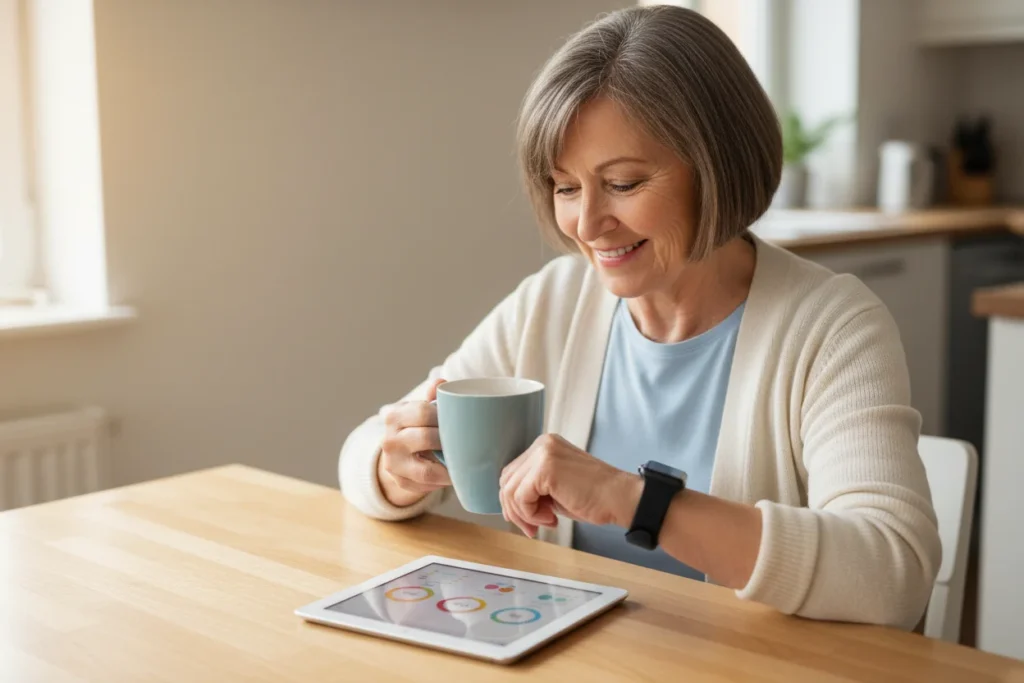
Digital health and wellness is a broad term, but for retirees, it comes down to a practical question: how can technology help me live better, feel better, and get the care I need — without making my life more complicated than it already is?
The tools in this space include:
- Health and wellness apps — sleep trackers, nutrition logs, meditation guides, habit trackers, and mood journals
- Wearables — fitness trackers, smartwatches, heart-rate monitors, and devices that track sleep and activity patterns
- Telehealth and telemedicine — virtual doctor visits, remote specialist consultations, and follow-up care without the waiting room
- Online wellness programs — coaching platforms, therapy services, guided exercise plans, and chronic condition management tools
- Digital behavior tools — screen-time dashboards, focus modes, notification controls, and app limits that protect your attention from the things that don’t deserve it
Here’s why this matters specifically in retirement: your health priorities shift in ways that catch a lot of people off guard. You’re not just trying to stay productive — you’re trying to stay well. Sleep quality, cardiovascular health, mental sharpness, mobility, stress management, and access to care all become more central to daily life than they were at 45. And digital health and wellness tools, used thoughtfully, can support every single one of those areas.
I think of it like having a very patient, very data-driven friend who never gets tired of tracking things, never judges you for having a slow week, and is available at 6 a.m. when you’re wondering whether last night’s sleep was actually as bad as it felt or whether you’re just being dramatic. That friend is useful. That friend is worth keeping around — as long as you’re the one setting the agenda, not them.
Why Digital Health and Wellness Is Important in Retirement
Modern life is loud. Busy. Notifications everywhere. And retirement, despite what the brochures suggest, doesn’t automatically make it quieter. If anything, the shift from a structured work schedule to an open calendar can leave some retirees feeling unmoored — more time, but less clarity about how to use it well. More freedom, but also more decisions to make without the built-in structure that work used to provide.
I remember the first few weeks of retirement feeling almost disorienting. Not bad — just unfamiliar. The days were open in a way I hadn’t experienced since childhood, and I wasn’t always sure what to do with that openness. Technology, I noticed, was very happy to fill the gap. It always is.
Digital health and wellness tools can be a genuine counterbalance — helping you sleep better, move more consistently, manage stress, and access care without needing to clear your entire day for a single appointment. For retirees dealing with the logistical friction of healthcare — long drives, limited local specialists, crowded waiting rooms, appointments that somehow always fall on the one day you had plans — telehealth alone can feel like a small miracle. I’ve had specialist consultations from my kitchen table in my pajamas. I’m not embarrassed about that. I’m grateful for it.
But there’s a real “but” here, and I want to name it clearly because I’ve experienced it firsthand: the same technology that helps you can also exhaust you if you’re not intentional about how you use it. An app that tracks your sleep can also make you anxious about your sleep. A fitness tracker that celebrates your steps can also make you feel like a failure on the days your knees have a different opinion about what’s happening. The tool is only as good as the intention behind it — and the boundaries around it.
The goal of digital health and wellness isn’t to worship technology or run from it. It’s to use it as a tool — one that serves your health and your life, not the other way around. That distinction sounds simple. Living it takes a little practice. But it’s worth the practice.
How Digital Tools Shape Our Relationship with Technology
Our relationship with technology is complicated. Like a friend who gives genuinely good advice but also texts you 47 times a day and somehow always knows when you’re trying to relax and chooses that exact moment to send you a notification about something that absolutely could have waited until tomorrow. Or next week. Or never.
For retirees, this relationship deserves some honest examination — because the habits we build around technology in retirement tend to stick. And some of them are worth building deliberately, with intention, rather than just letting them accumulate by default while we’re busy doing other things.
I spent the first year of retirement letting my technology habits run on autopilot. I checked my phone constantly — not because anything urgent was happening, but because I’d spent 30 years in a job where something urgent was always happening, and my nervous system hadn’t gotten the memo that things had changed. I scrolled in the evenings because it felt like relaxing. I kept notifications on for everything because turning them off felt like missing something.
None of it was making me feel better. Some of it was quietly making me feel worse. And I didn’t notice until I started paying attention.
On the genuinely helpful side, digital health and wellness tools can:
- Remind you to move when you’ve been sitting too long — which, in retirement, is easier to do than you’d think, especially when a good book or a good conversation is involved and the chair is comfortable
- Guide breathing exercises during stressful moments — and retirement has its own stressors, even without a commute or a difficult boss or a deadline that someone else created
- Help you track sleep patterns and bedtime consistency in ways that reveal things you wouldn’t have noticed otherwise — like the fact that your worst nights consistently follow your latest evenings on your phone
- Make therapy and professional support easier to access, especially if you live in a rural area, have mobility limitations, or simply don’t want to drive 45 minutes each way for a 50-minute appointment
- Connect you with communities of people navigating similar health journeys — which turns out to matter more than most people expect, and more than I expected
On the messier side, the same technology can:
- Trigger comparison and anxiety through social media in ways that are subtle and cumulative and easy to miss until you notice you feel worse after every session
- Encourage compulsive checking that fragments your attention and your peace without you quite realizing it’s happening
- Keep your brain overstimulated right before bedtime — exactly when you need it to wind down and let go of the day and stop processing information for five minutes
- Create guilt when you miss goals, which is the opposite of what wellness is supposed to feel like and yet somehow happens constantly with apps that were designed to help you
If your wellness app makes you more stressed than your actual life does, you’ve accidentally adopted a digital raccoon. Charming in theory. Chaotic in practice. And harder to get rid of than you’d expect.
The fix isn’t to abandon the tools — it’s to use them with intention. Notice what’s helping. Notice what’s adding noise. Adjust accordingly. That’s not a complicated philosophy, but it does require paying attention — which, it turns out, is also a wellness practice. Maybe the most important one.
The Core Benefits of Digital Health and Wellness for Retirees
When used intentionally, digital health and wellness delivers three meaningful wins for retirees: better mental health support, improved physical health tracking, and stronger social connection. Let’s look at each one honestly — not as a sales pitch, but as a genuine accounting of what’s actually available and what’s actually worth your time.
Mental Health Support — With Real Tools, Not Just Inspirational Quotes on a Sunset
Retirement is a significant life transition — and transitions, even welcome ones, can be emotionally complex in ways that sneak up on you when you’re not looking.
The loss of work structure, shifts in identity, changes in social connection, the health concerns that come with aging, and the quiet recalibration of what your days are for — all of it can affect mental well-being in ways that catch people off guard. I wasn’t prepared for how much of my sense of purpose had been tied to my work schedule. Not the work itself, necessarily — but the rhythm of it. The structure. The built-in reason to be somewhere and do something and feel like it mattered.
When that disappeared, I had to build something new. And some of the digital health and wellness tools I found along the way genuinely helped with that process — not by replacing the structure, but by giving me small anchors. A morning meditation. A mood check-in. A breathing exercise on the days when the quiet felt heavy rather than peaceful.
Digital wellness tools can support mental health through:
- Guided meditation and mindfulness apps that meet you where you are — even if “where you are” is skeptical, slightly impatient, and not entirely convinced this is going to work
- Breathing and grounding exercises available anytime, anywhere, without an appointment or a waiting room or a co-pay
- Therapy platforms and teletherapy — particularly valuable for retirees with limited local options or who simply prefer the accessibility and privacy of virtual care
- Mood tracking and journaling prompts that help you notice patterns before they become problems — because awareness is the first step in almost every meaningful change, and it’s a step that’s easy to skip
- Screen-time boundaries and app limits that protect your mental space from the slow drain of too much input and too little recovery
And there’s growing research behind the idea that digital habits have measurable mental health effects. A 2025 randomized controlled trial led by Pieh found that reducing smartphone screen time improved mental health indicators in participants — a meaningful signal that what we do with our devices isn’t just a lifestyle preference, it’s a health variable. Your brain is not being dramatic when it feels better after a quieter day. It’s responding to real input changes. That’s worth knowing — and worth acting on.
Physical Health — The Helpful Kind of Tracking
Digital health and wellness tools make it easier to monitor the physical health factors that matter most in retirement — and to do it consistently, which is where most health improvements actually live. Not in the dramatic overhauls. In the quiet, consistent noticing.
The things worth tracking:
- Daily movement and step counts — not to hit an arbitrary number, but to notice patterns and stay honest with yourself about what’s actually happening
- Cardiovascular fitness and heart rate trends — useful data for anyone managing blood pressure, heart health, or recovery from activity
- Nutrition and hydration patterns — because it’s surprisingly easy to undereat or underhydrate in retirement when you’re not on a structured schedule and nobody is putting a lunch break on your calendar
- Sleep duration and consistency — which we’ll talk about more in a moment, because it deserves its own section and probably its own conversation
- Recovery and rest — because rest is not the absence of wellness. It’s part of it. An important part. One that our culture has historically been terrible at honoring.
The real value here isn’t turning you into a spreadsheet person — though if color-coded health data genuinely brings you joy, I fully support that lifestyle and I have questions about your system and whether you’ve considered adding a second color for hydration. The real value is awareness. Most meaningful health improvements don’t come from one dramatic overhaul. They come from noticing patterns and making small, sustainable adjustments over time. Digital tools make that noticing easier and more consistent than relying on memory alone — and memory, I’ve learned, is an optimistic narrator that tends to remember the good days and quietly edit out the rest.
Social Connection — Yes, Even Online Can Count
One of the quieter challenges of retirement is the social shift. The built-in community of the workplace disappears, and replacing it takes deliberate effort that nobody quite prepares you for. You don’t realize how much of your social life was structured by your job until the structure is gone and you’re looking at a Tuesday afternoon wondering who you’re going to talk to.
Digital health and wellness tools can support that effort by connecting you with:
- Peer communities organized around health goals, chronic conditions, hobbies, or shared life experiences — people who are navigating the same chapter you are
- Accountability partners who help motivation last longer than a good intention on a Monday morning that somehow evaporates by Wednesday
- Professional support via telehealth — therapists, coaches, and care providers you can access from your living room without the logistical production of getting there
- Structured wellness programs that provide both guidance and a sense of community around shared goals — which turns out to be a powerful combination
For many retirees, the social support piece is the missing ingredient. Motivation fades. Community helps it stay. And digital tools, used well, can be a genuine bridge to that community — especially for retirees who live alone, live rurally, or are navigating health limitations that make in-person connection harder than it used to be.
I’ve met people through online wellness communities who I now consider genuine friends. That surprised me more than almost anything else in this whole digital health and wellness journey. I expected the apps to be useful. I didn’t expect the people to matter as much as they do.
How Digital Wellness Affects Mental Health and Emotional Well-Being
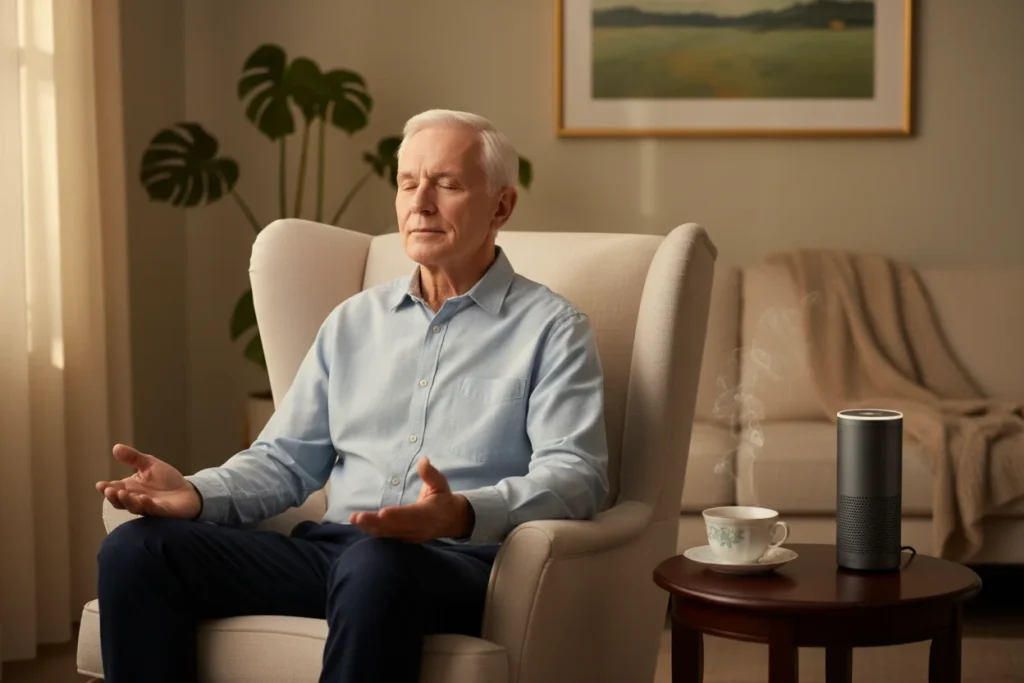
Digital health and wellness can be a significant support for mental health in retirement — but the outcome depends almost entirely on how you use it. The same phone can be a meditation guide or an anxiety machine. The difference is intention and habit — and the willingness to notice which one it’s being on any given day.
Used intentionally, digital wellness can reduce stress, improve focus, provide accessible mental health support, and encourage the routines that stabilize mood over time. Used carelessly, it can increase anxiety, fragment attention, amplify comparison, and disrupt the rest and recovery that become more important — not less — as we age.
Screen Time, Social Media, and the Anxiety Connection
Heavy screen time and certain social media patterns are linked to higher anxiety and stress — not because technology is inherently harmful, but because of how it tends to be used when we’re not paying attention. It can create constant comparison, keep your nervous system on low-level alert, disrupt sleep, and crowd out the offline connection that actually restores you.
Here’s a rule I’ve come to rely on: if you finish a scroll session feeling worse about yourself or your life than when you started, that wasn’t relaxing. That was an emotional subscription you didn’t mean to sign up for — and you’re allowed to cancel it. No explanation required. No guilt necessary.
Digital health and wellness means noticing those patterns and adjusting them with intention:
- Curate your feed so it reflects what you actually want to think about — not what an algorithm decided you should see based on what made you react last Tuesday
- Reduce passive scrolling in favor of active, purposeful use — go looking for something specific rather than just opening the app and seeing what happens
- Choose connection over consumption when you can — reaching out to someone beats watching strangers argue about things that don’t affect you and won’t be resolved by your continued observation
- Put a little friction between yourself and the apps that tend to pull you under — move them off your home screen, set time limits, make the default harder so the choice to use them is actually a choice
None of this requires dramatic willpower or a personality transplant. It just requires noticing — and then making one small adjustment at a time. Small adjustments, done consistently, are how most things actually change. Big dramatic overhauls make for good stories. Small consistent adjustments make for better lives.
Reducing Burnout and Sharpening Focus
Burnout in retirement looks different than it did during your working years, but it’s real and it’s worth naming. Too much input, too little recovery, and too many blurred boundaries between “on” and “off” can leave you feeling depleted even when your schedule looks manageable on paper and you can’t quite explain why you’re tired.
Digital wellness habits that genuinely help:
- Focus blocks of 25–50 minutes with a real break afterward — not a “check my phone” break, an actual break where you look at something that isn’t a screen and let your brain do nothing useful for a few minutes
- Notification trimming — because not everything is urgent, and your nervous system doesn’t know the difference between a news alert and an actual emergency. It responds to both the same way. Every time.
- “Do not disturb” windows during rest, meals, and meaningful time with people you love — because those things deserve your full attention, and they’re harder to get back than you’d think
- Short mindfulness breaks — two minutes of intentional breathing counts, and it adds up more than you’d expect over the course of a day
- Mini digital detoxes planned around something positive, not just deprivation — because “I’m not allowed to use my phone” lasts about four hours before you find a reason why this particular situation is an exception, but “I’m going for a walk and leaving my phone at home” is actually enjoyable and you come back feeling like yourself again
I’m a fan of the “one less thing” strategy: one less notification, one less late-night scroll, one less app that quietly spikes your stress every time you open it. Small subtractions. Real results. Your brain will notice — and it will thank you in the form of slightly better mornings, slightly calmer afternoons, and the occasional evening where you look up and realize you’ve been genuinely present for the last two hours and it felt good.
How Digital Wellness Influences Physical Health in Retirement

Physical health in retirement is built on consistency more than intensity. You’re not training for a competition — you’re building habits that support energy, mobility, cardiovascular health, and quality of life over the long term. Digital health and wellness tools support that goal by making feedback and self-monitoring easier, more consistent, and more sustainable than relying on willpower and good intentions alone.
And I say that as someone who has relied on willpower and good intentions alone for most of my adult life, with mixed results.
Blue Light, Screen Time, and Sleep
Sleep is one of the most important health factors in retirement — and one of the most commonly disrupted. I hear this from retirees constantly, and I’ve experienced it myself: sleep that used to come easily starts getting complicated. You wake up earlier than you want to. You lie awake longer than you used to. The quality shifts in ways that are hard to describe but very easy to feel the next morning when you’re on your third cup of coffee and it’s only 9 a.m.
And here’s where digital health and wellness can either help significantly or quietly make things worse — sometimes both, depending on the day.
Evening exposure to short-wavelength blue light from screens can interfere with melatonin production and circadian rhythms. A systematic review and meta-analysis by Shechter found that interventions to reduce short-wavelength light exposure at night can help reduce adverse effects on sleep quality. Your phone isn’t technically making you tired — it may be keeping your body from realizing it’s bedtime. Which is a subtle but meaningful distinction, and one that has real consequences for how you feel the next day and the day after that.
Practical steps that don’t require living in a candlelit cottage or giving up your evening television or pretending you’re not going to check your phone one more time before bed:
- Use night mode or blue-light filters in the evening — most devices have this built in and it takes about 30 seconds to set up, which means there’s really no good reason not to
- Dim screen brightness after sunset — your eyes will thank you and so will your sleep
- Stop scrolling in bed — I say this with genuine affection and zero judgment, because I have absolutely been the person lying in bed at 11 p.m. reading about something that could absolutely have waited until morning and probably didn’t need to be read at all
- Create a small no-screen buffer before sleep — even 15 to 30 minutes makes a measurable difference for many people, and it gives your brain a chance to actually wind down instead of processing information right up until the moment you close your eyes and then wondering why sleep doesn’t come
For retirees whose sleep patterns are already shifting with age, this is one of the highest-return digital wellness habits available. It costs nothing, requires no equipment, and the only thing standing between you and trying it is the habit of reaching for your phone. Which, I’ll admit, is not a small thing — but it is a changeable one. I know because I changed it. Slowly. With some backsliding. But I changed it.
Wearables and the Encouragement to Move
Wearables are a core part of digital health and wellness because they provide real-time feedback and gentle, consistent accountability — the kind that doesn’t require another person to be available and enthusiastic at 7 a.m. when you’re deciding whether to go for a walk or stay in your chair and see what happens.
I was skeptical of wearables for a long time. They felt like something for people who were already athletic and just wanted to quantify their athleticism. Then a friend convinced me to try one, and I discovered something I hadn’t expected: I liked knowing. I liked having actual data instead of vague impressions. I liked being able to see that yes, the days I moved more were the days I slept better, and that wasn’t just a feeling — it was a pattern.
For retirees, wearables can:
- Encourage daily movement in a way that feels motivating rather than punishing — a gentle nudge rather than a judgment, a celebration of what you did rather than a critique of what you didn’t
- Track heart rate and recovery — useful data for anyone managing cardiovascular health or simply wanting to understand how their body responds to activity and rest
- Support realistic goal-setting around steps, activity, and sleep — goals that are actually achievable, not goals designed for someone 20 years younger with different knees
- Help you notice patterns you’d otherwise miss — like the correlation between a stressful afternoon and a rough night’s sleep, or the way your energy improves on days when you move before noon, or the fact that your resting heart rate is lower on the days you skip the afternoon coffee
The important caveat — and I mean this sincerely, from experience: wearables should be informative, not emotionally controlling. If your device makes you feel guilty for resting, for taking a slow day, or for choosing a gentle walk over a workout because your body asked for something gentler — it’s not a wellness tool. It’s a tiny wrist-mounted critic. And you’ve spent enough of your life with critics. You don’t need one on your wrist, and you’re allowed to ignore it when it’s being unreasonable. You’re also allowed to take it off. That’s still an option.
Digital Wellness Habits That Improve Daily Life and Relationships
This is where digital health and wellness gets personal — because it affects how present you are with the people you love and the life you’ve actually built.
I’ve noticed something consistently, both in my own experience and in conversations with other retirees: the biggest relationship improvements often come from the simplest digital habits. Not the most sophisticated app or the most expensive wearable. Just a few intentional boundaries that protect the time and attention that matter most — the dinner conversations, the morning walks, the afternoons with grandkids, the quiet evenings that are only quiet if you let them be.
My wife pointed out, gently and then less gently, that I was physically present at dinner but mentally somewhere else — usually my phone. She was right. And the fix wasn’t complicated. It was just a decision, made deliberately, to put the phone in another room during meals. That’s it. That’s the whole habit. And it changed the quality of our evenings more than almost anything else I’ve done in retirement.
Managing Screen Time and Doing Digital Detoxes
You don’t need a weeklong silent retreat to benefit from a digital detox. You don’t need to find yourself in a mountain cabin with no Wi-Fi and a leather-bound journal you bought specifically for the occasion and then felt slightly self-conscious about because who are you, Thoreau?
Start with something genuinely manageable:
- A daily phone-free window of 30 to 60 minutes — morning coffee, an evening walk, whatever fits your rhythm and feels like something you’d actually do
- One screen-free evening per week — and plan something you actually enjoy for it, so it feels like a treat rather than a punishment
- A weekend morning without apps — just to remember what that feels like, and to notice whether you miss it as much as you expected (spoiler: usually less)
- Offline activities that you genuinely look forward to — not “I guess I’ll sit here now,” but something that actually draws you in and makes the time feel full
The key is building detox time around something positive. Deprivation without replacement doesn’t stick. Replacement with something better does — and usually feels surprisingly good within about 20 minutes, once your brain stops reaching for the phone out of habit and starts actually being where you are.
Device-Free Zones That Actually Work
Device-free zones are one of the easiest, highest-impact habits in digital health and wellness — and they work especially well in retirement, when home is where most of your life happens and the boundaries between “on” and “off” need to be created deliberately rather than inherited from a work schedule that no longer exists.
Consider making these spaces screen-free:
- The dining table — meals are genuinely better without a phone competing for your attention, and the conversations that happen when everyone is actually present are worth protecting. They’re also worth having.
- The bedroom — sleep is better without a device within arm’s reach, and the habit of reaching for your phone first thing in the morning sets a tone for the whole day that’s worth examining honestly
- Family and friend time — presence is the gift, and it’s harder to give when you’re half-elsewhere, half-scrolling, half-nodding while reading something that could have waited and probably didn’t matter as much as the person in front of you
- Morning routines — starting the day without immediately checking a screen changes the tone of the whole morning in ways that are hard to explain until you try it and then wonder why you didn’t try it sooner and also why nobody told you this was an option
Screen-time dashboards can help you see what’s actually happening — because most of us underestimate our usage until we see it in numbers and have a quiet moment of reckoning. That moment is useful. It’s not comfortable. But it’s useful. And it’s the kind of honest feedback that’s hard to argue with, even when you want to.
Digital Health and Wellness Tools: A Quick Reference
| Digital Health Tool | Purpose | Key Benefit for Retirees |
|---|---|---|
| Telehealth | Remote consultations | Reduces travel, wait times, and access barriers |
| Wearable Devices | Health monitoring | Real-time feedback on activity, heart rate, and sleep |
| Health Apps | Wellness tracking | Personalized habit support and goal tracking |
| Meditation Apps | Stress and sleep support | Accessible mental health tools anytime, anywhere |
| Screen-Time Tools | Digital behavior management | Protects rest, focus, and relationship quality |
What’s Next for Digital Health and Wellness
The future of digital health and wellness will be shaped by smarter personalization, broader telehealth access, better usability, stronger privacy frameworks, and AI-driven insights — when done responsibly and transparently. For retirees, the most meaningful developments are the ones that reduce friction and increase access — making it easier to get care, stay informed, and manage health without needing a technology degree or a 25-year-old nearby to explain the settings.
Telemedicine and Wearables: Expanding Access to Care
For retirees, telehealth is already a meaningful shift — and it’s one I’ve benefited from personally in ways I didn’t anticipate. It reduces barriers like travel, time, limited local specialists, and the logistical complexity of getting to an appointment when mobility or transportation is a factor. And when combined with wearable data, clinicians can potentially provide more informed guidance between visits — not just “how have you been?” but “here’s what your sleep and heart rate trends suggest we look at more closely.”
That’s a different kind of healthcare relationship. A more continuous one. And for retirees managing chronic conditions or navigating the health changes that come with aging, that continuity matters more than most people realize until they experience it and wonder how they managed without it.
Ethical Questions Around AI and Health Data
This is the part of digital health and wellness that’s exciting and slightly unsettling at the same time — and it deserves honest attention rather than either breathless enthusiasm or reflexive dismissal.
As AI and personal health data become more embedded in healthcare, important questions arise that affect all of us:
- Who owns your health data?
- How is it stored, shared, and protected?
- Are AI-driven recommendations fair and unbiased across different populations and age groups?
- What happens if the data is wrong — or misused?
Nebeker raised these concerns directly, calling for actionable ethics as technology becomes more central to health systems and research. And I’ll add my own take: health technology should earn trust, not assume it. Transparency should be the default — not an optional feature buried behind five dropdown menus and a privacy policy written in a font specifically designed to discourage reading.
As a retiree engaging with these tools, you have every right to ask how your data is used. Ask the question. Read the policy. Choose platforms that answer clearly and without defensiveness. That’s not paranoia — that’s being an informed consumer of something that genuinely matters to your health and your privacy.
FAQ: Digital Health and Wellness for Retirees
What are the best digital wellness habits for retirees to start with?
Start small and specific: a phone-free bedtime buffer, a device-free dining table, and one wearable or app that tracks something you actually care about. Consistency with one habit beats overwhelm from ten — every single time, without exception.
How can telehealth benefit retirees specifically?
Telehealth reduces travel, eliminates waiting rooms, and makes specialist access possible for retirees in rural areas or with mobility limitations. It’s one of the most practical and immediately useful digital health tools available — and it’s only getting better and more accessible.
How does screen time affect sleep in retirement?
Evening screen use can suppress melatonin and delay your body’s recognition that it’s bedtime. A 15–30 minute no-screen buffer before sleep, combined with night mode settings, can make a measurable difference — especially for retirees whose sleep patterns are already shifting with age.
Are wearables worth it for retirees?
For many retirees, yes — particularly for tracking movement, heart rate, and sleep. The key is using the data as information, not as a report card. A wearable that motivates you is a tool. One that makes you feel guilty for resting is a problem worth addressing — possibly by adjusting the settings, possibly by putting it in a drawer for a week.
How can digital wellness support mental health in retirement?
Meditation apps, teletherapy, mood tracking, and intentional screen-time limits can all support mental well-being. The social connection piece — online communities, peer groups, accessible professional support — is particularly valuable for retirees navigating the social shift that comes with leaving the workforce.
What’s the simplest way to start with digital health and wellness?
Pick one thing. A phone-free morning. A step goal. A sleep tracker. One small habit, done consistently, does more than a complete digital wellness overhaul that lasts four days and then quietly disappears while you feel vaguely guilty about it for two weeks.
Using Technology Without Letting It Run Your Life
Digital health and wellness is no longer a niche trend — it’s part of modern life, and for retirees, it’s increasingly part of managing health well in this chapter.
When used thoughtfully, it can improve mental health, support physical health, strengthen relationships, and make care more accessible than it’s ever been. The best part? You don’t have to overhaul your entire life to benefit. Pick one small habit — a phone-free bedtime buffer, a device-free dinner table, a wearable that tracks your sleep — and see what shifts.
Because digital health and wellness isn’t about being perfect. It’s about being a little more intentional — so your technology supports your well-being instead of quietly competing with it.
You’ve spent decades building a life worth living. The tools exist now to help you live it better. Use them on your terms. And if a wellness app ever makes you feel worse than your actual life does — delete it without guilt and go take a walk. That counts too. It always has. And it always will.






3 Comments
Comments are closed.