

Online Therapy for Retirees: Your Complete Guide to Mental Health Support After 60
Online therapy for retirees makes mental health support more accessible than ever — from anxiety and depression to chronic illness and life transitions. Here’s everything you need to know.
Key Takeaways
- Online therapy for retirees is just as effective as in-person care — and far more convenient for most people over 60
- Retirement triggers real mental health challenges: identity shifts, loneliness, grief, chronic illness, and anxiety about the future
- Evidence-based approaches like CBT work well via telehealth — research confirms outcomes are comparable to face-to-face sessions
- Medicare covers many online therapy services, including platforms like Total Life and Blue Moon Senior Counseling
- Support groups and peer networks amplify the benefits of individual therapy — especially for chronic pain and illness management
- You do not have to wait until things are unbearable to start. Getting support early is not weakness — it is wisdom
There is a moment that happens to a lot of retirees — and almost nobody talks about it.
It is not dramatic. It does not announce itself. It just shows up one ordinary Tuesday, maybe three or four months in, when the novelty has worn off and the calendar is looking suspiciously empty. You are standing in your kitchen at 10 a.m. in your pajamas, coffee in hand, and you realize — with a strange, sinking clarity — that you have nowhere to be.
And instead of feeling like freedom, it feels like falling.
My neighbor Carol knows that moment. She had been a hospital administrator for 38 years. Sharp, organized, the kind of person who color-coded her grocery list and still had time to bring you soup when you were sick. She had a retirement plan — an actual binder, with tabs, with a five-year vision. She had a countdown app on her phone. When her last day finally came, she cried happy tears and hugged everyone in the building twice.
She was ready. More ready than most people ever are.
And then, about eight weeks in, she stopped answering her phone.
Not dramatically. Not in a “call for help” way. Just quietly. The neighborhood walks she used to organize — she stopped showing up. The group texts — she went from the most active person in the thread to radio silence. Her daughter called me, worried. When I finally got Carol on the phone, she said something I have thought about almost every day since:
“I just don’t know what I’m for anymore.”
Eight words. And they hit like a freight train.
Because Carol was not depressed in the way people picture depression. She was not crying in the dark. She was not unable to get out of bed. She was just adrift. Untethered. Like someone had removed the scaffolding from a building that was still standing — technically fine, but suddenly very aware of how much it had been relying on that structure all along.
What Carol was experiencing had a name. It just took a while to find it.
She eventually started online therapy for retirees through her Medicare plan. She did not have to drive anywhere. She did not have to sit in a waiting room. She did not have to explain herself to a stranger in a formal office while trying to remember if she had fed the cat. She just sat in her kitchen — the same kitchen where she had made a thousand lunches and hosted a hundred dinners — with a cup of tea and a therapist on her laptop screen who actually understood what she was going through.
Not the brochure version of retirement. The real one.
Six months later, Carol was back. Not the same Carol — a better one. One who had figured out who she was outside the job title. One who had language for the grief she had been carrying without knowing it had a name. One who had planted a garden she had been dreaming about for a decade and was finally, actually, standing in it.
I am telling you Carol’s story because I think a lot of people reading this are somewhere in that same quiet room right now. Grateful for retirement. Struggling with retirement. Not sure they are allowed to feel both at the same time.
You are. And there is a door out of that room. Online therapy for retirees might just be the thing that helps you find it.
What Retirement Actually Does to Your Mental Health (And Why Nobody Warns You)
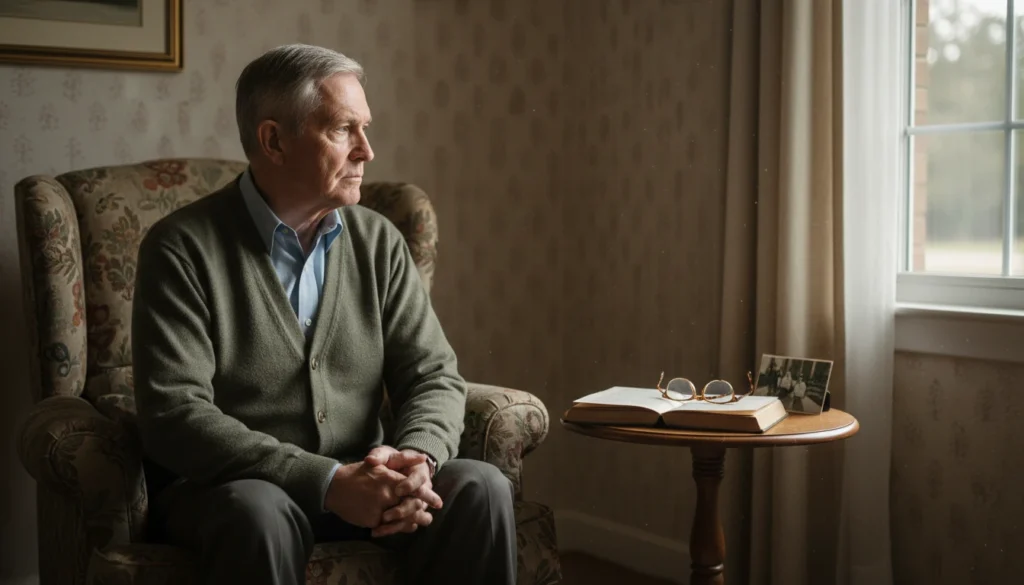
Here is what the retirement brochures never mention — and I have read a lot of retirement brochures, so I feel qualified to say this with some authority:
Leaving work is not just a logistical change. It is an identity earthquake.
For most of us, work was not just a paycheck. It was structure. It was purpose. It was a built-in social life, a reason to get dressed before noon, a way of answering “What do you do?” without having to think too hard. It was the thing that organized your days, your weeks, your sense of self-worth — often for decades. It was, whether you realized it or not, a significant part of how you understood yourself.
When that disappears — even when you chose for it to disappear, even when you were counting down the days on a countdown app, even when you had a binder with tabs — the absence can hit harder than anyone warned you it would.
And here is the part that catches people most off guard: you can be genuinely grateful for retirement and genuinely struggling with it at the same time. Those two things are not contradictions. They are not a sign that something is wrong with you or that you made a mistake. They are just the complicated, honest, fully human truth of a major life transition.
You are allowed to feel both. You are allowed to feel all of it.
According to the National Council on Aging, older adults face a distinct set of mental health challenges tied to aging and life transitions: bereavement, caregiving stress, chronic illness, loneliness, financial worry, and the loss of roles that once gave life its shape and meaning. Depression affects an estimated 6% of people over 60 — and that number climbs significantly with age and isolation.
The good news — and I mean this sincerely, not as a pivot to sell you something — is that these challenges are treatable. Not “push through it and hope for the best” treatable. Actually, genuinely, get-your-life-back treatable. And online therapy for retirees is one of the most practical, accessible, and effective ways to get there — without having to leave your house, justify yourself to anyone, or pretend you are fine when you are not.
What Is Online Therapy for Retirees — and Does It Actually Work?
Online therapy — also called telehealth therapy or virtual counseling — lets you meet with a licensed mental health professional from home, using your phone, tablet, or computer.
No commute. No waiting room. No “what if someone I know sees me walking into a therapist’s office” anxiety. No trying to find parking in a medical complex that was clearly designed by someone who has never actually tried to park in a medical complex. No rescheduling because your knee is acting up or the weather is bad or you just do not have the energy to be somewhere by 2 p.m. and perform “fine” for a waiting room full of strangers.
Just you. A private space. And someone who is genuinely trained to help.
And yes — it works. According to the American Psychological Association, 96% of psychologists agree that online counseling is a proven therapeutic tool, and 93% plan to offer it permanently in their practice. A randomized trial by P. Gehrman (2020) comparing video telehealth delivery of CBT for insomnia in veterans with PTSD to in-person care found that telehealth was non-inferior — meaning it performed about as well as face-to-face therapy.
That matters because sleep problems and anxiety are deeply intertwined in retirement. You lie awake worrying. The worry makes sleep worse. The poor sleep makes everything harder to cope with. And accessible, consistent care can be the thing that finally breaks that loop — not willpower, not “just think positive,” not a new supplement you saw advertised during the evening news. Actual support. Actual tools. Actual change that sticks.
Here is the thing I want you to hold onto, especially if you are skeptical: the goal of therapy is not the office. The goal is care. And care travels just fine over a video call. It always has.
What Does Online Therapy for Retirees Actually Help With?
Online therapy for retirees is not one-size-fits-all. It can help with:
- Anxiety and worry — about health, finances, purpose, relationships, or the future in general. The 3 a.m. kind. The “what if” kind. The kind that follows you into the grocery store and sits with you through dinner and is still there when you wake up the next morning.
- Depression and low mood — including the kind that does not look like sadness but shows up as numbness, irritability, or just feeling like you are going through the motions of a life that used to feel like yours and somehow does not anymore
- Grief and loss — of a spouse, a friend, a career, a version of yourself you did not even realize you were attached to until it was gone and you were standing in your kitchen at 10 a.m. on a Tuesday with nowhere to be and no idea what to do with that
- PTSD and trauma — which do not have an expiration date and can resurface during major life transitions in ways that feel confusing and completely out of nowhere, like something you thought you had dealt with decades ago suddenly knocking on the door again
- Chronic illness adjustment — the emotional weight of managing a long-term health condition that nobody really prepared you for and nobody around you fully understands, no matter how much they love you
- Loneliness and isolation — which, according to NCOA research, significantly increases the risk of depression and anxiety in older adults. And which is far more common in retirement than anyone likes to admit out loud.
- Relationship and family stress — because retirement changes the dynamics at home, sometimes in ways nobody anticipated and nobody quite knows how to bring up without it turning into a whole thing that nobody wanted it to become
If any of those sound familiar — if you read that list and felt a small, quiet “yes” somewhere in your chest — you are not alone. Not even a little bit. And you do not have to keep carrying it quietly, hoping it eventually gets lighter on its own.
It usually does not. But it can, with the right support. That is not a sales pitch. That is just what the research says, and what people like Carol have lived.
How Online Therapy for Retirees Works: What to Expect (The Honest Version)
If you have never done a telehealth session, here is the real version of what to expect — not the glossy brochure version, not the version designed to make it sound effortless and transformative from day one, but the actual honest version from someone who has talked to a lot of people who have been through it and come out the other side.
Getting Started Is Easier Than You Think
Most platforms start with a short intake questionnaire. You answer questions about what you are dealing with, what you are looking for, and sometimes your schedule and preferences. Then you get matched with a therapist — or you browse and choose one yourself, depending on the platform.
One thing I want you to know upfront, because nobody says this enough: you are not locked into your first match. Just like in-person therapy, it sometimes takes a session or two to find the right fit. That is not failure. That is not a sign that therapy “does not work for you” or that you are somehow too complicated to help. That is just how human connection works — even the professional kind.
Give yourself permission to try more than one. Give yourself permission to say “this isn’t quite right” and keep looking. The right fit is worth finding. And when you find it, you will know.
What a Typical Session Actually Looks Like
A standard online therapy session for retirees usually runs 45–50 minutes. Here is the honest rhythm of it:
- Check-in: How have you been since last time? Any changes in sleep, mood, energy, pain, or stress? This is not small talk — it is data. Your therapist is listening for patterns you might not even notice yourself, the kind that only become visible when someone is paying close attention over time.
- Focus: You and your therapist pick a topic. Anxiety about a health diagnosis. Grief over a loss. Tension with a family member. Trouble finding purpose now that the career is over. The weird guilt of enjoying retirement when others are still working. The strange loneliness of being surrounded by people who love you and still feeling alone in a way you cannot quite explain. Whatever is actually on your mind — not the edited version, the real one.
- Skill-building: A good session always includes something you can actually use. A breathing technique. A thought reframe. A way to talk to your spouse about something that keeps turning into an argument. A sleep strategy. A pacing approach for the days when chronic pain is running the show and you are just trying to get through it without losing yourself in the process.
- Next steps: Follow-up goals, optional homework if you want it, and scheduling the next session.
One practical tip I will pass along: find a private spot, test your audio beforehand, and put your phone on Do Not Disturb. Nothing derails a breakthrough moment quite like opening up about your deepest anxiety — and getting a spam call about your car’s extended warranty mid-sentence. I am not speaking from personal experience. I am absolutely speaking from personal experience. Learn from my mistakes.
The Approaches That Actually Work
Cognitive-Behavioral Therapy (CBT): Helps you identify thought patterns that keep you stuck — catastrophizing, all-or-nothing thinking, avoidance — and practice more helpful responses. It is practical, skills-based, and one of the most well-researched approaches for anxiety and depression in older adults. Think of it less as “talking about your feelings” and more as “learning to argue back at your own brain — and actually winning sometimes.” That is a skill worth having.
Acceptance and Commitment Therapy (ACT): Particularly useful for chronic illness and grief. Instead of fighting difficult feelings — which, if you have tried it, you know does not work and is also exhausting and demoralizing — ACT helps you make room for them while still moving toward what matters to you. It sounds deceptively simple. It is not always easy. But it works in a way that sneaks up on you, quietly and then all at once.
Exposure-based approaches: Used for PTSD and anxiety. Helps your nervous system learn that a memory or a trigger is not the same as a current threat — gradually and safely, at a pace that feels manageable, not terrifying. This is not “just face your fears and push through it.” It is much more careful, much more collaborative, and much more effective than that.
Mindfulness-based approaches: Increasingly supported by research for older adults. According to Everyday Health’s review of online therapy platforms, mindfulness-based therapies have shown strong effectiveness for mental health conditions in seniors — particularly for anxiety, chronic pain, and sleep. And no, you do not have to sit cross-legged on the floor or download an app or become a different kind of person. That is not a requirement. It never was.
Online Therapy and Chronic Disease Management in Retirement
Chronic illness management is not just about lab results and medication schedules. It is also about the emotional math you do all day long — the invisible calculations that nobody else sees and nobody else is keeping track of except you.
“If I push through today, will I pay for it tomorrow?”
“Is this symptom serious or just annoying?”
“How do I explain this to people who mean well but genuinely do not get it?”
“Am I being dramatic, or is this actually as hard as it feels?”
For the record: it is actually as hard as it feels. You are not being dramatic. Chronic illness is genuinely hard, and the emotional weight of it is real and valid and deserves to be taken seriously — not minimized, not cheerfully redirected, not met with “but you look so good!” from someone who has no idea what your morning actually looked like.
That mental load compounds. Stress worsens symptoms. Symptoms raise stress. It is a feedback loop that can quietly take over your life if nothing interrupts it — and the insidious thing about it is that it happens so gradually you almost do not notice until you look up one day and realize how small your world has gotten.
Online therapy for retirees is one of the most effective ways to interrupt that loop — not by eliminating the illness, but by changing your relationship to it in ways that actually matter and actually last.
How Online Therapy Supports Common Retirement Health Challenges
Diabetes: Online therapy can help with diabetes distress, burnout, and the all-or-nothing thinking that turns one off-plan meal into a week of guilt and self-criticism and “well, I’ve already ruined it, so I might as well.” Many programs incorporate stress management, behavior change support, and strategies to improve adherence — without shame as the primary motivator. Because shame, it turns out, is a terrible health strategy. It has never once helped anyone eat better or manage their blood sugar more consistently. Not once. Not ever.
Heart disease: After a cardiac event — or even a scary symptom — anxiety about exertion, diet, or “missing something” is extremely common. I have heard people describe it as living with a low hum of fear in the background of everything they do. Every twinge. Every moment of breathlessness. Every time they push themselves a little and then immediately wonder if they should have. Online therapy supports sustainable lifestyle changes and helps people manage that fear and gradually — genuinely, not just theoretically — regain confidence in their own bodies. That confidence is not recklessness. It is recovery.
Chronic pain: Chronic pain is not just physical sensation. It quietly reshapes your mood, your sleep, your identity, and your social life. It shrinks your world in ways that happen so gradually you almost do not notice until one day you realize you have stopped doing things you used to love — and you cannot quite remember when that happened or how, or whether you made a conscious decision or just slowly stopped showing up. Online therapy for retirees dealing with chronic pain often includes pacing strategies, cognitive approaches, acceptance-based skills, and support for grief — because losing old abilities is a real loss, even if it does not come with casseroles and condolence cards and people checking in on you the way they do for other kinds of loss.
A strong chronic disease program does not treat your emotions like a side quest. It treats them like part of the main storyline — because they are. They always have been. The research has just finally caught up to what people living with chronic illness have known all along, in their bones, on the hard days.
Why Telehealth Is Especially Valuable for Chronic Illness Management
Telehealth makes ongoing support more realistic for retirees managing chronic conditions. Instead of waiting months for a check-in while your symptoms change week to week, telehealth allows more regular contact — especially when your condition requires frequent adjustment and the ground keeps shifting under you in ways that are hard to predict and harder to explain.
Online therapy for retirees with chronic illness can help you:
- Troubleshoot symptom flare-ups and the anxiety spiral that often follows close behind, sometimes before you even realize it has started
- Adjust routines and coping strategies when life shifts — new diagnoses, caregiving responsibilities, travel, seasonal changes, the unexpected things that life keeps throwing at you regardless of your retirement plan and your binder with tabs
- Stay connected to care when mobility, fatigue, or pain makes leaving the house genuinely hard — not “I do not feel like it” hard, but actually, physically, logistically, exhaustingly hard in a way that healthy people do not always understand
Sometimes, that consistency is the secret ingredient. Not dramatic breakthroughs every week. Not a complete transformation in six sessions. Just steady, reliable support that keeps you from quietly drifting off course — and helps you find your way back when you do, without judgment, without starting over from scratch, without having to explain everything again to someone new.
Why Support Networks Make Online Therapy for Retirees Even More Effective

There is something uniquely healing about talking to someone who does not need the backstory.
They already know the vocabulary. They have had the same 2 a.m. Google searches. They have lived the awkward moments and the invisible losses and the “I do not want to complain but I also really need to talk about this” feeling that you cannot quite explain to people who have not been there — people who love you and mean well and still somehow manage to say exactly the wrong thing at exactly the wrong moment, with the best possible intentions and zero awareness of the impact.
That is what peer support networks bring to the table. And they work best alongside — not instead of — professional therapy. Think of it as a two-track approach: one track for the deep work, one track for the daily reality of living with other humans who actually get it without you having to translate.
The Power of Group Therapy and Peer Support in Retirement
Group therapy — whether clinician-led or peer-led — can amplify the impact of individual online therapy for retirees in ways that are genuinely hard to replicate one-on-one. It offers:
- Belonging: The opposite of isolation is not just “people.” It is “people who understand without you having to explain everything from the beginning every single time.” That distinction matters more than it sounds. It is the difference between being seen and being tolerated.
- Shared coping strategies: You learn what actually works in real life, not just what sounds good in a workbook. Real people, real situations, real results — and occasionally real humor about the absurdity of it all, which helps more than you might expect and more than any workbook will ever tell you.
- Motivation and accountability: A group can keep you moving forward on the weeks when your brain has decided it would rather just give up and watch television for six hours. Sometimes knowing that other people are showing up — people who are dealing with the same things you are dealing with and still showing up — is the thing that gets you to show up too.
A qualitative study by M. Farr (2021) explored patient-led peer support groups that continued after NHS pain management programs ended — patients kept meeting without clinician input to maintain the program’s benefits. The study found that peer support helped consolidate self-management and support social recovery. For retirees dealing with chronic pain, that is significant: peer support can help expand a world that chronic illness has been quietly, steadily shrinking — one cancelled plan at a time, one “I just don’t have the energy today” at a time.
Online therapy for retirees plus peer support is not “extra.” For many people, it is the difference between short-term improvement and long-term, sustainable change that actually sticks when life gets hard again — because life does get hard again. That is not pessimism. That is just honesty. And honesty, in the long run, is more useful than optimism.
Involving Family and Caregivers in the Process
When a retiree is dealing with anxiety, depression, grief, or chronic illness, family members often want to help — desperately, genuinely, with their whole hearts — but do not know how. They might offer advice that lands like pressure. They might avoid the topic entirely because it feels too heavy or too close to home. They might say “just think positive” with the absolute best intentions and the absolute worst timing.
They might hover. They might disappear. They might do both in the same week, sometimes in the same day, and have no idea they are doing either.
Sound familiar?
Online therapy for retirees can include family members in ways that genuinely improve outcomes — not just for the person in therapy, but for everyone in the household who has been quietly trying to figure out how to help without making things worse:
- Joint sessions: Helpful for communication, shared understanding, and navigating the new dynamics that retirement brings to a home — especially when two people are suddenly spending a lot more time together than they ever have before and discovering that they have very different ideas about what retirement is supposed to look like and neither of them wants to be the one to say it out loud
- Education: Family members learn what symptoms actually mean and what real support looks like in practice — not cheerleading, not fixing, not “have you tried yoga,” but actually showing up in ways that help. Specific, concrete, this-is-what-I-need ways.
- Relationship repair: Chronic stress makes people short-tempered and withdrawn — it is not a moral failure, it is a nervous system response. Therapy helps rebuild trust and teamwork when both have quietly taken a hit over months or years of just trying to get through it without anyone admitting how hard it has been
Even a small shift in how a family talks about mental health — less judgment, more curiosity, less “you should” and more “I hear you” — can change the entire atmosphere of a home. I have seen it happen. It is one of the most quietly powerful things therapy can do, and it costs nothing except the willingness to try something different than what has not been working.
How to Find the Right Online Therapy Provider for Retirement

Finding a therapist can feel a little like online dating, except instead of “loves hiking and brunch,” you are looking for “can help me stop catastrophizing about my health at 11 p.m. and actually sleep like a normal person again.” It is a lot. Here is how to make it simpler — and less overwhelming — so that “figuring out how to start” does not become the reason you never do.
Platforms Worth Knowing for Online Therapy for Retirees
Several platforms specialize in or are particularly well-suited for older adults:
- Total Life — Specializes in online therapy for seniors, accepts Medicare, and matches clients with therapists experienced in aging-related challenges including retirement adjustment, grief, and chronic illness. Built specifically for this population — not as an afterthought.
- Blue Moon Senior Counseling — Focuses specifically on older adults, uses CBT adapted for seniors, and accepts Medicare. One of the few platforms built entirely around this population — not as a feature, but as the whole point.
- BetterHelp — One of the largest networks of licensed therapists; not senior-specific but offers broad access, flexible scheduling, and a wide range of specialties. Good if you want a lot of options and the ability to filter by what matters most to you.
- Center for Purposeful Aging — Specializes in geriatric mental health, retirement adjustment, grief, and purposeful living for older adults who want more than just symptom management — who want to actually figure out what this chapter is supposed to be about and how to live it well.
What to Look for When Choosing a Provider
Licensure matters. Choose a licensed professional — LPC, LCSW, LMFT, psychologist, or psychiatrist. Licensure signals training, ethical standards, and accountability. It is not a guarantee of a perfect fit, but it is a necessary starting point. Do not skip this step, no matter how good someone’s website looks or how warm their bio sounds.
Match experience to your needs. Online therapy for retirees is broad. If you are dealing with grief, ask about grief-focused training. If you are managing chronic illness, ask whether they have experience in health psychology. If retirement adjustment is the main issue, look for someone who works specifically with older adults and actually understands what this transition involves — not just in theory, but in the lived, complicated, sometimes-funny-sometimes-devastating reality of it.
Ask direct questions before you commit:
- “What is your approach to anxiety or depression in retirees?”
- “Do you use CBT, ACT, or trauma-focused methods?”
- “How do you protect privacy in telehealth sessions?”
- “What does a typical treatment plan look like for someone in my situation?”
And give yourself full permission to switch providers if the fit is not right. A good clinician will not be offended. They will genuinely want you to get the best care — even if that means finding someone else. That is not rejection. That is professionalism. And it is exactly the kind of thing a good therapist will tell you themselves, unprompted, because they mean it.
Costs, Medicare Coverage, and Practical FAQs
Now for the part everyone wishes was simpler: money. Let us just get into it, plainly and without the runaround.
Does Medicare Cover Online Therapy for Retirees?
Yes — and this is genuinely good news worth saying out loud more than once, because a lot of people assume it does not and never look into it and spend years paying out of pocket for something their insurance would have covered.
Medicare covers many telehealth mental health services, including individual therapy, group therapy, and psychiatric evaluations. Platforms like Total Life and Blue Moon Senior Counseling accept Medicare directly.
If you have Original Medicare with a supplemental plan, sessions are often fully covered. If you have a Medicare Advantage plan, coverage depends on your specific plan — so a quick call to confirm is worth every minute of hold music. I know hold music is the worst. Call anyway. It is worth it.
Before your first appointment, check:
- Whether your plan covers outpatient mental health services
- Whether you need a referral
- Whether your provider is in-network
- Your copay or coinsurance amount
- Any session limits or prior authorization requirements
If you are paying out of pocket, ask about sliding-scale rates, package pricing, or community clinic options. A 15-minute call to your insurance company can save you weeks of billing confusion and a lot of unnecessary stress later. And you have enough stress already. That is literally why we are here.
Frequently Asked Questions About Online Therapy for Retirees
How often do people usually go? Most start weekly, then move to every other week as things improve. It depends on your goals, your symptoms, and what you are working on. There is no universal timeline — just yours. And yours is allowed to look different from everyone else’s, including the person you read about online who said they felt better after three sessions.
How long does it take to work? Some people feel relief quickly — especially once they have a plan and are finally sleeping better. Deeper change takes longer. You should start noticing progress in skills, insight, or symptom patterns within the first several sessions, even if you are not “done” yet. And honestly? “Done” is not really the goal. Growth is. Sustainable, real, this-is-actually-my-life-now growth that does not evaporate the moment something hard happens.
Is it confidential? Yes, with standard exceptions (imminent harm, abuse reporting). Your provider should explain confidentiality clearly at the very start, and all telehealth platforms must be HIPAA-compliant. Your business stays your business. Full stop. No exceptions for nosy relatives.
Can I do online therapy while also seeing a doctor for a chronic condition? Absolutely — and coordinated care is often ideal. Online therapy supports adherence, stress reduction, and coping, all of which directly affect physical health outcomes. Your therapist and your doctor can work as a team, even if they never meet. That is not unusual. That is just modern healthcare working the way it is supposed to — finally.
What if video feels awkward? Completely normal. Many people need a session or two to settle in and stop feeling like they are on a very serious Zoom call with someone who can see their messy bookshelf and the pile of mail they have been meaning to deal with for three weeks. If video is genuinely not working for you, ask about phone sessions — many platforms and providers offer audio-only options depending on your location and insurance coverage. The medium matters less than the connection. Always.
Common Online Therapy Program Types for Retirees
| Program Type | Key Features | Best For |
|---|---|---|
| Individual Therapy | Personalized, one-on-one sessions | Anxiety, depression, grief, retirement adjustment |
| Group Therapy | Shared experiences, peer support | Chronic pain, loneliness, PTSD, depression |
| Family Counseling | Includes partners or family members | Relationship strain, caregiver stress, communication |
| Peer Support Groups | Community-led, ongoing connection | Chronic illness self-management, social recovery |
Online Therapy for Retirees: You Have Earned the Right to Feel Better
Carol called me last spring to tell me her garden had finally come in.
She had planted it the previous fall — tomatoes, herbs, a whole section of flowers she had been wanting to grow for years but never had time for because there was always something more urgent, always somewhere else to be. She called me from the garden, actually standing in it, dirt on her hands, and she sounded like herself again.
Not the administrator. Not the person with the binder and the countdown app and the color-coded grocery list. Just Carol — curious, warm, a little funny, genuinely happy to be exactly where she was, doing exactly what she was doing, with nowhere else she needed to be.
She said: “I wish I had started therapy sooner. I kept thinking I should be able to handle it on my own. But asking for help was the smartest thing I did.”
I think about that a lot. I think about how many people are sitting in that quiet room right now — grateful for retirement, struggling with retirement, not sure they are allowed to feel both at the same time, not sure they have earned the right to ask for help — and just waiting for someone to tell them it is okay.
So here it is, plainly and without qualification: it is okay. More than okay. It is wise. It is the thing that Carol did, and it changed everything.
Online therapy for retirees makes it easier than ever to get real, evidence-based support — from home, on your schedule, covered by Medicare in many cases, and delivered by professionals who understand what this stage of life actually looks and feels like from the inside. Not the brochure version. The real one. The Tuesday-morning-in-your-pajamas-with-nowhere-to-be version.
You do not have to wait until things are unbearable. You do not have to justify needing support. You do not have to earn the right to feel better — you already have. You earned it over decades of showing up, working hard, and taking care of everyone else. Now it is your turn.
Here is your low-pressure next step: pick one platform, send one email, or book one free consultation. Not because something is wrong with you. But because you have worked hard to get to this chapter — and Carol’s garden is proof that it can be really, really good.
The tomatoes, she told me, were the best she had ever tasted.





One Comment
Comments are closed.